
Brian Ross at ABC News reports that “Iran has more than tripled its ability to produce enriched uranium in the last three months, adding some 1,000 centrifuges …” and adds that “Iran could have enough material for a nuclear bomb by 2009.”
Hang on there.
The US intelligence community, on the other hand, is sticking by its 2012-2015 estimate. Sheila MacVicar at CBS News reports that “neither the CIA, the Defense Intelligence Agency, nor the Director of National Intelligence have changed their estimates of when Iran could have a nuclear weapon. The time frame most often mentioned is 2012-2015.”
So what’s up?
They Have to Actually Work To Be Scary
Well, Iran may have installed 1,000 centrifuges, but that doesn’t mean Iran can operate them.
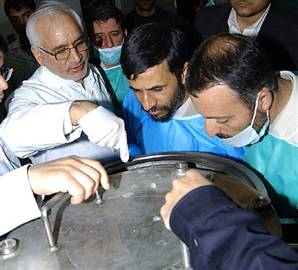
David Albright, the expert that Brian Ross quoted, was actually much less alarmist than the ABC story. “If … they get the centrifuges to work and actually enrich uranium on a distinct basis,” Albright said, “then you’re looking at them having, potentially having enough highly enriched uranium for a nuclear weapon in 2009.”
That is a pretty big “if” and the subject of today’s blog post.
Iran still cannot operate its current cascades on a continuous basis. Instead, the IAEA reports that Iran continues to feed UF6 “intermittently” into single, 10-, 24- and 164 machine cascades.
David and Jackie Shire recently did a really cool calculation based on Iran’s UF6 consumption to show that the centrifuges are only operating about 20 percent of the time (say 5 hours a day).
So cool, I decided to do it myself.
Math Rulz
The IAEA has published detailed data about how much UF6 Iran has consumed during various operating periods for its 164 centrifuge cascades (the amount of UF6 introduced into single machines and 10- and 20- machine cascades is probably trivial):
- “Since 6 June 2006, centrifuges in the single machine test stand and in the 10-machine and 20-machine cascades have been run mostly under vacuum, but with the feeding of UF6 into single machines of the 20-machine cascade for short periods of time. Between 6 and 8 June 2006, the 164-machine cascade was also tested with UF6. Further testing of the 164-machine cascade with UF6 was carried out between 23 June and 8 July 2006. During these tests, a total of approximately 6 kg of UF6 was fed into the machines and enriched to various levels of U-235. The feeding of UF6 into the 164-machine cascade was resumed on 24 August 2006.”
- “Since 31 August 2006, centrifuges in the single machine test stand, and the 10-machine, 20- machine and first 164-machine cascades at the Pilot Fuel Enrichment Plant (PFEP) have been run, mostly under vacuum, with UF6 being fed during intermittent periods. The installation of the second 164-machine cascade was completed and, on 13 October 2006, testing of the cascade with UF6 gas was begun. Between 13 August and 2 November 2006, a total of approximately 34 kg of UF6 was reported by Iran as having been fed into the centrifuges and enriched to levels below 5% U-235.”
- “Between 2 November 2006 and 17 February 2007, a total of approximately 66 kg of UF6 was declared by Iran as having been fed into the process and enriched to levels below 5% U-235. The environmental sample results thus far indicate a maximum enrichment of 4.2% U-235 in the first 164-machine cascade.”
You can combine this with the technical information provided by Iran Atomic Energy Organization Director Gholam-Reza Aqazadeh:
In the 164 chain, the maximum amount of material that we can feed the system is 70 grams an hour, with a 10 percent product of 7 grams. The product is 7 grams. Some 93 grams remain. When a series is operating 24 hours you have to multiply 24 by 70 grams. This is the total product of one series.
To recap. We have the dates of operation, the amount of hex consumed and the feed rate.
Let’s put that in a chart!
| Dates of Operation | # | Hours | UF6 Consumed (kg) | Operating Time (%) | |
|---|---|---|---|---|---|
| Possible | Actual | ||||
| 6-8 Jun/23 Jun – 8 Jul | 1 | 456 | 32 | 6 | 18 |
| 24 Aug – 2 Nov | 1 | 1752 | 158 | 35 | 22 |
| 13 Oct – 2 Nov | 2 | 504 | |||
| 3 Nov – 16 Feb | 1 | 2,568 | 360 | 66 | 18 |
| 2 | 2,568 | ||||
”#” indicates whether the cascade is Iran’s first or second 164-centrifuge cascade.
I made slightly different assumptions that David and Jackie about the dates of operation, but the result is the same. Iran operates is centrifuges about 20 percent of the time, on average about 6 days a month (or, again on average, five hours a day).
Workin’ Hard or Hardly Workin’?
One hypothesis is that Iran runs the centrifuges for awhile, they crash, Iran fixes them, rinse, repeat. We know that Iran had a big crash back in April 2006. Maybe that wasn’t the last.
A second possibility is that Iran is deliberately limiting the operations, keeping the centrifuges spinning empty in a vacuum. One reason might be to diffuse diplomatic pressure. Another explanation, which intrigues me, is that Iran is husbanding a limited supply of Chinese hex (UF6).
China sold Iran about 1000 kg of hex in 1991. China was also building Iran an uranium conversion plant at Esfahan, before the Clinton Administration—in a very good bit of diplomacy—stepped in to convince the Chinese to cut-off assistance. (One result is that the Iranians rely on a crap indigenous pulse columns. More on pulse columns.)
Iran has, apparently, been using the Chinese hex because their own UF6 contains impurities such as molybdenum that “plate out” (or collect on the walls) while the centrifuges spin, causing them to become unbalanced and crash. In fact, McVicar quotes a “Western diplomat” describing Iran’s “yellowcake” as “crap” and “full of impurities”. One wonders if that diplomat meant the hex?
As one can see from the table above, two continuously operating 164 centrifuge cascades would exhaust 1 ton of UF6 in about 10 months. So, if Iran still can’t make clean UF6, then they’ve got to be very careful with that supply of Chinese hex. And perhaps that explains why the IC is sticking with the 2012-2015 date.
Anyway, I don’t have any inside information, just a guess.
(Hat tip to SPK for kicking my butt to write this.)
Update Andrew Foland is understandably appalled by the opening jibberish that centrifuges “separate radioactive particles from the raw material.”

Yet another reason to love ACW! Thanks for the numbers…
I noticed you artfully dodged the senseless phrasing of the intro of the ABC report, which said “adding some 1,000 centrifuges which are used to separate radioactive particles from the raw material.” Hard to know what to read into that. It just bugs me.
I have some “maths” of my own. Whenever I read an article like the ABC news piece, I count up the number of “ifs” and variables cited by the “experts.” Then, I take estimate cited in the news article (the one designed to grab headlines, in this case, 2009) and add 1-2 years for each “if” and variable the experts gave. Viola! Instant estimative analysis that coincidentally (or maybe not) agrees with the IC estimate.
It bugs me, too. Don’t people take science classes any more?
I am a philosophy major, for goodness sakes. If I can do it …
As for the 1-2 year per if, I am going to use that, with credit. That is brilliant.
Don`t look at the video. Its even worse.http://abcnews.go.com/Video/playerIndex?id=3002228
It spares a few seconds at the end for facts, like that the centrifuges are not yet operating. This follows the claim that “its all in open defiance of the UN security council” If something is in “open defiance”, then why does one need “people familiar with the upgrade” as sources?
Does anyone know what this could refer to:”Iran says its facilities will only produce fuel for nuclear power plants. But the power plants they are now building could not run on the kind of uranium they are now producing.”Does it have the wrong plug? Can it be the heavy water reactor? wasn`t that only one of the reactors?
The only way you can have a segment edited like this is if you interview Albright, but he doesn’t explain the size of the “if the centrifuges work” “if” and you don’t read his papers. If you don’t have an intern read what your on camera source writes you are setting yourself up for trouble. What if isis-online.org was full of pro nader comments and/or flat earth propaganda? On top of that you have to ignore that you quote DNI testimony as “early next decade, more likely, mid next decade” to claim he testified that “iran wouldn`t have nuclear weapons capability until around 2015” I would say 2009 is closer “around” early next decade than early next decade is “around” 2015.
But on to serious things. With all the Iranian publicity over the few gram of LEU, is it possible the point of installing this many centrifuges this fast is for a good part a show? When you take the guys with lightsabers together with the arrests/hostage taking, military exercises and holocaust denial conferences you have got to wonder if there is anyone interested in anything more than show conflicts over manufactured issues. I bet opposition to gay marriage doesn’t energize Iranian followers they way it does Americans.
Isn`t there some risk in construction a thousand centrifuges when you have only recently found out its best to were gloves when you put them together? Is it possible that:if you have trouble getting componentsand you don’t have the UF6 to make production scale use of centrifuges anywayThat leaving the components in their original wrapping means your production is less at risk from slowdowns due to problems you could have found out with an experimental cascade?
Would it be possible to disperse precious components to minimize potential bombing damage while still staying within the NPT?
There is also the claim that everyone in the west didn`t give Ahmedinejad`s 3000 centrifuges by May claim much credence, “until now!!!” I guess I just dont know many westerners.
It seems to me that it would be desirable to search through the performance space of the machines by varying the pressure, enrichment rate, scoop locations, temperature gradient forcing, maybe even spin speed a little bit.
I imagine that this would take quite a bit of fiddling with the machines and might explain a lot of the effective downtime fraction.
Altho the ABC report uses mucho what-ifs, consider that the topic post contains at least as many “if”s (Chinese UF6, etc) per square centimeter as any mocked news article.
It goes with the territory.
All parties are working from flyspecks of data. In the past, engaging in augury by observing the roster and relative physical positions of Soviet officials on top of the Kremlin Wall on May Day was considered state-of-the-art. Now we are reduced to determining how soon Iran may have the Bomb by mass extrapolation of extracted partial sentences from IAEA officials. ——The Iranians may or may not be having real problems. Remember, during this last year, they have been testing and learning. The first cascades are for figuring out how to operate and interconnect the systems for the actual production facilities. Intermittant operating trials are expected as various configurations are tried out. AFTER testing, then the production machines are ramped up without fumbling around.
The Iranians are conserving UF6 in the test machines. It is sensible, regardless of gas source.
The low production rate of LEU (and consumed UF6) should not automatically be construed as totally the result of low thru-put or great intermittancy (altho it may be true).
As Albright said:
Also from Albright:
Again from Albright:
More:
It is useful to compare the current situation with the US Bomb program in April ‘44. Every necessary technology was in disaster-mode, with production almost non-existent. Yet, over the months everything fell into place, and by April ‘45, Japan was doomed.
Here is table of potential enriching progress by Iran.
Trying to be conservative, I assume that no enrichment occurs until June ‘07, starting with a single cascade, with cascades added at a rate of only one per every two months. Two columns are generated, one at 1.8 SWU/year production per P-1, and one at 2.5 SWU/year.
The red boxes are the points that 20 kg of 90% HEU could be produced. If the Iranians chose, they could produce LEU almost all the way, appearing to stay “civilian”, and breakout right at the end. It pushes the dates out only a bit.
The green boxes are the “Go Screw Yourself” breakout alternative. In that scenario, Iran receives the Russian LEU in June, diverts under 2%, and blatently enriches it either at its declared or possible hidden arrays.
One part of Albright’s quote as transcribed on ABC’s site is wrong.
He did not say, ”…and actually enrich uranium on a distinct basis.” If you watch the video, you can hear him say ”…on a sustained basis,” which makes a lot more sense.
The other irksome thing about this report is that Brian Ross (who should know better) cites “sources” for his alarming revelation, yet the only source who says anything to him—on camera or, apparently, off—is Albright. The other sources mentioned in the piece, an unidentified IAEA spokesperson, and Sean McCormack at State, refused to discuss the issue.
If you like this story, I’ve got some fancy aluminum tubes I’d like to sell you.
“having enough highly enriched uranium for a nuclear weapon in 2009” is such obviously misleading alarmism as to be downright dishonest. The uranium isn’t being enriched to weapons grade. And even if it was, there’s still quite a leap between having the uranium, and having a bomb. Albright should – and does – know better.
Instead of Iran’s centrifuge operations, how about some comments on the classified information that CIA has insisted to protect for Chinese even they didn’t want to protect for themselves?
http://www.lamonitor.com/articles/2007/04/06/headline_news/news01.txt
The Brian Ross quote that Andrew cites is a pretty clear indication that Ross doesn’t have much acquaintance at all with the field or with people who do. If he understood what he was writing, he simply wouldn’t write that.
So we may speculate whether he’s parroting something he got from someone else who doesn’t know what he’s talking about or if he garbled it himself.
On the moly hexafluoride question, its boiling point is 35 C, whereas that of uranium hexafluoride is 56. Should be easy enough to separate by distillation. So is the speculation wrong, or is this one extra step the Iranians can’t afford to add?
As to language, note that Ross says the Iranians “could have enough material for a bomb by 2009.” Note the double hedge, “could” and maybe not a bomb itself, just the material. But such hedges are often lost in retelling.
In the same way, Jeffrey “could” be making a bomb in his garage.
But probably not.
Interesting link, Chungta Hsieh. There are obviously a lot of benefits to being security cleared when working on a history of nuclear matters, but there are downsides too. There are other nuclear historians who got clearance and then found that it was as much of a muzzle as it was a door-opener — Barton Hacker and Richard G. Hewlett both wrote up accounts of their experiences with this (the former was very bitter about it, the latter somewhat laughed it off). Howard Morland refused to get cleared for the Progressive trial of 1979 on the grounds (if I am paraphrasing correctly) that he’d rather be wrong (and possibly right) and be able to print whatever he wanted than to know he was right but be at the whim of the censors. I know they’d never want to grant me clearance, but even if they did I don’t think I’d take it.
AtomAnalyst wrote:
We can, however, quote IAEA Director General ElBaradei, on Feb 19, ‘07,
Interviewed by the Financial Times, he was asked how far away is Iran’s centrifuge program “From getting three thousand functioning smoothly.”ElBaradei replied, “I don’t know, it could be a year, it could be six months.”
Surprisingly, even at the one year speculation, that means having in production twice as many centrifuges and in a half the time (and having them “functioning smoothly”, not just installed or being configured) as Albright’s worst-case scenario.
Hass wrote:
In a point I have attempted to make many times (and failed), IT DOES NOT MATTER if you enrich only to LEU. In fact, it helps keep the political heat off. LEU is the perfect feedstock for rapid enrichment. Starting with LEU, Iran would be just weeks from a bomb quantity of HEU.
And as to it being “quite a leap” between HEU and a bomb, yes and no. If Iran, desiring to have a bomb, inexplicably waited until it had sufficient HEU to even begin designing and building a bomb, then it likely would take a good year or so.
In practice tho, you do all your testing and preparation starting yesterday. NatU or DU metal are absolutely perfect simulants for HEU in implosion or gun testing. You have your bomb(s) sitting and waiting for their fissile cores. There is no lead time. Converting the very small amount of 90% UH6 to metal and then casting the core is a days, not months-long, garage-scale process (plus it would likely be processed in smaller quantities as it is created, rather than in one big conversion party).
CKR wrote:
It is the material that makes the bomb. The device itself is almost irrelevant. Iran possesses blueprints for an implosion bomb and certainly have the skill to build it (and design one, if needed). It is not magic. And should they wait a few more months, they “could” have enough HEU to build a gun. (And with apologies to Nicolas Freeling, nobody , not even terrorists, would use a 7 foot recoiless rifle)
As to Dr. Jeffery, if he raved violent hatred towards a neighbor, was in possession of a bombmaking manual, and began stockpiling “innocent bags” of ammonium nitrate fertilizer (for his lawn) and a drum of diesel fuel (for his Mercedes), we might have at least some basis for concern.
As an aside about Howard Morland… even after all these years, last I read of his, he still does not understand how a thermonuclear bomb works.
yale – I don’t deny the validity of your point, but I think you’re glossing over the costs of uncertainties in the Iranian program. Sure, the U.S. managed to turn a bunch of theory into a bomb back in ‘44 and ‘45, but the Manhattan project wasn’t under the constant scrutiny of the IAEA and international community, nor was it subject to UN’s ability to authorize sanctions or the use of force.
If the Iranians chose to violate their safeguards agreement, they have one of two openly: 1) openly enrich at safeguarded facilities or 2) covertly enrich at unsafeguarded facilities. The problem is that both of these options would leave clear evidence of safeguards violations (i.e. blocking inspections of Natanz, UF6 disappearing from the inventory, etc).
The U.S. managed to push limited sanctions through the UNSC based on very limited evidence of safeguards violations turned up the IAEA. I seriously doubt the international community would sit on its heels during a 12-18 months need to achieve an Iranian nuclear breakout.
Most importantly, that 12-18 months is just the time reguired to enrich enough fissile material for a bomb. Is enrichment an effective threshold for Iran, especially considering its limited technical capabilities? How long would it take for them to actually design a nuclear explosive device or even a deployable weapon?
Did anybody happen to catch Javad Zarif, Iran’s ambassador to the UN, speaking at the Nixon Center recently? (http://www.nationalinterest.org/Article.aspx?id=13924)
Quote: “Iran has, apparently, been using the Chinese hex because their own UF6 contains impurities such as molybdenum that “plate out” (or collect on the walls) while the centrifuges spin, causing them to become unbalanced and crash. In fact, McVicar quotes a “Western diplomat” describing Iran’s “yellowcake” as “crap” and “full of impurities”. One wonders if that diplomat meant the hex?”
To my understanding the diplomat meant, that already the yellow cake contains the impurities. That’s in line with what I’m hearing from various sources and with the assumption, that there are no real substantial hurdles to overcome the problem. If these assumptions are correct, the impurites would exist with all hex produced by Iran. It would explain, why some sources assume that Iran has only (or primarily) Chinese hex.
Yale wrote
“It is the material that makes the bomb. The device itself is almost irrelevant. Iran possesses blueprints for an implosion bomb and certainly have the skill to build it (and design one, if needed). It is not magic.”
Well, I was referring to the double hedge in Ross’s report, which allows practically anything to be stated, with the hedges dropped later.
But yale’s comment is so outrageous that I had to respond.
It’s not just the fissionable material that makes the bomb. Fat man is something like six feet in diameter, but the plutonium core is on the order of inches. There’s got to be something else, probably not polystyrene peanuts, between that core and the case.
Whether Iran has blueprints for an implosion bomb is in that category of intelligence that must be questioned. As has been pointed out, perhaps in this thread, our knowledge of what they have and don’t have is quite unsure.
Finally, an implosion device for enriched uranium? There’s no evidence that the Iranians have serious amounts of plutonium, and they won’t until the Arak reactor is operating for a while or they buy it from somebody.
I have to hand it to Yale; he does a very persuasive job of laying out a worst-case assessment of when Iran could get enough HEU for a bomb, and I tend to agree that getting the bomb itself put together would not take much longer.
One has to fear that this analysis could drive a US or Israeli decision to provoke an immediate crisis, or launch an attack, on the grounds that otherwise an irreversible situation will have been created.
But that, of course, another war, is the real worst-case scenario.
One bomb is not Iran’s goal, however; it isn’t even clear that Iran wants one. But they are working toward the capability to produce not one, but many, and if they do so, they will need to develop appropriate delivery systems (probably missile) and further infrastructure, which gets us back to something more like the IC consensus time frame for Iran to become a nuclear weapons state.
I have to wonder whether even Israeli analysts, for all of Ahmadinejad’s “raving hatred”, seriously doubt that Iran, as a state, can be deterred from committing national suicide, or fail to understand that deterrence (of US and Israeli threats) is most of what Iran is seeking in this game, apart from plain old national pride and prestige, regional leadership and incidentally, electrical power.
Yale,
“As an aside about Howard Morland… even after all these years, last I read of his, he still does not understand how a thermonuclear bomb works.”
So what is it that Moreland misunderstands?
“So what is it that Moreland misunderstands?”
That a primary purpose of low-z channel liner or filler is as suppressor of high opacity gas boil-off from the high-z case liner, thus allowing the Hohlraum to be maintained in open condition.