
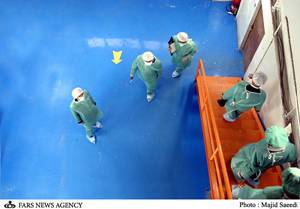
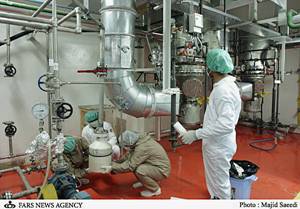
Iran’s Uranium Conversion Facility is the weak point in Iran’s nuclear fuel cycle. That was a victory for US nonproliferation policy under, gasp, the Clinton Administration.
The new NIE on Iran’s nuclear program contains a pair of substantive revelations.
Dafna Linzer in the Washington Post reported that a new NIE suggsts Iran may be further away from a nuclear weapon based on a “better understanding of Iran’s technical limitations”:
The sources said the shift, based on a better understanding of Iran’s technical limitations, puts the timeline closer to 2015 and in line with recently revised British and Israeli figures.
So what might those technical limitations be?
Paul reported in October that the intelligence community believed Iran’s uranium conversion facility at Isfahan (Esfahan) was the weak point in Iran’s fuel cycle and was waiting for the results from IAEA inspections:
The State Department official said that Iran seems anxious to test the conversion facility for possible weaknesses. U.S. officials judge that Iran cannot manufacture some necessary equipment for the facility and that Tehran lacks sufficient quantities of fluorine to process the quantity of nuclear material Iran has described. The United States is waiting on IAEA inspectors to present more details about the conversion facility so Washington can verify these judgments, the official added.
The IAEA inspectors visited and, voila, a new NIE (as well as British and Israeli estimates) with a “better understanding of Iran’s technical limitations.” In fact, Linzer notes “the work of U.N. inspectors” was a significant factor in US intelligence assessments.
This raises an interesting question: In a post-AQ Khan world, is uranium conversion the chokepoint for would-be bombmakers? Alex Montgomery, in a forthcoming IS article, argues that converting uranium is a difficult technical barrier for entrants into the nuclear club:
Although A.Q. Khan supplied both plans and parts, it appears that without the tacit knowledge required to develop nuclear weapons, successfully developing a capability requires much trial and error. … Iran is building a yellowcake-to-UF6 (uranium hexafluoride) conversion plant at Isfahan based on Chinese blueprints. Yet Iran has had difficulties producing high quality UF4 (uranium tetrafluoride) and turning it into UF6. Although less evidence is available from Libya’s program, the lags in time and difficulties seem to indicate that similar problems were encountered there.
***
No, but I did stay at a Holiday Inn last night …
If you want to enrich uranium with a centrifuge, you have to convert uranium yellowcake into uranium hexafluoride (UF6) gas, a process that requires the element fluorine. (The wikipedia has a nice summary.)
Fluorine is not user friendly.
Dr. Khan’s nuclear Wal-Mart sold finished UF6 gas, but not the uranium conversion facility (UCF) for the hardcore DIY bombmaker. Libya’s experiments were apparently unsuccessful. Libya attempted to buy secretly a modular UCF (from Japan), but never received all the modules. Ultimately, Tripoli just bought UF6 from Khan.
Iran, we now know, has also had a tough time. US nonproliferation policy probably deserves much of the credit for creating the technical problems that Iran is experiencing in attempting to create uranim hexafloride.
In early 1996, China notified the IAEA that it would sell Iran a UCF that would become operational by 2000.
By November 1996, the Clinton Administration had pressured China to stop nuclear cooperation with Iran, including the sale of the UCF. The Chinese—perhaps also influenced by a certain absence of Iranian hard currency—agreed to cancel the sale.
In 1997, Robert Einhorn reportedly told Congress that Chinese had provided a blueprint but not much else before agreeing to cease assistance. By all accounts, China did not build the facility—although individual Chinese entities may have transferred additional information.
In late 1998, the Washington Post and Wall Street Journal quoted US officials suggesting Iran had turned to Russia for assistance on the UCF. Although the CIA describes Russia as “a key supplier for civilian nuclear programs in Iran,” there is no public evidence linking Russia to Iran’s UCF at Isfahan (Esfahan).
In 2000, the CIA stated that Iran was constructing a uranium conversion facility—though no one seemed to pick up on the statement at the time.
Things really heated up in 2002, when an Iranian opposition group went public with reports of a large Iranian enrichment program—something the US IC already knew. By March 2003, the existence of a (presumably indigenous) UCF located at Isfahan was in the public record.
That facility was still not fully operational, though. In October 2004, IAEO Deputy Directory Mohammad Ghannadi-Maragheh (Ghanadi) claimed “the Isfahan UCF facility is 70 percent operational” and that “21 out of the 24 workshops in this facility have become operational.”
We now know that technical problems with the UCF may be an obstacle to Iran’s enrichment of uranium.
***
Technical problems may also explain Iran’s reluctance to suspend activities.
When Iran announced a suspension in November 2004, it indicated that it would finish converting 37 tons of yellowcake into uranium tetrafluoride by February 2005.
Iran confirmed this had happened in May 2005. At that time, Iran indicated that it would restart uranium conversion activities in “days” before agreeing to a further delay through July 2005.
During the suspension, however, Iran chafed at the prospect of keeping Isfahan closed, IAEO Deputy Director Mohammad Saeidi (Saeedi) told Reuters in mid-July that Tehran wanted to break IAEA seals and “test equipment there to check whether those are functional.”
Following the latest European proposal, Iran has now resumed fuel cycle activities at Isfahan under IAEA monitoring. “We can confirm that the Iranians have begun to feed uranium ore concentrate into the process line at the Iranian conversion facility in Isfahan,” IAEA Spokeswoman Melissa Fleming told VOA. VOA reports that the Iranians are converting yellowcake into uranium tetrafluoride, but not uranium hexafluroide gas.
One wonders if the last step is the hangup, what with lousy UF4 and too little fluorine.
***
The second revelation in Linzer’s article was that US intelligence no longer believes that Iran has a parallel program:
Sources said the new timeline also reflects a fading of suspicions that Iran’s military has been running its own separate and covert enrichment effort.
That claim gets repeated quite a bit—see this alarmist bit of trash in the New York Sun citing a “Western diplomat with access to sensitive real-time intelligence …” (full text from a third party).
Perhaps this will lay that particular meme to rest.

That sounds like good news … but we’ve seen just how willing the Bush admin is to distort or ignore intelligence it doesn’t want to hear. It doesn’t help when things like the Sun article or Jerome Corsi’s Atomic Iran spout falsehoods and propaganda.
Having Iran’s program run under IAEA observation benefits everyone.
Now, maybe I’m lazy and want other people to do research for me… but it seems more efficient this way.
Iran gets UF6 from Pakistan—never gets real UCF technology from A. Q. and company. Libya also appears to have gotten its UCF capabilities from a Japanese firm in the 1980s. Along with my understanding of the Pakistani nuclear program, this makes me think that A. Q. was not transfering UCF technology. In fact, it may be that Pakistan never mastered the technology itself. Pakistan had imported most of the key components from the West in the 1970s and 1980s, before the NSG realized the gaps in its export controls. Does anyone know of any evidence that Pakistan was able to reverse engineer and manufacture key UCF components? Which leads to my last question: where did DPRK get UCF knowledge from? Does it have the capability, or is it suffering from the same bottleneck that Tehran is? And what implications does this have for the infamous container of UF6 that went to Libya which may or may not have been of North Korean origin?
[Now, that is a comment. ACW]
Nice meaty post, Jeffrey.
You’re right that fluorine isn’t user friendly. It’ll burn a hole in your lungs just like that, and in many other things as well.
But there are other difficult aspects of the process. UF4 is a solid, and the product UF6 is also a solid at room temperature and pressure. Look at the phase diagram in the Wikipedia article. You have to go to temperatures of 125 F or so to make it a gas. So you’re handing hot fluorine, even nastier. Or you can use a gas to convert a solid to a solid, guaranteed to make the guys engineering the process unhappy.
And then, to make things even more interesting, while UF4 is relatively inert in the atmosphere (although it will go back to oxide if you leave it there long enough), UF6 reacts quickly with water and goes back to the oxide and HF, which is nastier than fluorine itself. So you have to make sure that no air ever reaches the UF6.
As for Chris’s last few questions, the principles of UF4 conversion are fairly obvious to a chemist or chemical engineer and have been in the open literature for decades. Executing it safely, like many of the operations involved in nuclear weapons manufacture, is the problem.
As to his last question, there are far too many uncertainties to say. The fact we haven’t heard any more about it suggests it may have been a trial balloon intended to undercut the talks with North Korea.
I find it really hard to believe that getting UF6 can be any kind of a bottleneck in the process. It’s just chemistry after all (no offense to chemists). Any decent chemist worth his or her while should be able to master the technology.
Yes, fluorine is a nasty chemical, but there are lot of nasty chemicals out there. It is probably not much nastier than, say, chlorine (and HF is not that much more difficult to handle than HCl).
I would suggest being careful with getting too excited about the difficulties countries may have with uranium conversion. Otherwise we’ll be getting statements like “Pakistan never mastered the [uranium conversion] technology”. Well, it sure didn’t run U3O8 through its centrifuges.
Pavel’s comment is the one I was going to make. Is it possible that Iran is having problems with large-scale U3O8-UF4-UF6 conversion? Sure. Will they solve these problems? Can they do that with their own resources? I’d bet on it. Is this likely to be the rate-determining step in Iran’s race to LEU or HEU production capability? Or anybody else’s? I doubt it.
BTW the NIE estimate of 7 years or more for Iran to get the bomb follows directly from public information about the current status, rate of progress and declared plans for the Natanz centrifuge and Arak heavy water and reactor facilites, with the judgement that unknown large-scale covert facilities and activities are unlikely to exist. In other words, no news.
I agree that they’ll get there eventually, but don’t put down the problems. Solids handling is one of the classic problems of chemical engineering. Also, gases that can turn to solids if they get too cool or if some air gets in can clog up pipes.
And fluorine and HF are harder to handle as well as more devastating if they escape than chlorine and HCl. They tend to require different materials.
There are well-known chemical engineering fixes for all this, but putting it all together can be harder than those who haven’t done it may think.
To Mark and Pavel:
I object to the methodological approach you’ve taken to this question.
I don’t think one can derive, through ratiocination, the difficulty associated with engineering challenges. That is an emprical question. If countries have trouble doing something, than it is hard.
For example, some folks have claimed that reprocessing plutonium is, in theory, easy. But the Chinese had a terrible time with reprocessing. Although China did eventually become proficient, the early shortage of plutonium had a profound effect on the development of China’s nuclear arsenal.
Another college argued about whether or not building a reliable thermonuclear weapon was possible without testing. He said the physics were straightforward. But early thermonuclear tests by the United States (or at least Livermore), China and India all failed. I haven’t looked at the specific causes of the failures to be sure, but they are have the same general fizzled yield.
I think the proper way to treat these questions is with data, not a thought-experiment. If the Libyans and Iranians had trouble building a conversion facility, than that is an important development in future nonproliferation policy. How important is an empirical question that can only be answered by looking at the success of DIY bombmakers.
Of course there is a reason proliferators fail in mastering some technologies. But it would be wrong, in my view, to think that it happens because fluorine is a particularly nasty chemical or solid chemicals are hard to work with.
I would say that these problems tell us about the level of commitment to the cause that those proliferators have. The reason they cannot master the technology means simply that they don’t really want to. Many countries want nuclear weapons without willing to invest adequate resources (in terms of money, organization, human capital, and human lives) into it. Some are probably not even able to realize what the true cost of nuclear weapon development might be.
So, I would agree that the problems that various countries had with uranium conversion, plutonium, or thermonuclear devices are very valuable data points. But I think they tell us a much more interesting story than just a story about difficulties in making some technology work.
Any problem such as F handling or U convertion process plant can be solved if a country has the ambition and resources.But the problem with Iran is the political power play they are making.Every milestone reached in the process puts them in a better bargaining position, so why not bluff a little and relate to any lab-size triumf as full scale achievement? how can so manny objectives be reached at the same time; a subsurface marine missile, successful launch of a warhead carrying missile,a breakthru in u enrichment process- everything is happening simultaineously at the diplomatic round table.
They are bluffing about their progress and they know for sure that thev west will never allow an atomic weapons in Teheran’s hands.