
The other day, I observed that US public statements imply that Iran’s centrifuges operate closer to 2 kg SWU/year than 3.
That is a little lower than previous public estimates by David Albright and Corey Hinderstein (The Centrifuge Connection, Bulletin of the Atomic Scientists 60:2, March/April 2004, 61-66) but within the range generally suggested for a P1-type centrifuge. Here is a handy chart produced by Marvin Miller at MIT:
Basic Parameters of Contemporary Centrifuges
| Type | P1 | P2 | Russia | URENCO | US |
|---|---|---|---|---|---|
| Rotor Material | Al | MS | CFRC | CFRC | CFRC |
| Speed (m/sec) | 350 | 500 | 700 | 700 | >700 |
| Length (m) | 1-2 | 1 | <1 | 3-4 | 12 |
| kg SWU/yr | 1-3 | 5 | 10 | 40 | 300 |
Source: Marvin Miller, “The Gas Centrifuge and Nuclear Proliferation,” in A Fresh Examination of the Proliferation Dangers of Light Water Reactors (Washington, DC: The Nonproliferation Policy Education Center, October 22, 2004), p. 38.
Technical information provided by Iran Atomic Energy Organization Director Gholam-Reza Aqazadeh fits perfectly: Aqazadeh claims Iran’s centrifuges are 1.8 m long and rotate at a linear speed of 350 m/s.
Aqazadeh also provides enough technical information to estimate the capacity of Iran’s centrifuges, stating the 48,000 centrifuges could produce 30,000 metric tons of 3.5 percent LEU per year with a 10:1 feed to product ratio.
Let’s do some math!
We can figure out the tails assay (how much U235 ends up in the waste) from the feed to product ratio.
xt=[(F/P)xf – xp]/(F/P-1)
Where xt is the tails assay, F/P is the feed-to-product ratio, xf is the percentage of U235 in feed, and xp is the percentage of U235 in the product.
(10(0.00711)-0.035)/9=0.0040
Once we have xt, we can use the FAS SWU calculator figure out how many SWU you need to produce 1 kg of 3.5 percent U235. (Rather than do the math by hand, which I would screw up). Multiply that by the product, divide by the numbers of centrifuges and … behold:
(3.64 SWU/kg)(30,000kg/y)/48,000 = 2.3 SWU/y
(My calculations were much messier—these orderly equations belong to a physicist who corrected an early error on my part. Live and learn.)
So, each machine operates at about 2.3 SWU per year—about what I figured the US uses in public estimates.
So why are the estimates so much lower than Albright and Hinderstein?
One possibility—suggested in Albright and Hinderstein, The Clock is Ticking, But How Fast?—is that impurities in Iran’s uranium hexafluoride “can interfere with the operation of centrifuges and reduce their output”—although they are careful to note “most IAEA experts believe that Iran can overcome this problem…”

Cool table
There is plenty of opportunity to practice math, as Ahmedinejad has been talking about P2 experiments… (http://www.sltrib.com/news/ci_3721842) (Does anyone have any idea where they get their component for all these things? They can’t be making everything by themselves.)
Wow! 300 SWU/yr that’s incredible!
And, I think this may help answer my question about the pressure too…
Compare the following figure of merit for the different centrifuges = SWU per (Vel^4 * Length)
P1 8.5e-11
P2 8e-11
Russia 4e-11 >
Urenco 4.5e-11
US 1.05e-10 <
So, apparently, the P2 almost as good as the US centrifuges in terms of theoretical flow pattern efficiency. Very impressive engineering by AQ Khan et al.[read: we may be doomed]
The 4 bellows design of the P1 seems to be consistent with the dimensions of a rotor to be supercritical only above the fundamental resonance. So, that checks out.
This is all consistent with a diffusivity * pressure product in the range of 0.05 kg m/s^3 which seems to be in the right range. Checks out again.
If the US machines are countercurrent centrifuges, they probably are configured for single step to LEU enrichment. If I am to believe the theoretical countercurrent formulae, I guess you could configure a single machine to go direct to HEU – although the working pressure might end up being too low. And, at 700 m/s, it is clear that the center of the rotor will be in the ballistic transport pressure regime. Truly amazing.
These numbers seem like a strong argument why the Iranians don’t need centrifuges. Their uranium is going to be a zillion times more expensive to produce than what the modern facilities produce.
I need to go off and see if I can’t figure out what the working pressures would be…
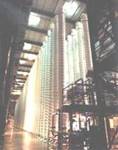
Background on the US Centrifuge:
http://www.usec.com/v2001_02/Content/AboutUSEC/NEIAmericanCentrifugeArticle-09-03.pdf
Excellent portal to all things centrifugal:
http://www.uxc.com/products/rpt_swu.html
yale
Jeffrey,
There is another very simple possibility for the lack of efficiency. If their actually rotational velocity is 300m/s instead of 350m/s that would give them a figure of around 2.1 SWU/unit/year rather than the approx 3.8 SWU/unit/year that would be expected for 350m/s.
Failing to spin to the design basis maximum speed would fully explain the drop in efficiency.
I have a problem with Agazadeh’s interview. He said the 164 centrifuges are fed with 70 g/h and the product is 7 g/h, so a cut of 1/10. For the product he gives 3,5 % enrichment. This gives tails of 0,4 % enrichment. Doing some math I arrive at a total separative work of 240 kg SWU/a. But this would mean a single P1 in Natanz has only 1,5 kg SWU instead of the 2..2.5 kg SWU as expected. What’s wrong here?