
click on the image for a larger version
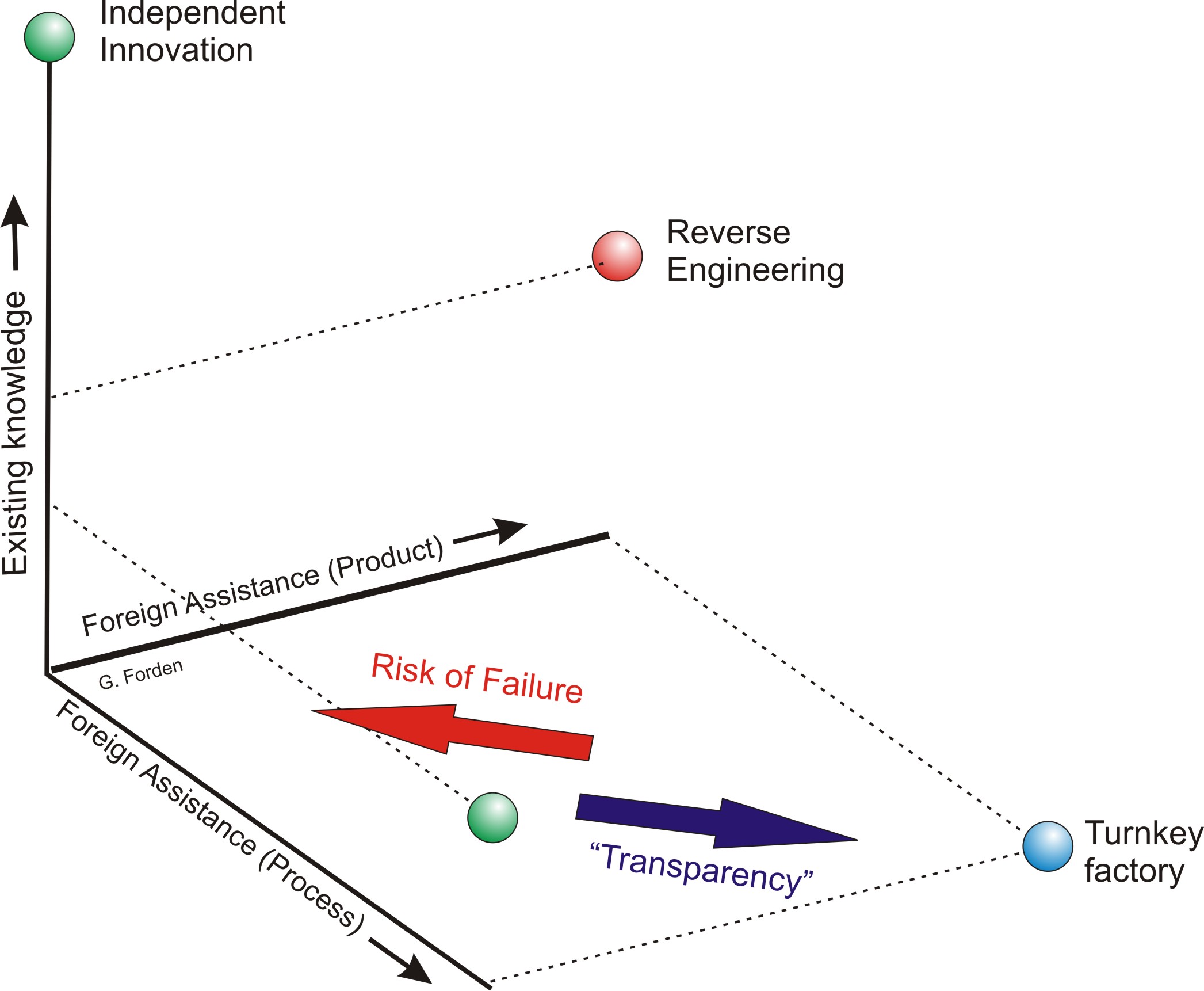
After all the information that has come to light about proliferation programs around the world, I think we are in a position to say what are some of the key factors that lead some countries to be successful and some to fail miserably in their pursuits of WMD. I have tried to systematize my thoughts on this into the very RAND-like drawing shown above. There are three important, independent axes in this drawing or theory. One is how much foreign “assistance” the proliferator receives in terms of the “product.” Another is how much foreign assistance he receives in the production line. The final important criterion, represented by the vertical axis in the diagram, is the existing state of knowledge in the country. It is very important to keep these two types of foreign assistance separate in one’s mind. A few examples should make it clearer, I hope.
The Three Axes of Proliferation
Reverse engineering represents the maximum assistance a proliferator can receive in the product alone: he gets—either by hook or by crook—a copy of missile, for instance, and takes it apart, measures the dimensions of all the parts, tries to determine their composition (not an easy task!), and then tries, on his own, to reconstruct the assembly line that made the thing in the first place. Note that the reverse engineer has no idea what the tolerances are on any of the components unless he also receives the blueprints, but that is often not what people mean by reverse engineering. In fact, reverse engineering, while very popular with politicians as being the proliferation danger facing the Western world, has a very poor track record as far as a proliferator actually using it to produce a missile or poison gas etc. I could give plenty of examples of this but I will limit myself to pointing to Iraq’s less than stellar performance in reverse engineering SCUD-type engines. After trying for about 15 years to reverse engineer either SCUD or SA-2 engines, Iraq gave up and imported several hundred just before the 2002 Second Gulf War because they simply could not produce enough, quickly enough, to use.
A proliferation profiteer who sells a “turnkey” production plant, on the other hand, is selling assistance in both the product (the missile) and the production line. A. Q. Khan is perhaps the most famous of these profiteers but he is far from the only example. Iraq desperately sought turnkey plants from both Imperial Chemical Industries and Pfaudler during the 1970s but was ultimately rebuffed by both. (It eventually found a small group of people to build its chemical plants for it, known at least part of the time as Pilot Plant.)
Purchasing turnkey plants is the most successful way of transferring technology to a developing country. This is true for WMD and it is true for civilian products as well, as has been amply researched in the case of South Korea, who started their civilian industrial development by leasing technology from developed countries, moved on to joint ventures, and finally—after thoroughly assimilating the technology—independent innovation. (This is very ably discussed by Linsu Kim in his book Imitation to Innovation. ) This introduces the third axis on this graph, the level of existing knowledge in the country.
Obviously, somebody has to innovate in the creation of a new product or a new weapon of mass destruction. The classic case is the United States creating the atomic bomb. I class this as having no “foreign assistance” even though the US benefited tremendously from non-citizens contributing to the project because by foreign assistance I mean somebody who has already done it, produced the WMD. The Manhattan project was, instead, an international collaboration and nobody had the answer ahead of time.
Improve and Advance
So far, I’ve only talked about the proliferator’s starting point. There is both a natural tendency as well as (usually) a desire to assimilate the technology, adapting it to local conditions and improving on it. How fast and how well this is done depends where on this plot the proliferator started, which includes their pre-existing knowledge. I have shown reverse engineering as a point with both maximum foreign assistance on the product (the missile say) and zero foreign help with the production process as well as a significant amount of pre-existing knowledge. For successful use of reverse engineering, that pre-existing knowledge had better be a through understanding of the production processes implied by the product.
Unfortunately for the proliferator, they have a tendency to start on a development path with too little knowledge. It turns out that how fast a nation can assimilate a new technology depends very heavily on where they start on this plot. Iraq, for instance, started reverse engineering SCUD-type engines with far too little familiarity with production techniques and were never able truly assimilate that technology. Their chemical weapons program also started with far too little existing knowledge but there you can see dramatic improvements each time they got foreign assistance so it makes a very interesting case study.
Tomorrow and Tomorrow
I had thought that tomorrow I would return to the Iranian case study and examine the existing infrastructure, in both academia and industry, for producing fiber reinforced ceramic composites. (Some eager wonk-readers have already started to analyze this!) But I want to continue this theoretical discussion a little bit more with discussions on two forces that drive the technological arc taken by proliferators: minimizing risk and maintaining secrecy. These act in opposite directions and are important drivers of how proliferators progress. I’d also like to discuss how Robert Schmucker’s ideas fit into this framework. His work contains much more than simply pointing to the lack of flight tests in North Korea, though I will certainly not be able to do his theory the justice it deserves. But discussing Schmucker’s work lets me also discuss the MTCR and what I call the “new proliferation environment” caused by the spread of precision engineering.
Sorry about the length of this post!
This series of posts consists of:
0) Do You Know What This Thing Is?
3) The How of Proliferation, Part 1

Of course, you’re confusing “how countries get WMDS” with “how countries get civilian nuclear programs that they’re entitled to under the NPT”.
That, of course, is complete nonsense and has absolutely nothing to do with what I’ve written.
I think using Iraq as the case example of reverse engineering is a disingenuous red herring. Iraq has never been an industrialized state, rather it is and has always been an agrarian state blessed with land a bubblin crude, Oil that is, black gold, Texas tea. The antics of a bunch of Hillbillies shouldn’t be the the metric by which we judge reverse engineering. Iraq’s pursuit of turnkey factories for the production of everything, from rockets to nerve gas, was commensurate to their limited technoeconomic culture just as reverse engineering of soviet weapon’s complexes may be commensurate with the technoeconmic level of industralizing states.
Azr@el,
You have to realize that Iraq’s pre-existing knowledge is taken into account in this framework. That is the vertical axis in the graph above. Besides, many “agrarian” states want WMD. Consider Libya. Consider North Korea, which was by force made essentially agrarian after the Korean War when the South got all the factories. “Disingenuous” is a bit harsh, don’t you think?
I retract “disingenuous” and offer forth “misleading” as a more neutral term. This derives from your statement that there are many examples of reverse engineering failing but that you would use the particular case of Iraq to illustrate the concept; which given their low levels of industrialization could be misleading. Allow me to point out that which you are already familiar with, without any dint of accusation that you’re carrying water for either side; the political dimension to the reverse engineering debate. It affects policy on issues as far ranging as space cooperation to weapons sales. Those claiming that reverse engineering is a near impossibility also tend to correlate highly with the set lobbying most fervently for expansion of export licenses for weapons platforms such as the F-22 as a mercantile commodity and scientific cooperation agreements with India in the fields of nuclear and “space” research. In this regard I believe my sentiments towards conventional proliferation are in line with your position on unconventional proliferation; the less the merrier
As a side note, my use of the term “Hillbillies” for those not familiar with the American serial titled “Beverly Hillbillies” was intended to point out that Iraq’s apparent technical accomplishments were illusionary achievements imported from abroad and financed purely by oil wealth. I did not intend to offend Arabs or Hillbillies by pointing out their low levels of technical accomplishments in the Modern and Post Modern Era or making any generalist allusions between the two.
I notice you base your argument on a link between those who believe reverse engineering is difficult and a political position. An interesting line of argument equivalent to damning by association. Perhaps it would be more helpful if you gave an example of reverse engineering actually working. Then we can fit it into the framework I’ve outlined. My guess, if you do find such an example, is that it will fall roughly where I’ve shown reverse engineering in the diagram, where the country already has considerable knowledge of the required production processes.
My argument is not that reverse engineering does not have “a very poor track record” merely that Iraq is a flawed basis from which to build your argument. The onus still remains upon you to construct a sufficiently strong argument to support your assertion regarding reverse engineering. And in highlighting the political attributes of the matter, my intent lays not in defining the debate but rather in informing it’s context.
Again, I personally believe you’ve given insufficient weight to the notion that foreign assistance(product) coupled solely with existing knowledge is high probability vector for proliferation but that’s not my argument.
Geoff, excellent work!
The only thing i would change is to put the level of “existing knowledge” almost at the same level than for “independent innovation”. Somebody being able to analyze and recreate an existing item to perfection has to be more or less able to “independently invent” in my opinion. At least he must have detailed insight in the physics involved, material sciences (plus an infrastructure being able to provide the right materials) and all the neccessary production techniques.
And another interesting point: How indistinguishable will a “rev-eng”-product be from the original? I think unless we’re talking about the proverbial “turnkey factory”, the, let’s say ‘unlicensed copy’ will differ in several significant aspects, be that either external appearance, general system performance or reliability. Compare for example all those chinese “rev-eng” copies of commercial items (e.g. cars, aircraft parts, sneakers etc.)!
I think so far nobody has ever come up with an indisputable example of 100%-cloning by completely independent “reverse engineering” (only examples of proof to the contrary!) – and my guess is that nobody ever will!
(BTW, i can’t help but notice that you, too, get your share of Azr@el’s type of discussion; I find it interesting to observe how he discredits the Iraqis as “a bunch of Hillbillies” while at the same time postulating the North Koreans being some sort of techno-wizards – all this from the same Azr@el using the term “bordering on racialism” in a comparable context on a different thread…)
I think some useful supporting evidence for Geoff’s observations can be found in the experience of Russians who were brought to Iran in the 1990s to help with missile technology. They recall that Iran was striving for reverse-engineering, based on imported “knowledge” of the Russian scientists — a sort of turnkey of the minds, but not production — and yet they also saw Iran was held back by limits at home. So it may well be a combination of all three factors.
One other case study that might come to mind is East German attempts to develop computer chips during the export regime of the 1980s. There is an interesting account of this in “Seduced by Secrets” by Kristie Macrakis. They similarly had the question of whether they develop turn-key facilities (if I recall), whether they could indeed reverse engineer (sometimes they could, sometime they couldn’t), and other related things. They serve as perhaps an interesting counter because they were not quite so technologically backwards in general as many of the proliferating nations we are discussing, but at the same time found it incredibly difficult to duplicate Western technology with their existing infrastructure (even though they had the benefits of extensive espionage).
Ad David,
I tend to take a dim view of annoymous Russian sources, in fact I rank them right up there with stories of “Iranian virgin rape before execution” from Rupert Murdoch outlets like Fox or the WSJ or the christian jihadi Church of Christ, Scientist rag Christian Science monitor.
Ad Alex,
I have not seen too many examples of latent capability coupled with a sample of a foreign product not resulting in a workable reverse engineering solution. The DDR’s go at a microchip industry was a cold start at chip design and more importantly chip fabrication. Consider that reverse engineering of propietary integrated circuits is common industrial practise these days and a common grad school team project for EE in that specialization. And in particular, consider the Iranian microchip industry, they seem to prefer modern open source chip designs for their 32 bit chips. But most revealing is that their fab hasn’t been able to get under 100nm i.e. it lags the IC field by a good decade.
The Iranian 32 bit processor designs are merely an extesnion of their preexisting 8 bit chip industry @ 180nm. For a successful reverse engineering to occur, one needs to have most of the pieces ready to go and only need to make advancements in as few fields as possible. The IRI didn’t have to reinvent chip fab from scratch all they needed to do was reverse engineer the chip design process and rely upon their preexisting industrial base in chip fab whereas the DDR had to not only master chip design but also chip fab, the latter being much more difficult and capital intensive.
1/3
If I may throw in my ha’penny’s worth:
In the world of gas turbine blades reverse engineering is a fact of life. The Original Equipment Manufacturers like GE, Siemens, Alstom, Mitsubishi, and Rolls Royce (to name just a few) don’t like it because it robs them of multi-million dollar orders for replacement blades (blades get changed roughly once every 3 – 8 years). Consequently manufacturing techniques and compositions, particularly for top-of-the-range ceramic coatings, are jealously guarded.
Nonetheless, third party suppliers do exist, and they can make a good living out of producing blades that fit OEM’s machines. Not only that, but the third party blades sometimes exceed the capabilities of the OEM blades. The reason is that third parties undertake a lot of repair and refurbishment work, and consequently they also get to see a lot of damage mechanisms.
In general, third parties can only offer blades for machines that are one or two generations behind the state-of-the-art turbines (if the blades don’t even come out until several years after they went in, then obviously the third party can’t even access the “latest” blades until many years after the OEM has already developed and produced them. However, in the space of a few months to a year or so, they can scan, dimension, cast and coat an exact equivalent. And we’re not talking mickey-mouse technology either: we talking about top-end alloys, with micron level tolerances, internal cooling channels and turbulators, and multiple layers of different protective and thermal barrier ceramic coatings.
All in all, technology every bit as advanced as gas turbines (or rocketry), with a time lag of just 3 – 5 years, is routinely reverse engineered and even improved upon.
2/3
The key factor in my mind, though, is that (a far as I know) all such third party companies are based in well-developed countries. For example: USA, Germany, Netherlands, and UK. They employ staff with a fantastic understanding of what they are doing, and a specialisation that is only possible in a country where there is a broad and deep technology base. For example, it is not unusual to find that such companies will employ a man who has spent his whole professional life researching a single corrosion mechanism of a very narrow group of alloys. And I believe that this is the difference between whether “reverse engineering” is a successful route to proliferation.
I get the impression that Iraq’s attempts to create better missiles, or to develop, say, carbon-fibre gas centrifuges, were thwarted by their generally thin and narrow technological base. In particular, they lacked the skilled technicians (e.g. CNC machine programmers), who are the link between between what looks good on paper (perhaps copied from an imported example) and what can actually be made.
For my ha’penny, North Korea is probably in a similar position: They may well have some “imported” expert scientists, engineers and technicians, but unless they have a solid base of skilled manpower in the country then they are never going to advance much beyond copying what has already been supplied to them (and maybe not even doing that so well). Von Braun and his top managers were successful because they were working in a country filled with top-rate scientists and engineers (prior to the war, anyone who wanted to keep up with advances in chemistry really needed to be able to read German). And the USA was able to absorb von Braun and team after the war because it had a country full of Goddards and Feynmanns, who could understand and build upon what was already done. But I just can’t believe that if the equivalent of von Braun and his acolytes parachuted into North Korea today they would be able to significantly speed up progress. At every stage they would come up against the lack of infrastructure and skills: Where would be the dozens of analytical chemists working on fuels (and where do they get their highly calibrated reagents, spectrometers, calorimeters, etc); where would a team leader get a group of flow dynamicists, and all the hardware that supports computational flow dynamics, not to mention high-speed wind tunnels, shock chambers, and whatnot. I just don’t see it.
3/3
In contrast to North Korea, I think that Iran is pushing more in the direction of developing its own capabilities. They have a larger population, and certainly more hard currency, but they also have (going back centuries) a very proud history of mathematics, science and engineering, and that shouldn’t be underestimated. I don’t mean that mediaeval maths is going to help them practically, but as a nation they expect to be able to do things themselves (I’ve found this on my own visits to the country), and such pride drives engineering progress faster than I’d have given them credit for.
OK, so much ranting was more of a fiver’s worth than a ha’penny’s worth!
But my point is that I feel reverse engineering, and even making maximum use of outside assistance, is bounded by the technological and industrial base in the country. I suspect North Korea doesn’t have it, and as a consequence they are limited to buying what they want, and maybe making incremental improvements on what they’re sold. This would make them more susceptible to sanctions of one kind or another. In contrast, I believe that Iran already has a deeper, more developed, technological base, and that they are working hard on increasing this (compare the number of Iran’s published papers in any “technology” area with those from North Korean researchers). In this case, Iran will soon develop a critical-mass (excuse the pun) on knowledge, which will allow them to continue proliferation-related advances independent of outside assistance; and thus independent of the effects of sanctions.
Hairs:
You’ve hit the mark!
Just a small annotation:
OEM-producers usually have the specifications of the original at hand (aka ‘help’) – so this simplyfies the copying-process significantly (as does the fact that, as you correctly wrote, most successful OEM-producers actually have at least the same level of technological/industrial sophistication than the original’s manufacturer).
Additionally, the higher the number of parts that have to be copied, the exponentially higher the overall level of complexity (turbine blades are one part – but what about the complete engine? Look e.g. at the difficulties the ‘masters of rev-eng’, the Chinese, have with the WS-10, their copy of the Saturn AL-31)…
In case of (large) ballistic missiles, we’re talking about thousands of parts that all have to be copied to sufficient quality – and then have to work together smoothly under extreme operating conditions!