
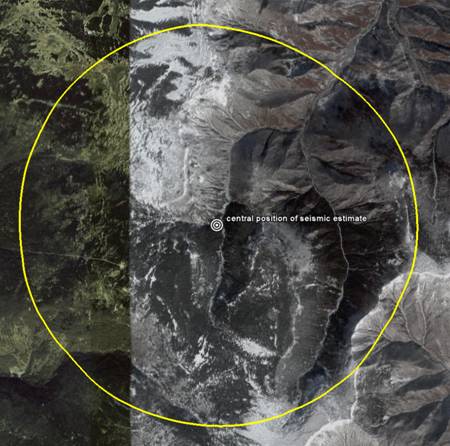
The position measurement of the 25 May 2009 “nuclear” test, with errors.
Up until now, I have been very skeptical of suggestions that the DPRK 2009 nuclear test was actually a conventional explosion. But because of a very interesting presentation here in Shanghai, I have changed my mind. (See Josh’s post for a discussion of how the USIC hedged its position.) I know think it is at least plausible that the latest test was a conventional explosion. This will complicate any eventual verification of nuclear disarmament in North Korea: it will be necessary to drill down to the explosion cavity and take samples to prove the presumed expenditure of plutonium.
What has changed, in my mind at least? I have been convinced by the talk here in Shanghai that if any radioactive xenon was vented in a sudden release, it would have been detected. It is, of course, possible that the point of detonation (“working point” in the Caging the Dragon terminology) was so deep or the geology so favorable for containment that none would have been released from an actual nuclear explosion. But that misses the point. If it is at least plausible that the “test” could have been conventional, then it is plausible that North Korea could use it as cover to hide 20% to 25% of its nuclear inventory, which totaled 30 kg of plutonium as of 2007 according to the North’s declaration. This would not be the first time a country tried to use expenditure of WMD to conceal a secret stockpile of it. Iraq tried to claim it used an additional 1000 tons of chemical weapons during the Iran-Iraq war than its own records showed. In that case, Iraq used the “missing” chemical weapons to gas the Kurds and Shia during the uprising after the first Gulf War.
Let us suppose, for the moment, that the DPRK actually did explode 2,500 tons of TNT instead of a nuclear device. How could they load a tunnel with so much conventional explosive and not be detected by the West’s satellites? This was the real reason I was so sure it had been a nuclear explosion. I was convinced, unfortunately before doing a very simple calculation, that the trucks filled with high explosive (HE) would be detected.
However, it is not all that much HE. If TNT was used, as opposed to a higher density explosive like RDX, North Korea would only have to excavate a cavity 12 meters on a side and fill it with high explosives.

If four 10-ton trucks delivered their load each night (with a fifth truck coming every 10th day) they could drop off all the HE within two months. Using RDX, or some other higher density explosive, could significantly decrease this time. That seems quite doable and to be potentially undetectable by the West.
Do I actually think North Korea was attempting to conceal approximately 6 kg of plutonium for later use? No, a single bomb’s worth of fissile material does not seem worth the consequences of eventual discovery. But this is a conclusion based on what I think is reasonable risk and intolerable consequences and I certainly could be wrong. I do think, however, that the scenario outlined here is plausible and warrants us insisting on drilling down and taking core samples to answer this question once and for all. The down side of such reentry sampling is that a lot of information about weapon design will be learned from the samples taken. This might reveal information about any foreign assistance to the DPRK (if such is the case) and might make it harder to get the North’s agreement to drill.

In that case, Iraq used the “missing” chemical weapons to gas the Kurds and Shia during the uprising after the first Gulf War.
Are you sure of this. I can’t recall any reports of this at the time and Wikipedia does not mention it. Also, how would Saddam Hussein know that the Kurds and Shia would revolt after the 1991 Gulf War if he thought the Americans would not intervene if he invaded Kuwait.
As to the North Koreans, since they seem to be determined to prove to the Americans that they are a nuclear power, why would they risk jeopardizing that by using conventional explosives. Any defector who could prove that the North Koreans resorted to using conventional explosives would be welcomed with open arms and more by the South Koreans.
I’m no expert on this subject but I was under the impression that nuclear explosive events occured at a time scale several orders of magnitude quicker than conventional explosives and this was impossible (or at least very difficult) to fake with chemical explosives. I had read that this is the fact that disproved the rumors going around that this is how the first fizzle-test was achieved… Am I full of it?
Geoff:
What did you find so convincing about the argument? I see the rationale, but I have to say I think Occam’s Razor suggests the most likely incentive would be to fix whatever went wrong last time — ie conduct an actual test.
blowback, check the UNMOVIC “Cluster Document” for t
the missing chemicals:
http://www.un.org/Depts/unmovic/documents/cluster.htm
Page 49.
The bombing of the Kurds and Shia came to light after the 2nd Gulf War and, it seems, all too many people were willing to overlook that terrible act in the general conclusion that Saddam had not produced more chemical weapons since 1991.
Fred, it is but both are still so fast that seismic waves cannot detect the difference.
Jeffrey, as I say in the piece, I don’t think North Korea did this but the alternative is plausible enough to warrant insisting on taking core samples. I do not think we want to let a 600 year old axiom of logic be our only verification method on 20 to 25% of North Korea’s arsenal. I would also add that the “consequences of eventual discovery” can only be applied if we take core samples.
Geoff:
Even in the absence of Noble gas emissions, would the seismology of the low-yield event allow experts to differentiate between a nuclear and a conventional explosion?
Michael
Hi Michael,
I should let real seismology experts answer that (please feel free if any are out there) but it is my understanding that no, they cannot tell the difference. They can tell the difference between an explosion, where there is a radial displacement of earth, and an earthquake but not between types of explosions. That is why the US used large conventional explosions to calibrate their detectors.
But as I say, I am not an expert on seismology and would deffer to any real expert.
Yes, I thought there was a distinctive seismological signature, a sort of double spike, for nuclear vs. conventional explosions. Could that signature be erased by a properly excavated cavern for the explosion to create decoupling?
There has been a certain amount of offline discussion about the point Michael raises, which I am just catching up to in a unsystematic fashion because Im in China. The issue being raised is that North Korea would have to detonate the 2,500 tons of HE fairly simultaniously. Otherwise individual detonations might well be distinguished. Such arguments do make it easier to detect conventional explosives. But, again, is it enough to say we didnt detect several detonations and therefore it was a nuclear explosion? Putting on my inspector hat, I have to say, no, its does not satisfy me. But then again, I havent seen the timing data. I hope someone with access to the data publishes a study on it.
I would just add that the usual situation CTBTO would face in discriminating between a nuclear explosion and a conventional one is where the outside world is concerned that an event is a nuclear explosion and the suspect nation claims it was a conventional explosion. There it might be credible to closely examine the seismic waves looking for sequential detonations. But the hypothesis here is that North Korea was doing everything they could to make a conventional explosion look like a nuclear explosion. If North Korea could time the simultaneous detonations of an implosion device well enough to get a fizzle of 2 kT, then it seems possible they could time the detonations of 2,500 tons of HE well enough to fake a nuclear seismic signal.
The scenario was discussed at the CTBTO’s ISS 09 conference in Vienna in June. Professor Paul Richards, who is said to be one of the best seimologists involved in the detection of underground nuclear explosions, went into much detail with a group of journalists after the press conference was over. Among other facts he cited that it would be extremely difficult to detonate such a huge amount of conventional explosives simultaniously so that you would see the same patterns in the seismographic data as you would expect for a nuclear explosion. He said, theoretically it would be possible, but he dismissed any other scenario than a nuclear explosion as highly unlikely. It was virtually impossible to find anybody else then me and some other journalists among the participants, who had serious doubts about what had happened in the mountains of NK – but still I am not totally convinced. We tend to believe that the Norks have at least some manufacturing know how and capacities for missile engines – which requires a lot of technological sophistication. On the other hand we think, they are not able to set off a conventional explosion in the low kt range that could be boosted by eg. detonating the HE in a cavern filled with water? Seems to be a somehow inconsistent conclusion to me. Has anybody seen data on how many occasions “accidental containment” occured in U.S. or other well documented nuclear tests?
No offense, but me thinks that Geoffrey is either the ultimate skeptic and terribly naive, or obfuscating.
Geoffrey, there are many people who have quite a well developed intuitive faculty that is able to reasonably make a valid assessment of the truth or not truth behind events such as the DPRK nuclear test. In this case, IMO, on a scale of 1 to 10, the likelihood of it being a nuclear blast is 9.999999999999.
Geoff: “That is why the US used large conventional explosions to calibrate their detectors.”
This brought on a tangential though; what if the first test was actually a convetional explosion, as rumored, to calibrate the sensors and possibly train personnel, and this one was the first real deal? What would be the technical implications with the NK device?
Jeff, Michael, hello to everyone!
Jeff, I think you should consider NK’s economic situation and also impossibility to get chemical material, the ammount which only a normal states can get, NK already long time short of chemical material for explosion.
Michael, according my friend who is the expert on seismic, it is difficult to tell difference, but still possible to judge, important is get full data all nearby stations.
Genxin
I think it is important to keep the H.E. detonation option as a possibility, for all the reasons you specify, but I think that it is the less likely alternative.
If it were a conventional explosion, it may not necessarily been primarily to conserve plutonium. The NKs may not be ready to detonate an updated bomb, but felt compelled to do some saber-rattling anyway.
What it looks like happened tho, was that the NKs took advantage of the political crisis to combine the saber-rattling with a test of a fixed weapon design. As horrifying a device as their subkiloton fizzle bomb was (see my comments under the post here ), they must have been itching to try out some modifications. As you can see from my comments under the post here , this test got them capable of devices comparable in yield to large portions of the historical US arsenal.
As an aside, to be conservative, I think that we should use 5kg (or somewhat less) of Pu as the unit measurement for their potential arsenal. 6kg is pretty high. The difference is at least one possible extra weapon.
I believe that the large conventional explosions the US has used to simulate nuclear effects (Minor Scale and similar) were initiated at a single point, usually a point of symmetry. E.g., in the middle of a spherical or hemispherical mass of explosive.
Now probably we also need to discuss what we can do and in a coordinated way to strenthen those monitor capability based in the experience and practice towards last NK’s test, make sure next time more accurate follow up.
Thanks Geoff. Very interesting post. Just had a couple questions.
Do you think our understanding of noble gases is good enough to be able to predict how well they would seep? Perhaps its a problem with the basic theory.
You mentioned foreign assistance. Theoretically, what could this entail?
Thanks
Geoff:
I asked Lynn Sykes, who knows a thing or two about seismology and nuclear testing, to help our readers on this. My question was:
In the absence of OSI and Noble gases, can seismology help us distinguish
between a low yield nuclear detonation and conventional explosives emplaced to
look like a nuclear detonation? And would you mind if I placed your answers
on ArmsControlWonk.com?
Here is Lynn’s answer:
Dear Michael:
Chemical explosions up to 100 to 1000 tons (0.1 to 1 kilotons) are used in
the mining industries in several known places in the world several times a
year. Nearly all of these very large chemical explosions as well as many
smaller chemical explosions, however, are not detonated instantaneously but
are exploded in a temporal sequence called ripple firing that takes place
over up to about a second. The seismic waves from a large ripple-fired
explosion can be distinguished by way of their spectral character from those
of a large instantaneously-fired chemical explosion. A lot of work on this
has been supported by DoD and DOE over the last 15 years and many results
have beeen published.
Today ripple firing is used very frequently since it is more efficient in
either breaking or removing rock and in reducing damage to nearby
structures. It is very cost effective.
DOE conducted an underground 1.3 kt chemical explosion at the Nevada Test
Site (NTS) in 1993, which was called either the “chemical kiloton” or
“non-proliferation experiment.” It was unusual for its large size in that
it was fired instantaneously. Its seismic waves were not different from
those of a nearby nuclear explosion of similar yield. A nuclear explosion,
of course, occurs instantaneously; hence its seismic signals can be
distinguished from those of a very large ripple-fired chemical explosion.
Livermore scientists report that large ripple-fired chemical explosions have
occurred well to the east of NTS at mines in northern Arizona; their seismic
waves distinguish them from instantaneous explosions.
Gases such as sulphur hexafluoride (SF6), that can be detected in minute
trace amounts were placed in the “chemical kiloton” explosion. They were
detected at the surface especially along cracks, joints and faults over a
period of months. These gases were detected mainly during periods of low
atmospheric pressure. An on-site inspection may well detect bomb-produced
radioactive products with appropriate half lives.
This brings me to the two North Korean explosions. Each was well-detected
seismically and the tunnel entrances were visible on unclassified satellite
images. Their seismic waves identify them as explosions (and not
earthquakes) but not necessarily as nuclear. That of 2006, the smaller, was
identified as nuclear by leakage of bomb-produced Xenon isotopes. That of
2009, the larger, was not as far as I know. Two possible reasons for this
are either 1) that it was buried deeper than the 2006 event or 2) that a
broad region of high atmospheric pressure (that the CTBTO staff says was
present for at least a week) suppressed the exhalation of Xenon isotopes
during times in which they might have been detected prior to their
radioactive decay to background levels.
The seismic magnitude of the 2009 North Korean explosion indicates its
yield was several kilotons if, in fact, it was nuclear. I know of only two
instantaneous chemical explosions, however, that were of that explosive
yield. Called the MEDEO explosions, they were detonated in 1966 in
Kazakhstan for a dam. Marshall (1970) indicates their chemical yields were
1.7 and 3.6 kilotons. So much rock was removed that it would be easily
visible on unclassified satellite images today. Chemical explosives of
those amounts would have required roughly 100 American-size freight cars to
transport them to the dam site.
Occasionally instantaneous chemical explosions of a few to several hundred
tons are conducted underground. They have been mentioned as appropriate for
Cooperative measures under the CTBT to insure that they were not nuclear.
In fact, scientists from Norway and Russia did such an on-site examination
for such a chemical explosion on Russia’s Kola Peninsula about 10 years ago.
So let me summarize my answers to your question. It is not a simple yes or
no. The seismic magnitude of the 2009 North Korean explosion was large
enough that it almost certainly must have been a nuclear explosion. It and
especially the smaller 2006 explosion would be considered low yield in terms
of testing practice by the U.S. and Russia in the 1980s. Likewise, the
magnitudes of the Indian and Pakistani explosions of 1974 and 1998 were
large enough that they too must have been nuclear even in the absence of any
other information. Seismic methods alone, however, could not distinguish
very low yield nuclear tests of 10 tons (0.01 kt) from instantaneous
chemical explosions of that yield.
Cooperative measures could be effecive down to very low yields for say the
Russian, Chinese and U.S. test sites if seismometers were operated on those
test sites and radioactive sampling was conducted on-site or nearby. Very
small earthquakes on the Russian test site at Novaya Zemlya are so rare that
their occurrence would draw suspicion and extensive analysis.
You have my permission to place the above on “ArmsControlWonk.com”.
Lynn
Lynn R. Sykes
Higgins Professor Emeritus of Earth and Environmental Science
Lamont-Doherty Earth Observatory of Columbia University
100 Washington Spring Rd.
Palisades NY 10964
What about the staging of such deliveries? How fast will those trucks move? How far will they need to go to deliver the RDX? Can that all be done under cover of darkness or outside of US/Allied satellite observations? It starts to get more complicated (certainly time wise) if you need to maintain intermediate storage facilities.
Trucks are very visible at night when they have theirs lights on. Driving truck with RDX at night without lights on is suicide.
Any accident would just harm NK, which means it’s against NK interests to attempt it.
Do they know how deep was that explosion? NK might be lucky and Xe outbreak might be local enough to avoid detection.
Hi Michael,
Thanks for posting Prof. Sykes’ comments. But I remain unconvinced that the “nuclear option” is proved simply by the size of the explosion, which is what Prof. Sykes maintains is the fundamental issue. It seems to me that 250 10-ton trucks could deliver 2,500 tons of TNT and that it would fit in a cube 12 meters on a side. (Just to repeat my the results of my calculation.) As to why Prof. Sykes spends so much time talking about ripple explosions, I’m at a complete loss. Perhaps he is implying that North Korea would have to detonate its conventional explosives more simultaniously than that, say within 1/10 of a second or a 1/100 of a second or even within 1/1000 of a second. All those sound do-able to me. Still, I’m very glad you posted his comments.
I should add that, because of a computer problem at MIT, I am totally out of email contact with the world.
Big conventional explosions for nuclear simulation:
http://en.wikipedia.org/wiki/List_of_the_largest_artificial_non-nuclear_explosions#Conventional_explosions_for_nuclear_testing
I would add just one more thought to my previous comment: in the context of special nuclear material accountancy, the burden of proof has to rest with the hypothesis that expends more nuclear material, i.e. the nuclear explosion hypothesis. Again, as a judgement call, I believe it was probably nuclear. But the conventional explosion hypothesis is plausible enough to warrant drilling down and making sure. Prof. Sykes’ comments that you cannot tell the difference just adds credibility to that nonnuclear hypothesis.
Geoff et. al.:
I believe this discussion constitutes a reaffirmation of the value of the CTBT’s OSI provisions.
Michael
It seems to me that many of the commenters are using very conservative assumptions which in my opinion may not be justified. For instance the use of TNT. NK produces conventional weapons that use a high explosive like RDX or PETN. If they were to use one of these high explosives in their nuclear simulation postulated here it would significantly decrease the total amount of explosive required. Both RDX and PETN only need 1500 kT to produce a 2500 kT TNT equivalent.
Also, why limit the trucks to carrying 10 Tons? A full semi can carry 25 tons. (NB: these trailers may be really full. I didn’t figure the volume of 25 tons.) If my math is right then you would only need 60 25-Ton trucks of RDX or PETN rather than 250 10-Ton trucks of TNT. A not insignificant difference.
Last opinion. RDX and PETN are both insensitive explosives that are very safe to transport. There should be little potential for trouble transporting at night without lights; especially if the driver is familiar with the territory and/or wears night vision goggles.
Michael Krepon has asked me to post the following for him:
Geoff, et. al.:
I asked Paul Richards the same questions I asked Lynn Sykes. Here is his answer:
Dear Michael (and fellow Wonk)
I appreciate the care with which you phrased the question. The many mine blasts and construction blasts done each day, once thought by some agencies to be a problem for CTBT monitoring, have to be dealt with but are not much of a difficulty.
To respond: seismology helps, but only in the sense that seismology places on the conduct of such an evasion scenario (for it to be successful) the requirement that the chemical explosive be detonated almost all simultaneously. This can be done, but adds to the overall difficulty, and danger (if, for example, not all the explosive does explode).
FYI, the reason for our inability to distinguish between seismic signals of an underground nuclear explosion and a simultaneously-fired chemical explosion of similar energy release, is that the observable seismic waves have wavelength of more that hundred meters (and period of at least several hundredths of a second). And so anything smaller than this (in space or time), such as a cube of chemical explosive, saturated with detonators that fire in much less than a tenth of a second, can’t be distinguished from a point source (such as a nuke, which releases its energy on an even shorter time scale). With CORRTEX-type monitoring, the difference between the two types of explosion WOULD be apparent, because such monitoring uses super-high frequencies and super-short wavelengths, and could detect the finite spatial scale and time duration of the chemical explosion.
Lynn Sykes has given you useful material. Papers on the subject include Khalturin, Vitaly I., Tatyana G. Rautian, and Paul G. Richards, The seismic signal strength of chemical explosions, Bulletin of the Seismological Society of America, 88, 1511—1524, 1998. [which can be downloaded as a PDF (1.3M) via http://www.ldeo.columbia.edu/~richards/my_papers/ChemExsig_strength_BSSADec1998.pdf ] and Problems for CTBT Verification posed by Chemical Explosions, paper taken through inter-agency review, and presented for the United States in Geneva, June 10, 1994, CD/NTB/WP.105, 1994. [I drafted this, and presented it in Geneva during CTBT negotiations. I don’t have an electronic version, but can send a copy if you wish…]
You are welcome to use any of the above in any way.
Let me also voice a concern that the Obama Administration has yet to grapple with the mis-information in circulation on CTBT verification issues—-or with some of the sources of mis-information.
Regards —- Paul