
click on the image for a larger version
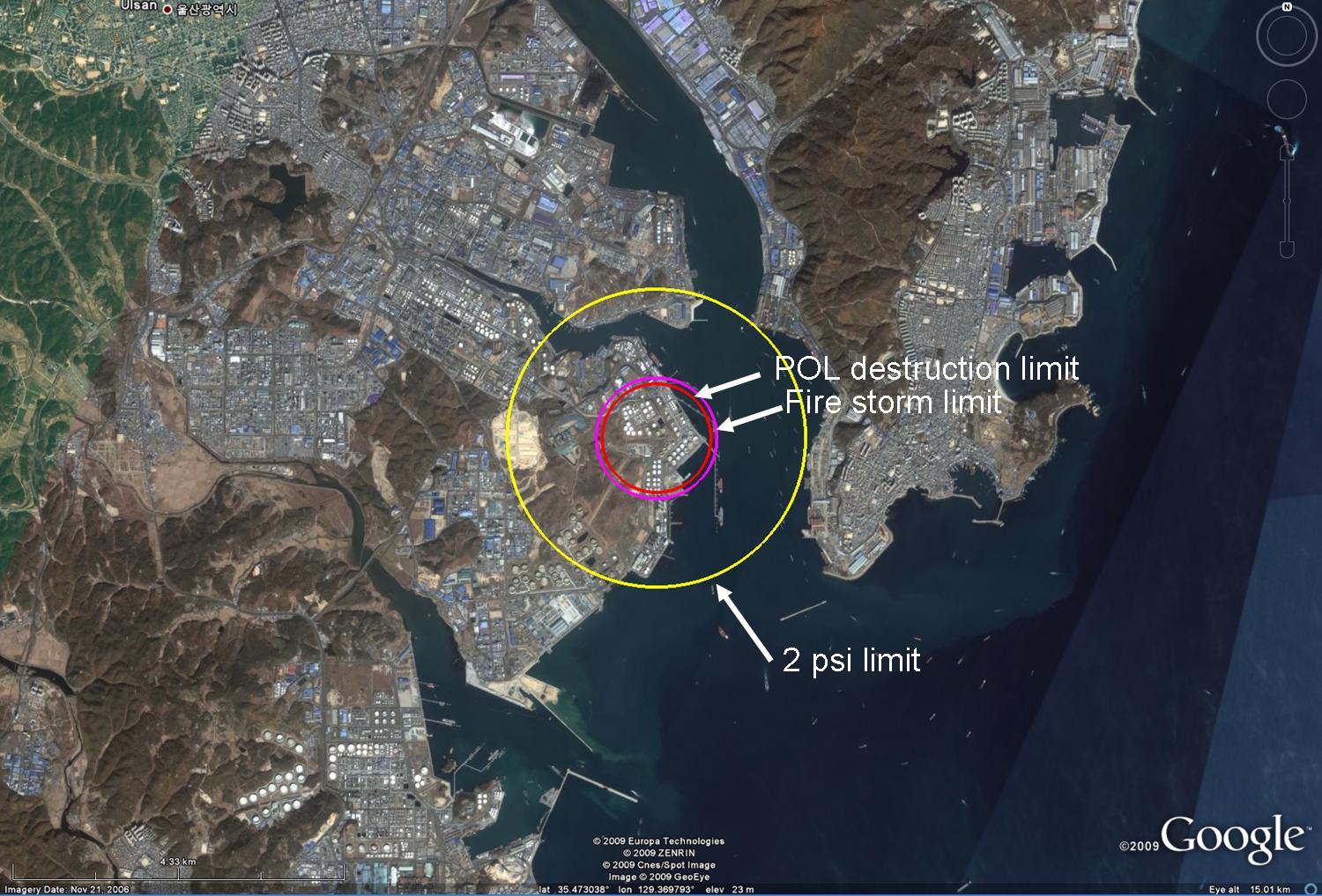
Four Kt nuclear explosion over one “sub-harbor” in Ulsan. Overpressures are for a 4 Kt nuke detonated at the optimum height to maximize blast effects. POL destruction limit is the range where blast effects cause severe damage to oil tanks. Thermal effects, i.e. starting a firestorm, are overestimated because slant ranges are used as ground ranges.
This title might be a little misleading. I certainly don’t want to imply that a 4 Kt nuke could not kill a lot of people. It certainly could. However, I have been thinking about whether or not North Korea might be able to use a few 4 kiloton (Kt) nuclear weapons—if that is their true yield—in what we in the West would consider tactical situations but in the context of the Korean peninsula would have strategic consequences. After all, it would seem that the US and South Korea would be in a very vulnerable position if the North launched an all-out invasion. In the standard war plans the US has for handling such an attack, often abbreviated as Halt, Build up, and Retake, involved a slow as possible fall back away from the DMZ with most of the US troops and supplies come in from outside the country.
It seemed, I thought, the perfect opportunity to use nukes. Blow up a few ports, I thought, and that would have a serious impact on the US strategy. This appears especially important when you look at the top six or seven ports. Two of these, Inchon and Tonghae, are fairly close to the DMZ and might be taken by ground forces in the first couple of days. Of the others, Ulsan, near the southern tip of the Korean peninsula, has 75% of the remaining berthing capacity. If Inchon and Tonghae could be taken by “conventional” forces, then destroying Ulsan could severely hamper the “Build-up” phase.
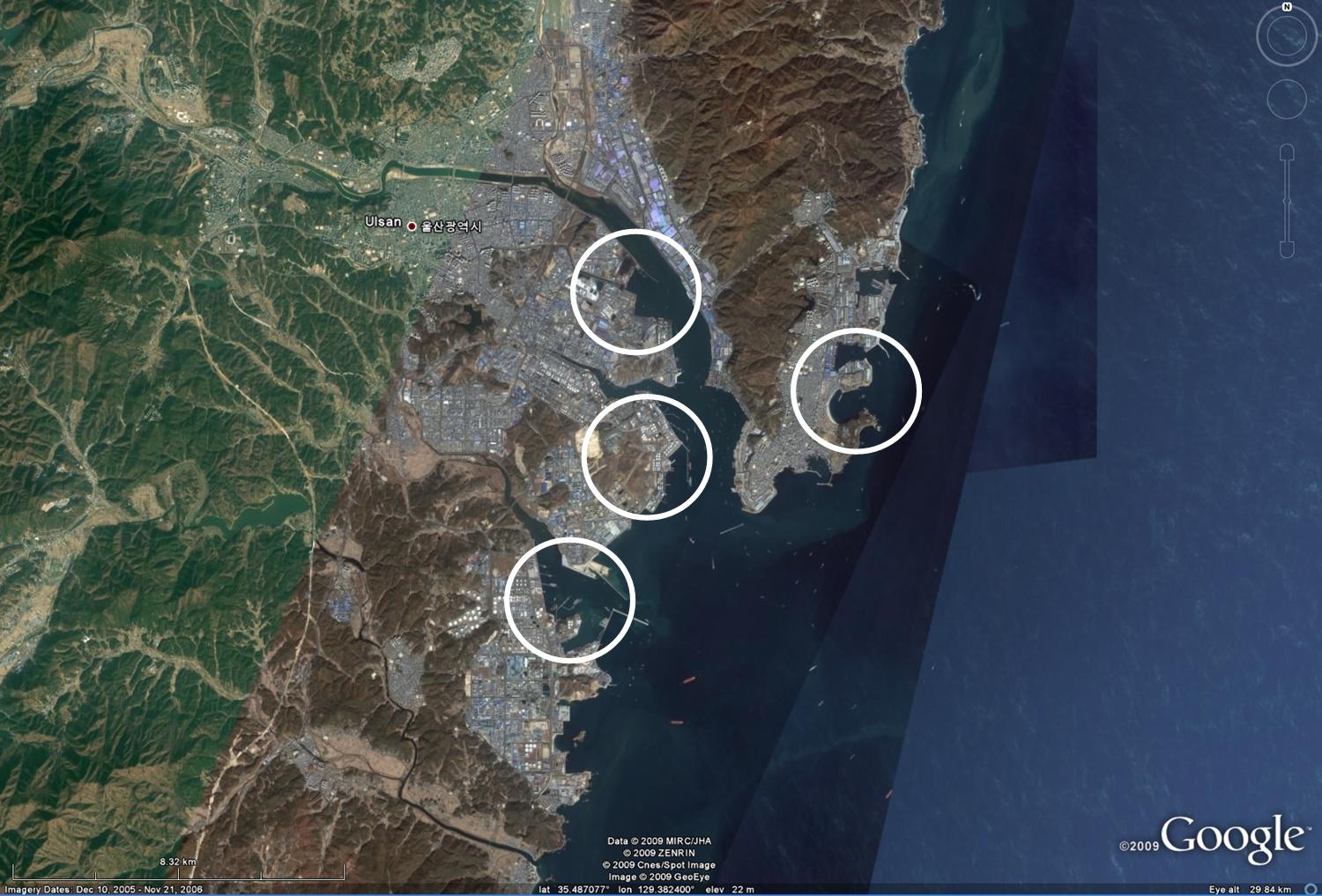
And it still might; but it would take more 4 Kt nukes than the North might want to expend on it. There are at least four (and arguably six) separate harbor areas in Ulsan. Baring a bottleneck for rail or road transportation that I haven’t seen in GoogleEarth, it turns out it would take four to six 4 Kt nukes to destroy them. Let’s consider in more detail an attack on one of those sub-ports, the one on the West side of the mouth of the main river.
There is a major oil tank farm associated with those docks, which presumably equipped with whatever specialized oil off-loading equipment is needed for that activity. Oil storage tanks are remarkably resilient to nuclear attack. This has only increased since 1977 when my edition of “The Effects of Nuclear Weapons” by Glasstone and Dolan was published. It seems that oil tanks get more resilient as they get bigger and most of the tank farm requires blast overpressures of 12 psi or greater. (Four kilotons is right in the transition region where the radius of creating a firestorm, about 0.8 km in for this yield, is just about equal to equal to the blast radius of 10 psi, which is just about capable of knocking over a large, half empty oil tank. This change over has to happen sometime since the thermal radiation must go as the fireball’s surface area, Y^2/3, while the blast radius goes as Y^1/3, where Y is the yield.) These blast radii assume the bomb went off at the optimum height. If it was a surface blast, to create the maximum amount of contamination, it is possible many of the oil tanks in the farm might survive a 4 Kt blast.
Knocking down the cranes needed to remove containers from ships would also require a 4 Kt blast to be very close. And much of the US supplies come in on roll-on/roll-off ships so perhaps the North would have to destroy quays, something that is very hard to do. Would the DPRK want to use four to six of its nukes to destroy Ulsan? It is possible of course, but that must be a large fraction of their current arsenal for only a 75% reduction in pre-existing berthing capacity. And there lots of possibilities for an imaginative, adaptive, and motivated US military to substitute for that capacity.

I strongly suspect that NK doesn’t see their arsenal as tactical nukes. They almost certainly cannot deliver them with anything like the accuracy required to vaporize a particular target.
What they would be for is what all nukes are for – making humans suffer and die.
Area of lethal burns from a 3 kiloton burst over the Chicago skyline for scale. This area includes the first, second, fifth, and sixth tallest buidings in the US:
… as he looked for his way through the woods, he heard a voice ask from the underbrush, “Have you anything to drink?” He saw a uniform. Thinking there was just one soldier, he approached with the water. When he had penetrated the bushes, he saw there were about twenty men, and they were all in exactly the same nightmarish state: their faces were wholly burned, their eye sockets were hollow, the fluid from their melted eyes had run down their cheeks. (They must have had their faces upturned when the bomb went off; perhaps they were anti-aircraft personnel.) Their mouths were mere swollen, pus-covered wounds, which they could not bear to stretch enough to admit the spout of the teapot. So Father Kleinsorge got a large piece of grass and drew out the stem so as to make a straw, and gave them all water to drink that way. One of them said, “I can’t see anything.” Father Kleinsorge answered, as cheerfully as he could, “There’s a doctor at the entrance to the park. He’s busy now, but he’ll come soon and fix your eyes, I hope.” – “Hiroshima” by John Hersey 1946
===============================
The Atomic Bombings of Hiroshima and Nagasaki
Report by The Manhattan Engineer District, June 29, 1946
TABLE D
Cause of Immediate Deaths
City – Cause of Death – Percent of Total:
Hiroshima
Burns 60%
Falling debris 30
Other 10
Nagasaki
Burns 95%
Falling debris 9
Flying glass 7
Other 7
============================
My uninformed guess is that if they are willing to use nukes but don’t have enough of them to destroy the required SK infrastructures, the KPA can still hamper US access by resorting to persistent chemical agents.
I’m wondering whether Buncefield has provided additional refinements to this oil overpressure model?
http://www.buncefieldinvestigation.gov.uk/index.htm
http://www.flickr.com/photos/gridlock/73582239/in/set-1556396/
I was about 600m away at the time, it was quite a bang…
…adding, I may be one of the few readers you have who’s actually been woken by something I honestly thought, however briefly, was a nuclear explosion. I’m about 20 miles outside London and Buncefield happened 600m away at 6am.
Keep up the good work chaps, it wasn’t a fun experience. Overpressure waves + seismic movement are not the best alarm clocks.
Great article. It’s my understanding that the US military relies more on Chinhae Naval Base than the Ulsan Port. Does anyone know if this is true?
Also, there are a large number of usable commercial ports in Korea, which in my opinion even further reduces the strategic utility of DPRK nuclear weapons. (If there was any to begin with)
“Oil storage tanks are remarkably resilient to nuclear attack.” Very interesting; I guess it’s true that you do learn something new everyday.
I wonder really about the North’s ability to stage an invasion of the South. The north’s armor is on par with Iraq’s 1990’s armor force and we saw how well that went for them against the M-1. The South uses the M-1, and manufacture something along the lines of the German Leopard II. I just don’t see DPRK armor breaking thru easily. Their Air Force has similar problems. The past 20 years have shown the F-15 and F-16 can more than handle outnumbered Mig-29’s and the DPRK only has a few. I think the most likely use of a DPRK nuke would be in a last dash or even accidental war with the South where the DPRK uses conventional artillery to bombard Seoul and establish a refugee backlog on the roads and city, then use the handful of nukes. But looking at the Chicago picture makes me think that all those tall buildings will save a lot of people in the burn radius by shadowing them.
Such a small blast radius for the tested yield of the DPRK nukes shows that they’d have limited use against armor unless it was extremely concentrated.
The real question is what does a 20 something do with a military at his disposal after what must be a rather dysfunctional upbringing? Maybe he won’t really be in charge, perhaps there’ll be some generalismo prefect to watch over the boy until he at least makes 30.
Andrew,
As I pointed out, the skyline was used as a scale reference.
If in fact the burst was over a high-rise environment, the effects would be complicated.
1) While the buildings provide shadowing, it also places people in a three dimensional array.
Any burst-side window up-and-down the structure sides exposes victims. There are often 10’s of thousands of people in a single tower.
2) In addition to heat, the blast would provide a withering flux of building debris – particularly glass and concrete – which would shred and crush building occupants and sweep the streets.
They would be hit by both local fragments and by projectiles of blasted buildings, cars, etc.
The radiation pulse that would kill most untreated people covers most of the same area.
Finally, if it were a surface burst, a plume of fallout would stream downwind.
Running with the theory that the DPRK was actually shooting for miniturization rather than large yields in their two tests and then assuming that they feel they can build a larger bomb what would the consequences be of a single 20kt detonation in Ulsan?
So when the US looked to develop micro nukes for hard and deeply buried targets, sites like Armscontrolwonk called them the greatest threat to world peace in history. But now the North Koreans might have a few, hey no biggie, they can’t do that much damage. The lengths the disarmament crowd goes to justify their misguided philosophy is astounding
Not as astounding as some people when they mix up whats good for the national interests of the United States with what’s good for North Korea. Believe me, they are very different.
Although I agree with the larger point of this item (several 4 kt bombs do not give North Korea a useful tactical nuclear force), I suggest that this calls for a little rethinking:
“Oil storage tanks are remarkably resilient to nuclear attack… It seems that oil tanks get more resilient as they get bigger and most of the tank farm requires blast overpressures of 12 psi or greater.”
This is true, as long as the tanks are mostly full. But note in Glasstone and Dolan what the damage pressure is for an empty tank: 1 psi, regardless of size.
What (you may ask) is the problem with that? Who cares if an empty tank is damaged? Well, what if the tank is not quite empty, say 10% full? The big tanks at Ulsan are 150 to 250 ft wide, and are probably around half that tall. A 10% full 250 ft tank holds about 20,000 cubic meters of oil. Several of the floating roof (pontoon) tanks in the picture are nearly empty (I looked the site up on Google Maps at highest resolution).
I suggest that a nuclear explosion over the tank farm is going to start fires at POL storage areas, even out past the 2 psi contour which may overwhelm resources to fight them (which will probably be impaired by the explosion). Prolonged exposure of undamaged tanks, perhaps full or nearly full, may set them on fire also. I suspect the result will be something like the mother of all refinery fires, and not limited to the POL destruction limit in the picture.
Carey, I think your suggestions are well outside the results supported by Glasstone.
Simple overpressure and thermal pulse are only one part of the equation.
Fuel tanks would by subjected to an enormous flux of high velocity missiles of all sizes and materials – some blazingly hot.
I would be surprised if a tank farm could withstand the schrapnel, blast heat pulse and fires being anywhere in the neighborhood of even the smallest atomic detonation.
See the Texas City explosion of 1947 for example
Geoff:
I agree, but don’t think this makes them wrong (which I suspect is your implication).
Glasstone’s treatment suggests it is based on the type of engineering analysis used for targeting, which is by its nature very conservative.
Note also Glasstone’s sentence in passing: “Furthermore, the leakage
can lead to secondary effects, such as the development of fires.”
Indeed it can. I think Lynn Eden is on to something that circumstances not easily modeled in target planning, like fire and the variable vulnerability of a real tank farm, have terribly important consequences in the real world.
My stubborn pragmatism does no more grant me leave not to interject strategic considerations into this technical exercise than maintenance of global deterrence would allow the U.S. to stay it’s hand and not respond in kind, if not a great deal more, in face of a North Korean incursion south of the DMZ with atomic supporting fires . Our network of security agreements around the world would be debased by any sign of temerity on our parts. And the human condition would deny us the luxury of a “humanitarian” demonstration, we’d be forced to draw blood, and in buckets.
The DPRK fully realizes this salient reality and as such would not open Pandora’s box save as a means of regime survival. For all the rhetoric of reunification, the North no longer believes it has the means to achieve this goal thru force of arms. Shame, shame of showing this weakness to their own people, is the sole reason they refuse to refute the slogans of their fathers and father’s fathers. In the last 2 decades we’ve witnessed the complete collapse of the offensive potential of their armed forces and we’ve also witnessed the leadership echelon consciously shifting their resources towards a defensive strategy. Imagine if the Brits had forced us to cede our southern states to that b*st*rd stepchild of a confederacy. This is what the Pyongyang is trying to come to grips with however slowly and laced with biterness.
And for the record, I believe it’s always been understood that in a nuclear conflict, the means of hindering the flow of traffic thru a maritime port have not been to target the terminal infrastructure but rather the neighboring city and it’s skilled labour that man the port facilities. In this manner the port could be returned to operations after the shooting had stopped sans risk of a creative workaround beforehand. In the meantime the evacuations of wounded and provision of medical and food aid would occupy whatever limited capacity survived the strike.
As a practical matter, I think even a large thermonuclear weapon obliterating the Ulsan docks wouldn’t be enough.
If one peruses around South Korea’s southern coastline in Google Earth, it’s hard to go many kilometers without finding another dock facility for large ships. Most of those appear to be RO-RO compatible, from first inspection. Going south and then west from Ulsan, I found several geographically separate port districts in Busan, four more around Jinhae and between Jinhae and Masan, one at Masan, one east of Goesong, one near Tongyeong, Gwangyang, a couple at Mokpo.
In case of actual war, one can put a 747 per minute worth of troops on the ground at any large airfield, and with what appears on first impression to be dozens of port facilities with several dozen linear kilometers of dockside which is RO-RO compatible between them I can’t see how one could interdict them without a massive air and sea campaign, or liberal use of chemical weapons. They can’t have enough nuclear bombs to hit all those ports, and airfields, just in the south. They might have enough chemical warheads to interdict a lot of them. They have enough aircraft to interdict them, if combat losses aren’t too extreme, which South Korea’s air defenses are likely to disprove rapidly. I don’t think they have nearly enough subs to effectively interdict.
I can’t see such a campaign actually succeeding. It would take something like China’s resources to pull it off.
@George: The two main oil import facilities for South Korea are at Incheon and Ulsan.
I think it would be safe to assume that a war on the Korean peninsula would be a fairly mechanized one on the US and South Korean side of things and having intact facilities to offload your POL would certainly be a major advantage in any conflict.
Given that Incheon is as much within the range of North Korean artillery as Seoul is Ulsan would definitely qualify as a target I think.
If nothing else it could certainly level the potential logistical playing field for a bit.
There’s also another refinery and docks facility at Yeosu (E127.77 N34.86 ish).
And a lot of beaches.
Refineries and tanker docks are efficient. You can move and unload million metric ton-ish loads of crude in a day or two with 35-50 people on the dock and on the ship. But military organizations are all about dealing with inefficient. If you have to ship diesel in 20 foot container tanks, unload with a crane, and ship it on a truck to the front lines, you’ll deliver multi-thousand-unit loads of those per ship per day as required. Or pull a tanker full of Diesel up to a deep berth alongside a dock with good truck access, and offload directly to tanker trucks. Or any of a number of other options.
South Korea has spent 50-plus years getting and being ready to deal with the North trying to come South again. They’re unlikely to be unprepared to the point that they run out of fuel. If their underground stocks aren’t enough to see through the initial offensive and handle a counteroffensive, it would be somewhat astounding.
This is all getting somewhat far afield. No matter how you look at it, the presumed North Korean nuclear arsenal is a poor match to trying tactical nuclear strikes to keep the US from intervening if they declare war. There are simply not enough weapons in the presumed inventory, and even if their war yield is far beyond their test yield (boosted design, actual design is multistage Teller-Ulam, using a tested T-U secondary design they got from China, say), it’s still not vaguely enough to actually militarily isolate the south.
Kill a lot of soldiers and sailors and dockworkers? Yes. Enough to be militarily significant? Probably not.
A 4kt burst would have more political fallout than nuclear IMHO.
Why would they want to waste their precious bombs on an unimportant target like an easily replaceable port? To buy a few days, maybe a week? There are things like lighterage, pump ships and crane ships that could emulate a port anywhere along the coast. No, the N-Kor nuclear capability is not built for peninsula warfare.
I would more worry about the large Japanese cities!
Strategic escalation. Maximizing the risk for the enemy. With an all out conventional assault on S-Kor N-Kor can put a dent into the Western economy, with a nuclear attack on a couple of Japanese megacities – hallelujah! That takes the N-Kor threat onto a whole new level. Think strategic!
Assuming that the NK bombs are too small (4kt) to cause the city-busting effects we associate with Fusion weapons (1MT+), how large of an area would they turn unlivably radioactive if the NK built the casing for their bombs out of Cobalt? Because I really do not think the NKs give a hoot about how much ecological damage they would do, their whole plan with their weapon program to date appears to be in the Blackmail category. And the threat of making a major SK town and countryside unlivable for a generation would be well within their capacity.
Cobalt in the casing of a 4kt fission device, boosted or otherwise, will have no effect whatsoever. The Cobalt-59 > Cobalt-60 transmutation requires not only the fast fusion neutrons of an Ulam-Teller but also a compression of the Cobalt-59 to increase it’s apparent cross sectional density to said neutrons and increase the probability of breeding Cobalt-60. The neutrons released by a 4kt fission boosted device, those that escaped the core, would be too sparse, the resultant high energy neutron flux insufficient to the task of transmuting much in the way of “dirty” tamper. Of course a 4kt fission device could scatter already radioactive isotopes, but then again so could regular chemical explosives at much the savings to the wallet.