
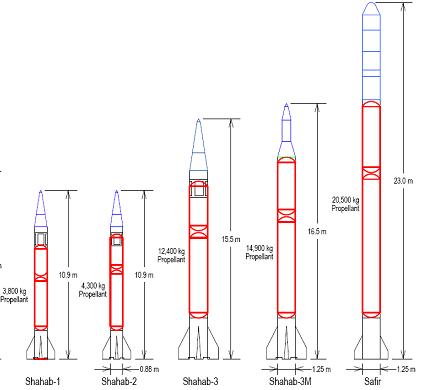
Diagram of Iranian liquid-propellant missiles from the EWI–JTA Technical Appendix. The latest debate, however, mainly focuses on Iran’s solid-propellant missiles.
If I knew a year ago what I know now, I wouldn’t have lost so much money in the stock market. But as important as that money would have been when I retire, it was just money. Unfortunately, there is an all too deadly analogy with Iran’s nuclear and missile programs. Many very serious and credible analysts firmly believe that Iran is set on getting nuclear weapons and the means to deliver them over large distances.
Given the potential danger posed by Iran’s development of ballistic missiles, the prudent course might appear to be to always err on the side of overestimating Iran’s ability to develop and produce its own long-range missiles. There is, however, reason to avoid like the plague overestimating: it can trigger inappropriate responses such as the invasion of Iraq where WMD was alleged and yet it didn’t exist. We are still suffering from that overestimation and will continue to do so for quite a while. The answer, of course, is to make sure you get it right.
That is why it is important that scholars continue to debate the nature and capability of Iran’s missile development program. One place such a debate is occurring is here, at ArmsControlWonk.com.
Another, is at the East West Institute, where they have set up a on-line forum to discuss the Joint Threat Assessment.
This debate has heated up recently with the exchange between Ted Postol and David Holloway on one side and David Montague, Uzi Rubin, and Dean Wilkening on the other.
In addition to the Joint Threat Assessment, including the technical appendix, the East West Institute has made available a number of additional papers including criticism by Montague, Rubin, and Wilkening, as well as a further response by David Holloway and Ted Postol.
While much of the debate in these papers revolves around technical missile details, the meat of the disagreement is on how much help Iran and North Korea have gotten and how much they might still need in order to develop more capable missiles. The unstated context is, of course, missile defense. Informed readers can examine all the papers and reach their own conclusions.
In the interest of full disclosure, I should mention my connection with the East-West Institute’s report. I was asked in early December 2008 to participate in a single meeting as an outside commenter on the preliminary findings of the technical sections. I believe the technical sections have changed considerably since then, though I do not know what influence I had. That has been my only connection with the report and, I believe, I can still be considered an independent observer. My thoughts on the Iranian missile development program were evolving at the time of that meeting and they have continued to evolve as more information becomes available. My posts on Armscontrolwonk.com are a good history of this evolution as represented by “snapshots” of my analysis over time. In particular, I have been impressed with what I considered the indigenous advances the Iranians have made.
If anything, I have probably attributed more indigenous capability than is actually the case, as I hope to discuss soon in future ACW posts. However, I believe that Iran is capable of indigenously producing engines for its Shahab missiles. I believe the evidence, such as it is (namely the Iranian production video tape that we have discussed so much here), is strong evidence that they can indigenously produce the second stage engines for the Safir; engines that use more potent propellants. The jury is still out on whether or not Iran can produce the turbopumps for those second-stage engines. (And only circumstantial that they can produce the trubopumps for the first stage, though I come down on the side that they can.) Nevertheless, if I can preempt some of my future posts, I believe Iran is still very dependent on outside expert help in solving technical problems as they arise. At the same time, they resist asking for such help whenever possible so as to develop their own capabilities.
The arguments involved in these reports and the responses they have elicited are important. They deserve careful reading.

Ummm…to characterize the reason for the invasion of Iraq as being due to an “overestimation” of WMDs there is not only contrary to reality, it is a pretty embarrasing thing to say too. There were no WMDs, our officials KNEW there were no WMDs, and lied about it. That’s not overestimation, that’s just plain deceit.
At last the meme that Iran’s nuclear work is only for electricity is dying. It is only a matter of time before Iran has nuclear warheads they can put on missiles. If we have more time than some think then great. If we have less time then we will need to be mentally and otherwise prepared.
I do not want to gamble millions of lives on the hope that Iran might not be as suicidal or homicidal as they appear. The stakes are too high.
That Ahmadinejad and Khamenei have made holocaust denial a part of their official policy does not persuade me that they are solid, rational, reliable, men.
@Fred2
Based on your emphasis on holocaust issue, I assume by “millions of lives” you mean people living in occupied Palestine aka Israel.
If that is the case and you assume Iran to be suicidal/genocidal, I wonder what stops Iran from carpeting Israel north to south with an array of chemical/biological weapons right now?
These weapons are technologically much easier to achieve and more deadly than an untested first nuke.
“where WMD [in Iraq] was alleged and yet it didn’t exist.” Debkafile claimed at the time that Iraqi WMD did exist and that Syria helped Saddam get rid of them, ie import them into Syria where they are still being stored.
Some of the commentary at the East West Institute involves projections on the acquisition and use of specific weapons. Unfortunately, there are no references to recent Iranian military history, which could serve as a guide to the intentions of Iran’s defense policy.
1) Regarding the use of ballistic missiles, during the Iran-Iraq War it is generally understood that Iran reluctantly entered into the stage of the war, which came to be known as “The War of the Cities”. Only after the repeated bombardment of Iranian cities by Iraqi ballistic missiles, did the Iranians feel compelled to respond in kind. The move was purely retaliatory.
2) While Iraq made great use of chemical weapons during the Iran-Iraq War, Iran refrained from its use entirely.
It should be kept in mind that this behavior is characteristic of Iran during the height of a raging war. Under conditions less than that of outright war, it’s expected that Iran would maintain at least the same level of reservation.
Fred2, without wanting to turn yet another forum into yet another tiresome battle between supporters of Israeli dominance of the middle east and everyone else the Iranians are rational actors with valid reasons for wanting a nuclear industry and conventional retaliatory capacity. They also have a justified distaste for and resistance to surrendering to US pressure after the illegal invasion of Iraq and the enormous and awful consequences of same. Lets not forget that the last time a country in the middle east submitted to US pressure to disarm the result was invasion, a devastated country and hundreds of thousands dead in the ensuing chaos.
Holocaust denial, ignorant and distasteful as it is, is not even vaguely equivalent to the recent illegal and immoral military activities of the US and its client Israel in the middle east.
The Postol vs. Montague-Rubin-Wilkening vs. Postol-Holloway debate — or perhaps it should be called a “dispute” — turns on technical points that are simply beyond the ability of us non-specialists to evaluate.
The forum that EWI has set up exposes us to competing views, but doesn’t referee them. Perhaps what would be most useful now is the academic peer-review process.
I detect a certain slide in the comments toward objectionable name calling that serves no purpose other than to create heat but no light. I think that the views on my introduction to the EWI report have now been fully aired and I will now only accept posts for this thread about the actual debate on the state of Iran’s missile development program.
“where they have set up a on-line forum to discuss the Joint Threat Assessment.”
I don’t see any discussion forum, there is just an equivalent of “reply about what do you think about our article”.
Considering there is nothing new about Iran missiles either, theirs civilian program has its first successful test, this long article was somehow wasted.
What about some article about SK, or Japan?
Here is video and article by Uzi Rubin
http://www.youtube.com/watch?v=4fpvK6fQE1E
http://www.jcpa.org/JCPA/Templates/ShowPage.asp?DRIT=1&DBID=1&LNGID=1&TMID=111&FID=442&PID=0&IID=3074&TTL=New_Developments_in_Iran’s_Missile_Capabilities:_Implications_Beyond_the_Middle_East
He says:“They have the engineers to understand what they are doing. They have the system engineers to engineer fixes and they have the program managers to run the whole program. They have demonstrated the ability to manufacture a 14-ton solid propellant rocket motor, and they have the infrastructure they need…….All of this infrastructure is in Iran…….The Iranians conducted six major tests of multi-stage missiles in eighteen months by two different teams from two different test ranges with all the instrumentation and flight control guidance system telemetry. When there is a challenge, they overcome the challenge.”
I should clarify that Uzi Rubin is one of the contesting authors so it is not surprising that he is stating his views.
Has anybody else noticed the mistakes in that EWI-JTA-drawing?
Only the Shahab-1/Scud-B is more or less correct (if i ignore that strange slash in the middle of the warhead…)!
The Shahab-2/Scud-C has a common bulkhead between both tanks, the guidance section is on top, not inside of the tanks and the warhead has no cylindrical section (or, again, that strange slash…).
Likewise, the Shahab-3/Nodong-A has a guidance section on top of the tank section, and the warhead again doesn’t have a cylindrical section. Besides, the hatches on the guidance section have about the size of that on the Scud, while the general proportions (not dimensions!) of both missile’s guidance sections are, if not identical, at least very similar. I also reconstruct slightly different numbers with a length of ~15.6m and a propellant weight of only ~ 11.9t.
Next, the Ghadr-1/Nodong-B? (here called Shahab-3M) has, according to my findings, three tanks, all of them with common bulkheads (in a similar array as the R-12/SS-4/Sandal and/or the R-27/SS-N-6/Serb – two oxidiser tanks near the tip and one fuel tank to the rear); Noteworthy is also that the Ghadr-1 uses the ~1.4 times smaller Scud-fins, not the original Nodong-fins as drawn here (there was a faked ‘Ghadr-1’-mock-up with this characteristic repeatedly paraded in recent years…). I can’t find any borderline between the warhead (which has a small conical flare at the rear in reality – and the cylindrical part seems to me to be too long in that drawing) and the conical guidance system on that one…and i’m measuring/estimating different numbers, yet again: length of ~16m, but a propellant mass of over 15t.
Last but not least, the Safir is, according to my own measurements (and that seems to correspond well to the officially announced numbers) only ~22m long; Again, i’m reconstructing the tank-layout totally different:
a) common bulkhead (don’t get fooled by that parade-mock-up the Iranians are showing around at exhibitions! That one differs in several aspects from the real flight-models!);
b) (larger) IRFNA tank to the front (but this time not divided by an additional intermediate wall – only one oxidiser tank), (smaller) Kerosene tank to the rear.
I could also say something about the tank-volume ratio of the upper stage, but well…
BTW, i’m still trying to figure out the pressure-gas-tank issue on the Safir IRILV’s first stage (something neither Mr. Montague nor Mr. Rubin nor Mr. Wilkening nor Mr. Holloway nor Mr. Postol seem to even only waste any thought on – in my opinion, pressure-gas is one of the most underestimated subjects in reconstructing liquid-fueled missiles!)…
I’ve said this before and feel the need to reiterate the point here; Ted Postel and David Holloway seem like very bright fellows…in their own field, which is not rocket design. For Postel that seems to be Nuclear Engineering and for Holloway; International history and political science. Both are great fields but hardly seem to be adequate preparation for designing Iranian rockets and thus they are more or less fanboys when it comes to the technical stuff. Uzi Rabin is at least an engineer well versed in missile systems, Dean Wilkening is a physicist gone policy wonk, and if David Montague is L. David Montague, then he’s quite well versed as well in regards to ballistic missile technology, in particular guidance systems. Now that being said, one commentator states the debate “turns on technical points that are simply beyond the ability of us non-specialists to evaluate.” Perhaps, but shouldn’t that be up to determination of the reader? I for one, just like Postel and Holloway, am incapable of addressing technical design issues regarding Iran’s future ballistic missile development, but fortunately there are several readers of this blog who are not only capable of addressing these points but also sufficiently articulate to propagate that comprehension to us laymen.
With that out of the way, let’s realize the major flaw in the report, the critique and the rebuttal to the critique; Iran is not seeking a Prague missile. Iran gains absolutely little from the development of a long range IRBM able to threaten Far West Eurasia and thus will not spend the resources to achieve that capacity. Iranian ballistic missiles, liquid or solid, seem to be designed with one particular range; Israel.
Since Iran is not being threatened with atomics from the Balkans, we can almost certainly rule out an IRI desire to have a MRBM able to reach out and smack Euro-land. The Safir-2 is obviously not a ballistic missile and would require extensive redesign to be serviceable as even a poor long range MRBM. Recall that the Safir-2 uses at least 5 different propellants, imagine the logistics nightmare of that fueling job.
Iran will probably continue to develop SLV’s for the sake of third world pride but any future incarnation of MRBM will continue to be Israel ranged weapons. Recall that Iran finds itself in the middle of an ambitious effort to replace it’s Shahab-3(M)s with Sejjil-2s. Considering that they wish an arsenal of a thousand missiles within the scope of the 5th five year plan(mar2010-mar2015) it can be said with some confidence that Iranian resources, with respect to solid rockets, will be severely taxed to the point of excluding any new major solid motor rocket.
Further another issue which hasn’t really been addressed is the scalability of Iranian jet vanes. The Sejjil-2 is probably the upper limit of what can be done with jet vanes, if Iran is to implement a larger diameter solid motor they’re going to have to develop an entirely new method of thrust control; not exactly their strong suite.
Azr@el:
As a point of clarification: by “us non-specialists,” I mean myself and people like me, i.e., non-specialists. This was not an attempt to characterize the entirety of the ACW community.
Concerning the future of the Iranian ballistic missile program, it is helpful to recall the words of the wise man who said, Prediction is hard, especially about the future. And indeed, there have been surprises in the past.
Now, in truth, prediction is quite easy: just say what you think will happen. The danger, of course, is overconfidence.
That’s where hedging comes in. As yet another wise person once said, Be approximately right rather than exactly wrong.
There is also the matter of what one’s predictions are based on. It is somewhat risky to make very strong, unhedged predictions based on one or more debatable assumptions. As someone else yet once said, Seek truth from facts.
Now, I’m not saying that I disagree with your prediction. What I’m saying is, I don’t actually know what will happen. When it comes to the future, some modesty seems appropriate.
Jochen,
Could you please amplify on your discussion about the IRFNA tank in the front for the Safir and why you think so? Do you agree with the diagram’s placement of the fuel tanks in the rear for the other missiles, such as what is called here the Shahab-3?
On a related issue, I would be interested in more details about why you think the Ghadr-1 has three tanks.
Im very interested in these questions.
Geoff
Geoff:
In case of the Shahab-3/Ghauri/Moksong?/Nodong-A, i think the tank layout is indeed identical to the Scud-B (aka fuel tank in front; Although it’s hard to see in most pictures, if you know what exactly you’re looking for, it’s possible to find indications for an intertank section at the right spot on some Shahab-3s and many Ghauris);
There is/was also a modified version of the Shahab-3 with inverted tanks (and i guess also an intermediate wall in the oxidiser tank) and possibly a smaller warhead. I interpret this as some sort of development inbetween-step to the Ghadr-1 (BTW, there was also at least one Shahab-3 tested with small fins – as i wrote, these were apparently taken over from the Scud). Do you remember all those rumors about R-12/SS-4/Sandal in Iran several years ago? My guess is that these referred to the tank-layout of that missile.
Which brings me to the three-tanks-issue (and why the oxidiser tank is shifted to the front): This is an old soviet trick to ‘tailor’ the center of gravity (used e.g. on the R-12/SS-4/Sandal, R-13/SS-N-4/Sark or the R-27/SS-N-6/Serb); Since IRFNA is more dense than kerosene or UDMH, this measure alone allows using a lighter warhead (and thus improving the overall mass ratio) without considerable loss in aerodynamic stability during actively-controlled ascent.
Two oxidiser tanks now additionally allow to empty the middle tank first (aka conserving the weight of the IRFNA in the front-tank, while otherwise in emptying tanks the weight naturally shifts to the rear) – voila, aerodynamic stability (or rather not more aerodynamic instability than can be compensated by the steering system until you’ve left the denser part of the atmosphere) with an even smaller payload!
Of course, all this only makes sense in combination with a separable warhead – the empty missile will be aerodynamically unstable for sure.
As far as i understand, this is also the configuration of the syrian/north-korean Scud-ER: three tanks with common bulkheads for ~100sec t-burn, IRFNA-tanks in front, separable warhead of ~500kg (with small additional fins for aerodynamic stability during reentry) and ~750km range (corresponding to a theoretical range without propellant residuals of approximately 800-900km). If you’ve read the UNMOVIC-Compendium attentively, you might notice interesting analogies to the ‘abandoned’ iraqi S-100/Al-Abbas-project…
Now, these center-of-gravity-considerations do not apply to the Safir, since that missile has more than enough weight to the front in form of a heavy second stage.
So i don’t think that a double-oxidiser-tank would make sense, although the oxidiser-tank to the front does make sense, but for a different reason:
This way, the internal fuel line can be kept as short as possible, which economizes on dry-weight; Also the omission of the internal oxidiser tank bulkhead (and the associated fuel line) further saves some kilograms (and, as a side-effect, simplifies the lower stage by leaving the complicated fuel-regulation system out).
I hope this sufficiently answers your questions?
Jochen,
It does and yet it doesnt answer all my questions. I have struggled in recent times to try to figure out what Shahab-3 mods are real and what are merely figments of Western analysts’ imagination. (Thats not directed at you but at a number of other people who it seems busily invent a new Shahab each time one is launched.)
A remaining question would be what evidence you have for these additional mods and also for putting one type of tank in front of the other for them? Is it based on your admittedly sophisticated analysis or is there more concrete evidence? Again, I ask because I am very interested in this question and need something more than speculation (again, Im not saying that is what you are doing, I’d just like to know the basis for something.) So for example, is there photographic evidence that the Safir has its oxidizer tank forward? I should say that I’m especially interested in what you say about the feed pipe but for an entirely different reason.
Geoff
Geoff,
“I have struggled in recent times to try to figure out what Shahab-3 mods are real and what are merely figments of Western analysts’ imagination.”
I know exactly what you mean! BTW, forget about all those fancy ranges in eccess of 1000km in case of the basic Nodong-A – impossibly small payloads, if my estimates are anywhere near correct (which, of course, i do hope for). I reconstruct something more in the range of 750km (800-900km without residuals – interesting analogy to the iraqi Al-Abbas and the S-13-project).
Considering the tank-issue:
My theories are primarily based on
a) analysis of mostly soviet missiles (hey, you can learn a lot by trying to understand why exactly that particular configuration was chosen),
b) mass-modeling of those missiles (a lot of ‘educated guessing’ involved),
c) an estimated shift of the center-of-pressure (again, ‘educated guessing’…) and, last but not least,
d) photographic evidence (although i haven’t that down pat – might take some time to find or get something really convincing online).
Perhaps this picture already helps:
Can you see the faint shade exactly where the intertank section would be on the Scud-B? (And yes, i know, that means the Nodong’s/Scud’s? guidance system has to be a lot more robust against aerodynamic instability than generally assumed, since the weight of the warhead can not be more than ~1.3 tons if stable on reentry – that would correspond to only ~450kg on a Scud-B…again, a strange similarity to the iraqi missile program of the 80ies/90ies).
In contrast, in this picture:
the intertank section can be identified at a different position (look directly behind that number; Do you see what i mean?).
Also, material from the ‘Shahab-3D’-shot from 07.07.2003 suggests small fins on a Shahab-3 with a purely conical warhead (sorry, couldn’t find anything online so far).
In case of the Safir and Ghadr-1, that is a little bit more difficult (especially on the Safir, where the Iranians seem to have taken measures to hide the double-weld-seams characteristical for tank-endcaps); Actually, i can’t find any intertank-sections on those missiles at all (just like on the Shahab-2/Scud-C), at least on the real flight-units; I suggest to generally keep an eye on potential locations of intertank-sections or the already mentioned characteristical double-weld-seams. Also helpful are fueling-valves – the Iranians apparently mark them in red, which makes a nice contrast on yellow/beige missile bodies even at not-too-good resolution. (Unfortunately, i couldn’t find appropriate photos online ad hoc; If you have access to corresponding pictures of sufficient quality, try to find the tank-endcaps with these tips .)
“but for an entirely different reason”
Now you’ve made me curious! In which direction are you thinking, if i may ask?
Thank you Jochen very much! Please allow me to build up the suspense a little while longer. I think you will find it worth the wait.
Geoff
Jochen,
After carefully examining your second picture, I am less convinced that it shows a double oxidizer tank than I was last night. For one thing, it is clearly a Shahab-3 (plain) missile because the navigation units are in the cylindrical portion of the airframe. Also, there are a number of other “dimple” rings along the airframe, perhaps they are the welded support rings? I’m also not totally convinced that the “double” dimple rings are different than where they are in your first picture.
I have been looking for images of the Shahab-3 with a baby bottle nosecone (one sign that is an “advanced” variant) that shows similar dimple rings and unfortunately cannot find any of high enough resolution to really help. However, I have found one that (probably?) shows the propellant inlets which I reproduce below:
I have pasted Robert Schmucker’s profile of an “improved” Shahab next to it (for which he places the oxidizer tank in front) and then artificially switched the positions of the fuel and oxidizer tanks to compare the positions of the inlets with one possible interpretation of the propellant tanks. To me, the inlets make more sense for the fuel tank in front but perhaps I’m not thinking about loading fuel in the proper way. How do you interpret the fueling inlets?
Geoff
The picture above may not represent the latest Shahab 3 variant, rather a previous shorter version.
*Note; please open the image in a new window to see the entire image.
This could simply be Norbert Brügge confusing an actual missile with a parade mockup. Or it could mean the IRI needed more space upfront for something. Fuel line and thus tanks probably stayed the same. Perhaps they wanted larger pressuriztion tanks? Terminal guidance package? As long as the tank issue is being addressed you might as well chew on this.
Just to reinforce the tank order discussion – this is a major if subtle and poorly known factor in launch vehicle design. It’s a tradeoff between aerodynamic stability (heavy forwards) and lightest weight (heavy aft). Three tanks gives you a mid-range solution – more dry mass, but can keep you stable longer.
All of this illustrates what modern space enthusiasts and engineers tend to call the Missile Fallacy, though; space launchers, and fixed position missiles, really can be any size you want them to be. Engine costs scale more slowly than thrust increases, and a bigger, less efficient, but easier to build and control rocket is often more advantageous.
Counterexamples are mobile missiles, tactical missiles upper stages, and SBLMs where space constraints really are tough.
Having read the various documents published by the two sides in the debate over the EWI report, it seems to me that an important issue that needs to be addressed is the potential accuracy of the software that both sides are using to model missile performance. Both sides have modelled the same missile configuration and obtained different performance estimates, and both ascribe these differences as errors or inadequate modelling by their opponents.
As might be expected, the best ballistic-missile modelling software is probably classified. The main software programmes in the public domain that I know of are those by Geoff Forden, Josh Levinger, and the Indian Bharat-Rakshak group. All have known limitations.
I have experimented with all three, using published official data on now-obsolete ballistic missiles in order to try to assess the accuracy of the three packages. In many cases, these show predicted ranges less than 10% from the real-world value, but in all cases, one or more of these ‘calibration’ missiles returns a result with a much higher inaccuracy – up to 20 %. Since missile data that give a good result in one programme can give a very poor result in another, these occasional poor results seem unlikely to be due to errors in the missile data being used.
In their most recent publication, the Montague/Rubin/Wilkening team say that each of the three have used different modelling software and that their results agree to within 2%, and also match the result from software used by the US National Air and Space Intelligence Center US Air Force to model foreign missiles.
These are higher levels of accuracy than I have experienced with public-domain software. It would be interesting to know what software each team member is using.
Holloway and Postol have said that the techniques and computer programs that they use have been “carefully checked and rechecked”, but we still do not know how they calibrate their software, and how accurate they believe their end results to be.
Doug,
Thank you for your careful post. You have, with much better than 10% accuracy if I might say, hit the nail on the head as far as this debate goes. The real issue is how well these models simulate reality, not how well they agree with each other. Unfortunately, there is a real “art” to picking the parameters. I happen to know that one of the programs is mine and Im very glad that it agrees so well with the other programs one team uses. However, it is, as you hint, only as accurate as the input information and there are plenty of places where assumptions are hidden etc. This issue of hidden “assumptions”—really unknowns as far as the proliferator’s missiles go, is why I think this debate can only go so far and we need to look for other data to make the case. That is why I have relied on things like videos of Iran’s production processes and, of course, the memos I received about Iran’s missile development program.