

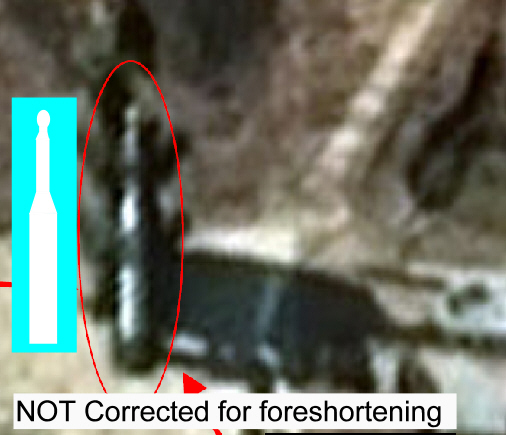
The image comes from ISIS while the outline to the left is my handiwork.
I’m starting to feel rather parasitic about using ISIS’s pictures for analysis so I’d like to thank them for publishing them in such a timely fashion! In fact, ISIS’s latest picture clarifies a lot of false impressions that early images of the rocket at Musudan-ri had left. Most importantly, earlier images had shadows cast by removable walkways that gave a false impression about the ratio between the first, second, and third stages: one had been left with the impression that the stages were more or less equal in length. The ISIS image sets this right: the first stage takes up about 2/3 of the missile. The third stage appears quite short with a fairly large nosecone fairing. This is in much better agreement with my model of the rocket and, I think, with others (such as David Wrights). We still don’t have enough information from this picture to start differentiating between the models that use very sophisticated second stages and those that don’t. That, I think, will require more information about the orbit of any satellite and, hopefully ala Iran’s openness, its mass.
