
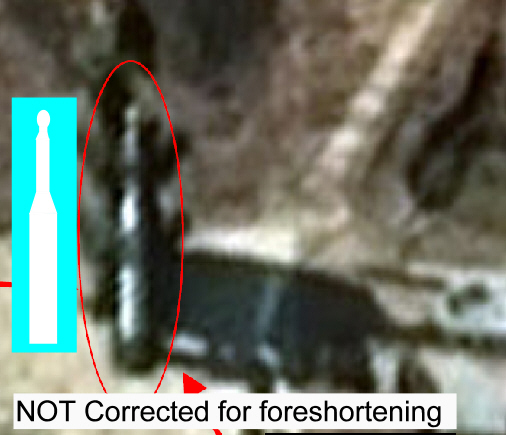
The image comes from ISIS while the outline to the left is my handiwork.
I’m starting to feel rather parasitic about using ISIS’s pictures for analysis so I’d like to thank them for publishing them in such a timely fashion! In fact, ISIS’s latest picture clarifies a lot of false impressions that early images of the rocket at Musudan-ri had left. Most importantly, earlier images had shadows cast by removable walkways that gave a false impression about the ratio between the first, second, and third stages: one had been left with the impression that the stages were more or less equal in length. The ISIS image sets this right: the first stage takes up about 2/3 of the missile. The third stage appears quite short with a fairly large nosecone fairing. This is in much better agreement with my model of the rocket and, I think, with others (such as David Wrights). We still don’t have enough information from this picture to start differentiating between the models that use very sophisticated second stages and those that don’t. That, I think, will require more information about the orbit of any satellite and, hopefully ala Iran’s openness, its mass.


Scaling from the circular pad, I get a first stage diameter in the 300-350 cm range. So are we talking about something like a Titan I? (http://en.wikipedia.org/wiki/Titan_I)
I wonder if they went with a single turbopump and 4 chambers or a unitary chamber design.
Dear ACW missile-heads: I wonder how this looks to your practiced eyes in comparison to the Taepodong-1. Clearly the proportions are different. How much in common do these systems have?
Nice to meet you.
I found such a japanese news report about N-korean launch vehicle detail.
Its PDF file is very interesting. They use six R-27 Zyb SLBM engine cluster for stage1, one high area ratio R-27 engine for stage2 , and R-27 Zyb steering engine for CUPB: common upper propulsion block.
The most funny thing in this news is… “Unha Launch Alliance :ULA “ have launch contract from U.S. Missile Defence Agency.
U.S. Missle Defence Agency confused “United Launch Alliance :ULA” with “Unha Launch Alliance :ULA” and they had launch contract with them!
“ULA” can launch same weight payload but only a half cost about space-X, they said.
2009 APRIL 1
VERY thorough April 1st hoax. I wonder who is responsible…
If it was real DPRK presentation – then it was sensational.
Yes, a very elaborate hoax. You can tell because the rocket doesn’t actually look like that. The hoaxers based their “briefing” on Globalsecurity.org’s interpretation.
I find it odd that no new picture was published for 4 days. There are report about refueling but with no photographic evidences.
Everybody:
Let’s be very careful not to overinterpret these early images (unquestionable an improvement over the 2006 launch…but not by much). They are simply too blurry and low-resolutioned (~0.5+ meters -> the visible pixels are likely a result of electronic post-processing; How accurate was this? Which of the darker portions of the missile-body can be attributed to gangways, shadows, a paint-job or anything else? Is the payload-fairing already fitted or not? etc., etc., etc.) to base any kind of serious reconstruction on. Especially, we all have to avoid “clearly seeing” what we want to see; a high degree of objectivity is particularly advisable on this issue.
To be honest, without further proof/better pictures, i’m inclined to assess Geoff’s speculative outline of the missile as neither more nor less (in)credible than the japanese “april 1st hoax” (as Tal Inbar put it, perhaps correctly)…
And let’s also never forget that what we see is only what the North Koreans want us to see!
Hopefully, the DPRK (and the NRO and the USN, perhaps also the japanese navy) wants us to see (preferentially a lot) more in the near future.
(BTW, if the NK’s should really have acquired presumably chinese 2.25m- or any other large-diametered technology, then i don’t understand why they didn’t design a comparably simple DF-3/CSS-2-like single-stage missile with ~3000km range before tinkering around with a high-risk³ multi-stage-system…)