
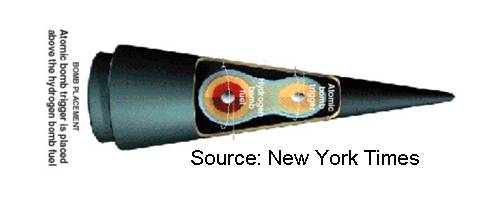
I recently heard a funny story about the negotiations for the START II treaty. It turns out that when the US START II treaty negotiators tried to explain to their Russian counterparts the need for a “strategic reserve” of nuclear warheads, they called it a hedge. The Russian interpreters alternately translated that as either “cheat” or “shrub”. No matter what you call it, however, the US decided to keep a strategic reserve of many thousands of nuclear warheads that could be quickly uploaded to Minuteman III or Trident missile systems. Both of these missile systems have had their numbers of warheads considerably reduced according to START II levels. These US warheads have been, if you will, “de-altered” but now is the time to deactivate them.
Asymmetries
This US strategic reserve is apparently not paralleled in Russian stockpiles. In fact, I’ve been told that Russia only keeps a very small number of warheads assembled to replace those that are judged inoperable. This seems to be consistent with other reports that Russia recycles its fissile material to manufacture new warheads. If such an asymmetry really does exist, and I have no reason to doubt that it doesn’t, the US strategic reserve represents a significant barrier to the drastic reductions in nuclear weapons proposed by the so-called Four Horsemen: Secretaries Shultz, Perry, Kissinger, and Sen. Nunn. On the other hand, there are other potential asymmetries that might make it difficult for the US to dismantle its strategic reserve.
Chief among these difficulties in reducing the US stockpile of strategic reserve warheads is the belief that US warheads are far more difficult and time-consuming to make than Russian warheads. For instance, the unclassified time it takes to produce a US pit is six months with a similar time given for the production of a secondary. The production lines of these can, of course, be run in parallel and multiple pits and multiple secondaries can be worked on at the same time. So the number of warheads the US could eventually produce could be quite large but there would be a significant time delay. But if Russian warheads are produced with a considerably smaller start up time, the US could quite legitimately feel threatened. (Of course, a fissile material cut off treaty and a permanent disposal of warhead materials is the ultimate goal, but I’m talking about the near term and not letting it get in the way of major reductions.)
Confidence Building Measures
It seems to me a good first step in increasing confidence between the US and Russia should be to increase the transparency associated with the time it takes to produce warheads. At the same time, neither side should be asked to give away design secrets. (I don’t really want to get into an argument about whether or not there are any true secrets between the US and Russia about their nuclear weapon designs, they just won’t want to do it.) But it shouldn’t really be necessary to give away design secrets in order to verify the time it takes to produce them. Historical production records, such as orders to begin production of such and such a warhead type, orders to transfer warheads from one facility to another, perhaps even the so-called Russian “passports,” if they are redacted of any secret information, might be useful.
As a gesture of goodwill, the United States could simply hand the Russians a list of the titles of documents associated with the production of warheads. It doesn’t even have to be an exhaustive list if some of the titles are classified. If the Russians reciprocated, these lists could be a starting point for discussions of confidence building measures that might eventually result in a reduction or elimination of the strategic reserves of nuclear weapons. Strangely enough, both Russia and the US have had considerable shared experience with this documentary forensics from their days of cooperating with the inspection process in Iraq. Let’s build on that!

I dont believe it takes 6 months to build either a pit or a secondary! Surely, if the US really thought its existence was threatened, it could build warheads as quickly as it needed to. The US should just get rid of this “hedge” (I like cheat better!) and be equal with Russia.
I can do no more than repeat the numbers the Department of Energy has given me for the time it takes to manufacture a pit or a secondary. However, CosmicRay is also doing no more than expressing what is with all probability Russia’s concern about the necessity of the US strategic reserve. This is exactly why both sides need to build their confidence that they understand the concerns of the other.
Don’t forget that RRW and Complex 2030 (the central part being a significantly increased capacity to manufacture pits) are sold by DoE and DoD as a mechanism to eliminate the hedge stockpile and thereby greatly reduce the US warhead stockpile overall. However, RRW and Complex 2030, whether by RRW we mean Reliable Replacement Warhead or Reliable Refurbished Warhead (the current plan, it seems), would still preserve the asymmetry that you speak of because one of the idea’s of RRW and Complex 2030 is to “surge” the US stockpile if necessary…in other words just another form of “hedge”. This should be seen in the context of “dissuasion” spoken of in the NPR.
Would the Russians be satisfied with a nuclear weapons production complex that would be unable to match US surge capacity? I doubt it. You can eliminate the hedge stockpile and still preserve all the de-stablising features of this stockpile, which seems to be what DoD and DoE are gunning for. Congress is stalling, but if Brand Obama buys the underlying conceptual framework such as “tailored deterrence” and “dissuasion” then some variant of the Bush plan becomes highly likely.
I could support an RRW if it did two things:
1) It meant that we would never have to design another warhead again or ever test one. (This was one of the options for the RRW but for some reason the national labs didnt like that idea.)
2) It could put our warhead manufacturing speed on a par with the Russians.
Im not an expert on the RRW but my guess is that it does nothing to reduce that 6 month lead time nor would the “surge” capacity that MarkOB mentions. Unless it is a fundamental redesign (with a different design philosophy, one that emphasizes simplicity of manufacture), then the surge capacity is just the ability to make more in parallel and does not address this issue of the six months. Of course, as I say, I’m not an expert on the RRW.
The problem that Russia has is not with U.S. inactive warheads in storage. It is that the U.S. has spare capacity on its launchers, while Russia doesn’t.
I agree with Pavel, he hits the nail on the head. Russia does not care how many warheads the U.S. has in reserve. These warheads mean nothing unless there is a post-boost vehicle to deploy them on.
Under START, the U.S. and Russia could reduce the number of warheads on their missiles (downloading), but, if they took off more than two warheads, they’d have to change the PBV so that they could not upload quickly. The U.S. hates this provision, as it is quite expensive, and the U.S. plans extensive downloading on Tridents (they will still count as 6-8 warheads, according to START, but will carry fewer). The problem for the future is not in the warhead production side. If the U.S. and Russia further reduce their “real” deployed warhead numbers (i.e. using START counting and definitions, not SORT declarations), to something like 1,500 (or fewer) warheads, and the U.S. wants to maintain a viable Trident fleet (2 bases, one or 2 boats on station in each ocean), then it is going to have to deeply download Trident missiles. Russia will not allow that unless the U.S. changes out the PBVs, which the Navy strongly resists. This is one of the biggest impediments to finding agreement on a follow-on to START.
Geoff,
you mention two things you’d like the RRWs (allegedly to be forever untested) to do, one additional thing I’d like the RRW program to do is to increase rather than diminish U.S. security.
See also the two articles in the December ACT by Dick Garwin and Jeffrey Lewis.
Pavel, could you provide more analysis on the capacity point? Surely, you don’t mean that MIRVs don’t count for more capacity?
Gelfant: Here is an example – the U.S. declares 150 of its Minuteman III missiles as single warhead missiles. But they can still carry 3 warheads each. The “upload potential” in this case is 300 warheads. START Treaty has limits on this, so it is not much of a problem there. But if you go to an “operationally deployed warheads” count, this would change. For example, Trident II missiles might be counted as carrying five warheads, while they are capable of carrying eight, and so on. This is an old debate that goes back to START II, where the problem was especially bad (from Russia’s point of view).
Way to complicated to include potential manufacturing capacity in a treaty. At some point in any contract/treaty you got to trust the other side. The less lawyer-ish a treaty, the better. The beauty of SORT, despite its imperfections.
Plus it’s always easier to ISR platforms and missiles, than warheads.
The best hedge against sneakyness of the other side is to increase the survivability of the own deterrence complex.
The number 1500 was mentioned: For the U.S. to go to the lower SORT limit (of 1700, which is agood number) and still be survivable and effective against Russia, it would have to restructure the triade, incl new missiles and boats.
Btw, the test-ban treaty undermines deterrence. On both sides of the equation. And especially if RRW is never fully tested.
One of the most interesting things about this thread is that no one seems to be taking seriously going down to very, very low levels; such as zero, or failing that, 100 warheads.
In order to get to such low levels, I think there has to be better understandings of the asymmetries inherent in the two stockpiles/arsenals. Note from my original post, I did not talk about a treaty involving warhead production capacity; only increasing the transparency of that important factor.
I am reminded of a project I was doing for CBO on how to increase confidence between Russia and the US in the late 1990s. Plutonium production, which never would have been included in any treaty, was a contensous issue at the time between the two sides. The US had just come out with its estimate of how much plutonium the US had in its stockpile (about 100 tons) and when I asked my friends in the DoE how much plutonium Russia had produced, they said about 200 tons, but that they would never admit it. When I talked to my Russian friends, they were convinced that the US had produced 200 tons. I was struck by the symmetry of that disagreement.
I hope that not only can we go to very low numbers (zero would be best); much lower numbers than people in this thread have been talking about. If we do go down that low, we need to destroy warheads in the strategic reserve and at that point production capacity becomes an important asymmetry that both sides should understand. Thus, the exchange of information about that production capacity becomes an important confidence building measure.
Geoff,
in fact, in my paper, I advocate for multilaterally getting down to 10’s of Uranium-based devices.
A couple of comments:
1) The problem (for the Russians) that Pavel cites, the U.S. ability to upload warheads quickly to make use of unused launch capacity, can be addressed, I think, by ‘decommissioning launch capacity’, that is – replacing the downloaded warhead with identical dead weight that is permanently attached to the bus (with accompanying removal of the normal attachment and release gear). It does not seem to me to that making this modification would be “quite expensive” (as poster anon asserts). Reversing it would be significantly more difficult and would provide a ‘warning factor’ that the U.S. was re-arming.
2) I suggest that the U.S. desire for the ability to rapidly surge its deployed warheads is not a legitimate one. Geoff Forden points out that no one is talking on this thread about going to near zero numbers, but think about the striking contradiction between that idea and the U.S. goal of having the option for a rapid return to roughly Cold War warhead levels. These two roads lead in opposite directions, and they cannot be reconciled.
The zero option is no real option. The apple was bitten into and now we know …
Of course one can ask what are the chances that the major powers go to war. But I believe that strategic nuclear weapons are ultimately a tool of peace and stability. And of cost savings, in case a doctrine would be enacted that eliminates conventional war as an option against nuclear powers, and the conventional forces were sized accordingly.
The idea of rushing warheads into production is useless – you either trust your deterrence capability, or not, something that – beyond a certain threshold – is dominantly passively defined (survivability), not actively (number of platforms and warheads) anyway. The other one would also “rush”, in which case you’re back to the start line, or you have to use your bombs before the other is finished rushing …
Same goes for hedges or reserves, or whatever you call it. Useless. And both the rushing-option and the reserve show distrust in the own deterrence capability, and are thus destabilizing.
I think a good part of the “rush into production” idea has to do with tactical warheads. That’s why a SALT-type treaty should also include tactical warheads. For the U.S. and Russia I throw the number 800 onto the barrel head, whereby “tactical” could be defined as below 100 kt.
A good primer on RRW and what deterrence means
@ FSB:
Seen Oelrich’s responds back then. Guess the answers have to be given on a most basic, animalic level. What works in a gang of hoodlums, works on international level. Any too academic approach might fail. KISS and honest, straight foward and understandable under stress when mentally reduced to a scared ape.
Strategic nuclear deterrence: Game of chance with binary character between sane more-or-less equals (near/peer) who understand the implications. Keeping the other one affraid. There is no “prize”. Never use first, though. But if used in response, respond fully – and don’t waste them by targeting military objects (which also keeps the required minimum lower). In fact strategic deterrence should not specifically target military installations at all, but the enemy on a most fundamental and primal level (Can target a few warheads at enemy nomenclatura hide-outs though, to keep them and their families personally at risk). Strategic deterrence not applicable to non near/peer actors.
By “respond fully” I don’t mean firing all you got, just not to play with “limited” response. The possibility of multiple enemies is of course real, so never use more than one third on one enemy. But then if strategic nukes are used between two powers, deterrence didn’t work as thought, and the other enemy/enemies might think ‘well, better use our stuff before he uses it on us, now that the concept proved wrong’. So there is a good chance that a strategic nuclear attack is directed against ALL strategic nuclear powers from the very beginning.
Must also consider tactical nukes: Much more difficult. Not part of deterrence against (near)-peer competitors. Might use first – but only against strictly military targets. Important, as they provide an response option below the strategic threshold. If he could, Hitler might have nuked the Red Army in 44/45, but would he have nuked Moscow? And also tactical nukes protect from stupid encroachment games and salami tactics a la ‘but I/they didn’t do enough to justify an all-out strategic attack’.
Why? Against what? “Sane” blackmail basically. A madman might not care, a martyr might welcome it.
When? Ha! The key question of a response-only doctrine for strategic weapons. When a state-actor fires against important or multiple CONUS cities. Not for outlying islands or allies, not for a hole in the prairies of Wyoming. Also not really suited as response to an asymetric nuclear attack, like sneaking a container-nuke into Long Beach port.
But why then, afterwards? Well, revenge of course. We are not forgiving people. And one has to say so to give credibility to the game.
Here NMD comes in and makes sense, since if successful it might relieve from a “full repsonse” if only a few nukes are launched against CONUS from, say, North Korea, or if they launch against Oahu or Guam. (Not talking about why they should do that). Or if accidentially launched.
Strategic nukes against non-state actors is of course B.S. Same goes for strategic nukes against non-nuclear state-actors. One of the big inprecisenesses in most discussions, that lack of distinction between strategic and tactical, not the only the broad use of the word “deterrence”.
Don’t have a real opinion about RRW, just say if done it should be fully live tested (not just components and subassemblies, not with DU substitute – the real thing) before put into an RV.
I agree that for strategic deterrence no sophisticated bomb is needed. Neither a terribly clean one. Such is only interesting for a first-strike followed by land grab.
Ok, gotta run …
Distiller,
disturbing line of thought you have.
I believe it makes sense to engage China and Russia to go down to 10s of nukes each: USA Russia China.
Deterrence failure is a major concern
Just because we have not f**ked ourselves yet does not mean deterrence works: all it means statistically is that we may have been lucky. Too many close calls. Case in point: Norwegian missile.
NMD does not make sense — even if it works it encourages your enemies to increase stockpiles. destabilizing.
Anyway, the real threat is not from Iran or N. Korea launching missiles at us: if they wish to deliver a nuke it will be in a sailboat.