
Many people have written in objecting to my theory that the Sejil uses liquid propellant steering engines for thrust vector control and, I have to admit, that they have had some very good arguments. Perhaps the most persuasive arguments have been:
- The boxes hang far below the end of the solid propellant motor’s nozzle and would subject any such engines to temperatures and a corrosive environment that would destroy them.
- Placing steering engines farther up the boxes, away from the exhaust from the solid propellant motor’s nozzle, would require that the SPM’s nozzle be considerably smaller than the missile’s diameter. This would make the compression ratio inside the motor considerably greater than the expansion ratio as it leaves the nozzle.
People who raise the first point do, of course, ignore the fact that the boxes, which in the jet vane theory contain the servo mechanisms, would also be subject to these same environmental challenges. Pictures that show Soviet designed ICBM’s that use jet vanes for their large solid propellant motors clearly show that these servo mechanisms are protected by the nozzle itself, with holes cut out for the jet vane supporting arm to pass through. Of course, jet-vane theorists could well say that is the reason the missile is said to have failed: the boxes burnt through and the missile flew off course.
People who hold the jet vane theory also say that the side pipes are unrelated to TVC. Some of them say that their purpose is a mystery that will remain for some time. Others have suggested that they might be retrorockets to move the first stage safely away from the second during staging. (This is important as one of the Falcon-1 flight tests showed when the jettisoned first stage bumped into the second and broke the engine.) These people have not, in my opinion, offered a good reason for putting the retrorockets near the empty stage’s center of mass.
Wonk-reader Babak has sent in a new (at least to me) picture he captured from a video of the launch that shows a close up of the boxes and, most importantly, the space directly beneath the solid propellant nozzle. The question I have is: where are the jet vanes? There is something there, but it is very thin and appears, at least to me, to be venting something. Surely the jet vanes for such a missile would be much thicker than what ever that thing is. (They would have had to be very successful in minimizing the size of their jet vanes, as I discussed in Moving ‘em Out to Move Them Up ,to make them invisible in this photo!)
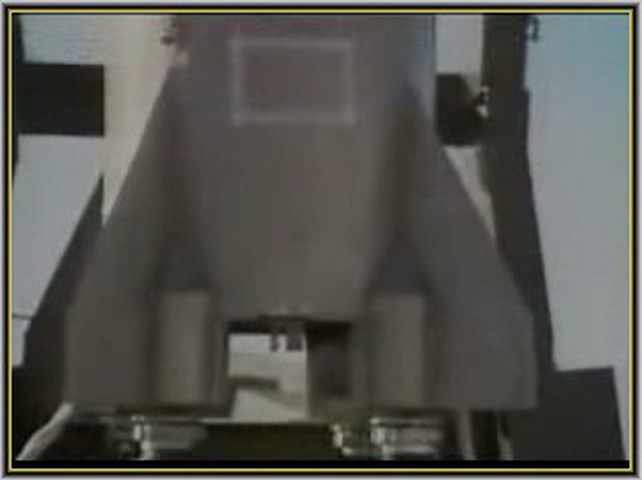
If anything, I think this photo yields further support for the liquid-propellant steering engines and not just the negative evidence of not showing jet vanes. Where I originally thought the boxes were cowlings to protect them from the air stream, it now appears that they might encircle the engines to protect them from the harsh environment found under the solid propellant motor. The rectangular appearance of the boxes could then be explained by allowing the engine to swing back and forth perpendicular to the missile body to steer the missile. After all, with four such steering engines, you only need to provide each engine with a single degree of freedom to completely control pitch, roll, and yaw.
So as Wonk-reader Tal Inbar notes, we may never know for certain what Iran is using for TVC until we see them parade the missile down the streets of Tehran. Until then, I feel that the preponderance of evidence still favors liquid-propellant steering engines though I have to admit your arguments, wonk-readers, have certainly shaken my conviction.

Steering doesn’t require half the 1st stage tankage; this much is plainly obvious. If we are to hypothetically assume that indeed half the 1st stage is devoted to liquid propellant and the remainder to solid propellant than it wouldn’t it be more pragmatic to assume the rocket is a hybrid; a liquid oxidizer with a solid fuel core? If that were the case then the oxidizer might possibly be nitrous oxide, such an oxidizer when pulled down from the liquid tank and fed into a catalyst with a nozzle could provide steerage as it self reacted.
Of course this is merely a deduction from your two main assumptions; liquid half tank and solid bottom tank.
My feeling is that if you are going to go to the trouble and expense (i.e. the mass penalty) of installing liquid-propellant steering engines, you might as well make them contribute to the thrust of the missile. That, I think, means that you devote a considerable amount of fuel to powering them. It appears, to me, that the Iranians felt that the best solution to this problem was to give half the first stage to liquid propellants. As to making the motor a hybrid, I don’t see the need or how it would fit into a logical, over-all development path. But I could certainly be wrong about that.
Devoting half stage to liquid propellant make the entire missile unnecessary complex; Furthermore, the whole point of building a solid propelled ballistic missile is not (just) range – its operational use, more survivability, more chances of launching a salvo of missile with little warning time – is lost, if the missile is built as your preliminary assumptions states.
But Tal—that was exactly my point when I stated that I didn’t see how this was advancing Iran’s solid-propellant missile technology. I take it that you don’t see any jet vanes either?
In the picture I see no jet vanes nor vernier engines. I will have to check again the raw materials provided to me by Israeli TV station – high quality footage from Iranian TV. It IS possible that the picture was taken BEFORE installation of delicate vanes. (such is the case with a lot of Iranian missile – jet vanes are not present until launch).
Fair enough. I look forward to learning what you discover.
This picture obviously was taken from the youtube-video “MRBM Iran missile Sejil” by somebody named “moni123s”. I think it’s very important to watch the video and not just look at the stillframe, because then it gets clear that there isn’t something venting – this seems to be more like something immobile in the background.
The obviuos lack of jet vanes on this picture does not necessarily mean that this is NOT the kind of TVC used on this missile – the vanes simply might not yet be installed (see for example the picture of Safir that Mehdi added to his comment on “Moving ‘em Out to Move Them Up”).
But i am willing to consider also other kinds of TVC (although i still think that the general appearance of the exhaust plume clearly counts against vernier-engines and, as can be seen on the picture in this article, the erected missile rests on the bottom of the boxes – exactly where the openings for the vernier-nozzles should be).
BTW, we haven’t yet discussed to what extent the upper stage uses the same kind of TVC (although in my mind it would be reasonable to assume this).
It’s not as obvious to me as it is to you that the missile rests on the boxes. To me it looks like it might rest on, say, a metal strut running down the back of the box.
As to the second stage, I think it was inert. Of course, this is because it doesn’t seem to have the side pipes so perhaps this is a circular argument. That doesn’t make it any less possible though!
Another video, includes computer animation and more closeups:
http://www.youtube.com/watch?v=AX8BWiYLFd8
Higher resolution copy can be downloaded from
http://rapidshare.com/files/166042230/irinn_darabi_sejil.wmv
And finally a comparison between Shahab 3B and Sejil:
http://img.photobucket.com/albums/v204/mattin4/shahab3bnm-1.jpg
and
http://img.photobucket.com/albums/v204/mattin4/y54y45y54.jpg
Paul, Great links. Thanks!
Retro rockets clearly discovered using the new video clip. I can’t post pictures so I am sending Geoff a pic, please post it here for me.
(Note added:Please see the next post for Tal’s image, GF)
Here is the picture Tal Inbar sent. Unfortunately, I cannot add it to his post.
ps I cannot make a habit of posting these pictures. In fact, this is the last one I will post for a reader. From now on, please post on a different website and give the link.
Is this a retrorocket cover? I’m afraid I think you have to want to believe it is in order to see it as one. I’m not saying its not, but I think I will need to see the jet vanes before I believe that little ellipse is a retrorocket cover. Other Wonk readers will, as always, carefully consider the evidence and make up their own minds.
I took the picture from a Youtube video: http://www.youtube.com/watch?v=RfM_6t-GnEI (username: Alexsnakedoc )
It looks like it is an un-edited version of this video (shorter than the first one): http://www.youtube.com/watch?v=GkTg-4DM0Xc
I was also wondering about following points:
1. To Tal Inbar and Jochen Schischka: The picture (and video) shows missile erected and on resting points. When does one assemble jet vanes? After erection and in a small space between resting points and missile? Or before erection? Is before option more convenient? If so, no vanes can be seen in video.
2. It can be seen that exiting plume from nozzle of Sejjeel is homogeneous and expanding without dead zones created by vanes, unlike Shahab – 3 (compare http://www.b14643.de/Spacerockets_1/Pictures/shahab-3_8.jpg with http://www.b14643.de/Spacerockets_1/Diverse/Sejil/Sejil_5a.jpg ). Does that imply lack of jet vanes for Sejjeel?
3. If Iranians have figured out how to manufacture jet vanes resistant to rapid erosion caused by solid-fueled engine what keeps them from building a gimbaled nozzles TVC?
4. It seems that disputed fuel-oxidizer pipe has an open end (close to fins).
5. Does it look like that texture of missile’s surface is different in two stages? Does first stage have a smother surface than second one? (http://www.isna.ir/ISNA/PicView.aspx?Pic=Pic-1233813-5&Lang=P)
Excellent work, Tal Inbar, thanks!
Now, if the sidepipes really are retrorockets, then we have to think about their operational purpose:
Why would they be used on a lower solid-rocket stage? (Could this be connected to the usage of a non-functional upper stage?)
Why are they positioned like this, approximately near the center of mass of the burnt-out first stage? (Does this have some sort of kinematic reason?)
To Babak:
to 1.): Originally (german A4/V-2, russian R-1, R-2 etc.), the jet vanes were mounted exclusively on the erected missile during the final pre-flight checks; On newer missiles like Scud, it’s possible to install the vanes already on the horizontal missile; I think the smaller the missile, the more convenient it is to pre-mount the vanes due to the cramped conditions under the tail of the erected missile.
to 2.): Not necessarily, since the layer of black smoke around the rocket flame on the Shahab-3 (and the similar Scud) is a effect generated by the kerosene-film-cooling of the combustion chamber. Since this sort of cooling-technique can only be used on liquid-fuel-rockets, it is not surprising to not find similar light-colored stripes plowed into the exhaust plume by (still somewhat hypothetical) jet vanes on the Sejil.
to 3.) I think you grossly underestimate the level of complexity of a liquid-fueled, four-chamber gimbaled vernier-engine! Jet vanes should be by far more simple to implement, especially since the Iranians have great experience with (and possibly even their own production capability for) vanes and servos of comparable dimensions, although this would be for liquid-fueled missiles.
to 4.) Due to my interpretation, the lower part of the “sidepipes” is only a cable duct – and it simply ends where the solid-booster motor-casing ends.
to 5.) Yes/No/I don’t know…(this could perhaps indicate an inoperable upper stage)…
BTW, it came to my mind that we have an excellent example at hand of the exhaust plume of a solid-rocket-booster surrounded by four liquid-propellant engines (NTO/UDMH in this case):
The indian GSLV!
Geoff:
Please compare the exhaust of both missiles – i consider this to be the strongest argument against liquid-fuel-verniers on the first stage of the Sejil!
What is the overall development arc of the Iranian missile program? Most of their efforts seem scattered in every direction, those that prove successful are nurtured with talent and resources, the remainder are left to starve on the R&D vine. This results in a very schizophrenic endeavor with the odd chimera here and there. From what we’ve seen the Iranians have experimented with every technological means within in their reach to loft a payload downrange. We also know that they have an accuracy issue with liquid propellant rockets which they believe will be addressed by a switch to solid rocket technology.
The only thing that comes to mind is perhaps they’ve yet to master turbopump technology and their supped up units are giving them non-predictable levels of thrust when scaled up which is compromising their accuracy. One way of bypassing this development roadblock is to switch to solid castings with smooth burning characteristics. Another would be to use pressurized fuel tanks for a liquid rocket thus negating the need for a turbopump. And yet a third approach would be using a pressurized oxidizer tank feeding into a solid fuel core with some bleedoff from from the oxidizer tank used to provide steerage via 4 catalyst bed nozzles.
2cents<>A thesis
Thinking that the missile was lost because the jet vanes failed due to the aluminium erosion problem isn’t going to work.
Iranian missiles are extensively flight tested on static test stands and its there were the erosion problem was solved. Rethinking the jet vane discussion I came to the conclusion that if there is a metallurgical problem with graphite vanes eroding to aluminium particles a may possible combination of an outer layer made of a hard carbide like tungsten could solve the problem. Its not like this would be a revolution since Russians, Chinese and also Pakistanis have also solved the erosion problem with their jet vanes.
But as I already said before, the static installation on which the missile rests, makes venier engines very unlikely.
The mysterious boxes at the Sejil missile probably are pressure – gas tanks for thrusters. The tanks (8) of the first stage are placed below between the 4 fins. A pipeline joins the tanks with the covered thrusters. The tanks (4) of the second stage are placed directly beside the thrusters. The function of the thruster is unclear. Probably they have the task, to separate and/or to push away the stages.
A Wonk-reader who would rather not be identified writes:
To Jochen Schischka :
Thank you for answering my questions. Regarding Q#3 I think there was a misunderstanding. I was only wondering use of the same graphite jet vanes as in Shahab-3 without any manufacturing improvements necessary for a solid-fuel engine (like density and coatings) directly in sejjeel. Such improvements might mean accessible technologies toward gimballed TVC.
Hybrid solution ?
Is it possible for the Sejil to have an hybrid rocket motor for the first stage (liquid O2 + solid synthetic rubber ) ?
Ahmed—the only reason I would suspect it had a liquid propellant component is because of the sidepipes that could be interpreted as fuel lines. I believe, though Im far from certain, that a hybrid would feed the liquid component down through the top of the solid component; so there wouldn’t be a need for fuel lines outside the missile. (I suppose it could still use liquid propellant steering jets for TVC, but then they would be monopropellant engines.)