
Advocates of the Robust Nuclear Earth Penetrator often emphasize the existence of more than 10,000 Hard and Deeply Buried Targets (HDBTs) to suggest that a military requirement exists for the Robust Nuclear Earth Penetrator. NIPP’s Eric Miller, for instance, argues:
The Senate should follow the House and authorize the RNEP …
[… Because] the program addresses the proliferating threat of hard and deeply buried targets. According to a joint 2001 Department of Defense and Department of Energy report to Congress on hard and deeply buried targets, more than 10,000 underground targets exist worldwide, with more than 1,400 known or suspected to be sheltering weapons of mass destruction, ballistic missiles, or other military command facilities.
These figures will only increase as U.S. intelligence capabilities bring watchful eyes to bear on above ground facilities. The dilemma is that many of these underground facilities remain impregnable to conventional weapons. An inability to counter these buried targets will only encourage those pursuing weapons of mass destruction to invest more heavily in them. To assume otherwise would be naïve, to remain unprepared could prove reckless.
This is misleading. The report says “many are protected facilities are shallow ‘cut and cover’ design with a concrete structural overburden of less than ten feet thickness” that “can be held at risk by current or developmental weapons …”
The number of HDBTs in rogue states that could be held at risk by the RNEP is closer to tens, rather than hundreds or thousands.
The National Academies concludes “A few hundred of the strategic HDBTs could be candidates for targeting with the Robust Nuclear Eath Penetrator.” Similarly, the Congressional report mentions “hundreds of much harder facilities (having a concrete overburden equivalent of 70-300 feet) protect strategic functions (e.g. leadership, command and control, WMD) …”
Most are these “hundreds” are located in Russia or China—which would imply a very different rationale for the RNEP than the Administration has offered. As the following chart by the Defense Intelligence Agency makes clear, only a few are located in “rogue” states like Iran or North Korea:
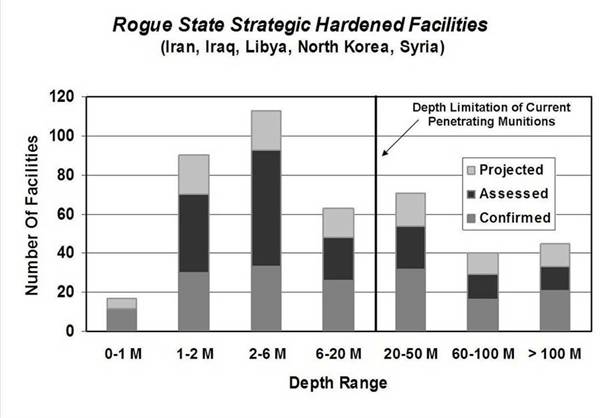
Source: A Primer on the Future Threat, The Decades Ahead: 1999-2020 (SECRET/NO FORN), July 1999, reprinted in Scarborough, Rumsfeld’s War: The Untold Story of America’s Anti-Terrorist Commander Regenry, 2004.
These numbers have almost certainly declined with the invasion or Iraq and the decision by Libya to renounce weapons of mass destruction. Of these targets, many—perhaps most—are located in North Korea. Frank Kramer testified in 1999 that the North Koreans “have a great many underground facilities.”
This isn’t to suggest that “rogue state HDBTs” don’t exist, just that the problem is a few facilities in a handful of countries—something that could be inferred from the number B61 Mod 11 earth penetrating nuclear weapons depoyed in the 1990s: 50.
Moreover, many facilities are merely “assessed” as opposed to “confirmed.” In fact, the caption on this chart reads:
Although the majority of hardened facilities are relatively shallow and thus vulnerable to our current suite of penetrating munitions , an increasing number of strategic assets are being housed in deeper and harder facilities that are less less suspectible to a conventional attack. Greater intelligence ganularity is required to identify and exploit alternative methods for holding these facilities at risk. [Emphasis mine]
That speaks directly to the concern, expressed by the National Academies, that RNEP would require “more precise and reliable intelligence” to be superior to using a surface burst nuclear weapon.
There are still, of course, many unanswered questions. I’d like to know what percentage of these facilities are near heavily populated urban areas and more precise information about the function of the facilities.
Precise intelligence is someting we most certainly do not have in the case for North Korea, as the sad story of Kumchang-ri demonstrates.
In 1998, DIA concluded from satellite images North Korea was building an underground nuclear reactor and reprocessing facility near Kumchang-ri. Subsequent visits by American inspectors, however, revealed “there was no way that it was nuclear” according to Jack Pritchard.
Lt. General Patrick Hughes, then-Director of DIA, defended the assessment by noting “just a real hard target” for intelligence gathering. That is precisely the kind of “hard target” that RENP cannot penetrate.

Just which American inspectors were in the DPRK in 1998? I can’t seem to find any reference. Thanks.
“These numbers have almost certainly declined with the invasion of Iraq and the decision by Libya to renounce weapons of mass destruction.”
I think it’s worthwhile to consider the effects that the war in Iraq had on underground facilities (particularly those related to WMD) outside of Iraq. I wasn’t sure whether the above quote refers to reduction in underground facilities in Iraq itself, or a reduction across the globe based on the deterrent effect of the invasion of Iraq.
Such a deterrent effect was almost certainly present in Libya, though there were a bevy of other factors that contributed to their decision.
However, it seems that in the aftermath of the invasion of Iraq, those countries who are determined to develop WMD will be all the more vigilant about keeping their programs “under the radar.” Could this not result in an increase in underground facilities, making the RNEP increasingly useful?
I regret the lazy way that I wrote this sentence:
I merely meant that any underground facilities in Iraq and Libya were no longer releveant to the RNEP debate.
I think the invasion of Iraq had very little to do with Libya’s decision, as Ronald Bruce St. John argues. This is more Paul’s area; he may want to elaborate on this issue.
I believe it is plausible that the invasion of Iraq may “result in an increase in underground facilities,” but wonder if the number of facilities is really an important measure. After all, one presumably hardens the most important functions first, so more facilities may not be important enough to warrant the RNEP.
Other questions may be more important, such as: Are the facilities co-located with civilian populations? Do adversary camouflage, concealment and deception efforts prohibit sufficiently precise targeting to make RNEP useful?
Those things could also accelerate in the aftermath of Iraq, making RNEP less useful. Or some countries might invest in even deeper bunkers that RNEP cannot reach.