
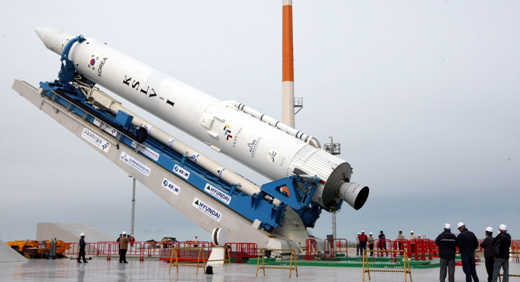
The launch of South Korea’s “indigenous” space launch vehicle (KSLV-1) has once again been postponed, this time to around August 19th; presumably due to weather issues. I haven’t been able learn the intended orbit (other than its going to be LEO, or low Earth orbit). So it is an interesting question of whether or not it will overfly Japan. You will, of course, remember all the uproar over North Korea’s space launch attempts which certainly did overfly Japan, causing concern that stages (or a warhead) might fall on that country. South Korea’s space launch center is all the way at the southern tip of that country so it is at least possible for them to pick an azimuth so that it doesn’t overfly Japan. However, if they do, the satellite will have to have at least an orbital inclination of 62 degrees, considerably increasing the “threshold” velocity needed to get into orbit. Of course, South Korea is partnering with Russia to build the rocket (Russia is building the cryogenic liquid propellant first stage while S. Korea is building the solid-propellant second stage) so this might not be an issue. Does this acquisition path sound familiar to anyone?
By the way, Peter Brown at the Asia Times is asking some interesting political questions about the launch so be sure to watch his byline.

Orbit:
perigee: 300 km
apogee: 1,500 km
inclination: 80º
period: 103 minutes eccentricity: 0.082435
The liquid propellant stage is cryogenic – liquid methane fuel, liquid oxygen oxidizer.
The South Koreans building the solid motor second stage is at least dual-use technology development, but the first stage screams “space launch vehicle” not missile…
The Japanese space launch infrastructure has more clear IRBM / ICBM dual use linkage than the South Korean program to date. The M-III and M-5 launchers, the J-1, etc.
Japan and Korea have already been in talks about a possible overflight:
http://rescommunis.wordpress.com/2009/04/28/japan-not-to-block-south-korea-launch-overflight/
http://www.youtube.com/watch?v=zsd017iKB60
From the looks of this it seems most of the ISP burden will fall on the Russian first stage. And off the top of my head I can only think of one other liquid methane engine and it was nowhere near this size. Which grants me considerable apprenhension regarding the likelihood of success of the KSLV-1. Anyone up for a wagering pool?
Correction, the KSLV-1 will use an RD-191 burning Kerosene and LOX not liquid methane, the Kerosene does not seem to be chilled to boost storage density. I’m still putting even money it’ll go roman candle.
To George William Herbert:
Are you sure about LOX/Methane? I’ve read something about LOX/Kerosene, and that would fit in a lot better with the documented russian heritage of that engine (and be more consistent with the visible tank-volume ratio)…
To all:
An interesting detail: obviously an external fuel line (i think this is for the LOX-component).
Any idea how they implement roll-control (my guess is that at least some of those bulges at the intertank section contain additional steering thrusters fed by the main propellants)?
BTW, i personally consider the use of a solid-propellant second stage as some sort of less-than-ideal solution for a space-launcher; I guess this is a product of the earlier south-korean sounding rocket program. Maybe we’ll see a ‘real’ upper stage (LOX/LH2) getting developed for that vehicle sooner or later.
Based on that compromise-type of upper stage, i’d tip on the South Koreans injecting into a rather flat inclination (aka an overflight of Japan – but certainly not, like the North Koreans, without japanese permission).
Jochen,
I agree with you entirely about the first stage. Not only is that the ugliest external fuel line I’ve ever seen, but the non-cryogenic propellant is kerosene. I also think that the second stage is simply that very short section with the smaller diameter right behind the nosecone. That, in turn, implies that South Korea has not mastered casting large grains (as you say, they have most, but not all, of their sounding rocket experience with solid propellants).
To Jochen S.
The roll control could be from tapped-off turbine gas. I recall that that was supposed to be the method of roll control for the Angara first stage with the RD-191 engine, though I don’t have a reference for it.
I think you’re right about the methane versus kerosene.
Murray Anderson
This spells trouble. This missile could only increase competetivenes between both countries. Considering NK should do its economic reforms and population control, this could cause a lot of brutal problems in Asia.
When NK did theirs missile tests it was fine, at least they had something they could be proud of.
This is the AFP story referred to above by P.J.:
TOKYO — Japan sees no problem in South Korea’s plans to launch a rocket carrying its first satellite which may fly over Japanese territory, the government said Wednesday. “I believe there is no problem as we have been holding informal talks on the issue, including on the aspect of safety” with South Korea, Foreign Minister Hirofumi Nakasone told reporters.
The two-stage rocket will be launched in late July and “is due to fly over Japanese territory,” Foreign Ministry Press Secretary Kazuo Kodama was quoted as saying on the ministry’s website.
Kodama stressed that the South Korean rocket launch is different from the one by the North on April 5 as “the launch by North Korea is banned under the UN Security Council resolutions 1965 and 1718.”
“On the other hand, there are no such resolutions for a South Korean rocket launch,” he said. “We also know through informal talks with South Korea that their launch is planned for peaceful purposes.”
Japanese media reports have said the South Korean rocket is likely to fly over waters off Japan’s southwestern Kyushu island and the southern Okinawa group of islands, and that the first stage will drop in the East China Sea off Kyushu and the second stage in waters off the southeastern Philippines.
The flight path described in the article is almost straight south from Korea, and is consistent with their official plan for an 80º orbital inclination.
Where PJ Blount mentions that, “Japan and Korea have already been in talks about a possible overflight.” I also point this out while adding that, “many Japanese government officials described the measures taken during the North Korean launch (in April) as prudent and necessary, so these same officials must be quite confident that nothing will go wrong during this upcoming initial flight of the KSLV-1. But this view goes against what is being said in the hallways at MOEST where, “experts have been telling anyone that asks that the chances of the [KSLV-1] successfully reaching orbit are less than 50%.”
Yale,
Thanks for finding those pictures. I have been looking for academic articles describing the rocket and havent had much luck (these are often published but perhaps only after the first launch). By the way, your photo of the second stage also shows it uses a flexible nozzle for TVC (those things shrouded in white are obviously jacks for maneuvering the nozzle). I’m going to have to look at the papers S. Korea has published on its sound rocket program to confirm that they have flown those before.
The article on Japan’s evolving reasons for concern about North Korea’s overflight is very interesting. (I should state here that I agree with the UNSC’s ban on the DPRK’s launch and missile development program in general.) After all, I thought Japan was concerned about empty stages falling on Japan, not concern over whether or not the flight was banned by the UNSC. However, since the article states that the inclination will be 80 degrees there is little concern of that happening here. Nevertheless, Japan’s response is confusing to say the least.
So are two-stage SLVs in vogue now? It seemed that one of the unusual things about the Safir was the two-stage design.
As for Japan’s reaction, I understand one of the rationales for their hubub over the Unha launch was that in 98, not only did the TD-1 overfly Japan unannounced, but one of the stages landed uncomfortably close to Japanese territory. Then, when the Japanese press showed a map of where the Unha stages would land the public got antsy. So Japan’s reaction was more intended to deal with the public concern than, I think, with any real threat from the NK launch. I don’t see the Japanese public reacting the same way in this case if there is an overflight.
PC,
We have to go back to why some of us (including, or perhaps especially, me) found the Safir using only two stages so surprising. At the time, I thought it was more likely that the Safir had a solid-propellant third stage like the one shown in Yale’s pictures rather than using a more powerful liquid propellant. (Note that the KSLV-1’s first stage uses LOX-kerosene, which IS a more powerful propellant than SCUD-type fuels.) We now know, after considerably more information was released, that the Safir used engines based on foreign designs. My previous posts on the How of Proliferation would explain that as a way of minimizing risk and that Iran’s existing infrastructure (which, for liquid propellant engines, is also very large) has undoubtedly assimilated that technology too.
To Yale Simkin:
Thank you for posting these pictures!
To Murray Anderson:
Hmm, i’d mark that as unlikely; The RD-191 is a staged combustion aka closed-cycle type – the turbine exhaust gasses leave the missile through the (apparently two-axis-gimbaled) main nozzle, too.
To all:
Another interesting detail that hits my eye: There are obviously two (aka one set of) small fins on the first stage (I think we saw a similar configuration on the north korean Eunha-2)!
After some short research, i’ve come to the conclusion that the KSLV-1-first-stage is obviously a complete URM-1-module from Khrunitchev’s Angara!
Considering the upper stage: Even smaller in diameter than the payload-section; I think this makes the KSR-heritage quite likely. Another noteworthy detail: two-axis gimbaled nozzle!
My guess is that those two containers visible in that photo are fuel-tanks for pressure-fed roll-control steering thrusters with hypergolic propellants like e.g. NTO/MMH (based on the rather small dimensions, i assume that this is for the second-stage burntime only – the first stage possibly has an independent, larger-dimensioned roll-control-system).
To Jochen S.
Yes, I know it’s staged combustion, so there’s plenty of turbine gas available. If you tap off some the engine won’t be closed cycle, strictly speaking, but I can’t imagine that that would be an important issue.
The Angara rocket is intended to be used in a single RD-191 form, at least for small payloads, so it would make sense to build the roll control capability into the engine.
Murray Anderson
Jochen,
There appears to be something funny about the “fin” seen in the image at the top of the post. Does it appear to you (as it does to me) that the “fin” is still horizontal in the image of the rocket being lifted into position?
I have seen statements that the first stage engine is either a “detuned” R-191 or an old r-151. Dunno.. If it ran by converging shockwaves, I would be able to make a better guess.
The second stage of this 2-stage slv is the small homegrown solid attached to the payload box.
Here are a bunch of good links with many images. Some of the images are of an engineering mock-up.
The official KSLV site is fun, but I suggest you use the Google toolbar auto-page-translator to get the most out of it.
http://www.b14643.de/Spacerockets_1/Rest_World/KSLV/KSLV/Description/Text.htm
http://www.b14643.de/Spacerockets_1/Rest_World/KSLV/KSLV/Description/Frame.htm
http://www.b14643.de/Spacerockets_1/Diverse/Russian%20engines/engines.htm
Video with some good closeups:
http://tvpot.daum.net/clip/ClipView.do?clipid=14704235
http://www.khrunichev.ru/main.php?id=1&nid=385
All sorts of goodies:
http://www.kslv.or.kr/
Geoff,
I zoomed up the image of the “twisted” fin, and it appears to be an illusion.
The fin is black with a white trailing edge. In the first post image, that white edge (at the proper tilt) overlays the mounting hardware and only looks horizontal.
To Murray Anderson:
I don’t see how such a procedure like you describe could be easily implemented in that type of engine. Besides, i don’t see any indications of this in neither the URM-1-module nor the KSLV-1.
To all:
Check out the pictures on these pages:
http://www.khrunichev.ru/main.php?id=1&nid=1061
and
http://www.khrunichev.ru/main.php?id=138
especially that one:
I think (apart from the obvious similarity with the KSLV’s first stage) we can see the same box-like structure with a hole in the middle (for the pivot of the fin, here plugged by a red covering); I’m starting to suspect that these two fins (apparently traversable as a whole) are intended for in-flight roll-control…
http://www.fareastgizmos.com/entry_images/1008/20/korean_rocket.php
If Naro is the first stage common rocket module of the Angara, then it begs the question; where was it manufactured. Was it built in Russia and then transferred to ROK. If so, would this not be a flagrant violation of the MTCR and the ICOC.
http://forum.nasaspaceflight.com/index.php?PHPSESSID=8ecb82cf1591538b97201dc099e39948&action=dlattach;topic=13849.0;attach=93195;image
Either way, I don’t believe it’s in anyone’s interests to have a successful launch of an SLV from the Korean peninsula. To Russia and the PRC, it’s a commercial threat, to the U.S. it’s a destabilizing provocation that may accelerate DPRK nuclear and ballistic ambitions and to the Japanese, it’s a potential overflight risk should the ROK shoot for a polar launch in the near future.
I will also note in passing that the Briz-M non-cryo upper stage of the 2stage Angara lite configuration would have delivered 2 tons to LEO from Plestesk, whereas the “indigenous” ROK solid rocket upper stage seems to be a microsat launcher. And the upper stage is known to contain PRC components, to what degree? My Google-fu has not revealed.
Congratulations to the South Koreans if they manage to get this chimera in the sky, if not; Guhn-Bae! and pass the sujo, this will be embarrassing.
Here’s something from Energomash, referring to their test of an RD-191 on August 3 http://www.npoenergomash.ru/eng/about/news/news_93.html
There is a reference to roll control:
“Gimballing of main combustion chamber was conducted successfully during test, block of roll nozzles worked out normally also.”
I’m not sure what to make of that, but it’s up-to-date, and from the horse’s mouth.
There is a small protrusion with what might be a nozzle at the side just after the end of the LOX line in the second image posted by Yale Simkin. There’s a similar item exactly opposite that position in the image of the Angara engine posted by Jochen Schischka with what looks like a red cap over where the nozzle would be.
Now, I’m no rocket scientist, so I must ask ones who read (or write) this blog whether those are or could be roll control nozzles. Also, why would there be both nozzles and fins for roll control is intriguing. Could the weight of the fins and additional drag from them cost less than the savings on thrust from not diverting exhaust to roll control at lower altitudes, where fins would still have sufficient control authority?
Azr@el:
The Naro is indeed the first stage of the Angara – I can’t speak to arms control agreements, but for the Russians this is likely about foreign investment in the Angara program. They’ve been after a replacement for the Proton since 1997, and the program has suffered years of delays due to lack of funds.
To Anon:
I’ve noticed those “small protrusions”, too, but they seem to me to be too narrow for a rocket chamber (or two opposite ones) about the right size for roll-control on such a large launcher; I’d rather interpret these as some sort of lug for lifting or fastening purposes.
To Murray Anderson:
Well, that does not exclude a possible separate steering thruster system (that would make a lot more sense to me than “steering by turbine exhaust-gasses” in a closed-cycle engine), does it?
To all:
On the roll-control issue: do you think aerodynamic rudders alone will be sufficient for that purpose at/around liftoff?
What do you all make of those (apparently eight) elongated bulges around the lower part of the intertank section? Maybe retrorockets for staging?
Considering the upper stage: I’m measuring/estimating a diameter of approximately 1m; I can’t help but wonder if that kick-stage was originally developed for a more capable version of the KSR-3.
And last but not least: Has anybody else noticed the huge empty volume of that payload fairing (and the quite excessive volume of the conical “interstage section” that is anything but filled by the tiny kick-stage)? A lot of unused space to fill on later versions of that missile in my opinion…