
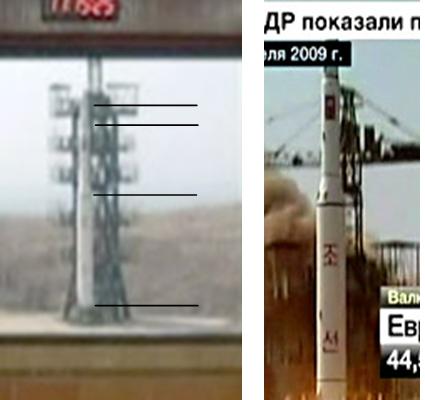
Images from the ground of the Unha-2 launch are starting to come in. Besides an amazing satellite image by DigitalGlobe and presented by GlobalSecurity.org of the the Unha-2 in flight, there are North Korean television images starting to appear in the West. (I should mention that the flare at the of the rocket’s contrail is not the rocket plume but rather indicates that the CCD camera on board the satellite saturated.) I’m going to be analyzing these images and hope to write more but I wanted to get these out as soon as possible.
There are a few comments I’d like to make:
1) The first stage is not quite as large as I thought based on a slanted satellite view. It’s much closer to half the rocket length than the 2/3 that I originally thought. I think I was mislead by the projection of the interstage as seen from a funny angle.
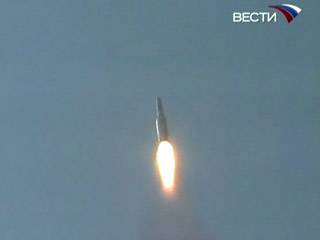
2) While you cannot see the individual nozzles on these images, you have to say its more consistent with a cluster of engines than a single engine. ( See this image of the missile in flight.)
3) The diameter is the first stage appears quite large. More work needs to be done on measuring it.
4) No fins are visible on these images or the one the of the missile in flight. While fins are not needed to insure a rocket’s stable powered flight, some analysts had automatically put them on their models.
5) No clear indication one way or another (at least with the cursory viewing of them I’ve made so far) of vernier engines or gimbaled engines.
Update: It’s a cluster! I cannot tell for sure whether or not its 2 or 4 engines but it is definitely a cluster. New info is coming so fast and furious that it’s almost worth missing the Carnegie conference.
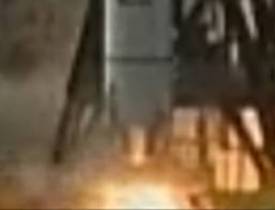
By the way, so many of you are viewing this site, I am having a very hard time posting updates! This must be a good sign, but it’s causing me a lot of problems with lost work.
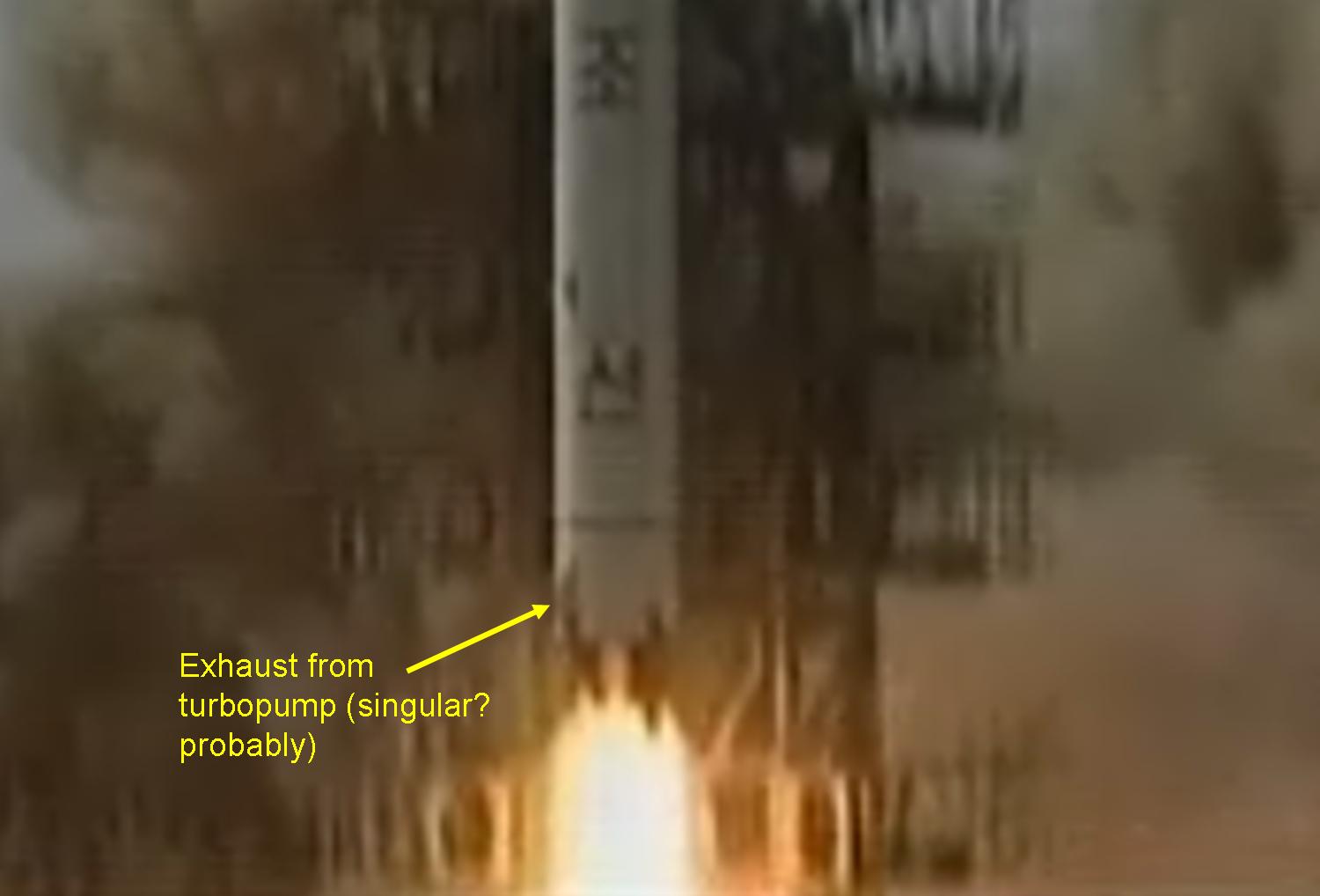
Update: The cluster of engines seems to use a single turbopump. Its still possible, of course, that each nozzle has its own turbopump but given the location of the exhaust exit, Im guessing that its a single pump. This implies a both a reduction in weight and an increase in sophistication on North Korea’s part. This image is a lot more convincing when you look at it in the video because you can see the exhaust plume from the turbopump pulsing.
Update: Gimbaled engines or jet vanes? I cannot tell for sure (if you look at the image of the turbopump exhaust I point to above) there appears to be four (you can see two spaced approximately 1/4 the way around the stage’s circumference) members sticking down from the airframe to below the nozzles. These could be either structural members to support the rocket on the launch pad or extensions for bringing down jet vanes to the level of the nozzle exits. I frankly think the support structures is a more likely alternative so I’m guessing the first stage is guided by gimbaled engines.
Update: I didn’t mean to rule out vernier engines. They are certainly still a possibility.
Update: The DigitalGlobe/GlobalSecurity.org image of the Unha-2 contrail is going to prove to be an analytical goldmine! I have made a rough GoogleEarth overlay of it it. Now, to find out the exact time the image was taken and use these to triangulate the Unha-2’s trajectory during early flight!

Awfully hard to tell from the photo from behind the rocket whether there are 1, 2, or even 3 or 4 engines in the cluster. The image is pretty well saturating.
Concur: no fins. That’s a first for the DPRK, at least as far as photos seen in the West. Also, no indication of vernier engines unless they are hidden in the saturated reason around the main engine cluster.
I want to see a shot that shows the engine cluster (?) just a second or two after takeoff, and I wouldn’t mind seeing one that shows ignition and the behavior in the flame pit.
Going to be hard to measure the diameter unless we can get a good read on at least one other dimension. I vote for the gantry; should be able to deduce the height of the gantry from its shadow in a pre-launch satellite photo.
—pete
Forget the rocket details. Look at the photo on the left center. Is that a nixie-tube display?! If the DPRK is still manufacturing nixi-tubes they could sell some to the retro electronics crowd and make a buck or two.
Saaaaay, where’s that “bulbous fairing” all of the “it’s an SLV, not an ICBM” suckers were pointing to pre-launch? I don’t see it.
Geoff, please be careful with that satellite-image! I think this is rather an aircraft (probably with a polished silver-finish), NOT the Unha-2-missile; As i wrote before, in my opinion the terrain features of the photo do not match! (I can’t find those valleys, rivers and beaches anywhere near Cape Musudan, not to speak of the general outline of the shoreline…can you?)
yes, I can; you just have to look for it. See the GoogleEarth overlay Ive posted.
Agree about that satellite image. If the Google Earth image you linked is geo-rectified properly, then it is way off the 90 deg heading the booster was supposed to be on.
…How do we know this isn’t a video of the ill fated 2006 test?…and what is the korean guy saying?
http://www.youtube.com/watch?v=ZvhPb6cH810
Sorry to be blunt about this, buy you guys have no idea what you are talking about. You are forgetting that this is a projection of something fairly high off the ground and rising by a point in space that is looking at it from an oblique angle. Sorry, but I dont have any more time to spend discussing this; I’ve actually got to do some work.
>>you guys have no idea what you are talking about<<
re: the lack of a bulbous SLV fairing?
I’m referring to the close-up launchpad pics & videos, not the Google Earth stuff.
Sorry John, I know that and Im afraid I wasnt referring to your post. And I came across harsher than I really intended to be to the people who were talking about the googleearth stuff and for that, I apologize.
Jochen Schischka, Please look at:
http://www.isisnucleariran.org/assets/pdf/Musudan_ri_Missile_Flight_6April2009.pdf
Geoff:
First of all, calm down.
Second, i agree with you, the sat-photo obviously shows the region you suggest (I’d never have looked there! The north-arrow in the sat-image on the globalsecurity-page points definitely 90° in the wrong direction);
Third: it definitely makes no sense for the Unha-2 to fly into the direction of Vladivostok, does it? Or do you expect that missile to zigzag back to the impact point in the sea of Japan? (Do we have exact impact locations yet?)
Please reconsider if this could not be a misinterpretation. (BTW, i also agree with the CCD-saturation. I just don’t think this is from the rocket flame, but more likely a reflection of the sun from a glittering object – like a silvery aircraft, which would also elegantly explain the straight contrail.)
Hey Geoff, have you seen this video from NHK of the lift-off (I think, my Japanese is pretty much non-existent)?
Is there footage of the launch without the AP banner across the bottom of it anywhere?
All I can say is that’s seriously annoying placement…
Super high resolution shot of the ISIS image here as well I may add. URL links to the digitalglobe.com site:
http://tinyurl.com/dbzxdz
And @Jochen I doubt that an aircraft would leave the heat shimmer visible in the above image… never mind the slight absurdity of a large aircraft flying over North Korean airspace in the same vicinity at the same time as the launch.
I’m confused. Looking at the NHK video Vic gave a link to I spy with my little eye…. Closed cycle, Kero Lox, with film cooling. This must be wrong because there’s no frost on any of the stages. But the plume sure does not look like NTO-MMH or like fuel. And what was that puff of smoke at engine ignition at the interstage between stages 1 and 2? It was white on my monitor, not brownish. I know I must be wrong as I thought the DPRK evolved their vehicles from the Scud and used storable liquids. Where am I going wrong?
It is highly unlikely that a Lox-Kero combination is used, but I agree that the plume is not consistent with NTO-Hydrazine, or similar. Rather, the video suggests TM-185 and AK27, the standard Scud formulation.
As for the puff of smoke at the top end of the first stage: Just before ignition, fuel and oxidizer lines, as well as the compressed gas lines are opened by rupture discs. The compressed gas is injected into the propellant tanks to prevent them from collapsing as the fuel and oxidizer are pumped out. I would hazard to guess that the puffs are the result of opening the compressed gas lines.
Tom:
But that is the point: according to the globalsecurity-page, this image was taken about 102 minutes before the satellite ended up in sea-synchronous orbit – a somewhat long flight-time for this missile! (But well, they also placed the north-arrow pointing in the wrong direction…)
Do you remember the north-korean notices about relocating a “fleet” of MiG-23/Flogger to “protect the satellite launch” (see for example http://www.globalsecurity.org/wmd/library/news/dprk/2009/dprk-090402-rianovosti01.htm)? I think a weather-recon-flight before the launch would be quite logical – and a Flogger’s Tumansky R-29 (or some other jet’s engine) at ~10km height (about -50°C ambient temperature) could quite well also be responsible for the heat shimmer.
There is one thing that i don’t understand – why would the Unha-2 take such a detour in the direction of Vladivostok to turn around in midair so that the lower stage drops into the safety-zone? That doesn’t make sense to me.
BTW, thanks for the super high resolution shot!
To Andrew Tubbiolo:
I’ve been wondering about this “puff of smoke” myself (i perceived it as somewhat yellowish/orange, but i could be wrong); If the oxidiser is IRFNA with a high NTO-share, that would be somewhat logical: the shock/vibration at ignition dissolves some nitrous oxide and an overpressure-valve at the top of the oxidiser-tank dumps some of that gas;
I think Kerosene is right (see the typical film-cooling effect – exactly like on a Scud or a Nodong, also the right colour of the exhaust), but i tend to rule out closed-cycle (this smells too Scud-like…); Surely not NTO/MMH (the flame would be a lot less opaque) or LOX (no icing).
Geoff,
It quotes you: “Iranian success despite embargo is a real achievement, and they have joined a very limited club and that policies of embargo have not been successful and the behavior with Iran should be changed and a new policy is required.”
The translation is not word for word. I guess they are quoting your NYTimes and TV interviews.
Does the video really add significantly to our knowledge? (there was another video showing the 2 stage and release mechanism before).
Mac,
It certainly is a loose translation of what ever I said. At best, and in a different context, I said it was obvious that our policies toward Iran were not working.
It raises my level of understanding and I would appreciate it if you could point me toward the video of the second stage release mechanism (and any other interesting Iranian videos).
Ref: nixie tubes. What you’re seeing there is a blurred 7-segment LED display. If you look at this video http://www.youtube.com/watch?v=ZvhPb6cH810 at the 1:52 mark you can see it in context.
Erratum
The North arrow which appeared in the first image on the GlobalSecurity.org website annotating the North Korean U’nha 2 rocket in flight was incorrectly pointing almost 90 degrees to the West. The new image depicts the North arrow 18.7 degrees to the right of the top of the image.
North arrows are used to orient the general user, and are not to be used for navigation. The image that was provided by DigitalGlobe was not a geotiff or had no geocoding data attached. The error was mine alone.
I’ve been puzzling over what Geoff interprets as an exhaust for a common turbopump; Is it possible that this is instead a small fin? The perceivable jittering (or “pulsating”) of the dark film-cooling-smokelayer in the video could perhaps be ascribed to aerodynamic disturbance or some slight instability in the film-cooling-layer (or maybe jet-vane-operation?). Don’t get this wrong, i’m talking about only two small fins, not four – a quite unusual configuration (which could probably explain why the North Koreans obviously expected a ~30 times higher inaccuracy in range than laterally – additional lateral fin-stabilizing?).
Furthermore, i’m inclined to interpret the light-coloured stripes in the film-cooling-smokelayer (right beneath the black-coloured “members sticking down from the airframe to below the nozzles” <- these would act as actuator-fairings as well as support, quite characteristic for such structures) as a telltale sign of jet vanes. Compare this to similar effects on Scud- and Nodong-engines (which obviously employ the same propellants and cooling-techniques – and undoubtedly jet vanes).