
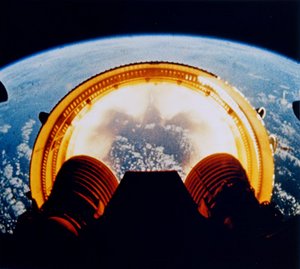
Saturn interstage falling off, click here to watch the complete video
I wish I knew what the 2006 Tae’podong-2 looked like. My guess is that it was very different, at least in the details, than yesterday’s Unha-2 launch. Why do I say that? Because I’m starting to see a pattern in North Korean and Iranian missile development programs that are more different than they are similar. Of course, my guess about the 2006 Tae’podong-2 is somewhat circular but nevertheless…
I posted a while ago about Why We Test Things and the upshot was that we, in the West, only flight test things if we are pretty sure how they are going to go. But a failure can usually be attributed to a single cause that most likely is associated with the integration of the entire weapon. For instance, the Trident shown on that post was apparently going in a crazy spiral because a wave slapped the nozzle as it left the surface of the water. The Falcon-1 failed, on at least one of its test flights, because fuel left in its regeneratively cooled engine continued to give a small thrust that sent the first stage careening into the second and broke the second stage engine. In both cases, I would venture, the developers made a small change to the system and flew it again with essentially the same rocket in every other respect.
Iran seems to follow a similar, very systematic, development path. The August 2008 Safir launch reportedly failed in its second stage. (My guess, based on very little information, is that it failed at stage separation/ignition.) The Iranians seem to have diagnosed the problem, made a correction to one part of the system, and flew essentially the same rocket in February 2009. And that followed at least one sounding rocket flight that seems geared to study staging separation.
What is North Korea’s record of responding to failures? It would have to be considered to respond to failures poorly. On top of a reputation of conducting very few flight tests, they also seem to always start over when they have a failure. (Perhaps they “change” project managers?) The Tae’podong-1, flown in August 1998, apparently failed in its third stage. Instead of correcting that failure and retesting, they built the Tae’podong-2. The Tae’podong-2 failed (probably spectacularly) in 2006 just 40 some seconds after launch. Now, the Unha-2 failed sometime after its second stage ignited. (I consider that a strange place for it to fail. A failure during separation, with all the pieces landing in the same spot as the first stage, would have been more understandable.) Did North Korea start over from scratch with the Unha-2? That’s why I’d like to know what the 2006 Tae’podong-2 looked like. Unfortunately, there is no real information on what it looked like in the public domain.
Update: (1:35 pm EDST) Reports are starting to come in that the Unha-2 failed after the second stage burn was complete with the second stage splash down inside the predicted zone. That makes a lot more sense to me than a failure somewhere in the middle of the second stage burn.
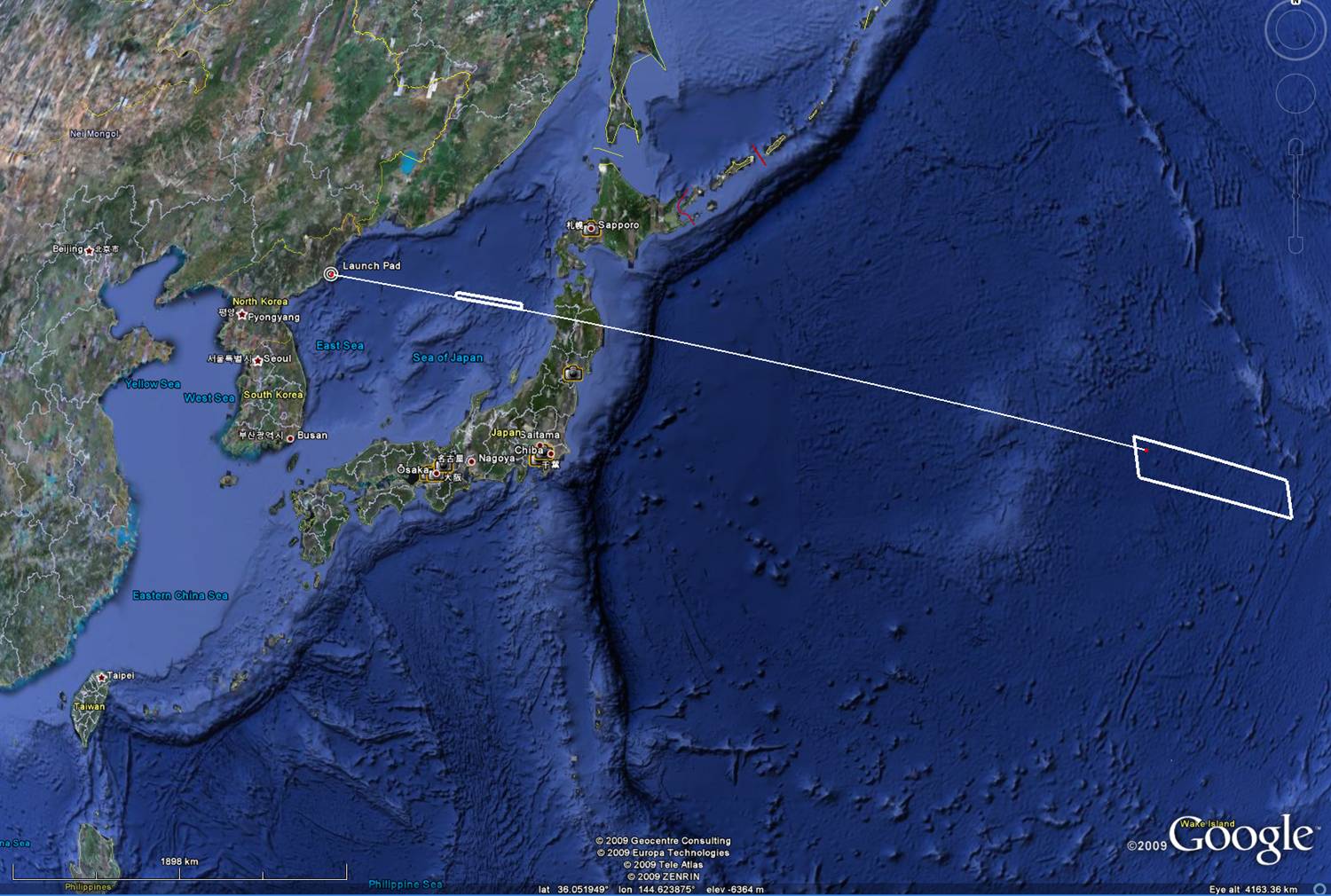
Update: (9:30 am EDST, 4-7-09) Here is an example of the printed reports that have started to surface, though I’ve been told less formally by others as well. I’ve plotted the “range” of the second stage as reported in these media stories here.

This is an excellent point and right on the money.
If you look at the Iranian presentation on Omid to the United Nations Office for Outer Space Affairs, you can observe some details of the process the Iranians followed (essentially the same process we in the West use – going through a PDR, CDR, simulation, test, validation, …). Of course this is not a surprise as a significant number of Iran’s engineers and scientists are Western trained. Furthermore Iran has the industrial base, money, time, and people to let it operate this way. Note that Iran launches first, announces second, and when Omid reaches end of life, that is it – no more mention of the project; but North Korea announces first and weeks in advance, launches second, and milks the launch from zero to infinity in terms of propaganda.
So this observation is completely correct, and further validation of a technological and system engineering bifurcation of sorts between the Iranian and North Korean space/missile programs. Iran right now is not just technologically more advanced than North Korea, but fundamentally different (and ahead) in terms of their “process”.
I may be mistaken but I think the reason why Iranians make steady progress (and I can already smell a long term space program) is due to the fact that they don’t see themselves in competition with anybody which reduces possibly a significant amount of political & psychological weight from the shoulders of their scientists. Where NK seems to be in race to show “superiority” over South Korea for political reasons and possibly rushing its scientists for a development that Kim Jong Il can use as leverage for bargaining more with West, Iranians have a calm attitude of not only showing sophistication and demanding due respect, but also there is a psyche of advancing for the “sake of science” and having a positive role; a pattern which can also be seen in other branches: Nano technology, Stem cell research, etc, which honestly I think is quite a breath of fresh air and a positive step.
I think one variable to take into account (reaching back somewhat into your previous article, linked to here, about the difference between large-N testing strategies and small-N testing strategies) is industrial consistency.
That is, the significance of a large-N testing strategy is different depending on what a priori expectations you, as the program manager, have regarding your ability to consistently manufacture identical parts, and assemble them into identical systems. If your confidence in that is low or moderate, you may need a lot of tests of “identical” systems to a) establish how consistent your manufacturing is, and b) establish what range of outcomes can be expected solely on the basis of manufacturing inconsistencies. It’s only once you’ve satisfied yourself that your manufacturing processes are relatively consistent and reproducible that it makes sense to start thinking about using large-N testing strategies to map out the performance envelope, or calculate a parameterized failure rate, or do anything of the sort – much less to even consider the small-N testing strategies you’ve discussed.
Where I’m getting at with this is, Geoffrey – do we have any types of sense of whether the North Koreans would be capable of building a series of essentially identical Taepodongs at this stage if they wanted to?
Haninah,
I hear what you are saying and I don’t have a really good answer for that. My current thinking is that this represents a “philosophy” rather than a manufacturing limitation, though that is certainly possible. However, you don’t start out to make a Taepodong-1, with a Nodong first stage, SCUD second stage, and who knows what for the third stage, and find you have made, because of an inability to do precision machining, a Taepodong-2 instead. That is certainly a development choice.
Thanks for the prompt response, Geoff. I agree – I didn’t mean to imply that the pattern you observe resulted simply from manufacturing inconsistency. If anything, I’m suggesting that the scatter-shot nature of their testing strategy which you observe has concealed – probably not intentionally – a whole other set of potentially fascinating data, regarding their ability to manufacture systems consistently.
And furthermore, as a result, any projections of future capabilities implicitly include an additional assumption that’s not often expressed – not only that they can demonstrate a certain capability by a certain date, but that they can achieve reproducibility with regard to that capability.
The primary difference between NK and Iran is political, not technical. NK “test” launches are conducted primarily for political purposes and not as part of steady development effort. The timing of test launches are based more on political factors than technical ones. This explains why NK conducts so few tests and why those tests are more likely to fail. It’s all about the character of the regime.
for what it’s worth, it wouldn’t necessarily be that odd for the rocket to fail mid-burn. instability can exist after a startup transient, which can lead to a failure. fatigue failure can occur on moving parts. thermal environments can exceed expected limits and fail materials as they heat up or cool down too much during a burn. tank drainage can lead to dynamic effects. all of these things are no more or less likely than a stage separation mechanism failure.
Along the same lines of infrequent tests and the probability that the DPRK ICBM/Space program is dysfunctional along the same lines as the society in general. It could also be due to the passing of a more experienced generation (by natural means) and a lack of testing practice for a hypothetical younger less experienced one.
Does anyone have any pointers to insights into DPRK test infrastructure, design institutes, publications, or maybe even a back issues of “Juche Aerospace Week”?
Andrew
Let’s not forget that the Iranians have a lot more money to play with.
That said, i can not fully comprehend why everybody automatically assumes that the northkorean and the iranian launchers are so absolutely different. This is not necessarily the case (perhaps the Iranians just were more fortunate?).
I must add that on the other hand i also can’t exclude this possibility (actually, at the moment i’m playing with the thought of the Unha-2 and the 2006-shot being some sort of modified Paektusan-1 with a Nodong-B/Ghadr-1-like 1.stage with an uprated ~33t-Nodong-engine plus the original Paektusan-0.88m-upper-stages…somewhat similar to Safir IRILV, but not identical – sort of “look, we can do it, too” in hangeul), but due to the complete lack of hard photographic evidence of the 2006- and, frustratingly, so far also the 2009-DPRK-shot, almost everything must still be considered a possibility (including a R-36M/SS-18/Satan-like monster with six gimballed closed-cycle-high-pressure-engines in a 3.whatever-meter-body and presumably a nuclear upper-stage-engine…or alien anti-gravity-technology…or a warp-drive…or…), or at least can’t be disproved.
I must say (again) that i find the “large-diameter-4-or-more-engines”-theories particularly confusing (that might be generally accepted lore, but do we have any concrete evidence, not just rumors, of such a configuration?), since i’d expect a much simpler single-stage-missile based on this technology in advance of a high-risk multi-stage system. First, iron the wrinkles out of that one – then on to the next step. Not all-in-one-fail-thrice (BTW, the first stage seems to have worked nominally this time – quite surprising for an almost unproven design, isn’t it?).
Has anybody found (high-resolutioned) photos or videos yet? Credible radar-tracking data? Do we already know more about the splashdown-locations of the stages?
Geoff — can you point me to a source for your update, above, on the 2nd stage landing in the expected zone?
Thanks.
Orbview satellite was able to photograph the missile in flight!
http://www.globalsecurity.org/wmd/world/dprk/no_dong-launch-imagery-20090405.htm
What do you make of this:
http://www.globalsecurity.org/wmd/world/dprk/no_dong-launch-imagery-20090405.htm
Some sort of belated april fool’s joke?
(I can’t trace the location of this image back to anywhere in North Korea, at least not anywhere near the launchpad, the “contrail” has all characteristics of a typical aircraft’s condensation trail, the “rocket plume” looks very much like a typical google-earth-image-interference instead of a real rocket’s exhaust and the “102 minutes” figure just doesn’t fit…)
Jochen, interesting comment. In particular, I would ask: has anyone actually been able to measure the absolute size of the Unha-2 from the published satellite photos? Can we rule out that it’s the same size as Paektusan-1, is it definite that it’s a bigger first stage – or is that just RUMINT?
Re: the image of the rocket in flight. The flaring at the end of the contrail shows all the characteristics of saturating the CCD camera. I’ve seen this from reflections off of roofs and some fires (such as gas flares near oil drilling operations). So I would say its real and quite an amazing coincidence.
Readers may think that I am beating a dead horse here, but once again I seek the answers to 2 simple questions below. Now, thanks to this Kyodo News article out this morning, my questions become even more difficult to dismiss.
N. Korean vessel tasked with tracking rocket malfunctioned: Yonhap
SEOUL, April 7 KYODO
A North Korean commercial vessel that set sail for the Pacific Ocean with a mission to locate a rocket that the North launched over the weekend turned back with mechanical trouble, Yonhap News Agency reported Tuesday.
‘‘We don’t clearly know the mechanical problem that appears to have prevented the ship from further sailing,’‘ an unidentified South Korean official was quoted as saying.
So again, I ask —
How exactly did NK continue tracking their missile far out over the Pacific? Does NK rely upon a land-based or shipboard tracking capability in the zone which lies well to the east of Japan?
And does anyone know if there were any Chinese Yuanwang or Dongdiao missile tracking ships present in this zone during the launch?
http://newsru.com/world/07apr2009/raketatv.html
According to this Russian link, (and images in the upper right)the North Korean TV showed the missile. If true, these are by far the best images I’ve seen.
To Jonathan McDowell:
If i compare the proportions of the shadows of the missile’s first stage and the launch tower in the march-29 photos from both DigitalImage and GeoEye with pictures of the 1998-launch, i’d consider it possible that both launchers had diameters in the same range (Paektusan-1 had without doubt a 1.25m-Nodong-A as first stage)…but since both satellite-images have a resolution in the range of 0.5-1m (high squint-angle! at nadir?), i’d be rather reluctant to bet on it (mark that at such a level of blurring this could also support a diameter of ~2.25m – or that it’s possible that the launch tower now has a different width than in 1998). Also, perhaps the upper stage has a smaller diameter – but again, not sure.
If only we’d have at least 1998-like material to work with…
Geoff:
How do you explain the 102-minutes-figure (for a missile with a flight duration of ~10-15min)? Why do the terrain features not at all match the landscape around Musudan-Ri? What do you make of the “launch direction” to the south-east? And why would a missile spend such a long time inside of the atmosphere at horizontal flight (otherwise, we’d see the “frozen lightning” phenomenon – the contrail gets blown in different directions at different heights due to different wind-directions)? “Depressed trajectory” with “boost-phase-maneuvering” to avoid missile intercept of a satellite-launcher or what?
>So I would say its real and quite an amazing coincidence.
I wonder. The orbital elements of the satellite are in the public domain, so NK almost certainly knew it would be there and could figure out POCA within a few seconds. (Presumably that’s when the picture would be taken.)
So might they have launched 30 seconds or so before that precisely so the picture could be taken? As my five year old nephew says, “Look at MEEE!!!”
Wow, these are in fact the first real images of the “Unha-2”!
Thanks a lot, ED! Well done!
Now we can say for certain that the upper stage(s) had a smaller diameter than the lower stage.
For what it was worth, not much, CNN had film of the launch on the news at around 9AM (Tuesday). Unfortunately, they ran some kind of banner (“North Korean Launch” or the like) directly over the stern obscuring the engine(s) completely.
The TD-1 was always a different rocket, cobbled together basically from a Scud and a No’Dong. Some in the intelligence community thought it was the forerunner of a series-production run, but others (me for example) thought it was likely a one-off attempt to do something spectacular. It probably also had the goal of demonstrating staging with a large-ish bird. One thing that seemed amazing at the time was that they used vernier engines on the first stage, as opposed to jet vanes. I thought that showed a well-planned strategy of technical upgrades.
We know the TD-1 failed during third stage burn, but I suspect that the details of what I learned back when are still classified. Even while CIA was getting excited about the possibility of a TD-1 missile, the DPRK was already showing some things that pointed to the TD-2, and that looked to be a much more “useful” weapon.
Failures during burn are by no means unheard of, even in the US manned space program. Transient failures at staging are at least equally common, but the DPRK did managed to stage the TD-1 successfully.
I am intrigued by Geoff’s thesis that the DPRK basically changed the design significantly from the first “TD-2” launch to the second over the weekend. Could be. Makes a certain amount of sense. One thing is for certain: when you go years and years between launches your proficiency at executing a launch goes to hell.
Still absent are any photographs of the supposed satellite payload, as far as I can tell. That’s not proof there WAS no satellite payload, of course. And the ‘tracking ship’ story is very interesting, too. Are there any clues about how far down range it was supposed to be located, and what if any special hardware was on its decks?
Yahoo! has the video of the launch.
http://cosmos.bcst.yahoo.com/up/ynews;_ylt=Ah3V524gTfigru1CGaM.qjCs0NUE;_ylu=X3oDMTE0aHQ0ZXE3BHBvcwMyBHNlYwN5bl92aWRlb3MEc2xrA2ZpcnN0dmlkZW9yZQ—?ch=4226714&cl=12856348&lang=en
Meanwhile, Iran has released a very interesting video that answers almost all of the remaining issues regarding the Safir-2. The beginning of the video is very interesting.
http://www.youtube.com/watch?v=N7d_P4YImjA&fmt=18
This clearly shows that Safir-2 was a 2-stage launcher; In addition, it tells a lot about propellant. It seems propellant/oxidizer were not cryogenic.
One more thing, there is another small satellite (Mesbah or the previous launch’s dummy satellite?) can be seen mounted on the launcher.
Geoff,
They mention your comments about the launcher, which was published in WP.
Fantastic film clip Amir! Thanks so much posting it. Also, which comments are those? Im afraid I dont remember.
Amir:
Thank you very much, this video (especially the first 30 seconds) answers a lot of open questions considering Safir IRILV (which is in fact quite different than Unha-2 – who would have thought; what a difference some good pictures can make).
But, regrettably, not all. For example, what is the exact thrust level of the first stage engine? ~33t? Where/how is the pressure-gas stored? Of what material (type and thickness) are the tanks made?
BTW: note the extended nozzles (also on the turbine-exhaust!) on the two-chambered gimbaled upper-stage-engine.
Geoff,
Oops my mistake! It was NY Times not WP.
Geoff,
BTW, they mention it at 7:00 in the video.
Geoff,
It quotes you: “Iranian success despite embargo is a real achievement, and they have joined a very limited club and that policies of embargo have not been successful and the behavior with Iran should be changed and a new policy is required.”
The translation is not word for word. I guess they are quoting your NYTimes and TV interviews.
Does the video really add significantly to our knowledge? (there was another video showing the 2 stage and release mechanism before).
BTW in some organizations in Iran they try to imitate the professionalism of US type organizations despite the technology comes from China, Russia or other countries. Honestly speaking every Iranian admires the professionalism of US organizations. As you know IRIAF personnel and some other sectors were exposed to US methods, organizations, etc. Iranian higher education system for example is based on US system (i.e. 8-12 PHD level courses + qualification exam + oral exam). Every time the British system has been proposed (i.e. research only) the majority have rejected it. The same people prefer to follow the steps of US rather than perhaps Chinese.
Mac,
It certainly is a loose translation of what ever I said. At best, and in a different context, I said it was obvious that our policies toward Iran were not working.
It raises my level of understanding and I would appreciate it if you could point me toward the video of the second stage release mechanism (and any other interesting Iranian videos).