
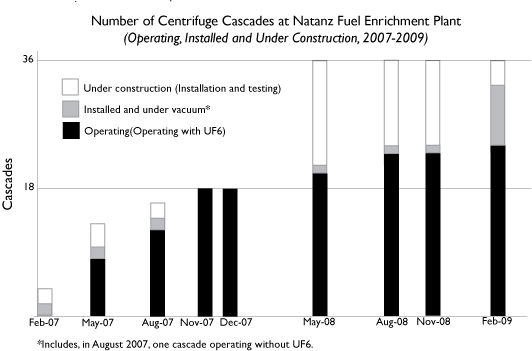
I wanted to talk about Joby Warrick’s story, Iran Easing Aspects Of Nuclear Program, Report Cites Lag at Centrifuge Facility. A senior UN official told journalists that Iran has slowed installation of a second module of 3,000 centrifuges:
“The pace of installing and bringing centrifuges into operation has slowed quite considerably since August,” a senior U.N. official said in briefing journalists on the new IAEA inspection report. The official, speaking on the condition that he remain anonymous, said the agency “has no information” to explain the slowdown.
[snip]
On Tuesday, IAEA chief Mohamed ElBaradei hinted at the report’s findings at a news conference and suggested that Iran may be attempting to send a positive message to President Obama.
“They haven’t really been adding centrifuges, which is a good thing,” ElBaradei said. “Our assessment is that it’s a political decision.”
I don’t know about ElBaradei’s interpretation.
If you look at the chart at the beginning of this post, it shows the number of cascades at the Natanz Fuel Enrichment Plant. (Readers should recall that this does not include centrifuges at the Pilot Fuel Enrichment Plant and that the 18 and 36 cascade marks correspond to about 3,000 and 6,000 centrifuges).
I made sure the x-axis is cardinal, rather than merely ordinal.
You can see the “lag” quite clearly in the number of centrifuges that Iran is operating. The Iranians brought online the 18 cascades in the first module by November 2007. Since then, Iran has bought only six additional cascades online — three after May 2008 and only one since August.
On the other hand, the slowdown may just be an artifact of how Iran is installing cascades. In addition to the 24 operating cascades, Iran has another nine installed and under vacuum. These could come online very soon, mostly likely before the next Board Report. Iran could easily have 5,400-6,000 centrifuges operating by May.
It seems to me that, rather than a political decision or technical difficulties, the Iranians are just changing their installation patterns.
I am interested in other people’s thoughts, but I suspect the Iranians are actually scaling up their installation work. Here is my hypothesis:
Initially, the Iranians were building one cascade at a time, like a succession of small art projects. They had limited experience installing cascades and probably a small number of trained personnel. So, in the Board Reports, one would see a pattern: a few cascades, one or two under vacuum and a handful under installation. In the next report, the cascades under vacuum testing would have become operational, while a few more of the ones under installation had graduated to vacuum testing.
Now, Iran seems to have shifted to mass assembly. Installation on all the cascades in the second module has proceeded more or less simultaneously. So instead of small, but steady, increases in the number of centrifuges, I would expect the installation to resemble a step function in the future — with each increase being relatively large. Hence, the nine cascades about to brought into operation.
It isn’t clear where this stops — Iran is continuing installation work on three more modules that will each hold 18 cascades. The IAEA report suggests that the work is related to “the installation of pipes and cables” for future centrifuges — but no actual centrifuges yet. It will be interesting to see how quickly the Iranians scale up their installation effort in the future modules.
It would be nice if the Iranians were to forgo feeding hex into those nine cascades, but I don’t see why they would do us that particular favor. The incentive for Tehran right now is to install as many centrifuges as possible. And there is real danger if political leaders create a false hope that the Iranians are slackening the pace of installation, when I suspect that hope will feel like betrayal when the Iranians hit six large (6,000) this spring.
Tomorrow, I am going to try about why I think it is a mistake to focus on breakout relative to other scenarios.

perhaps they want some redundancy in case Israel (plus Mini-me, USA) decide to bomb some of the cascade sites.
Kind of like missile “defense”, eh?
I agree that “it is a mistake to focus on breakout relative to other scenarios”. Yet it best not be ignored. It is the 800 lb gorilla that has just walked into the room.
What is important is to note that that an absolute change has occurred. From this point on Iran’s ability to build a bomb is its choice, not its capability. Breakout, diversion, slow rampup to a weapons arsenal, etc. are matters of political will.
The worst case scenario – whatever its likelihood – is now part of the calculus.
There is an infinite difference between the time when your scary neighbor down the block first buys a handgun and when you see him come home with a box of bullets.
FSB:
The nine cascades under vacuum, as are all the cascades, are within the Natanz FEP. It is not a redundant capability, it is a larger one.
Would FSB explain to us how on Earth it would be possible to target/destroy 3 or 4 cascades, for instance, without irreversibly damaging the 2 or 3 others? (Now THAT would be “surgical” targeting). They are all co-located in the same subterranean site, which is the FEP.
I agree with Yale that breakout scenarios should not be ignored – especially since they may shape some political or public opinion perceptions. Jeffrey, it may be a good time to rejuvenate the discussion on time factors for various breakout scenarios. We may want to look at the Iran Watch timeline, for instance – which seems exceedingly pessimistic to me.
my mistake.
But the essential point remains: since they are churning ‘fuges out like sausages it should give the hawks some pause. What exactly will destroying a couple of sites do? Iranians apparently have a well-oiled production facility….somewhere.
nodong,
My take on breakout timelines may be found here
Jeffrey,
Just idle speculation, but maybe the Iranians have made some hardware, feedstock, or operating modifications which will be implemented in these new arrays.
The performance of their existing producing cascades is, although stable, rather low. These new virgin machines may be the roll-out of a higher performing system
I believe El-Baradei is correct when he assess that Iran has made a political decision to slow down the speed with which to install new cascades in Natanz. I also believe that Iran is now technically capable of increasing the paste of the installation to roughly 6000 total operational by the end of this year.
But El-Baradei being correct doesn’t entitle him to such declarations, at least not until the end of his mandate. This is only the tip of the iceberg and shows how political the fight behind the scene has been between Iran and the secretariat in keeping matters in the technical and legal boundaries.
The more one politicise the issue in a body with technical and legal mission, the more it reveles an agenda of weakenning the NPT and its safeguard regime.
One question that springs to mind is whether the new pattern you cite may have something to do with the possibility of a freeze-for-freeze beginning of negotiations.
What exactly would Iran freeze under such a scenario? Installation? Operation? both?
Miles:
The same thought crossed my mind, but the Iranians did bring online one of the cascades under vacuum.
So, I don’t think they’ve frozen yet, though perhaps they will.
I certainly hope so.
J
we’ve heard a lot lately that some companies are “too big to fail” and I think that the main issue here is not so much “breakout” as something of a similar sort. That is, how advanced does Iran’s enrichment program have to be before it too becomes “too big to give up.” The more advanced it becomes the more likely that proposals to internationalise Iran’s fuel cycle will be undercut.
In so far as “breakout” goes capability we could get ultra-technical and maybe argue that Iran has pretty much a “breakout” capability. The LWR could be operated at the appropriate burn-up, and with a hot-cell capability, hey presto you have a breakout capability. So, I guess we have been living with a kinda breakout capability already without all the hullabaloo.
Maybe they haven’t slowed, maybe their main effort is now directed elsewhere and Natanz has become the sideshow.
Nice Zelazny reference there.
I think there are two possibilities:
1-Iran is slowing down the installation for political reasons.
2-Iran doesn’t want to spend money on P-1’s and wants to keep room for IR-2’s and IR-3’s.
I’m wondering why we continue to install IR-1 centrifuges while we have more efficient IR-3 series.
Even if there are problems with IR-3 models, we can wait until these problems are fixed; then we install the better ones.
Jeffrey:
I certainly hope not! But slowing down (for only a certain short period) would be a good gesture on the Iranian’s part aimed ONLY to decrease tensions while making sure any such move is not misconstrued as forfeiting its right to further install, operate or enrich!
Iran has officially denied that it is slowing down enrichment .
One needs smooth, reliable power to run the cascades.
If covert acts are being directed at the operation of the cascades, perhaps that is a factor.
Is there any evidence of this?
I wonder if the title of this blog post – “Nine Cascades in Vacuum” was deliberately modeled after a stanza of the “Twelve Days Of Christmas.”
Intentioonal or not, I think you have a good starting point for creating a whole song. Any suggestions?
Lets impose UN sanctions on the U.S., they are obviously trying to build a bomb by diverting nuke materials…
J House:
I have worked at stations on the Iranian grid during the last few years and the grid’s (frequency) stability was similar to that of Malaysia, Thailand etc. Certainly Iran’s grid frequency is much more stable than what I’ve seen in India, and India’s is reputed to be better than Pakistan’s. So if Pakistan can run centrifuges with no problem then that suggests that the static frequency converters available on the market are more than capable of coping with natural grid fluctuations.
With regard to “covert acts” I presume that nations opposed to the Iranian enrichment programme will be trying to sabotage it by introducing deliberately faulty equipment into the process. But it’s hard to see how that would get through the testing performed before the equipment is used. Maybe the programme can be slowed down by forcing Iran to perform rigorous component tests, but I don’t think it would be possible to stop the enrichment completely this way (and I think we can assume that if it was possible then that would have been done by USA / UK / others).
Is there any evidence of covert action to interfere with the power supply? As mentioned, I’ve read the stories in the newspapers of western intelligence agencies introducing faulty equipment into Iran’s supply chain, but if it is occurring then I suspect it is restricted to the on-site processes; personally I’ve never seen (or heard of from colleagues) any evidence that the power grid as a whole has been affected.
Yale:
I think it’s an unintended echo of “Nine Princes in Amber.”
Ah, those were the days…
FSB,
Mislaying/misaccounting for 5 tonnes on natural uranium and 189t of depleted uranium does sound an impressive feat. It’s rather a shame the Inspector General does not (or can not) indicate if this is mostly accumulated small measurement errors, or mostly the loss of identifiable physical resources.
Reading between the lines it seems the DOE has abandoned parts of its materials database and accepted new on-the-ground measurements without serious enquiry, to create a fresh baseline. The Inspector General worryingly notes “[those] with original programmatic responsibility for the materials … were not contacted for additional explanations, justifications, or approvals before the [database] changes were made.“
At a higher management level the Inspector General worryingly notes “a few key commitments made by the Department were not completed nearly eight years after our earlier audit.”
This is no great example to other IAEA member states, other than that it has been publicly acknowledged.