
It appears that six European satellites have gone missing from the NORAD tracking catalog. All are in highly elliptical orbit and, historically, were “tracked” once each orbit, which in the case of the four Cluster II satellites (used to keep track of solar weather) about once every 2.4 days. The last updates to their orbital elements were made in mid-November. What could have happened?
Actually, losing satellites used to be not too uncommon, even important adversarial satellites. I did a study once that looked at Russia’s (and, of course, the Soviet Union’s) early warning satellites. Those were observed, on average, about once every day. But they would occasionally be lost. Usually this was associated with, for instance, the Russians moving a geostationary satellite to a new longitude. Sometime between one observation and the next planned one, the Russians had moved the satellite to a slightly different altitude and it had “drifted” at a rate of over 1 degree per day to a new position. Usually, the US tracking network picked the satellite up before it reached its new position and it could be watched moving along the geostationary band.
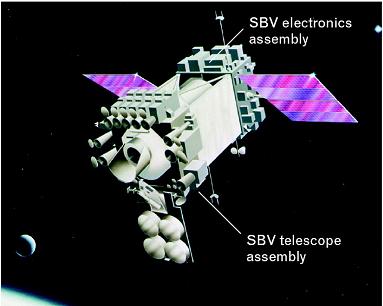
The incidence of losing satellites greatly decreased when the US started using a satellite-based telescope to track satellites. Called the Space-based Visible (SBV) and mounted on the MSX satellite, this sensor tracked satellites for ten years. Unfortunately, it stopped functioning in June of last year. We can look back on the history of observations of the Cluster II satellites and see the effect of the death of this sensor on the frequency of observations of the Cluster satellites. During all of 2007, there where 14 times when observations of the Cluster II FM8 were made on every other orbit. In the 5 months between SBV’s demise and when the Cluster II satellites were lost, there were a total of 11 times the satellite was tracked less frequently than once every orbit and several times when seven or more days passed between observations. It would be interesting to know if ESA moved these satellites in November but we certainly can see the importance space-based observations have played in space situational awareness.

Geoff,
On a somewhat related topic, have you seen this yet?
In the last quarter of 2007 the CLUSTER array was boosted to a higher orbit. The perigee was raised 2500 km. This was primarily to minimize eclipsing (which is real hard on the spacecraft) and secondarily as a life extension.
I have not seen any changes recently, but I will keep checking.
Geoffrey:
I love your posts—
MKrepon
Geoffrey:
Actually, The number of daily TLEs published by NORAD decreased by 40%, since Nov 2008.
Do you have any idea what is going on?
Wang Ting—thanks for pointing this out! I am only able to look at individual satellites (or small groups of satellites) and havent noticed this effect. When I check a “random” geostationary satellite (I picked Chinasat 22a), I dont see any such decrease. But perhaps that just means it is confined to near Earth satellites. If so, it might indicate a problem with the radar fence in Texas. But I need more information, and confirmation, before I can start jumping around—something that would clearly be justified if true!
I have looked at this issue in more detail and find that the 40% reduction Wing Tang points out is, in all likelihood, some sort of bookkeeping problem and not a real loss of space situational awareness. This sort of thing has happened before, though not to the same extent that has happened since November. If it is the same problem seen in the middle of 2005, we can expect a whopping big load of orbital elements to be entered into the catalog at the end of what ever problem is bothering the NORAD track, with their epochs corresponding to the gap. I also think that the Cluster II satellites are probably not lost, they are just victims of this problem. It is an open question, at least to me, whether or not NORAD is aware of these satellite observations. If not, this problem represents a real decrease in space situational awareness. If it is just a transfer issue from NORAD to NASA, then its just us amateurs who are suffering a space situational awareness problem. (The more I think about this, more likely this later possibility seems to me.)
While the Cluster II satellites are probably not really “lost,” the effect I pointed out—a decrease in the frequency of observations due to the loss of SBV—is real: there is a statistically significant decrease in the frequency of observations of Cluster II satellites between June (when SBV died) and November, when the “hole” in satellite “observations” occurred.