
Greetings from the Atlanta Airport — I am off to the Republic of Korea this week. Before I go, I wanted to share another great talk I heard from the meeting George Lewis hosted at Cornell.
Yousaf Butt, now at the Harvard Smithsonian Astrophysics Center, gave a wonderful talk athat leaves me further doubting the Bush Administration’s claim that USA-193 posed a risk to human health and needed to be shot down.
We’ve gone round and round on this one, both on this blog and elsewhere. (You should, if you have a chance, read the exchange between Yousaf and Andrew Higgins in Space Review — starting with Yousaf’s letter, Higgins’s reply and their final exchange).
Since Yousaf and Higgins exchanged letters, Yousaf has succeeded in having NASA release, through the Freedom of Information Act, one of the studies in question: Robert L. Kelley and William C. Rochelle, Atmospheric Reentry of a Hydrazine Tank.
The study concludes — not surprisingly — that the tank (and hydrazine) would survive re-entry to pose a risk to human health. But a more interesting question is whether the study would have survived peer review.
As Yousaf notes in a technical commentary for the Bulletin of the Atomic Scientists, the study makes three assumptions that the authors acknowledge are unrealistic. What is particularly disturbing, is that the simplifications all push in one direction — to inflate the likelihood that the hydrazine tank will survive:
1. NASA modeled the remaining hydrazine as as uniform mass along the interior surface of the sphere with a void in center. (The tank was 3/4 full). In fact, the tank contains a bladder that pushes the hydrazine toward the fuel out-take.) Here are Yousaf’s diagram.
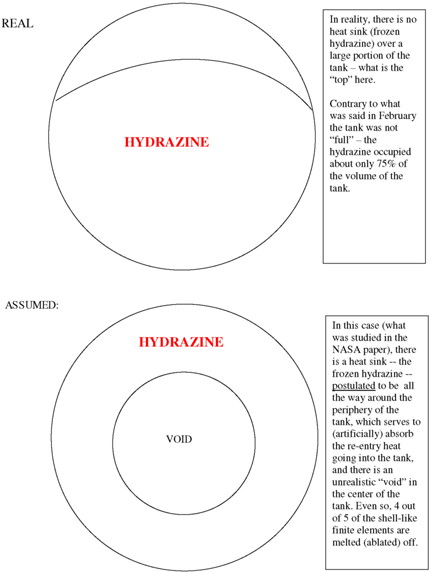
By evenly distributing the hydrazine around the tank, NASA can assume that tank would tumble and that the heat, therefore, will be uniformly distributed around the entire tank. If the mass is off center, the tank would stabilize during reentry, like a shuttlecock, loading the heat on the front-end.
2. NASA modeled the hydrazine as a single finite-element. This means that before any of the hydrazine is assumed to melt, it must all begin melting. “The simplification in this model which could have the largest impact is also difficult to address,” Kelley and Rochelle wrote. “It is extremely likely that the N2H4 in contact with the Ti wall will melt away in layers.”
3. NASA modeled the temperature of the frozen hydrazine as 214 K, even though temperatures in excess of 250 K are more realistic. “The initial temperature of the tank and the N2H4 was dictated to be 214 K for this study,” Kelley and Rochelle wrote, “although the actual temperature would very likely be higher.” Dictated?
Simplification is, of course, necessary in modeling. I am clearly out of my depth in refereeing this dispute, but the one-directional nature of the bias is disconcerting, as is the fact the hydrazine tank exploded and burned for tens of seconds unexpectedly. Such things do not inspire confidence in NASA’s model.
At issue — other than the truthfulness of certain public officials — is how NASA models the reentry of spacecraft and debris like tanks of hydrazine. NASA uses a one-dimensional model called the Object Reentry Survival Analysis Tool (ORSAT). The European Space Agency has developed a multi-dimensional code called SCARAB — Spacecraft Atmospheric Reentry and Aerothermal Breakup.
Both are good for simple object that like tumbling spheres. But many spacecraft, like all cows, aren’t spherical. There is some reason to think SCARAB is going to be more accurate for objects, like the hydrazine tank on USA 193, that deviate from these simplifications.
Now that doesn’t prove that the tank and hydrazine would have burned off. Fortunately, Yousaf and his colleagues at Hyperschall Technologie Göttingen, an ESA contractor, are using the SCARAB code to build a three-dimensional model of the tank of hydrazine.
It will be interesting to see if the hydrazine, and the Administration’s story, survive re-entry.

very wonky.
Just wondering: After a few years of regular reading of this blog, I’m still waiting for the advertised “Too obscene for publication” bits.
You are telling us the Administration fudged and lied? No way!
I believed everything they told me about bringing India into the “mainstream” of the NPT.
All the assurances…. all the clean waivers, all the assurances about no Indian testing.
Let me go and wash those Press Releases 7 times with sand.
There is indeed a resurgence of interest in the rationale behind the shootdown. See:
September 2008, Atlantic Monthly, by Guy Gugliotta (Washington Post space reporter)
“How preparations for tomorrow’s satellite wars could ruin life as we know it today”
http://www.theatlantic.com/doc/200809/space-war
————————————————
Bulletin of the Atomic Scientists, Yousef Butt article
http://thebulletin.org/web-edition/features/technical-comments-the-us-satellite-shootdown
—————————————-
August 19: Peter Brown: “Shooting Down A Satellite: A Prudent Public Health Measure?”
http://informationdissemination.blogspot.com/2008/08/shooting-down-satellite-prudent-public.html
————————————-
“U.S. Satellite Shootdown: The Inside Story”, by James Oberg, on the IEEE Spectrum Online site, August 6,
http://www.spectrum.ieee.org/aug08/6533%5D
—————————
… and the lead item on the front page of my own home page, http://www.jamesoberg.com
People’s thinking about atmospheric entry survivability is often skewed by hollywoodized graphics and misunderstood (often carelessly misreported) space events. The idea that the frozen hydrazine tank could survive was counter-intuitive apparently everywhere at first, including in the Pentagon where the going-in presumption was (as it was and remains, in the outside world) that everything would burn up completely, or almost so. But as detailed calculations last December began insisting, and has NASA’s independent validation effort confirmed, the early convenient assumptions were just that — wishful thinking.
Most of the advocates on this thread remain stuck in the first ‘wishful thinking’ stage. I suggest that by now, they are emotionally determined to remain there, for any number of ego or ideological or other reasons.
We’re going to see a lot more playing around with math models, by people who don’t seem to ever have had to do it for a living, or bet people’s lives on the outcomes. I suggest that once you have determined the answer you want, it’s easy to manipulate initial conditions, models, and fudge factors to get the computer to tell you what you want to hear.
Perhaps one cautionary tale from the ‘real world’ of rocket science can serve as a warning to this approach.
from my 1995 article —
Max Faget: Master Spaceship Builder —
http://www.astronautix.com/articles/maxilder.htm
“Despite his reputation as a meticulous engineer, Faget always retained his instinct for high-performance flight testing, an instinct that sometimes proved more accurate than exhaustive theoretical calculations. He even has a space souvenir to make the case for his intuition: a simple piece of blue plastic wrapper.
“One of his early Apollo design questions was how much heat shielding to install on the lee side of the Apollo capsule to protect it when it reentered the earth’s atmosphere upon returning from the moon. “Based on intuition, not calculations, I said you didn’t need to put anything on it,” Faget says. “But the people who were doing calculations were ultraconservative. They put about an inch of ablative material on the lee side. Sure enough, when the thing reentered, it still had its thin mylar dust sheet. So my intuition would have saved at least four or five pounds a square foot, carried all the way to the moon and back, absolutely useless.”“
More fundamentally, the short paper that was released displayed the use of sophisticated computer methods used to calculate an exact result based on inexact and very crudely estimated parameters, such as the initial temperature, various heat-transfer and aerodynamic coefficients; they did not even have actual data on the heat capacity of frozen hydrazine. Nevertheless, their result was that the hydrazine would absorb 68% of the energy needed to melt it completely!
Garbage in, garbage out, but the garbage coming out certainly suggests a significant likelihood that the hydrazine would melt, given the uncertainty of the garbage going in. Yet NASA chief Michael Griffin asserted complete certainty that the hydrazine ball would land frozen solid.
A second brief paper similarly used fancy math to screen deceit in estimating the likelihood of harm in the assumed case that the hydrazine tank did land intact.
Recall the claim that people within an area of “two football fields” might “incur something that would make you go to the doctor.” This offhand estimate was the basis for the official estimate of “one in 45 to one in 25” chance of a “casualty” resulting.
The result is entirely dependent on the assumed size of the affected area. The fancy math was entirely unjustified, given the uncertainty of the number going in. Integrations, binomial coefficients, population databases, effective area corrections – it is all baloney, when the answer depends so strongly on an assumed or crudely estimated input. You can do just as well in a few lines:
Earth population: 6.7 billion
Surface area (including water) between +- 58.5 latitude: 435 M km^2
==> Average density of people below satellite orbit: 15.4 persons/km^2
==> Expected number of persons C within some affected area A: C=A*15.4/km^2.
==> If you assume A=0.011 km^2 (“two football fields”) you get C=0.166
==> If you assume A=0.00229 km^2 (27m radius, Geoff Forden’s number) you get C=0.035
==> If you assume A=0.000314 km^2 (10m radius) you get C=0.0048
==> If you assume A=0.000079 (5m radius) you get C=0.0012
Note that C is an expectation value for the number of casualties, which is not the same as the probability of any casualty (let alone any fatality). To obtain the latter probability, one must divide C by the 1 + the average number of other people found within any area A which contains at least one person.
However, even this point is not worth rehashing. The key parameter is the area A. 5m is a reasonable estimate for the lethal radius of the intact tank full of hydrazine, given the likelihood that it ignites on impact. Anyone further away might want to see a doctor but would not likely suffer serious long-term injury. This leads to a probability of a fatality in the neighborhood of one chance in a thousand, still assuming the tank lands intact and frozen as Griffin claimed to be certain it would.
If the two papers released by NASA represent their assessment of the likelihood of harm to people from an uncontrolled reentry, then it is clear that no serious study was undertaken. A serious study would not have suffered from the deficiencies Yousaf identified in the reentry calculations, and it would also have attempted to make a realistic estimate of the lethality of the hydrazine. It would have found negligible risk.
Concern about possible harm to people on the ground was not the driver of the $100M defacto ASAT test. If that had been the case, a serious study would have been done, and if anything it would have been biased against finding a high risk, given the cost of the operation.
NASA policy is to take risk mitigation when the chance of injuring someone as a result of something you are planning to do is above one in ten thousand. This does not mean they would shoot down the space station, already on orbit, if it had one chance in a thousand of killing somebody. It does not even mean they won’t go ahead and do something if the risk from it can’t be reduced further.
It is completely clear that the hydrazine was just an excuse.
MG: “NASA policy is to take risk mitigation when the chance of injuring someone as a result of something you are planning to do is above one in ten thousand. This does not mean they would shoot down the space station, already on orbit, if it had one chance in a thousand of killing somebody. It does not even mean they won’t go ahead and do something if the risk from it can’t be reduced further.”
The Compton Gamma Ray Observatory de-orbit decision is a counter-example to your misunderstanding of the policy. Designed for a deliberate disposal due to its high-density components, the satellite’s attitude control system began degrading in late 1999 and had become no-fault tolerant by early 2000. At that point, and against significant controversy, NASA decided to de-orbit the spacecraft while it still could, lest a further degradation remove the capability of controlled de-orbit — even though it had years of scientific value ahead of it. How is that action consistent with your interpretation of the 1 in 10,000 policy?
Your ISS example is not clear. How is it that you expect ‘shooting down’ the station would reduce ground impact hazard?
I would like, once again, to point out the immense disparity between the current Administration’s established willingness to spend money on mitigating risk, and the expenditure in this case of the (reported) $60 million for this shot, and the claimed level of risk (a risk of fatality of no more than 1 in a 1000). This is taking all of the Administration’s statements about this incident at face value.
Can anyone cite any other instance of this Administration willing to spend anything like $60 billion dollars per expected fatality on hazard mitigation? How about even a mere $60 million per fatality.
I too remain sceptical about the real motivations behind the shoot-down. However, it is worth realising that having all the assumptions made in the same (pessimistic) direction is standard practice in engineering, when modelling the prospects of an adverse event.
For example, if you are looking at the likelihood of a bridge collapsing, and there is some uncertainty around the strength of a component, then you would always assume it lies at the weak end the range. So I don’t find anything too sinister in that.
Carey, Obering has said that the odds were 2 to 4%, consistent with Geoffrey’s estimate of 3.5% IF the tank reached the ground (we differ on that ‘if’). While he regards 3.5% as low enough to risk it, officials did not, as they have spelled out several times. The chemical hazard — the odds of multiple casualties — were orders of magnitude higher than any previous orbital debris threat (except perhaps Polyus-Skif in 1987, or the Mars-96 plutonium canisters that hit Bolivia in 1996, but those were Soviet cases and they get a ‘by’, as usual — look at the press coverage). I am persuaded that the common misperception — it’ll obviously burn up completely — was also the case with DoD officials until December 2007 when somebody (not NASA) finally did quantitative entry survival calculations and realized differently. The key factors — solid frozen hydrazine at 100% load, with a violently tumbling entry that would NOT stabilize in the time period of max thermal stress — added up to the realization that NASA’s calculations (which have correctly modeled entries into atmospheres of Earth, Venus, Mars, Jupiter, and Titan — nice work!)confirmed.
I am happy to discuss technical details with any interested parties.
Jim Oberg’s commentaries in the IEEE Spectrum (and the almost identical Space Review piece) do not discuss any real technical details of the re-entry of USA-193’s hydrazine tank. They instead amount to no more than saying “my friends and colleagues at NASA and other US govt agencies continue to assure me that there was a real danger from USA-193’s tank re-entry”. Those kind of statements have no relevance to a scientific or technical debate.
If there were studies done by NASA or other US agencies to show that USA-193’s tank should have survived re-entry, then let them show it to the US public.
The NASA study I obtained via FOIA does not support the the contention that the hydrazine tank would have survived re-entry. In fact, it shows that the tank would have ablated away in any location not intimately heat-sunk to the hydrazine. Since the tank was ~3/4 full there was a large portion of the tank with no hydrazine heat-sink, and at least that large portion of the tank will have ablated away — with certainty. Our independent simulations support that scenario.
The tank will ablate through at roughly 48 km altitude. Subsequent to that, at about 33 km altitude it will suffer peak dynamic pressure which will disperse the then liquified/slush contents high up in the atmosphere with no risk to anyone on earth.
Talking about risk numbers only makes sense if the tank would have made it down intact: with certainty, it will not have. Even in the NASA study, in the initimately heat-sunk hydrazine contact region, 4 out of 5 finite-elements are ablated away. In the non-heat sunk regions the tank melts away completely (ORSAT and SCARAB agree on this). Had the NASA simulation used a finer finite-element grid: eg. 20 finite-elements, then 19 would have ablated away leaving nothing but a foil thickness — and that in the hydrazine heat-sunk region. The rest will have burnt up completely.
An independent analysis of the same NASA paper by Dr. Geoffrey Forden of MIT reaches the same conclusion.
The FOIA’ed NASA paper is posted at the Bulletin for all to see.
I would be interested to hear from any other real practicing engineers or scientists what their opinions are of this study.
Jim Oberg says in his commentaries:
“The media has widely portrayed the project as aggressive and militaristic, an excuse to threaten China, and a backdoor gimmick to test “space weapons”. As a result, a well-defined and thoroughly-researched technological hazard assessment—one that it may be hoped should not ever be needed again, but could well be—has wound up buried in obscurity and obfuscation.”
The only reason the analysis has wound up buried in obscurity and obfuscation is that — according to a NASA official familiar with the studies — the US govt has imposed a gag order on NASA.
If there are any govt. studies that indicate that the tank would have survived re-entry let the US govt dig those studies out of obscurity and present it to the US public.
kme: while it is legitimate to err on the side of caution, one cannot abandon reality altogether!
Otherwise we would be predicting that all bridges are always on the verge of collapse and nothing could ever be built!
Things re-enter all the time — much bigger and much “more dangerous” stuff than the 0.5m radius hydrazine tank has recently re-entered and will continue to do so for the foreseeable future
Over the last 40 years, more than 5,400 metric tons of materials are believed to have survived reentry with no reported casualties.
The Mir weighed 120,000kg and harmed no-one.
In light of Dr. Butt and Dr. Forden’s analysis we really must confront our government to come clean as to what the real motivations were for the interception. The other motivations may have been fine, but they ought to have been vetted by the House Intelligence committee or other congressional bodies. The President/DoD is not authorized to do whatever he wants in our form of government without oversight. That would be the Soviet form of government!
JimO – I don’t know what other factors may have been involved in the decision to scuttle Compton, but the 1 in 10,000 guideline is not an inflexible policy, and obviously not only NASA but lots of other folks in government and corporate operations take greater risks than that all the time, not only with their own personnel but the general public as well. I didn’t mean to suggest “shooting down” the ISS would protect anyone, but again, hypothetically, do you honestly believe the ISS would be terminated if it suddenly emerged that it somehow posed a one in a thousand chance of killing someone?
Anyway, NASA was not in charge of or responsible for NROL-21, but was only asked to produce these shoddy risk analyses in support of the shootdown decision. So citing NASA’s risk mitigation policy was just another convenient excuse.
Even accepting the 1 chance in 25 number, since when has the US government been willing to spend $2.5 billion per expected person, somewhere on Earth, who might have to “go to the doctor”? Especially given 24 out of 25 chances of no one being hurt at all in the no-action case?
Since a more honest estimate would have placed the risk of a fatality at less than 1 in 1000, no-action could easily have been justified if there had been any reluctance to spend $100 million (the updated official figure) on this demonstration of American ASAT capability.
kme – This was not a case of being conservative in calculating a required safety margin; rather, it was a case of being extremely liberal (sloppy if not deliberately dishonest) in estimating risk, in order to justify an action taken with other motives in mind.
James, what Geoffrey actually wrote was this:
The Pentagon has reported that they expect the area contaminated by a fully loaded hydrazine tank, if it reached the Earth’s surface intact, to be 30 yards (27 meters) in radius. Taking into account the probability of crashing on land and the average density of people, we can expect 3% chance of killing or injuring a single individual (average casualty would be 0.03 people)
The 3% is not an estimate of a fatality, but an estimate of someone being within 27 m of the impact point if it survived re-entry (stated to be the radius of the hydrazine contamination zone) and the area where someone is subjected to the hazard of injury or death, assuming also that the probability of surviving re-entry is 100%.
The expected fatality rate would be a fraction of this due to the uncertainty whether it would survive re-entry (again, accepting the modeling that suggests survival is possible), and the fact that not all injury is fatal.
The 1/25 to 1/45 risk numbers being mentioned are not NASA’s — they were released by General Obering. They are the military’s numbers.
NASA presumably has much more sane numbers along the lines of few in 10,000, if — IF — the tank survived reentry
(which it would not)
Unfortunately, NASA is not permitted to talk about the risk numbers its scientists arrived at.
NASA has had a gag-order imposed on its scientists by the US government.
Here is what a senior NASA scientist at JSFC involved with the risk studies of USA-193’s hydrazine tank told me: “At the direction of the USG, NASA is not permitted to discuss the final assessed human casualty risk from the potential hydrazine cloud….”
FSB: “Over the last 40 years, more than 5,400 metric tons of materials are believed to have survived reentry with no reported casualties. The Mir weighed 120,000kg and harmed no-one. In light of Dr. Butt and Dr. Forden’s analysis we really must confront our government to come clean as to what the real motivations were for the interception.”
FSB, I’d also like you to come clean about why you insist that Mir fell to Earth randomly and it was merely ‘good luck’ that pieces from it and other heavy satellites haven’t hurt anybody. To the contrary, the public record persuades me that active hazard-mitigation efforts for heavy satellites (with the layered peel-back structures that promise significant hardware delivery to Earth’s surface) have been undertaken routinely and for decades, because it has long been deemed unacceptably dangerous to let them fall to the ground randomly.
I’m glad you mentioned Mir. The Russians devoted two ‘Progress’ robot tanker flights at the end of that program solely to provide enough delta-V for a controlled entry over the South Pacific. Those flights are valued at in excess of $120 million. Are you suggesting that either a) the Russians did NOT do this, or b) that the Russians wasted the money?
Huh?
The MIT physicist’s widely quoted number, expected casualty = 0.035, based on an assumed casualty radius of 27m, is not a 3.5% probability of someone being hurt, despite the MIT physicist having said so. It is not a probability at all. It is a dimensioned quantity, measured in persons. It is 35 millipersons.
As I have explained, this is simply the assumed affected area, pi*(30yd)^2, multiplied by the average density of people below the satellite’s orbit, 15.4 persons/km^2.
Nobody has explained how the figure of 30 yards was chosen, or what it means.
Given the nature of hydrazine’s toxicity – it is not nerve gas, it will not immediately incapacitate you, but it will make you choke and burn and want to get away from it – the estimate of a 30 yard radius is way too large for serious injury. Only people already immobile or who were incapacitated by being hit directly by the tank or burnt in a resulting fire would have been likely to be seriously harmed (or killed).
Based on this, about 5 yards is a more reasonable, and still conservative, estimate of the radius for serious harm. This leads to an expectation of about 1 milliperson seriously hurt.
If you know how to take account of clustering, or the propensity of people to be found near each other (and not to be found at all in the ocean, desert, etc.), then by dividing the expected casualty by the clustering number (which also has the dimension of persons) you can convert the expected casualty numbers to a dimensionless probability of anyone being hurt at all.
One way to estimate clustering is to ask how many total people are likely to be found within an affected area that contains at least one person. If you are an average person on Earth, at an average time on an average day, how many others are likely to be within 30 yards of you? Within 5 yards?
The clustering divisor is thus likely a few persons for 30 yards, and close to unity persons for 5 yards.
For a 30 yard radius, that leads to a probability of less than 1%, and for a 5 yard radius that leads to around 0.1%.
So now, pick your number for the radius of harm; I’ve told you how to calculate your own WAG for the risk of a casualty.
All of this is still, of course, assuming that the tank lands intact. But the NASA paper strongly indicated it would actually break up high in the atmosphere.
Yousaf Butt has criticized a NASA/ESCG study that assessed the likelihood of the hydrazine tank onboard the USA-193 spy satellite surviving reentry (“Technical comments on the U.S. satellite shootdown,” Bulletin of the Atomic Scientists, 21 August 2008). In particular, Butt writes that the NASA analysis used an oversimplified modeling for the burn through of the titanium tank and the treatment of the frozen hydrazine as a single finite element shell in the heat transfer simulation.
While any numerical model can always be improved, in this case we are able to bound the problem (that is, determining if a frozen tank of hydrazine can survive reentry intact to reach the ground) with some simple, back-of-the-envelop calculations. More sophisticated computer models or detailed blueprints of the satellite are not really required.
A good place to start is a classic N.A.C.A. study by Allen and Eggers on spacecraft reentry from 1958, which is available for free from the NASA Technical Report Server. [1] This classic report was the basis for all subsequent work on spacecraft reentry, and the model of reentry heating it developed is found in aerospace textbooks and is still widely used for “first-order analysis” of a reentering spacecraft.
Using the analysis in the Allen and Eggers report (which anyone with an undergraduate-level knowledge of physics and thermodynamics can follow and reproduce on their own), it is possible to show that the heat transfer upon reentry would not be enough to melt, much less vaporize, a block of frozen hydrazine reentering from a naturally decaying, low earth orbit. This analysis is valid even if the propellant tank’s titanium skin were absent altogether. Any additional material between the hydrazine and reentry flow will only reduce the heat loading to the hydrazine, making this conclusion even more valid.
Sometimes, the First Law of Thermodynamics is good enough, and estimates based upon it are often more reliable than sophisticated computer models.
This article in The Bulletin was written in apparent ignorance of well-established relations for predicting aerodynamic heating upon reentry. I hope in the future they ask someone with aerospace engineering credentials to vet such commentary on the questions surrounding the USA-193 shootdown.
1. Allen, H Julian, Eggers, A J , Jr, A study of the motion and aerodynamic heating of ballistic missiles entering the earth’s atmosphere at high supersonic speeds, NACA-TR-1381, 1958.
Watching physicists pretend to be engineers is always good for a laugh. Simple question for yousaf – would localized melting of the hydrazine next to the tank wall increase or decrease the rate of heat transfer into the hydrazine and/or cooling the titanium tank skin?
Andrew:
That seems like a strange argument to me — after all, NASA was modeling the survivability of the tank in the first place. Presumably it was important for some reason other than the possibility that it might pancake on someone.
In particular, the NASA study makes clear that without being coupled to the titanium tank, the frozen block of hydrazine “would be susceptible to internal movement and fracture from forces
associated with the spinning, decelerating tank.”
It isn’t clear to me that one can bound the problem as you suggest.
Dr. Butt writes: “In the non-heat sunk regions the tank melts away completely (ORSAT and SCARAB agree on this). “
I am interested in learning more about these SCARAB results. Can we presume that this statement is intended to mean that the SCARAB runs have been completed? Please tell more.
I appreciate comments regarding the meaning of Dr. Forden’s 3.5% figure and will definitely move towards the light on this one. Thanks!
One more experiment on heat transfer that you can do at home, or over a campfire in your backyard — the old trick of boiling water in a paper cup. Many’s the time I’ve won bets with incredulous marks, including PhDs, who were as certain as anyone posting above that flame always burns paper because, well, because it’s SO HOT. Place your bets — but it doesn’t pay to substitute personal certainty for the laws of heat transfer.
JL: “That seems like a strange argument to me — after all, NASA was modeling the survivability of the tank in the first place. Presumably it was important for some reason other than the possibility that it might pancake on someone.”
Yes, there has been concern about tanks and other spacecraft structures surviving reentry and NASA has been studying this problem for some time. See this study (also here) by NASA Goddard from 2003, for example, on how to “design to demise” a propellant tank upon reentry (note that these studies were focused on the demise of nearly empty hydrazine tanks). To do this kind of work, obviously more sophisticated modeling is needed.
So, it makes sense NASA, ESA, etc. have been developing sophisticated codes like ORSAT and SCARAB. For example, if you want to know which spacecraft components are likely to survive reentry. Or if you want to modify the design of tank to ensure that it will disintegrate, it is essential to identify weak points, etc., that can be used in a strategy to promote demise.
Since these models were available, they are probably what was used in assessing the USA-193 reentry scenario (I’m guessing, here). However, the results of these more sophisticated models should and, in fact, do agree with my simple order-of-magnitude estimates above. Any they concur that the frozen hydrazine would not be entirely vaporized before reaching the ground.
The problem with sophisticated models is that it is always easy to question a particular modeling assumption or approximation, as Yousaf Butt did in the case of the NASA/ESCG study. Some of his criticisms (such as treating the frozen hydrazine as a single “lumped capacitance” finite element) are quite valid critiques. This is why it is a good idea to step back and do so simple, back-of-the-envelope calculations to see the order of magnitude. As I explained above, these calculations show that, even under a “worst case” scenario (reentry of a naked block of frozen hydrazine), the heat transfer would not be nearly sufficient to vaporize it entirely.
It is interesting to note that Andrew Higgins originally started by saying that the tank would have survived (see our exchange in the Space Review from earlier this year, starting from:
http://www.thespacereview.com/cgi-htdig/htsearch
and then search on my name and Andrew Higgins).
He was wrong on that count. The titanium tank is ablated away during re-entry with
certainty — even the NASA study backs this up.
Jake: where there is no hydrazine, the tank will ablate away. I am a physicist and an engineer also by the way.
The hydrazine itself will be melted and/or in slush form after the peak heating that
melts the tank (you can see Micheal Griffin’s Feb 14 press release on this:
http://www.defenselink.mil/transcripts/transcript.aspx?transcriptid=4145 ) — unless
of course one assumes the extremely low initial temperatures for the hydrazine
such as 214 K that even the NASA folks find unbelievable: they say those were
“dictated” to them.
Furthermore, it is very likely that the hydrazine will auto-ignite once the tank is ruptured.
That even frozen hydrazine can auto-decompose exothermically in the vacuum of
space has been proven empirically
Andrew Higgins is perhaps ignorant of the physical chemistry of Hydrazine, as are
many so-called “experts”.
Charmingly, Andrew does not address the question raised in the NASA study (whether the Ti tank survives: it does not)
The NASA study itself says the frozen block of hydrazine “would be susceptible to internal movement and fracture from forces
associated with the spinning, decelerating tank.”
So at 33 km altitude the ruptured super-heated tank and any liquid/slush/fractured frozen hydrazine that does not deflagrate exothermically will be dispersed harmlessly.
If things are as simple as Andrew Higgins makes out why would the USG censor NASA? Why is there a gag-order on NASA and who imposed the gag-order?
Why Are Andrew Higgins and James Oberg interested in, or OK with, the USG hiding information when they have both been wrong about the Ti tank’s survivability already?
As I pointed out before, Dr. Geoffrey Forden of MIT who also examined the NASA papers reached exactly the same conclusion I did.
If there is a study that shows that there was danger from the hydrazine let the US govt come forth with it.
JL: “In particular, the NASA study makes clear that without being coupled to the titanium tank, the frozen block of hydrazine ‘would be susceptible to internal movement and fracture from forces associated with the spinning, decelerating tank.’”
My discussion above was about heat transfer. Aerodynamic loading is a different issue, but it can be similarly bounded.
Again, go back to 1958 and another classic N.A.C.A. study by Chapman, again available on the NASA Report Server. He showed analytically (i.e., using paper and pencil – no computers required) that a non-lifting object reentering from natural orbital decay will experience a maximum deceleration of 8 g’s (see Fig. 9 in Chapman’s report). Amazingly, this result is independent of the shape or size of the object. If you do detailed simulations of the reentry trajectory, as Geoff Forden and I have done, you get the same number: 8 g’s. Some recent cosmonauts and astronauts reentering on a uncontrolled (non-lifting) Soyuz capsule experienced the same thing, 8 g’s.
Spinning and other effects are not likely charge this number significantly. If you claim they can, it is up to you to run the numbers to demonstrate it.
Since tanks are designed to survive loadings of 10 g’s on launch, and aerospace engineers tend to be a conservative bunch who put in factors of safety in design, the reasonable assumption is that the tank will survive 8 g’s upon reentry.
Of course, we can always dream up scenarios where the shape of the tank is modified by reentry in such a way that it becomes a lifting body, with the lift vector oriented in just such a way that it augers into the atmosphere and breaks up under more intense g-loading. How likely is this?
In engineering, it is usually a good idea to stick to the conclusions of the first-order analysis. And the first order analysis here says the tank would have survived.
HA!? Is the same Dr. Higgins that also told us dipsh*ts on this blog that the titanium tank would have come down intact?
I suggest Mr. Oberg and Dr. Higgins consider taking part in a Don Quixote play — not sure who would be Sancho Panza…
Mr. Oberg: my examples from the Aerospace Corp website show that Delta stage II’s etc. re-enter all the time; yes, some big things are put down on purpose, but many bigger things than a 0.5m radius tank come down all the time. OK?
The hydrazine toxicity is not such that it needed a $100m ASAT demo.
That was done because it was considered good fun by the folks at MDA, NRO & possibly it seems NASA.
FSB: “Mr. Oberg: my examples from the Aerospace Corp website show that Delta stage II’s etc. re-enter all the time; yes, some big things are put down on purpose, but many bigger things than a 0.5m radius tank come down all the time. OK?”
The standard criterion is the 1:10,000 casualty risk, and Delta-II stages are right on that boundary. Everything riskier than that boundary, it is generally accepted in the spaceflight operations community worldwide, require mitigation measures. For example, when Mir approached end-of-mission, the Russians spent $120 million to launch two Progress tankers to perform a contrlled deorbit — as was proper. It’s not a question of “bigger things than a 0.5 meter tank” — it’s a question of things big enough and built in a manner that analysis shows a threshold of risk.
Dr. Butt may not have properly understood and relayed to the public his communications with Nicholas Johnson at NASA JSC. Ive FOIAed their correspondence and will post it on my website so everyone can see both sides of the entire conversation and then judge of Dr. Butt’s digest form is related to it.
Aside from recitations of faith in the tank’s “certain” destruction, there’s been no engineering analysis shown anywhere along this thread to back up the fervent conclusions which, historically, we can see came before the analysis, not after it.
Dr. Butt has been misled if he thinks I am interested in anybody “hiding” relevant data. However, some of the crucial analyses related to how long the USA-193 structure may have sheltered the tank during entry do seem related to Top Secret information on its design and materials. Security restrictions aren’t ‘censorship’, no more than imagining there must be ‘removed’ 5th and 6th pages from a stand-alone 4-page NASA paper (the Matney report) reflect proof of such censorship.
How about the SCARAB results? Was the proclamation that they supported the tank-is-dead theology premature, or entirely imaginary?
JO:
There is nothing secret about the tank re-entry study: it was released by FOIA by Dr. Butt. It shows the tank would have ablated away at high altitude, and the slush hydrazine dispersed — see the reference Dr. Butt gives to Mr. Griffin’s comments above. Last I checked at 7-11 slush is easily dispersed.
If you anything at all about engineering then you will see that if the Ti tank heat-sunk to the hydrazine is 80% ablated away, then where it is not heat-sunk it will be completely ablated away as properly described by Dr. Butt in his Bulletin piece.
I tend to agree with the critique of the NASA study presented by Dr. Butt of Harvard — and backed up by Dr. Forden of MIT.
As Dr. Butt says it is only 80% ablated away as that is the number of nodes chosen for the finite-element grid: more nodes, more ablation.
Do you think a 0.2mm Ti tank thinkness can withstand peak dynmaic pressure and g-forces of re-entry?
You say that the risk of Delta stage II’s are right around few in 10,000. That is also the number Tim Gulden of UMD got in his study — search on “Tim Gulden” in this blog.
Jeffrey: I suggest you start moderating the unproductive comments on the blog.
A tribute to the late William (Bill) C. Rochelle – (15 May 1937 – 7 May 2008), one of the co-authors of the paper that Dr. Butt is claiming he understands better than the authors did, is at this link (page 2).
http://www.orbitaldebris.jsc.nasa.gov/newsletter/pdfs/ODQNv12i3.pdf
I’d just like to suggest we consider who understood the issues better, the lifelong professional or the passionate and brook-no-doubts ideologue?
Jim-O,
very inappropriate. we all respected Bill Rochelle, but getting personal is inappropriate.
Either the study stands on its merits or it fails.
Being a professional in the field I can attest that this NASA study would not have passed peer review. I too am shocked that Bill’s name is on the study. This seems symptomatic of the culture at NASA and other agencies where internal documents are not subject to peer-review.
Just as one example the authors mention “Two bounding heat transfer modeling techniques were considered. The first envisioned a
solid ball of frozen N2H4 in the center of the tank with a vacuum (following depressurization of the tank at the time of vehicle break-up) between it and the tank inner wall.”
This bounding study would indeed have resulted in ablation of the tank given the modeling described in the paper, but was never reported on in the paper — it was just dropped. Any peer-review would have caught this oversight.
It is not a matter of better numerical codes as described by Prof. Higgins, but the fact that very elementary assumptions were unjustifiable and that bounding cases mentioned in the paper were simply unreported.
The thermodynamics described by Prof. Higgins could apply but it cannot be as simple as Prof. Higgins implies else NASA would not have commissioned such a detailed (but ultimately low fidelity and misleading) study. If really all that was going on was the 1st Law of thermodynamics then we would presumably have a one-page memo from NASA describing just that. Instead a fairly detailed (but wrongly implemented) ORSAT study was commissioned and only the assumptions and results favoring preservation of the tank studied and reported on. This is quite clear to any professional in the field.
Jim, I think you can help in this debate by working to release the other studies mentioned that were apparently made by US government agencies, but please do not start quoting obituaries of our good friend to try to win points in some debate — It is in bad taste.
JO:
when all else fails — get personal! Great journalism ethics!
When you have finally familiarized yourself with the engineering principles at work here you will see that the NASA study is its own worst enemy.
I strongly feel you are not in a position to moderate this debate, and that you are not adding to your credibility by your increasingly odd comments.
Yousaf: “It is interesting to note that Andrew Higgins originally started by saying that the tank would have survived (see our exchange in the Space Review from earlier this year
and then search on my name and Andrew Higgins). He was wrong on that count. The titanium tank is ablated away during re-entry with
certainty — even the NASA study backs this up.”
I never recall stating that there would not be local burn-turn of the tank. Indeed, some of the pictures I have seen of tanks that have survived reentry show signs of burn-through at some point.
Rather, my calculations showed that the total amount of heat transfer would not be able to melt, and certainly not vaporize, the entire mass of hydrazine if it were frozen. The tank was a secondary consideration (frankly, I didn’t even include it in my calculations). I was not even aware that it was titanium, nor does this fact affect the results of my calculations.
In regards to the NASA/ESTEC study: as you have pointed out, the Kelly and Rochelle treated the hydrazine as a single element that was characterized by a single temperature. This is called a “lumped capacitance” model in heat transfer; it is a modeling assumption. It is easy to show that, if fact, this is not the case for the full hydrazine tank reentry.
To fill in some background on heat transfer theory: the depth of heat penetration into a solid can be estimated by sqrt(alpha * time), where alpha is the thermal diffusivity of the solid. For a frozen liquid like hydrazine, the diffusivity is of the order of alpha ~ 10^-5 m^2/s. Since reentry heating only lasts a few minutes, you can plug these numbers into your calculator and show that heat could only have penetrated into the outer few centimeters of the frozen hydrazine ball. This is a fundamental result dictated by the solution of the heat conduction equation.
So, the center of the hydrazine ball would have to remain frozen, and only the outer layers heated up. If these layers were able to undergo phase change, they may have been able to draw enough heat from the titanium tank to prevent it from ablating. Resolving this question would require an even more sophisticated model. Indeed, Kelly and Rochelle conclude their paper with, “It is extremely likely that the N2H4 in contact with the Ti wall will melt away in layers.” This was a deficiency in their study, and they acknowledged it as an area for further improvement.
I sometimes get the impression that many of those involved in this discussion may have never done real engineering and may not understand how to interpret results of models and codes. In a complex problem such as reentry, you cannot expect models or codes to predict highly specific details, in this case, such as: Is there ablation of the tank at some point? Exactly how much of the hydrazine will melt or vaporize? Will the tank be deformed or remain spherical? At what rate will it spin? Frankly, answering these questions from pure simulation is state-of-the-art or beyond current capability, which is why we still need to do experimental testing of new reentry vehicles.
Rather, what models and codes can do is give estimations. If those results are consistent in showing an event is likely to happen (or not happen) by an order of magnitude, then you might start to trust them. If the results are within the “noise” (uncertainly) of your modeling assumptions, then you need to carefully assess the sources of uncertainty and invest in better modeling to bring them into acceptable fidelity with reality.
In the case of USA-193, my back-of-the-envelope calculations (which I have already posted to this forum) showed that the total heat transfer would be able to melt about half the hydrazine, but only vaporize a few percent at most. As I explained above, since much of the heat remains concentrated at surface layers, some of it will likely be vaporized. I posted this calculation on 01 March 2008 (its buried in the Comments here, a bit past halfway down).
The Kelly and Rochelle study concluded that the hydrazine would have only absorbed about 68% of the heat needed to raise the hydrazine to its melting point.
Thus, both of our calculations, made using different assumptions, are consistent and concur that there would not have been, even under a worst case scenario, enough heat transfer to melt, and certainly not vaporized, the hydrazine entirely.
How is it possible that we could use different models, make different assumptions, having access to different details about the tank, and still get answers that more or less agree? It’s because if you start with the fundamentals (conservation of energy, basic heat transfer relations, etc.) and understand the physics, it is hard to go wrong.
The same thing goes for the reentry aerodynamics loading: simply analysis shows that it peaks at 8 g’s (as I explained in a posting above), so the prudent assumption is that a tank designed to survived 10+ g’s on launch would also survive here.
If you want a more refined picture to examine specific questions (such as: Will the tank burn through at a specific point?, etc.), then you need a more sophisticated model and more details about the tank, the satellite, etc. But if back-of-the-envelope calculations and engineering codes (like the Kelly and Rochelle paper) are consistent in showing that there was not enough heat transfer by an order of magnitude to vaporize the hydrazine, then it is a pretty good assumption that it will not be vaporized.
Yousaf: “Furthermore, it is very likely that the hydrazine will auto-ignite once the tank is ruptured. That even frozen hydrazine can auto-decompose exothermically in the vacuum of space has been proven empirically.”
I am not aware of any data to back up the claim that hydrazine vapor would autoignite upon tank rupture. The combustion, explosion, and detonation properties of hydrazine have been studied and quantified, and it is extremely difficult to concoct a scenario whereby hydrazine could burn or explode at these low pressures. Gas-phase combustion rates typically scale with pressure or the square of pressure. At the near-vacuum conditions of reentry, you simply cannot have unconfined gas flames, explosions, etc.
Further, as explained in my previous post, only a fraction of the hydrazine could have been vaporized via reentry heating. Even if it did autoignite and burn or explode (unlikely), it would not generate sufficient overpressure to further rupture the tank. Even if the liquid or frozen hydrazine did ignite and burn (even more unlikely, again given the low ambient pressures during reentry), the burn rate would be insufficient to consume even a tiny fraction of the remaining hydrazine before it hit the ground. The data to support this is well established in the combustion literature, as I have already discussed.
Please note that the link you provided above was a magazine article with no supporting data, not something from the scientific literature.
While these reports of an “explosion” being observed during the shoot-down are intriguing, something to consider is that the impact of the 20 kg kill vehicle against the satellite at 9 km/s or so resulted in releasing about 800 MJ of kinetic energy in just 10’s of microseconds. This is the energy equivalent to about 160 kg of high explosive going off on the tank’s surface. It is not surprising that spectroscopic observation of the event would show the decomposition products of hydrazine, given the amount of energy that the impact dumped into the hydrazine. This should not be taken as evidence that the hydrazine would have exothermally decomposed on its own upon being released into near-vacuum.
Yousaf: “Andrew Higgins is perhaps ignorant of the physical chemistry of Hydrazine, as are many so-called ‘experts’.”
I have worked with bulk quantities of hydrazine in my lab. Specifically, I studied its detonation properties in mixtures of hydrazine/hydrazine nitrate. (Note that pure hydrazine does not detonate, which is why we studied it in a mixture with hydrazine nitrate.) The results of that study are available here.
Colleagues of mine from McGill University were involved in performing the hydrazine vapor explosion and detonation tests at White Sands in the 1980’s and 90’s that contributed to the aerospace industry standard reference for hydrazine handling and safety. While I did not participate in these tests, I have thoroughly studied the results and have done similar testing with other energetic liquid propellants and explosives.
I have worked in the field of detonation and explosion physics for the last 18 years and have published extensively in this field. You can see some of my publications here.
While I am not a physical chemist, I have read and utilize the most recent compilation of all known data for hydrazine’s thermochemical properties .
If you are aware of any specific areas of my hydrazine ignorance, please enlighten me.
Mr. Oberg writes:
“One more experiment on heat transfer that you can do at home, or over a campfire in your backyard — the old trick of boiling water in a paper cup. Many’s the time I’ve won bets with incredulous marks, including PhDs, who were as certain as anyone posting above that flame always burns paper because, well, because it’s SO HOT. Place your bets — but it doesn’t pay to substitute personal certainty for the laws of heat transfer.”
This, and Oberg’s other litany of irrelevant factoids, are becoming triesome to educated readers of this blog: please Mr. Oberg stop!
The NASA study that Dr. Butt has brought to light shows — if you care to read it, that is — that four out of five of the finite-element nodes that the Ti tank was divided into for the purposes of modeling are ablated away — even where the Ti tank is contacted by the frozen hydrazine. Do you actually understand what this means?
It is not Dr. Butt’s argument — this is stated in the NASA paper. Dr. Butt is very likely correct that where there is no hydrazine contact the tank is ablated away completely.
Please stop with your backyard physics! In another commentary you have mentioned something about icy meterorites surviving to ground: yes, they do so because most of their mass is ablated away during atmospheric entry. You are not doing lay readers a favor by these wrong examples, and you are honestly pissing-off many expert readers.
Your mention of Bill Rochelle is also completely besides the point: the NASA paper does not say that the tank would have survived to the ground. It is very careful to say that it studies just the heat-transfer aspect of the problem (and that in a rather oversimplified way). The aspect of the problem it does not treat is the subsequent dynamics of re-entry after the tank thickness has been reduced from 3.56mm to 0.7mm (or less — one obtains 0.7mm for the division of the tank into 5 nodes, but this is model-dependent).
So Bill Rochelle’s paper does not say that the tank would survive: it shows how it would have been largely ablated away, and does not address the issues of atmopsheric/g-force loading subsequent to the ablation.
OK, great! — now Andrew Higgins and I actually do agree on something: that the tank would not have survived re-entry. Progress. (Hopefully, this satisfies Jim Oberg)
However, I find it odd that Andrew now says that he never previously claimed that there wouldn’t be burn-through of the tank. Here are a couple of his previous statements
“So, now we have a robust tank that has survived reentry…”
“Finally, the intact tank hits the ground, still more than half full of frozen hydrazine.”
“Unless you provide analysis to the contrary, the best engineering assumption to make is that, like several prior tank reentries have shown, the tank will be ripped from the spacecraft bus, free to vent any hydrazine vapor building up without the risk of an explosion that could rupture the tank, and thus has a good chance of surviving reentry.”
Note that the assumption of the inside and outside pressures being equal is not necessarily valid as there will be supersonic flow out of the vent holes decoupling the inside and outside pressures. Thus, it is even possible that the tank ruptures from thermal (or even explosive) overpressure even before it ruptures from ablative burn-through.
Andrew, no-one is asserting that there is enough re-entry heat input to vaporize the entire hydrazine contents. What is being argued here is that if the slush hydrazine is dispersed at between 50-30km altitude it will be spread over so large an area that there will be no toxicity issue.
The fact that the Kelly and Rochelle study concluded that the hydrazine would have only absorbed about 68% of the heat needed to raise the hydrazine to its melting point is not pertinent as they used an incorrect initial temperature.
And again, and as noted in the NASA study, the frozen hydrazine “would be susceptible to internal movement and fracture from forces associated with the spinning, decelerating tank” so that the assumption of the hydrazine remaining intact is not valid. There is more than just thermodynamics at work here — there is also just the regular dynamics which tend to shatter objects during re-entry pressures & g-forces. Both the released NASA study and the consensus NASA/DoD/NRO/USG studies referred to by Griffin agree on this fact. The thermodynamic penetration-depth arguments have to be drastically modified if you take the (remaining) hydrazine ball and shatter it into tiny slush-sized bits since the surface area is effectively increased by orders of magnitude.
Recall, NASA administrator Mr. Griffin mentioned that according to the best models he’d seen that the re-entry heating — and dynamics — would render the contents of the tank into slush. Slush, as someone already mentioned, is something that is easily dispersed such that its toxicity at ground level is minimal. Certainly, no-one could have been expected to have been killed with a couple of pea-sized chunks of hydrazine ice surviving re-entry. The liquid hydrazine would probably have been spread out even more when it hit the jet-stream altitude.
Thus, having the tank ablate through at ~50km altitude is actually pertinent to the problem as that is what was keeping the hydrazine together to cause the much-feared hydrazine toxicity issue. Incidentally, it is useful to remember Gen. Cartwright’s description of the hydrazine toxicity which does not seem particularly scary
“…it’s similar to chlorine or to ammonia in that when you inhale it, it affects your tissues in your lungs. You know it’s — it has the burning sensation. If you stay very close to it and inhale a lot of it, it could in fact be deadly.”
If Andrew Higgins strongly feels that NASA administrator Mr. Griffin was wrong or misleading about whether the hydrazine turned to slush during re-entry then maybe we should try to get the government to release their studies. Not unlike what I’ve been advocating all along.
The information (Kelley/Rochelle paper & Griffin’s statements) we have from NASA so far shows:
a. Certain ablation of the tank at ~50-30 km altitude
b. dispersal of the slush contents at a high enough altitude to render the toxicity minimal at ground-level
That is the government’s information to-date.
Jim Oberg wrote:
“Dr. Butt may not have properly understood and relayed to the public his communications with Nicholas Johnson at NASA JSC. Ive FOIAed their correspondence and will post it on my website so everyone can see both sides of the entire conversation and then judge of Dr. Butt’s digest form is related to it.”
Jim,
#1) please note that you mentioned Dr. Nicholas Johnson as the possible source of my information from NASA, not I. I cannot confirm/deny that. I think this is somewhat irresponsible of you. I had been rather careful to attribute the quote (“At the direction of the USG, NASA is not permitted to discuss the final assessed human casualty risk from the potential hydrazine cloud…”) to an unnamed NASA official.
#2) You can FOIA the email correspondence if you like, but you can also ask me nicely and I’ll show it to you, providing you can show me that the relevant NASA official has also OK’ed your seeing it. A synopsis: the NASA official says little more than “trust us we, and other USG agencies, did a bunch of studies.”
And it also mentions the quote above that there is a gag-order imposed on NASA from the USG such that NASA official cannot even talk about the final risk numbers. We are not talking about any Top Secret studies — NASA officials are not allowed to say what the risk number was from the hydrazine tank according to their studies.
So it does not cast the USG in a particularly favorable light. In any case, I’d be happy for you to post the correspondence on your website.
#3) BTW, talking about posting emails, would you like me to post your email to me describing what you thought a finite-element node was?
Time to harvest the wheat and separate out the chaff.
* The Kelly, Rochelle paper showed that surface heating of the titanium tank wall outpaces conduction through the wall and into melting hydrazine, resulting in ablation of the titanium even where the interior of the wall is in contact with frozen or cold liquid hydrazine. The paper reported only 80% burn through due to having used only a 5-node simulation, but any technically competent person, such as the study’s authors, would have immediately recognized that this indicated the likelihood of actual complete burn-through and breakup of the tank.
* The Kelly, Rochelle paper carried through computer calculations to determine a fairly precise number for the amount of heat absorbed by the hydrazine, but this was based on crudely estimated parameters, with no apparent effort to bound errors or estimate uncertainties in the result due to uncertainties in the inputs. Garbage in, garbage out, but nevertheless the garbage out indicated the likelihood of substantial melting of the hydrazine, given that it is not a pointlike mass and given the limited rate of heat conduction (as pointed out by Andrew Higgins).
* Additionally, the tank was not full, and would have burned through immediately in some places, allowing any liquid or vapor to escape.
* Higgins’s arguments about the rate of heat conduction into frozen hydrazine say nothing about the rate of ablation of hydrazine exposed to the full heat and blow-by of reentry, let alone the likelihood of breakup due to thermal stress and aerodynamic loading of an irregularly shaped chunk of ice.
* The numbers that have been used to estimate the effective area for harm, assuming some or all of the hydrazine makes it to the ground near people, appear to be arbitrary and grossly inflated, not based on any careful consideration or modeling of what might happen in various scenarios.
* The Matney study on risk from the hydrazine falling near people displayed some fancy math but did not state any numerical results or acknowledge that the resulting risk estimates would be grossly dependent on the assumed effective area for the hydrazine toxicity, to such a degree as to render all the fancy calculations superfluous (as compared with the crude calculation I displayed above) unless a similarly careful and thorough modeling study of harm due to hydrazine toxicity were undertaken (which apparently was not).
We can conclude that no serious study of the risk of harm, sufficient even to establish whether that risk was more or less than the mystical 0.01% figure that NASA sometimes applies (and again, this was not NASA’s bird nor was it NASA’s intercept) was undertaken – or if it was, it remains under wraps.
A $112M operation was apparently conducted on the basis of what seems to have been no more than a few $k of clearly inadequate studies which not only would not have passed peer review, but would have been harshly graded as student papers.
So again, the claim that it was the hydrazine tank that drove the decision to conduct a defacto ASAT test is laughably implausible.
James Oberg asks: “How about the SCARAB results? Was the proclamation that they supported the tank-is-dead theology premature, or entirely imaginary?”
Neither actually. That the tank is ablated away is shown even by the released NASA study, btw.
As I have pointed out to you more than once in private emails our independent studies have been underway for some time. They agree with the NASA study that the tank will ablate away. There are also a couple of other ways for the tank to demise.
Perhaps you are unfamiliar with the peer-review process so let me describe the time-line for you:
1. The studies are completed.
2. A draft is written
3. The draft is modified such that all authors on the study agree with the precise wording.
4. The paper is submitted to a journal.
5. The editor sends it to one or more peers for comments.
6. You wait.
7. The comments from peers are sent to the authors and the paper accepted, rejected or conditionally accepted for publication.
8. After the changes are made, the modified version is sent back to the peer(s)
9. You wait.
10. The paper is finally accepted or rejected, or further modifications are suggested by the editor.
11. Final changes are made & the paper finalized for publication.
12. Couple of months later the paper appears in the journal.
I will be the first to admit that the process is frustratingly time-consuming: it can easily be a year or more between the completion of the studies and the appearance of the paper in print.
As of a couple of weeks ago, I would have been willing to share a preprint with you — as I had told you at the time — but, obviously, now you must wait just like most other people to see the final version as I do not have full faith in your journalistic ethics.
In the meantime, I suggest you re-read the NASA paper carefully to convince yourself why even that study implies complete ablation of the tank in any region not in contact with the hydrazine heat-sink.
Peter Ford: “Please stop with your backyard physics!”
The thing about physics is that, in fact, it is the same from your backyard to orbit and everywhere else.
Something very ironic is happening here: the Kelley and Rochelle study is being discredited because it treated the hydrazine as a single finite-element, while at the same time is being taken as definitive proof that the tank would have demised upon reentry (e.g., Yousaf: “The titanium tank is ablated away during re-entry with certainty — even the NASA study backs this up”).
The fact that the hydrazine was treated as a single “lumped” mass in Kelley and Rochelle study was a contributing factor to why the majority of the titanium in their simulation ablated away. Since it was treated as a single, uniform temperature mass, it was not allowed to undergo phase transition where it contacted the tank. It is plausible that local melting/vaporization of the hydrazine would have increased local heat transfer rates sufficiently to keep the tank well below its melting point. You would need a more sophisticated model to investigate this.
The Kelley and Rochelle study should not be ridiculed for its modeling assumptions while at the same time be taken as proof that the tank would have survived.
Rather, it should be taken for what it is worth: an estimation of the total heating of the tank using an engineering code, for which a number of assumptions are made.
Grant: “The thermodynamics described by Prof. Higgins could apply but it cannot be as simple as Prof. Higgins implies else NASA would not have commissioned such a detailed (but ultimately low fidelity and misleading) study.”
It makes perfect sense to do a more detailed study, esp. if you already have the tools available.
The purpose in doing a simple estimation is not to convince the public or to replace NASA analysts or anyone else. Rather, it is suggested as an exercise for people on this forum who treated the possibility of a frozen tank of hydrazine coming down from orbit intact with ridicule and derision. Someone who as analyzed this problem seriously would realize otherwise, and probably not start concocting conspiracy theories.
For example, you would probably not use terms like “Bullsh*t” (the title at the top of this posting) if you had bothered to do some simple reality-check calculations in the first place.
Peter Ford: “In another commentary you have mentioned something about icy meterorites surviving to ground: yes, they do so because most of their mass is ablated away during atmospheric entry.”
So, by your reasoning, if the hydrazine ice block ablates, some of it will survive to reach the ground as well?
Note that meteorites, which enter the atmosphere at between 12 and 70 km/s, experience several times greater heat flux than something coming down from orbit, since hypersonic heat flux scales with the cube of velocity.
If a ice meteors survive reentry (this possibility remains controversial in the meteoritical community, with evidence of ice meteors being sketchy), then a block of ice coming in from LEO will survive for sure.
Andrew Higgins:
I think that the hypothesis that some people wanted to conduct an ASAT test is far from a conspiracy theory. From various descriptions of the decision-making process, I believe there were multiple reasons for destroying the satellite. It seems that, higher up, the focus was on hydrazine, either genuinely or as a PR decision. But my understanding of how the ball got rolling was that it had relatively less to do with the hydrazine risks — whether they are real or not.
As for that — whether the risk were real — I am open to the possibility. I find the discussion educational and enjoyable.
What I do not find educational or enjoyable is your occasionally lecturing tone, and now the implicit suggestion of bad faith on my part.
That’s the line, for me. If you think that I am acting in bad faith — or Yousaf is, for that matter — go find someplace else to comment.
Andrew,
please back up and assess carefully what is actually being stated.
You say:
“Something very ironic is happening here: the Kelley and Rochelle study is being discredited because it treated the hydrazine as a single finite-element, while at the same time is being taken as definitive proof that the tank would have demised upon reentry”
It is not at all ironic.
The Kelly and Rochelle study is being discredited (mainly) to the extent that the geometrical modeling of the hydrazine was inappropriate. Please see the figures at the top of the post.
Even with the lumped capacitance modeling an 80% ablation resulted, over the entire tank surface.
A more realistic distribution of hydrazine would result in no hydrazine contact over a large portion of the tank — again examine the figures at the top of the post.
Where there is no hydrazine contact the tank will ablate away, since the only reason that the single finite element is preserved in the hydrazine contact region is that fact that there is an artificial boundary condition set to pin the temperature of the inner-most finite-element to the frozen hydrazine temperature due to the lumped capacitance. If the frozen hydrazine is missing over a portion of the tank, then there is no such boundary condition valid.
Thus, the tank will ablate away in the region where there is no hydrazine contact, and will >80% ablate away in the hydrazine contact region (>80% as the lumped capacitance serves to ‘over-protect’ against tank ablation).
Again, the only reason as little as 80% is ablated away is because only 5 finite elements were chosen. If 20 finite-elements were chosen for the modeling, 19 would ablate off. If n finite-elements were chosen it is likely n-1 would ablate away — in the hydrazine contact region. If the non-contact region, all the tank ablates away.
Have a look at Fig 6 in the Kelley/Rochelle paper.
This is all spelled out in my Bulletin piece, but you do have to take the time to read it.
Thus, though the Kelley/Rochelle study is imperfect, it still demonstrates that the tank will ablate away.
Grant above makes a good point (also stated in my Bulletin piece) that one of the very important bounding studies mentioned in the Kelley/Rochelle paper was never mentioned further (probably because it would have resulted in ablation of the whole tank).
Peter Ford makes another good point that the Kelley/Rochelle study does not really advocate for tank preservation at all: it simply shows that if you used an oversimplified model, with an unrealistic geometry (both acting to preserve the tank), then you still get >80% ablation of the tank.
A more realistic geometry of the hydrazine results in complete ablation of part of the tank.
Andrew,
please address the technical point raised by Grant (and also myself btw in my Bulletin piece):
the authors mention “Two bounding heat transfer modeling techniques were considered. The first envisioned a solid ball of frozen N2H4 in the center of the tank with a vacuum (following depressurization of the tank at the time of vehicle break-up) between it and the tank inner wall.”
This bounding study would indeed have resulted in ablation of the tank given the modeling described in the paper, but was never reported on in the paper …
Surely you have at least some elementary codes at McGill to show what would happen to a 3.56mm thickness Ti tank of 0.52m radius with an thermally decoupled (or only radiatively coupled) interior mass of 454kg launched at 78km at 7.5 km/sec and at an entry angle of -0.2 degrees.
Kindly check what would result and elucidate us on this bounding case study that was mentioned in the NASA report but never reported on.
yousaf: “Where there is no hydrazine contact the tank will ablate away…”
Presumably the ‘hollow’ section would be at the trailing side? How then could titanium ablate away, if even the plastic dust cover over the lee side of the Apollo command module refered to by Faget not even melt or get singed? And that was at 11 km/sec vice 8 km/sec initial entry speed. The shuttle has returned from orbital flight with fist-sized hunks of water ice still attached to the payload bay doors centerline, how could they survive in the scheme proposed by Yousaf? Sorry, just another real-world ‘back yard’ anecdote, if the equations don’t allow it, then the anecdote must be irrelevant or incorrect.
Aren’t all the models omitting the two most significant dynamics aspect of the entry, that the tank is sheltered in spacecraft structure for a large fraction of the heating load, and that it tumbles and remains tumbling for the remainder of the heating phase?
Thanks for the instruction in the referee process of the scientific method. I didn’t see the step where the author’s pique can grant him the smug justification to not disclose non-copyrighted source materials in his possession.
Personal email exchanges, I presume, are still protected by privacy laws. I can post all of my own, as desired, including one where I questioned Yousaf about the meaning of the word ‘node’, prior to being better informed by Nick Johnson.
Jim:
I am not sure that the tank remains sheltered within the spacecraft for the majority of the heating load. The NASA study seemed to indicate that it would separate. Similarly, it isn’t clear if the tank would tumble or, because of the uneven distribution of the frozen hydrazine, stabilize like a shuttlecock.
It may be that those two things are true, but that is a matter of debate.
I think this issue with e-mail and article is getting a little testy. It wasn’t very nice for Yousaf to say that he doesn’t trust you, but that is his decision. We must respect it.
As for the emails, as far as I can tell, it was you who first publicly identified Johnson as the source.
If Yousaf was quoting Johnson, even anonymously, he shouldn’t have done so without permission.
I appreciate that you FOIA’d the emails. Perhaps if Johnson is willing to give you his consent, you and Yousaf can post the emails online, thus avoiding the lengthy FOIA process.
Jeff, that’s our intent, and Nick has agreed [the hold-up is Gustav-related]. But in the bigger picture, the advice here is sound — MORE work by other analysts needs to be described. Can you suggest a more ‘neutral’ website to host the email exchanges?
Jeffrey,
you are quite right.
The NASA study commences at the point that the tank separates from the space-craft at ~78 km altitude. This is mentioned in the NASA study. I advise Jim, again, to kindly read the NASA study more carefully than he has done so far.
The peak heat load is at ~48 km altitude.
The peak dynamic pressure & g-force are max. around ~33 km altitude.
Incidentally, as regards tumbling or not: it is not that relevant. As I mention in my Bulletin piece, in both cases there is ablation of the tank in certain regions:
1. If it is tumbling then the region with no hydrazine heat sink will ablate through. Recall that the tank is not 100% full and that it also has two holes which allow any hydrazine melt to escape.
2. If it is not tumbling then the leading edge ablates away as the heat is not distributed over the full sphere but concentrated in one region close to the stagnation point.
As regards the ice on the payload bay doors of the shuttle:
1. We don’t know how much ice they started out with.
2. Last I checked, the shuttle does not re-enter with its payload bay doors facing the incoming flow (!)
I am glad that Jim Oberg is interested in my studies and I will share those with him once they have completed the peer-reviewed publication process.
In the meantime, I suggest Jim Oberg also try to obtain the government studies which have already been (presumably) completed.
The NASA study I obtained argues that the tank would be >80% ablated away in the hydrazine contact region, and burned-through where there is no hydrazine contact. Since the tank ~75% full, there is substantial part of the tank with no hydrazine contact whatsoever. Please see the figures at the top of the post.
Even if we take the NASA study at face value and say that the tank is just 80% ablated away, then it will not survive the re-entry g-forces and pressures.
Andrew Higgins says “simply analysis shows that it peaks at 8 g’s (as I explained in a posting above), so the prudent assumption is that a tank designed to survived 10+ g’s on launch would also survive here.”
This would be the case if the identical tank that was launched was coming down. As we have seen, even the NASA study says >80% of the tank thickness is ablated away, so we are not talking about the same tank going up as coming down. The tank coming down is much weaker, even if we ignore for the moment that in the hydrazine non-contact region the tank, in fact, would have ablated through.
Note that what I am saying is not in conflict with what Kelley/Rochelle say in the NASA report: I am simply telling you what the report says. If you like, you can read the report for yourselves.
As I conclude in my Bulletin piece:
“A U.S. official familiar with the study has indicated that higher fidelity models than those in the released study were also used by government agencies to model the tank reentry. But since they haven’t yet been made public, it’s difficult to meaningfully comment on them. Therefore, although it should be presumed that the public-health reason for the interception was legitimate and made in good faith, the official study released so far certainly doesn’t support the contention that the tank would have survived intact to the ground.”
What I am saying is that what was released to me does not support what was said at the Feb 14 press briefing that the tank would “survive intact”
James Oberg aks:
“Presumably the ‘hollow’ section would be at the trailing side?”
Well, not if it is tumbling — as you yourself are advocating!
There can only be such a thing as a specific leading and trailing edge if the sphere is not in tumble.
In any case, even at the trailing side (assuming no tumble) there can be hotspots: flow dynamics are not trivial.
If the spheroid is not tumbling, then the heat-load is much greater near the stagnation point (i.e. leading side — the “front”) and the tank burns through there, despite there being hydrazine there, at leat initially. (There is a vent hole at the “front” end where hydrazine melt can be expelled).
As you are in touch with Nick Johnson I suggest you ask him “What happens if the tank is not tumbling upon re-entry? do you find that it ablates away in hotspots or not?” I have asked him that question and have been satisfied with his answer.
Jim Oberg also asks:
“How then could titanium ablate away, if even the plastic dust cover over the lee side of the Apollo command module refered to by Faget not even melt or get singed?”
The Kelley and Rochelle NASA paper tell you exactly how.
Kindly read the paper.
Kelley/Rochelle explain how >80% of the tank thickness is ablated away even if assuming an unphysical hydrazine distribution and lumped capacitance modeling that tends to save as much of the tank as possible (see figures at the top of this page).
Where there is no hydrazine contact the tank ablates away completely. This bounding case was mentioned in the study, but not reported on.
Not that a hydrazine explosion is necessary for tank demise (ablation suffices), it is useful to clear up some misunderstandings.
Andrew writes:
“I am not aware of any data to back up the claim that hydrazine vapor would autoignite upon tank rupture. The combustion, explosion, and detonation properties of hydrazine have been studied and quantified, and it is extremely difficult to concoct a scenario whereby hydrazine could burn or explode at these low pressures. Gas-phase combustion rates typically scale with pressure or the square of pressure. At the near-vacuum conditions of reentry, you simply cannot have unconfined gas flames, explosions, etc.
Further, as explained in my previous post, only a fraction of the hydrazine could have been vaporized via reentry heating. Even if it did autoignite and burn or explode (unlikely), it would not generate sufficient overpressure to further rupture the tank. Even if the liquid or frozen hydrazine did ignite and burn (even more unlikely, again given the low ambient pressures during reentry), the burn rate would be insufficient to consume even a tiny fraction of the remaining hydrazine before it hit the ground. The data to support this is well established in the combustion literature, as I have already discussed.”
Firstly, it is certainly possible for pure liquid hydrazine or a liquid/vapor hydrazine mix to explode, though the mechanism does not have to be a technical “detonation” (deflagration or thermal runaway mechanisms work fine).
This is backed up by the definitive text on the subject, AIAA’s Special Project Report SP-084-1999 “Fire, Explosion, Compatibility, and Safety Hazards of Hypergols – Hydrazine”, which states:
The detonation of neat liquid hydrazine has not been observed… Although there have been reported explosions of liquid hydrazine, at present none of these observations is thought to be the result of liquid detonation but rather they are attributed to the presence of multiple phases in the liquid hydrazine or other mechanisms.
The issue of what pressure will be inside the Ti vessel as it is being superheated is not as simple as Dr. Higgins makes out. Yes, there are two (small) holes in the vessel, but since the outflow from these is hypersonic the interior pressure is essentially decoupled from the outside pressure. Thus the interior pressure can indeed reach tank bursting pressure even if the outside pressure is essentially 0.
There are two ways that tank bursting pressure may be reached: one is just thermal expansion of the vapor, and the other is explosion of the hydrazine liquid/vapor mix.
Hydrazine is known to transition to a thermal runaway decomposition at ~1360K — see page 331 of this document
Thus, when the Ti wall temperature reaches that temperature (it goes to >1900K according to the NASA study) the hydrazine may explode in a thermal runaway.
Again, I simply mention this as an aside and there may indeed be effects suppressing a hydrazine explosion.
A hydrazine explosion is not necessary for tank demise since ablation suffices to achieve that (according to the NASA study); however, it is something that may well occur given the decoupling of the inside and outside pressures, and the known exothermic decomposition properties of hydrazine. If an explosion does occur, it is just one more way that any remaining hydrazine will be pulverized.
Gentlemen,
I was asked by a colleague to comment on the ‘meteoritic’ aspect of the problem described here: i.e. that of approx. 0.5m radius icy “meteoroid” entering the atmosphere at ~8 km/sec. I will restrict myself to that as I am not familiar with the rest of the discourse.
The short version of the answer is that there will be a very high likelihood that the the icy body of that size will fragment upon re-entry. There are various mechanisms that cause such fragmentation, even of large stony meteorites, but the ones most relevant for an icy body of the size described are: 1) shock propagation into the body 2) the
thermodestruction and blowing off of the surface layer 3) detachment of the
fragments as a result of meteoroid “husking”.
Of these probably the differential thermal strain (“thermal shock”) leading to “husking” is most relevant here: the outside layers are heated so rapidly that they basically peel off the inner layers during atmospheric entry. Once one “husk” is removed the process is repeatable until the entire “meteoroid” is fragmented.
(You may get a vague sense of this differential strain by the ‘crackling’ of ice cubes when boiling water is poured on them. However the temperature differential in meteors is much greater!: 1000’s of C)
An early study, but one that has the relevant physics at the level probably needed here is: The effects of thermal radiation, conduction and metoriod heat capacity on meteoric ablation, Jones, J.; Kaiser, T. R., Monthly Notices of the Royal Astronomical Society, Vol. 133, p.411 (1966)
The relevant pages are: pp. 417-418.
The study is found publicly at:
http://articles.adsabs.harvard.edu/cgi-bin/nph-iarticle_query?1966MNRAS.133..411J&data_type=PDF_HIGH&whole_paper=YES&type=PRINTER&filetype=.pdf
Notice that that study addresses stony meteoroids — icy ones are certainly easier to thermodestruct in a similar manner.
I should be happy to try to answer any questions that may arise regarding this limited domain of my interests.
Regards,
DOR
Jim Oberg comments: “Thanks for the instruction in the referee process of the scientific method. I didn’t see the step where the author’s pique can grant him the smug justification to not disclose non-copyrighted source materials in his possession.”
Jim, I am not the sole author of these studies and my Co-I’s are not comfortable with disclosing anything before a full peer-review has been completed. However, even if they were agreeable to release the materials, I have no obligation to release them to you, as noted by Jeffrey.
Again, you need not wait for any of our studies: if you take the time to read the NASA paper you will see that it argues for complete tank ablation in any region not in contact with the hydrazine.
Jim —
You mention a neutral site to host the documents.
Let me propose Jonathan McDowell and his site, Jonathan’s Space Page. There is no one I know with more knowledge about the history of space or more integrity.
I’m seeing growing areas of agreement, and the reasons for disagreement seem clearer (but it may be a mirage).
The paper alone does not prove the tank survives. I agree. I have found no persuasive explanations for why other papers, or a recreation of the logic leaving out classified information about spacecraft structure, could not be provided.
The physics of reentry heating, for me, is balanced against long experience with (and profound study of others) entering spacecraft which hadn’t studied the equations. Flippant dismissal of the ice on the lee side of one shuttle landing (“we don’t know how much ice it started with”) is closed-minded, because in fact we DO know how much, we have photographs of the ice chunk, and saying we don’t is the conjuring up of a factoid to win an argument, not to enhance understanding. I’ve got to avoid pointing fingers on this because, as the adage goes, there are always fingers in that same hand pointing backwards as well.
What I’m also still clinging to is the idea that the paper does NOT prove the tank FAILS to survive, either. If it is a starting point for an analysis with a different purpose, you can add in shell-by-shell melting, not whole-iceberg temperature homogeneity. ‘NASA experts’ have told Butt and me that such studies were also done, and show that heat transfer rates are adequate to produce NO ablation to speak of in areas of slush contact. Higgins has also addressed this process and his comments have not been adequately responded to here, I believe.
We also bring different baggage to the issue of using equations to enforce our models on reality. My own experience has made me much more cynical — and much more cautious — in operating regimes such as those exemplified by spaceflight. In more well-bounded scientific disciplines, I can see that specialists without real operational experience can have much higher confidence levels — manipulating math models is what many people do most of the time — and get much more sincerely convinced they are smart enough to know nature’s truth. If there’s one lesson I have from my professional experience, it’s that I’m NOT. I deal in approximations and best guesses and margins and a quest for cues when models are failing and we gotta bail out of them and fall back on what past experience has taught us nature does, rather than what we predict it will do because the equations say so.
I love equations — I’ve worked to make useful applications of them for forty years. My degrees are in math. But familiarity has bred, if not contempt, then distrust in our own trust in them.
That’s a bias. It may explain a lot. But it’s also got me — and the spaceships I’m been responsible for steering, including the foundation orbit of the ISS — home safe, and set off warning bells in other cases (warnings that other folks often didn’t appreciate) when alternate paths became necessary.
If we are converging on some areas of agreement, and on some get-well strategies, it’s also due in large part to Dr. Butt’s detailed, patient (mostly!) explanations of why he believes the way he does, and to a lesser extent to the patience of other folks who tolerate my ‘back yard physics’ stories — which, as Anthony has graciously pointed out, really IS the same physics that steers the stars.
Now, we still disagree. But maybe WHY we disagree is getting clearer. Or maybe not (sigh). I think energy is more productively directed at shaking loose more source materials — as I did with my ground-breaking (I think?) interview with Kevin Chilton. Nick Johnson is also helping. Others who watch this discussion, mostly in silence, may have contributions to make if they feel they will be properly exploited — either directly, or in emails to any of us individually. My own address is on my home page www dot jamesoberg dot com.
The thermal conductivity of solid hydrazine is an order of magnitude lower than that of titanium metal, and that of liquid hydrazine is about a factor of 50 lower still.
Therefore if in simulation the exterior of the titanium tank ablates even when the interior surface is pinned at at an unrealistically low temperature, then in reality the ablation will proceed through the titanium/hydrazine boundary and into the hydrazine even if the latter is assumed, unrealistically, to remain solid.
So, Kelley and Rochelle’s results actually indicated that the tank would burn clear through, not just 4/5 or 19/20 or any (n-1)/n of the way, even where it is initially in contact with hydrazine ice, and even if the hydrazine were initially distributed in a shell with a void in the middle.
Also, the hydrazine ice near the interior surface of the tank will have melted, and the liquid will be immediately blown away once the wall burns through. The remaining exposed ice surface will melt and as it does the liquid will be blown away, far more rapidly and with less heat absorbtion than a process which required vaporization of the entire mass.
JimO- You are right that the Kelley, Rochelle paper does not prove that the tank would not have survived or that none of the hydrazine would have made it to the ground. Neither does anything in the rest of this discussion. You are also right that in real-life engineering, experience may deviate from simple theoretical models.
However, the Yousaf’s FOIA asked the government to release any relevant studies supporting concern about harm due to allowing uncontrolled reentry of USA-193, and this is what they released.
Since the Kelley, Rochelle study actually indicates that the tank would probably not have survived reentry, this cannot have been the basis for the professed concern about the hydrazine.
Furthermore, a realistic estimate of the risk of a fatality from the tank landing intact puts it in the range of one chance in a thousand. A 90% probability of the tank breaking up and the hydrazine being dispersed at high altitude would satisfy NASA’s 1-in-10,000 rule (which in any case is obviously not DoD policy).
Do you really still think it is plausible that this $112M defacto ASAT test/demo would have been undertaken if whatever tiny bit of concern for remotely conceivable harm to human life might have been left after looking at these facts were the only motivation involved?
“Do you really still think it is plausible that this $112M defacto ASAT test/demo would have been undertaken if whatever tiny bit of concern for remotely conceivable harm to human life might have been left after looking at these facts were the only motivation involved?”
Mark, do you really believe that Russia spent $120 million (or make your best estimate) on the two Progress tanker missions needed to safely deorbit Mir, when the odds of human injury were so nearly non-existent? Or was there something aboard Mir they HAD to hide from the world? How does their expenditure and effort fit into your view of ‘normal’ (or even ideal) space safety practices?
Your own question is transparently rigged. No more tricks. We really have more important tasks that have been dropped into our laps by default.
In my view, the decision to make the intercept rests on the perceived hazard, in the context of existing world norms for space debris hazard mitigation. Beyond the numbers, as I was told by men I have learned to trust, was the ‘regret factor’ of having been able to do something, but not doing it, in the hypothetical of post-impact looking at the unlikely but not impossible result of human damage.
Did some people think there were collateral benefits? Quite possibly. Note there were also collateral costs — Chilton told me the BMD folks were actually reluctant to accept a three month schedule hit to their own planned development work.
I was surprised to learn they had NOT factored in what I had thought would have been an obvious and very, very likely source of measurable harm — public panic enflamed by media hysteria. The number of deaths caused by panicked evacuations based on phony news stories struck me as probably higher than statistical direct expected casualties — and the tank wouldn’t even have needed to survive to spark such exoduses in a dozen places around the world in the final hours. The post-impact (or even post rumored impact) damage to a region’s economy, and consequent human costs, could easily have been severe, if Palomares is any example. How would the world have avoided such self-inflicted wounds? Depend on the sobreity and responsibility and professionalism of the mass media? Talk about ‘virtually impossible’ options! (grin)
Dear Jim:
Your comment illustrates the worry I have about the political implications of the way that this mission is being justified:
I worry that by arguing the “shot” was within international norms, that we are handing the Chinese a ready-made excuse and mission profile to resume ASAT testing. Of course, that is one of the reasons that I would have placed the burden of proof on the NASA and others to demonstrate a significant human health risk, rather than simply not be able to rule it out.
As I said at the time: “The Chinese will use this to excuse their January 2007 test and, perhaps, future ones. The Russians seem interested in playing along, too.”
This was not a freebie, despite what some people think.