
I’ve been waiting for press reports to see if the much awaited NIE on Iran’s nuclear and ballistic missile programs has been completed and, if so, whether the IC has moved up its estimates on when Iran could, or is likely to, acquire a bomb.
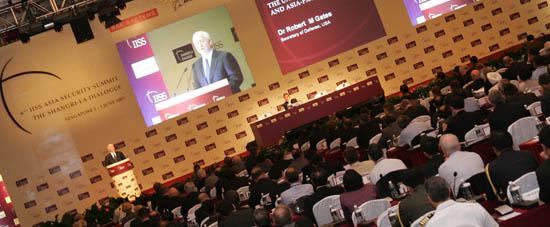
No announcement came, but on June 2 SECDEF Bob Gates (above), who knows how to read intelligence estimates, reiterated the early- to mid-next decade line during the IISS Shangri-la dialogue:
Question: … For a number of years now, the United States has been, at least according to the press and national intelligence estimates, foreseeing the possibility of Iran crossing the nuclear threshold within a period of around ten years, sometimes less, sometimes more. That estimate doesn’t appear to change much over the years, although from what I understand, and you have reiterated, that Iran has actually been doing stuff. And if I believe the latest newspaper reports concerning the IAEA’s assessment of Iran’s progress in terms of deploying and running centrifuges, the arithmetic would tend to point towards a threshold date much, much, closer than the ten-year timeframe which the United States has been putting forward. The IISS itself has been talking about a three-year timeframe. What is the current estimate? Thank you very much.
Secretary Gates: I think that the general view of American intelligence is that they would be in a position to develop a nuclear device, probably sometime in the period 2010, 2011 to 2014 or 2015. There are those who believe that that could happen much sooner, in late 2008 or 2009. The reality is because of the way that Iran has conducted its affairs, we really don’t know, and it puts a higher premium, it seems to me, on the international community coming together in terms of strengthening the sanctions on Iran so that they begin to face some serious tradeoffs—in terms of their economic well-being and their economic future—for having nuclear weapons. I don’t think anyone begrudges Iran the capacity to have peaceful nuclear power under proper safeguards and supervision. The key is whether they will have nuclear weapons. And so I think there is a way to move forward in this, but it does require all of the nations in the world to come to an agreement that Iran having nuclear weapons is a dangerous prospect, and increasing the pressure on Iran to try and make some very difficult questions in terms of the role they want to play in the international community and the impact on their own economic well-being. I think probably everybody in this room wants there to be a diplomatic solution to this problem. Having to take care of this problem militarily is in no one’s interest, but it does put a premium on unanimity in the international community—and I would say especially in the U.N. Security Council—in terms of ratcheting up the pressure on the Iranians, not next year or the year after, but right now, in line with the uncertainty about when their capability actually will come online.
The very straightforward answer came during questions, obviously, after his speech.
Gate’s 2010-2014 comment interesting because, as the question states, Iran “has actually been doing stuff.”
The 2008 or 2009 estimate is easy to understand—Iran could, with the current 1,968 centrifuges operating at 1.5-2.0 kg SWU per year and assuming 4.8 t SWU/a to produce 25 kg of 90 percent HEU, produce a significant quantity of HEU in 14-19 months or, say, September 2008-February 2009. (Readers might want to double check that calculation.)
But the “general view” of the IC is still—at least as of June 2007—2010-2015.
That’s odd, isn’t it?
One explanation is that the IC must believe Iran is going to, or has, run into some substantial operational barrier—maybe those Iranian manufactured components and/or UF6 feedstock really do suck ball bearings—that could add a year or more to the estimates.
That might explain the IC sticking by the 2010-2015 estimates, as well as the recent slowdown from Iran’s crash installation period this spring. For example, “a senior European official” told WaPo’s Robin Wright “They’ve committed down a road to expand as quickly as possible. But Iran won’t be the first to discover that it does happen to be rocket science, and development has its peaks and troughs.”
I had earlier noted that IAEA officials said Iran had enough good imported components 1,000-2,000 centrifuges, so that we would have to wait for evidence that Iran could get over 2,000. Stilll waiting, I guess.
Or, maybe, Iran may simply be attempting—as David Albright suggested—to learn to operate the centrifuges installed, rather than building more.
Or, maybe, Iran just wanted to create facts on the ground (underground, actually), avoid new sanctions and, perhaps, cut a deal.
Probably worth figuring out.

On Secretary Gates’ comment noting that “having to take care of this problem militarily is in no one’s interest,” it’s worth noting that Gates co-chaired, with Brzezinski, a CFR task force that gave an approving nod towards selective engagement with Tehran. (Of course, the member list of that task force is more revealing than Gates’ name being on the report.)
As per indigenous centrifuge production, Ali Akbar Velayati, a foreign affairs adviser to Khamenei, said yesterday Iran was self-sufficient in the area of centrifuge production and that all centrifuge parts were built and assembled in Iran. This could be, as you note above and Paul told TIME earlier, another attempt to “create facts on the ground” for political purposes. Either way, perhaps the next IAEA report will make an attempt to clarify this.
Iran has been just two-five-10 years away from building a bomb for the last 20 years as pointed out by Cordesman
And having the “capacity” isn’t exactly the same thing as building a bomb now, is it? Lots of countries have the “capacity” to build a nuke right now, theoretically speaking.
Correct me if I’m wrong, but there seems to be a mismatch in terms. Your calculation is for having a significant quantity of HEU. Gates’ estimation is for “be[ing] in a position to develop a nuclear device.” Perhaps the delay is the time the IC foresees Iran taking to produce the weapon from the material (which presumably means that they believe Iran would, under this very hypothetical scenario, try to build a true weapon rather than a crude device).
I’m with hass on this one—merely calculating SWUs and UF6 throughput is only part of the manufacturing process. It is probably fair to throw a few extra years on to account for weapon design and construction.
The WAPO article that broke the 2005 NIE stated:
Next Chernobyl in Iran?…may delay things bit…
http://www.newscientisttech.com/channel/tech/mg19526121.600?DCMP=NLC-nletter&nsref=mg19526121.600
Remind us, please, what kind of weapon we think Iran is likely to build with the HEU. Gun-assembly air-dropped bombs, single-stage implosion weapons (maybe boosted) that can be put on Shahabs, or what?
Dear Mr. Lewis,
I believe you are over-complicating a very simple situation. Is it not likely, in light of the experience with Iraq, that the US intelligence is simply voicing the views of its political masters? Similarly, Iran may simply be intent on building a nuclear weapon and secure in the belief that it will not be attacked under any circumstances.These assumptions do make things a lot simpler, don’t they?
“And having the “capacity” isn’t exactly the same thing as building a bomb now, is it? Lots of countries have the “capacity” to build a nuke right now, theoretically speaking.”
By my count it is 3. Japan, Germany and Ukraine could maybe do it in under a year. Brazil too? I don’t know, I would like to.
Could there not be concurrent programs running in Iran for the bomb itself and the nuclear material?