
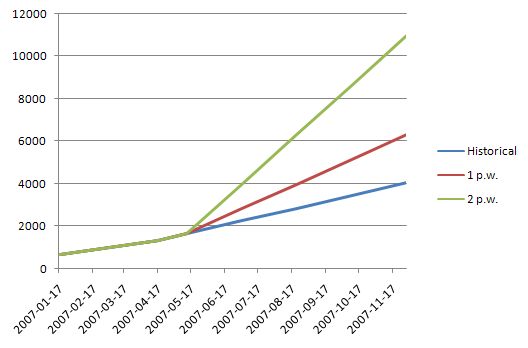
The chart is by Andreas Persbo, who has another interesting blog post expressing skepticism
about the IAEA’s assessment that Iran may install 3,000 centrifuges by August and 8,000 centrifuges by the end of the year.
“Although ElBaradei is a very capable guy,” Andreas concludes, “I personally remain sceptical to any claim that the Iranian’s suddenly constructs at a pace much higher than historically proven.
To help, Andreas made that graphic, as well as a table.
| Date | Historical | 1 per week | 2 per week |
|---|---|---|---|
| 7 January 07 | 656 | ||
| 16 April 07 | 1312 | ||
| 13 May 07 | 1640 | ||
| 2 July 07 | 2247 | 2810 | 3980 |
| 21 August 07 | 2855 | 3980 | 6320 |
| 10 October 07 | 3462 | 5150 | 8660 |
| 29 November 07 | 4070 | 6320 | 11000 |
Source: Andreas Persbo, “Iranian centrifuge construction,” Verification Matters, June 15, 2007.
Mark Heinrich with Reuters has a very good story that mentions some of the same questions that Andreas raises, particularly whether the question of whether the centrifuges are working as well as expected.
Damn the Torpedoes, Full Speed Ahead
Whether or not Iran keeps this pace, it seems that the Iranians are rushing to build large numbers of centrifuges that don’t work very well. (Paul has a nice roundup on some of the problems.)
That, to me, is very, very telling.
Iran—far from complying with UN Security Council demands for suspension—is racing, either for a bomb or to create “facts on the ground” that will present the United States and the EU-3 with a fait accompli.
Either way, Iran’s centrifuge program now seems driven by politics not technology.
Pakistan Did It, Too
”[T]he amount of centrifuges in there isn’t that important,” Persbo argues, adding that “the size of the facility already exceeds what Pakistan had at the beginning of their nuclear weapons programme.”
That’s true—Pakistan’s centrifuge facility at Kahuta probably had around 1,000 machines at the beginning of Pakistan’s bomb program. (Mark Hibbs reports the number of centrifuges in Kahuta as having now stabilized around 3,000.)
There is another, more apt comparison between Pakistan and Iran that ought to be made. Pakistan, too, assembled large numbers of sub-optimal centrifuges that frequently crashed as part of a, well, crash bomb program.
Hibbs recently quoted a pair of Western officials describing Pakistan’s early centrifuge efforts by noting that a would-be nuclear weapons-state might be …
… willing to take decisions and shortcuts which would mean that the initial failure rate of the machines might be as high as 10% and that ‘’after two or three years of operation, a very large number of machines would crash.’’
This, another Western official said, was ‘’exactly the route’’ followed by Pakistan during the early years of its centrifuge program in the 1970s and 1980s when it set up its first SWU plant at Kahuta. ‘’They built a lot of simple machines, there were lots of holes in the diagnostics, so they could make HEU in a hurry,’’ one official recalled1.
In 1992, US officials confirmed to Mark Hibbs and David Albright that Pakistan may have built as many as 14,000 centrifuges, out of which only 1,000 operated at Kahuta. Pakistan’s “junk pile,” according to one official “is sizeable2.”
What Do We Do?
The difference between Pakistan and Iran, of course, is that inspectors still have (limited) access to the Iran. If Iran starts churning out HEU with the current set of centrifuges, we’re likely to know before they have enough for a bomb.
At this point, Iran seems to be racing to create facts that will improve its bargaining power and, at a later, date give Tehran a bomb option.
Our top diplomatic priority ought to be getting a “warm standby” solution—where the centrifuges spin empty—as the technical basis of an interim pause during which Iran returns to compliance with the Additional Protocol (so we can inspect the centrifuge workshops). We can then negotiate some kind of multinational arrangement that imposes a much more intrusive inspection regime.
Keeping inspections in place, and getting Iran back into compliance with the Additional Protocol, is probably more likely to contribute to our security than toothless demands that for a suspension to which Iran responds by speeding up its program.
I think about policies to constrain and monitor Iran’s program over time, integrated as part of a larger coercive diplomacy to manage Tehran. I’ve written before about a hypothetical policymaker with an “indifference curve that defines the rate at which she is willing to allow Iran access to enrichment technology in exchange for better capabilities to monitor Iran’s activities.”
That, not coincidentally, is the subject of a little workshop that the New America Foundation is hosting with Stanley Foundation and the American Association for the Advancement of Science in mid-July.

Not exactly Led Zeppelin tickets, I know, but it should be quite a show.
footnotes
1 Mark Hibbs, “CIA Assessment On DPRK Presumes Massive Outside Help On Centrifuges,” Nuclear Fuel 27:24, November 25, 2002, 1.
2 David Albright and Mark Hibbs, “Pakistan’s Bomb: Out of the closet,” Bulletin of the Atomic Scientists 48:6, July/August 1992, 38-43.

With condescending phrases like “if Iran is very very good and well behaved, then we can allow them access to safe Nuclear Technology” it is clear that you have no idea what this is about or what the politics of this is about!Who appointed America to be the judge, jury and the executioner?Who appointed America as the Global Good and anyone who is not blindly obedient as the Global Evil?
From an American or an Iranian point of view, this is not about Nuclear Technology, weapons or anything of that sort.From Iran’s point of view, this is about “independence, political, foreign policy, economics, cultural” etc.From an American point of view this is about “not allowing a renegade country to break away from the world domination of America in political, foreign policy, economics and military”Now read your own article within this context and see if it makes sense?Travelling to a location as a tourist or even a reporter, or having a 10 minute “chat” over a glass of wine (or tea) does not constitute knowledge of people or the country.
You have to live amongst them as an ordinary person, see what they see, feel what they feel and then you will understand what this is all about!Whether you like him of hate him, the Iranian President tried to explain himself, Iran and many other nations who feel a fundamental and historical grievance against the West in general and America in particular, in his infamous 18 page letter to Bush. But because it did not have “sound bites” and was more than one paragraph, it fell on deaf ears.Not surprising, when your audience is western politicians or media with an attention span of a gold fish and the intellect of an amoeba.
“give Tehran a bomb option” is a meaningless, scaremongering assertion only since any country with a nuclear infrastructure has the “option” to build a bomb – including BRazil and Argentina. Its like saying butter knives have the option of being used as murder weapons.
“give Tehran a bomb option” is a meaningless, scaremongering assertion only since any country with a nuclear infrastructure has the “option” to build a bomb – including BRazil and Argentina. Its like saying butter knives have the option of being used as murder weapons.
Instead of drawing speculative parallels with the Pakistani program, a much simpler explanation for Iran “rushing” (in fact Iran is behind the nuclear schedule envisioned during the Shah’s time) are the constant threats of bombardment and sanctions, and the looming energy crisis. No amount of “coercive diplomacy” will make Iranians give up their sovereignty and energy security.
A direct request to Jeffery…
Oft quoted here are the “official” intelligence community’s estimates of Iran’s possession of 20 kg of HEU sometime next decade.As I have repeatedly pointed out, I think that those outside “official” estimates are an unsupportable crock.
I see 2009 as CW, with 2010 as superstition, and 2008 as heresy. (Altho, I am tending to jog these up a year, with 2008 as the new Conventional Wisdom)
What I would like is for you to post YOUR estimate.
Based upon what you see as valid data, and incorporating whatever error bands you need, when do YOU see Iran with a bomb’s worth of HEU?
Ignore any LEU already produced. Starting now using any reasonable performance (and kg-SWU/yr that you choose, whatever feedstocks, duty cycles, crashes, etc) that you are comfortable with, and with any growth rate in capacity that makes sense to you, while accumulating SWUs as they go along, what do YOU compute.
Assume two paths, one with Iran producing only LEU and then breaking out when SWUs have accumulated, and another going direct to HEU from NatU.
Use a spreadsheet, calculator, whatever, but what date range do YOU see?
No, Hass, to say that Iran is moving cumulatively closer to the capability to build a nuclear explosive device is not at all like saying butter knives have the option of being used as murder weapons.
Nothing will stop the Iranians. There is nothing to deter them with, unless the USA would be serious about relentless 24×7 x 365 decapitation strikes on the mullahs (no one would believe that)
The only question is to decide whether or not the Iranians can be deterred from use. If we look at the words of every leader in Iran since 1979, I’d have to say, no.
If yes, then we can have a cold war, and lots of useful strategies obtain.
If not…better to act today.
Better act today against what, exactly? The speculation that one day in the indefinite future, Iran may take an IAEA-monitored and safeguarded uranium enrichment program and decide to make a HEU and build a bomb? Well then, we should start bombing Japan, Argentina, Brazil too. Not to mention all the other countries that are going to become more and more reliant on nuclear energy in the future, and will want their own secure fuel source. Or perhaps we should bomb Iranian schools to prevent then from learning calculas, because learning calculas could be used to build nukes…
I am intrigued by all the estimates as to when Iran will “go nuclear.” I have the ultimate respect for those who make them, and consider them a valuable addition to the discussion.
However, I also believe anyone who really thinks Iran has not already made the political decision to build at least a couple of bombs is in serious danger of deluding themselves.
I was in Pakistan many times during the ‘80’s, before the Pressler amendment finally forced the Bush 41 folks to cut off foreign aid. Nothing I heard during those several visits gave me any confidence they would not move ahead, “even if we have to eat grass,” as Bhutto reportedly told Kissinger (who, remember, had told Bhutto “we will make a horrible example of you.”)
During one trip, the idea was even floated to me and others, whose names are being left out to protect the innocent, that the Paks would let the IAEA in prospectively, but not allow them to try to reconstruct what had happened before. They would therefore be allowed to retain the minimal deterrent force they had achieved, which fit well with their strategy at the time, namely to build a weapon of last resort. I believe that is Iran’s goal, (“The Minimum Means of Reprisal?”) and that there is little to be done save implementation of a grand, out-of-reach Middle East plan that includes a single Palestinian state, security guarantees from outside powers, maybe even a regional free trade agreement, all of which seem really distant at this point. (I actually wrote an inarticulate article proposing this in 2002 or 2003, in YaleGlobal Online. Don’t bother reading it.
Each proliferator has learned from the previous one. The major problem that I perceive is that the Israelis’ strategy of calculated ambiguity, followed for so long by India, was litrally blown up by the BJP in their ill-conceived decision to test again. So now the nuclear strategy most logically pursued by near-nuclear nations is that same ambiguity, followed by what I fear will be an inevitable test. In the meantime, as Iran has shown, it is possible to have a virtual deterrent, the subject of a forthcoming article somewhere foolish enough to publish me. But I want to provoke all the folks who read this excellent website and get their ideas.Who knows? I could even be wrong!!!
To me, it appears we have three options: bomb; accept; or inspect. Each has its obvious drawbacks. What do you guys really think? This could well be the most important national security issue of our age, and the lack of serious thinking about this (except of course by Lewis, Albright, et. al.) is scary.
Notice that I have not included the nutcase in the DPRK in this comment, because I have long ago stopped trying to figure Kim out. Today he wants the bucks in Macao in order to shut down his reactor; tomorrow he probably will demand a Hollywood cosmetic surgeon to do liposuction, fix his teeth, and stretch him to 6 feet tall before shutting down Yongbyon.
Hass asks: Is ”[t]he speculation that one day in the indefinite future, Iran may [overtly] take an IAEA-monitored and safeguarded uranium enrichment program and decide to make a HEU and build a bomb?”
Well, that is one scenario, and its important to note that there are serious limits to IAEA’s ability to safeguard effectively certain types of declared nuclear materials—especially when the State in question hasn’t signed the Additional Protocol (AP).
Another scenario is that Iran—which hid nuclear materials, technology and activities from the IAEA for nearly two decades—may do it again, but this time to acquire clandestinely weapons-usable fissile material. The IAEA comprehensive safeguard agreement (CSA) that the Iranian government concluded gives the Agency the right not only to account for Iran’s declared nuclear material, but also to ensure the absence of undeclared nuclear materials, and any undeclared technology and activities related to such material, in Iranian territory. CSAs, however, only give the IAEA the ability to exercise its right with respect to accounting for declared nuclear materials.
Until the Iran ratifies the AP (as Japan did in 1999), the IAEA will not have the actual ability to exercise fully this right, and ensure the absence of undeclared nuclear materials, technology and activities in Iranian territory.
Iran signed and implemented the Additional Protocol and allowed more inspections that even the AP required – with no evidence of a parallel program. Instead, the demands on Iran were simply raised, to abandon enrichment entirely. And Iran has indicated it is willing to allow AP and higher level inspections – but first its right to enrichment has to be recognised.
The NPT does not expressly affirm the right of any States Party to the Treaty to enrichment. Article IV only speaks of “nuclear energy for peaceful purposes without discrimination and in conformity with Articles I and II.”
What precisely this means is a matter of legal interpretation, as is the extent to which this necessarily includes enrichment. But it is a fact that the NPT nowhere explicitly mentions “uranium enrichment.”
Regardless of whatever rights the Islamic Republic of Iran (or any other State Party to the NPT) enjoys to “nuclear energy for peaceful purposes” under the Article IV, these rights are expressly qualified by the need to be in full conformity with Articles I and II. Article III, the IAEA safeguard article, helps to ensure conformity with Articles I and II. The IAEA Board of Governors found Iran—which hid nuclear materials, technology and activities from the Agency’s inspectors for two decades—to be in noncompliance with Article III. The Iranian government refuses to enable completely the IAEA to fulfill its role and right to verify the absence of undeclared nuclear materials, technologies and activities in Iranian territory. The IAEA has been clear about what problematic issues Iran must account for in order to explain fully its past violations of Article III and the related comprehensive safeguards agreement; Iran refuses to cooperate completely with the IAEA Secretariat. The Islamic Republic is therefore consciously preventing the IAEA from ensuring that Iran is conforming with Article III, and from helping to ensure that Iran is now fully conforming with Article II.
There’s nothing in the NPT that excludes enrichment but the language is sweeping – to the fullest extent possible and without discrimination.
Noncompliance with Art III requires proof of diversion of fissile material to military use, and the IAEA has found no such thing.
Iran has implemented MORE inspections that its safeguards agreement requires.
You can go over this over and over again Anon but the facts won’t change.
Incidentally, enrichment is a sovereign right that was merely RECOGNIZED by the NPT, not granted by the NPT. Iran has the absolute sovereign right to enrich regardless of what the NPT says.
To begin with, no right is absolute, Hass. For example, the Declaration of Independence recognizes the “inalienable right” (or, depending on the version of the Declaration you’re reading, the “unalienable right”) of man to “life, liberty and the pursuit of happiness.” But such rights, and their exercise, are not without limits. Malfeasance can lead someone to be denied happiness (e.g., fined), liberty (e.g., jailed) or, in extreme cases like first-degree murder, life (e.g., executed).
Under the NPT, Iran’s right to “nuclear energy for peaceful” purposes is not absolution and not without qualification. Outside of the NPT, I would certainly agree that Iran has a right to any nuclear material, technology or activity, including not only enrichment, but also so-called “nuclear explosions for peaceful purposes” (cf. NPT’s Article V), and even nuclear-weapon warheads themselves. But by signing and ratifying the NPT, a State agrees to abide by an international agreement that affirms the right of States Party to “nuclear energy for peaceful purposes without discrimination and in conformity with Articles I and II.” Which is to say that this NPT-recognized right—by being constrained by Articles I and II, the operative parts of the agreement that make it necessarily a nonproliferation treaty—is already less-than-absolute.
Moreover, Article IV doesn’t call for the “fullest exchange” of nuclear materials and technology, but for the “fullest possible exchange.” The qualification is crucial, for some nuclear exchanges are not possible under the NPT, because they would wholly undercut Articles I and II. That is why, for example, exchanges toward the purpose of “nuclear explosions for peaceful purposes” are not possible under the NPT. That is also why, when a State fails to comply with its Article III and IAEA safeguard obligations, complying States block nuclear exchanges with that noncompliant State.
In sum, so long as Iran remains an NPT signatory, its right to “nuclear energy for peaceful purposes” is not absolute, but constrained by full conformity with Articles I and II.
Moreover, by violating Article III and its comprehensive safeguards agreement (CSA), Iran undercut the key source for assuring that it is conforming fully with Article II. Iran concealed nuclear materials, technologies and activities from the IAEA for nearly two decades; obstructed IAEA efforts to account for such concealment; was found by the IAEA Board of Governors to be in noncompliance; and continues to stonewall the IAEA. (Larijani’s meeting with ElBaradei may mark the start of something different, but no one should hold their breath.) So long as Iran continues this course, and denies the IAEA the ability to ensure the absence of diversions to weapons or unknown purposes, it will prevent the IAEA from ensuring that Iran is conforming with Article III, and from helping to ensure that Iran is now fully conforming with Article II.