
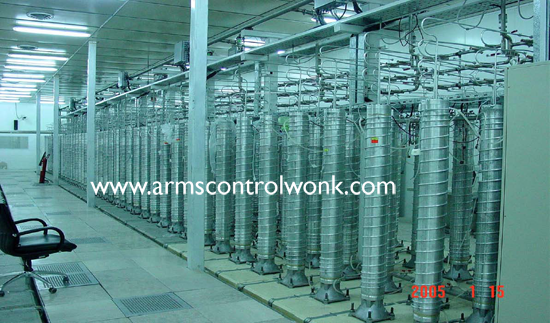
Yeesh, sometimes it’s hard to be a wonk.
Today, I planned to write about what happens if Iran places its centrifuge cascades in “warm standby.”
Still do, actually. But, first, a little housekeeping.
A Clarification To Yesterday’s Post
So in my last post—Pimp My Cascade—I didn’t notice how much Paul Beaumont’s story in The Observer story conflated P1 and P2 centrifuges.
First, I talked about problems that Iran is having with making the tiny ball bearings on which the rotors spin. That may be true, but Beaumont wrote that Iran had trouble manufacturing bearings for carbon-fiber rotors—which is a reference to the P2 centrifuge. I just kind of skipped over that.
Iran may or may not have had trouble with the bearing’s for the less sophisticated P1, which Iran will install at Natanz. We don’t know—although I have noted reasons for skepticism.
Second, I mentioned that the P1 rotors are made from aluminum, not maraging steel. I therefore concluded, wrongly, the maraging steel must be another reference to the P2—forgetting that Iran’s P2 design, unlike many others, uses a carbon composite:
An engineer who had previously worked on P-1 design established a private company after leaving the AEOI and proposed to work on P-2 centrifuges with composite rotors. He thoroughly explained to the inspectors the reasons for his choice of the composite rotors of carbon fiber instead of maraging steel. The experiences of industrial countries substantiate his claim.
As for what use Iran might find for maraging steel, a friend kindly asked: Um, from what are the bellows in the P1 made? Oh, That would be maraging steel ….
Experts who saw these drawings assessed that, based on the design’s materials, dimensions, and tolerances, the P1 in Iran is based on an early version of the Dutch 4M centrifuge that was subsequently modified by Pakistan. The 4M was developed in the Netherlands in the mid-1970s and was more advanced than the earlier Dutch SNOR/CNOR machines. Its rotor assembly has four aluminum rotor tubes connected by three maraging steel bellows.
So the inability to manufacture maraging steel might inhibit the manufacture of the bellows for the P1.
Now, About Warm Standby
Iran may announce that it is placing its cascades in so-called warm standby —“the centrifuges at Natanz would continue to spin with inert gases instead of uranium hexafluoride (UF6).”
To be clear, warm standby would not meet the UN Security Council demand to cease all centrifuge related R&D—Iran, according to the IAEA, would still learn about “the life expectancy and durability of key mechanical components, the failure of materials, the effects of vibrations, electric power requirements…a detailed understanding of the different ways that centrifuges can fail, and information needed for the development of more advanced centrifuge systems.”
That doesn’t mean, however, that warm standby might not be part of a verifiable pause in Iran’s centrifuge program. Under “warm standby” Iran will not learn some things that have bedeviled the Iranian program, including “the relationship between UF6 gas flow, temperature and stress corrosion.”
It would seem to me that, if Iran makes this announcement, the United States and its European allies should move swiftly to consolidate the suspension, er standby.
Warm standby could be part of a verifiable pause in Iran’s program, if coupled with other measures including renewed adherence to the Additional Protocol and progress on resolving outstanding questions about Iran’s past activities, particularly its P2 centrifuge program.
Warm standby is not a comprehensive or indefinite solution to the problem, but it does present a face-saving measure for Iran to return to negotiations. We should reciprocate, modestly.
At the same time, some aspects of pressure must remain on the table, particularly if Iran continues to construct the IR-40 heavy water reactor near Arak or refuses to cooperate with IAEA inspectors.

G’day:
Beyond learning about the lifetime issues, what are the issues involved in just shutting down, and then restarting the centrifuges.
Under warm standby Iran will not learn some things that have bedeviled the Iranian program, including the relationship between UF6 gas flow, temperature and stress corrosion.
More precisely, Iran will not learn “the relationship between UF6 gas flow, temperature and stress corrosion” USING THOSE CASCADES (which may very soon reach six 164 units – 4 underground and two in the lab.)
Unfortunately, they will become experts in those issues using the micro-cascade of 2 or 4 or 8 or whatever centrifuges in test in the old squash court under the stands at the cricket stadium at Ol’ Teheran U.
Cascades are not needed to answer these questions (or possibly now, former questions).
All the while, the 1,000 centrifuges will be calmly whizzing along, just waiting for their first taste of pure hex made from a smidge of the 10s of tons of primo UO2 from our friends the Russians, already pre-enriched almost 90% of the way to HEU.
Ready to go along with the Po-110 for the initiator being whipped up at one of their “research” reactors? Or to use with one of the implosion assemblies getting the finishing touches now that their long testing series out in the hills is completed?
Or as Cochran and Paine point out:
Finally, any truly credible international safeguard system for such facilities must somehow address two problems—the possible parallel development of clandestine facilities and the inherent threat to “break-out” of the NPT—which may be the most significant components of international concern regarding Iran’s emerging national capacity for uranium enrichment. Once this capacity is fully developed, the critics reason, what is to prevent Iran from siphoning off small quantities of low-enriched uranium (LEU) product for further enrichment in a small clandestine parallel facility, or from suddenly leaving the NPT and reconfiguring the plant to produce highly-enriched uranium (HEU) from already enriched LEU feedstock. LEU typically represents 70-90 percent of the total separative work needed to enrich uranium to 80-90 percent U-235 (?)…
Good question..
yale
Sorry for the newbee technical question, but what is the function of the… chair in the left side of the picture? Do they just sit there and watch the centrifuges in case one blows up? Doesn’t that kind of give an unhealthy mess? Do they climb on top of it to fix things? That would be one shoestring budget nuclear program.
But back to the topic of an enrichment standby. I noticed that this scoop came from Jeffery and Steve Clemons (Congrats on the new job btw).
Steve has a new post up how he has been sworn to secrecy by this international diplomat with a huge story he told Steve, and 300 others, on the 6th.
Its one of those long and winding posts Steve always writes full with useless details such as:
* Meeting the diplomat thanks to another “significant” think tank “in town”
* This diplomat being of the “more important” “international” kind
* The diplomat who being in front of an 300 people audience with the likes of Helene Cooper of the New York Times and Jim Hoagland and Karen DeYoung of the Washington Post
* Steve asking a question on something “extremely important” to US foreign policy
* A NYT journalist talking to Steve about how much not talking about this sucks… I guess she agrees on the “extremely important” bit.
* Steve’s question having to do with a story neocons called a “European fabrication”.
Boy does he sound frustrated he cant share any details. Anyway I fired up google to get some of the agenda`s for the “significant” think tanks. Did anyone know the Carnegie endowment http://www.carnegieendowment.org/events/ had a big two day launch of their “new vision”? It sounds like a big Washington insiders gig… Why, I bet there could easily have been, I don`t now, over 200 people there?? I bet big journalist wouldn’t wanna be any other place at that time.
For dessert they had Ambassador Javad Zarif, Permanent Representative to the United Nations of the Islamic Republic of Iran over for a little Q&A.
He is a diplomat, he is “international” (UN), he knows stuff of “extreme” importance to US foreign policy. Could it be he mentioned something on this warm standby deal? A confirmation that its on the table maybe? Are there any neocon claims this is a European fata morgana? Does anyone have something to help a someone on a lone speculative quest?
Nuclear enrichment is Iran’s right, and is necessary for the country’s future. No Iranian politician is going to give it up.
A theocratic regime has no rights at all.
Alas, no matter how offensive they may be, even theocratic regimes have rights.
Actually, nuclear enrichment for peaceful purposes is Iran’s right. Iran’s intent is the core of the issue. Given Iran’s previous subterfuge and weapons-related activity, the international community is prudent in its skepticism regarding Iranian claims of peaceful intent, particularly when Iran’s President can’t keep his mouth shut.
Whether or not nuclear energy is necessary for the country’s future is debatable.
Perhaps no Iranian politician will give it up, but are there any that would support the level of intrusive inspection necessary to reasonably guarantee Iran could not clandestinely enrich fuel for weapons?
And responsibilities.
I would think it would be easy to say Iran is handling the development of their nuclear fuel cycle in an irresponsible manner.
The absence of rights is not a value judgement. It has a very clear legal implication, that a foreign country can take any action regarding the government of Iran and its individual members, as long as such an action is not prohibited by the laws of the foreign country.
Another newbie question. From Cochran and Paine: “With an enrichment plant tails assay of 0.2% U-235, one kilogram (kg) of HEU product can be obtained by enriching 175.73 kg of natural uranium (0.711% U-235), with a separative work requirement of 227.34 kg SWU. Assuming the same tails assay, the 175.73 kg of natural uranium can be enriched to LEU, producing, for example, 20.88 kg of 4.5% U-235, and requiring 160.56 kg SWU. An additional 66.73 kg SWU are required to further enrich this 20.88 kg of LEU to obtain 1 kg of 90%-enriched HEU product. In this example, 70% of the separative work is used to produce the LEU and 30% to get from LEU to HEU.”
Is this a statement that the amount of time to separate from 0.7 to 4.5 percent is longer than the time from 4.5 to 90 percent, or simply a statement that fewer centrifuges are required to go from 4.5 to 90?
B.A. Wrote:Is this a statement that the amount of time to separate from 0.7 to 4.5 percent is longer than the time from 4.5 to 90 percent, or simply a statement that fewer centrifuges are required to go from 4.5 to 90?
The short answer is: Yes.
Both are true. The vast bulk of the separative work (and the time it takes) is done going from the natural uranium (at 0.7% U235 content) to Low Enriched Uranium (LEU) at 4.4% U235 content.
The remaining work to go from LEU to HEU may be done extremely rapidly with a large number of centrifuges, or proportionately longer with a smaller number of centrifuges (using a hidden array of machines or subset of the full set of cascades).
Let me give a crude explanation of the counter-intuitive process.
Imagine a bowl with 1,000 ping-pong balls in it. 993 of the balls are green. 7 of the balls are red. The balls are at “0.7% Red Enrichment.”
Now imagine reaching in the bowl and pulling out unwanted green balls. You are doing “separative work”. You will be leaving the red balls in the bowl.
Remove 840 green balls, a long and tedious job.
Now you have 153 green balls and 7 red balls.
You are now at “4.4% Red Enrichment”
Last step. This time remove only 152 green balls.
This leaves 7 red balls and 1 green ball or an “88% Red Enrichment.”
So note: It took EIGHT-FIVE percent of the work to go from 0.7% to 4.4%!
That is why “Peaceful” enrichment is a fraud, and selling someone LEU for their “civilian” power plant is nutzy if they have even a miniscule and crude enriching technology – centrifuges, calutrons, whatever.
To Bill Arnold:
Like it says, it is a measure of separative work. That could mean either less time with the same number of centrifuges, or the same amount of time with fewer centrifuges.
It may help to read “kg SWU” as “kg SWU per annum,” i.e., a rate of work over time.
It is perfectly counterintuitive that it takes much more effort to go from 0.7 to 4.5 than to go from 4.5 to 90, but think of it this way: enrichment basically amounts to the removal of excess U-238. To get from 1% enriched to 2% enriched would require removing fully half the U-238 present. After that, it’s all downhill.
Hass wrote:Nuclear enrichment is Iran’s right, and is necessary for the country’s future.
Ignoring, for the moment the necessity (or desirability) for Iran (or for that matter ANY country to use nuclear energy), is it strictly true that Iran has the “right”?
If it had the “right”, than how could sanctions have been already applied?
Going back to the Cochran and Paine essay that was previously quoted:
Iran is right in insisting that the current U.S. and EU policy of singling out Iran, while turning a blind eye to construction of sensitive nuclear fuel cycle facilities in other countries, is symptomatic of a double standard that is unfair and unsustainable. But recognizing this bias in Western policy does not mean that Iran is correct when it insists that it has a clearly established and unlimited “right” under the NPT to deploy a complete nuclear fuel cycle, in defiance of the views of the other Parties to the treaty and the IAEA.
Under Articles I and II of the NPT, the nuclear weapon State Parties are obligated “not in any way to assist, encourage, or induce any non-nuclear-weapon state to manufacture or otherwise acquire nuclear weapons or other nuclear explosive devices…” and the nonnuclear weapon State Parties are obligated “not to seek or receive any assistance in the manufacture or nuclear weapons or other explosive devices.”
All Parties are obligated under Article IV of the treaty to interpret their “inalienable right” to the peaceful uses of nuclear energy “in conformity with Articles I and II of this treaty.” In other words, the “right” to exploit nuclear energy for peaceful purposes is not unlimited, but rather constrained by the nonproliferation obligations undertaken by the Parties in Articles I and II. It is a well-settled principle of legal interpretation that no statute or treaty should be construed in such a way as to nullify its basic intended purpose.
These articles clearly bar transfer to, and receipt by Iran of any form of assistance in the manufacture or acquisition of nuclear weapons. To the extent that the international community sincerely views Iran’s long-concealed program to acquire a large-scale enrichment capability as undermining or circumventing the basic purpose of these articles, then the international community is clearly within its rights in insisting that Iran cease its enrichment efforts until some mutually acceptable arrangement can be worked out, i.e., until a majority of the Parties come to believe that large-scale enrichment by Iran no longer threatens to circumvent the prohibitions in Articles I and II of the Treaty.
How do you organize a large number of centrifuges so that the enrichment is quicker, i.e. make the time/number of centrifuges trade-off? Is there a recommended tutorial/survey article on this publicly available?
Andy wrote:
“Perhaps no Iranian politician will give it up, but are there any that would support the level of intrusive inspection necessary to reasonably guarantee Iran could not clandestinely enrich fuel for weapons?”
This question would become operative if the US altered its position that Iran should not be allowed to have any enrichment capability under any set of rules, however stringent.
As Yale argues persuasively in this forum, the US position is not unfounded, since even a very limited Iranian enrichment capability would put Iran within sight of quickly obtaining enough fissile material for a small number of bombs.
The other side of the coin is the question of whether Iran can be prevented from gaining that capability, and what are the consequences of trying to prevent it.
The third way, which was apparently open in 2003 and which nobody seems to be trying seriously to reopen now, is a grand bargain which would ultimately allow Iran to fulfill its peaceful nuclear and other ambitions, in the context of normalized relations with the West and at least accomodation with Israel.
Mark G. points out that we seem to have seriously bungled a nice-looking opportunity to do some major peacemaking with Iran back in ‘03.
See Paul K’s thread on the lost cause here
I have to say I was ignorant of the fundamental mathematics of enrichment – thank you Yale for explaining it so clearly. I’m surprised it isn’t used policy debates because it’s very persuasive.
Mark,
The nice thing about America is that a change in the US position can potentially come every four years. If the Iranians are smart they should keep quiet until a new administration takes office – one that will probably be more amenable to negotiation or at least less confrontational.
Bill: from my limited understanding the precise configuration of the centrifuge cascade isn’t the key issue: if your cascade of centrifuges is set up so as to go from natural uranium to LEU, you can just collect the end product and run it through the cascade again and again until you get the desired purity. It’s just an issue of the number of centrifuges you have, their efficiency, and probably most importantly whether they will run reliably for long periods of time without smashing themselves into a million pieces from vibration.
The major tradeoff actually relates to how quickly you get your HEU, versus how much uranium you waste in the process. Basically, the more u-235 you want to squeeze out of your natural uranium, the more work it is to get a given quantity of HEU.
That said, Rod Barton, an Australian, wrote an book which briefly discussed the pilot-scale enrichment plant Australia built back in the 1960s and 70s. According to Barton, according to his conversations with the plant builders, the most difficult part of the whole procedure was not the centrifuges themselves, but the plumbing…
You can play with the numbers with fas.org’s SWU calculator (do a google search for it – links don’t seem to be working).