

Say that three times fast.
And, yes that is a picture of Iran’s 164 centrifuge cascade.
Reuters’ Mark Heinrich reports that Iran has completed a second 164 centrigue cascade at the Natanz pilot fuel enrichment plant—but that the Iranians are conducting only “dry runs” without any uranium:
“The second cascade was brought on line earlier this month but they appear to be just running it empty. That is, vacuum-testing to assess durability,” said the diplomat, close to the Vienna-based International Atomic Energy Agency.
George Jahn with AP had a similar story, but his nearly 800 word article was hacked to death by a number of newspapers. (The link I posted has everything, I think). ElBaradei confirmed the second cascade during his visit to the US (see stories by WaPo’s Linzer and NYT’s Sanger), adding that Iran was ready to introduce uranium into the new cascade.
Hard to say whether the Iranians are deliberately going slow or having technical trouble. David Ignatius had a long story in September, reporting that Iran’s “centrifuges are overheating when uranium gas is injected.”
“The Iranians are unable to control higher temperatures, and after a short period they must stop because of higher temperatures. So far they haven’t been able to solve this,” says one Western intelligence official who has been briefed on the IAEA findings. In addition, this official said, some centrifuges “are simply crashing—10 or so have broken down and must be replaced.”
Apparently some (but just some) of these analysts think the problem relates to Iran’s dirty hex—something I have blogged to death. (Oh say, here, here, and here just to get you started.)
Paul recently summarized
all the intel dope that we have through October.
Placing Iran’s Enrichment Activities in Standby
I give you all of this to renew an old debate that began with a paper my colleague, Matthew Bunn, wrote entitled, Placing Iran’s Enrichment Activities in Standby. In that monograph Bunn argued that placing the centrifuges at Natanz in one of two “standby” modes offered a way out of the current stand-off over suspension:
One option for Iran to suspend enrichment activities without compromising its future ability to resume enrichment is to place the 164 centrifuge cascade at Natanz in a standby mode. The United States considered “warm standby” and “cold standby” options for its Portsmouth enrichment plant several years ago. Despite the vast technical differences between a large gaseous diffusion plant and a small centrifuge facility, these approaches may provide analogies that the parties could draw on to forge an approach acceptable to all sides. An acceptable approach would have to assure the United States and Europe that the standby activities would not significantly increase Iran’s capacity to manufacture nuclear weapons material; by the same token, accepting such an approach would require Iran to make a strategic decision not to pursue an option for rapid production of such material.
David Albright and Jackie Shire disagreed, calling warm standby a “bad idea” and citing an IAEA report that warned Iran would learn information about “the life expectancy and durability of key mechanical components, the failure of materials, the effects of vibrations, electric power requirements…a detailed understanding of the different ways that centrifuges can fail, and information needed for the development of more advanced centrifuge systems.”
Policy disagreements are good for our community. Jackie and I even still did BloggingHeads together.
And, David and Jackie had a point: they were right that Matt (and me, too) didn’t emphasize that zero centrifuges would be the best option. But—as the recent news points out—our choice is probably not between zero and 164, it’s between 164 (or 328 now) and something worse—an Iranian nuclear weapon, maybe, or a war … or both.
The IAEA hasn’t released the report (hello, friends! it’s called e-mail!) but one of the areas where actually running UF6 through the centrifuges could improve’s understanding of centrifuge operations turns out to be … the relationship between UF6 gas flow, temperature and stress corrosion.
So, it would seem to me—given the problems that Ignatius claims Iran has experienced—we do have an interest in keeping the hex out of the centrifuges, something that placing the centrifuges in standby—either warm or cold—accomplishes.
The Downside
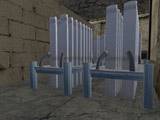
Of course, that means we don’t get to send in assault teams to blow up nuclear facilities near Natanz and Esfahan—which you know, is kind of a bummer.
Fortunately, we have virtual reality. Kuma\War—a free online war game—makes first person shooter games based on “real-war events from the news.”
And, oh yes, that is a CGI centrifuge cascade at Natanz (right, above).
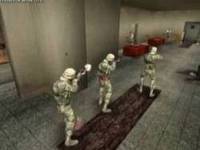
Mission 58: Assault on Iran
is a little wet work to stop the Iranian bomb, a chance—in the words of the trailer—to “destroy the materials … destroy the knowledge … leave no trace ….”
And, hell yes, “destroy the knowledge” means you get to mow down Iranian nuclear weapons scientists at their desks (left).
I don’t know, did that guy look like he tried to surrender?
Anyway, makes for great virtual fun, even if it would also make for lousy real-life policy.

Apparently the Iranian response to Kuma/War was released last month:
http://today.reuters.com/news/articlenews.aspx?type=internetNews&storyID=2006-09-30T141007Z_01_RON037445_RTRUKOC_0_US-SECURITY-IRAN-GAME.xml&WTmodLoc=InternetNewsHome_C1_%5BFeed%5D-5
Isn’t this encouraging children to be cruel to helpless renegade nuclear weapons scientists?
I love the serious tone of the Reuter’s story:
Clearly written by someone who has never enjoyed the simple pleasure of HALO.
I have a hypothesis for the overheating problem, but keep in mind that I am a centrifuge ignoramus. Let us suppose that the Iranian machines are Zippe type units that use the pickup scoop to generate the countercurrent flow.
In this case, I think the centrifuges are spinning far too slowly and this is causing the overheating. Ideally, the scoops are in a zone in the rotor where the pressure is considerably reduced due to the centrifugal acceleration. The centrifuges are spinning so slowly that the scoops are no longer in a rarefied gas zone inside the rotor. Note that the pressure is proportional to the exponent of angular frequency squared. Consequently the generated shock wave dissipates far more energy because it has to push through far more gas. The result is that when they bring up the pressure of UF6, the machine generates hundreds of extra watts of heat which can’t be rejected. This happened because the machine was designed to be operated at 350 m/s but is only operating at maybe 250 or even 200 m/s.
Let’s do the numbers:
Rotor speed (design) 350 m/sRotor speed (actual) 250 m/sRotor radius 10 cm (?)Scoop radius 7 cm (?)Scoop width 1 cm (?)Ambient pressure at the rim 1 atm (?)
To get a rough estimate of the scoop dissipated power, we can integrate the fluid kinetic energy incident on the scoop and it’s supporting structure from the inner hub to the radius of the scoop radius.(this is easier but less accurate than using the shock equations and some estimates of effective projected area) This integral can be done in closed form and the analytical result is too long for me to post here(I’ll send it and a plot of scoop power to anyone who is interested) I find that the “scoop power” goes from less than 100 W at 350 m/s up to nearly 600 W at 175 m/s. If there are two scoops, double it.
To calculate temperature rise, we can assume that the rotor is a blackbody. Assume a 2 m long rotor, emissivity 90%, and motor efficiency of 80%, then 600 W translates into a temperature rise of the rotor of about +75 C which is I suppose a reasonable guess for the operating temp limit.
WOW! The Iranian machines are junk and spinning at 1/2 to 2/3 of the design speed. Therefore, the SWU will be 10% or so of the 2-3 SWU design point – e.g. less than 0.5 SWU.
This is great news(if you don’t happen to be Dick Cheney). This will be very difficult to fix because it requires that the centrifuge manufacturing and tolerancing process be improved dramatically. It is not just a matter of tinkering around a little bit.
I an very surprised that nobody understands how completely irrelevant the centrifuge problems are. Jeffrey described the choice we face, but got it rather wrong. There are just two choices – Iran developing nuclear weapons or the US going to war.The Iranians will of course find nuclear development difficult, but they will succeed unless somebody stops them. Simultaneously, nobody can guarantee they haven’t already got many more centrifuges and cascades, because there is very little credible information on Iran. In this situation, there is one simple thing the administration should do – publicly announce that the US will renounce all mutual defense agreements with countries that do not support massive sanctions and rule out military action against Iran.If the EU is unwilling to ensure the security of US forces in the Middle East and that of the State of Israel, it should be left alone. Permanently.
Well, “John Smith (with no e-mail),” your comment strikes me as self indulgent.
You make a claim — “there is very little credible information on Iran” — which is meaningless. In some areas we know quite a bit about Iran’s progress from IAEA inspections and national technical means; in other areas, we have less knowledge.
Whether we can confidently detect a clandestine Iranian program will depend very much on the particulars, not a sweeping statement offered with no evidence.
As for your policy statement, even if I accept your rather dramatic reduction of the outcomes for Iran, making a sweeping statement as you propose — “publicly announce that the US will renounce all mutual defense agreements with countries that do not support massive sanctions and rule out military action against Iran” — would reduce the chance of an effective sanctions regime or, if necessary, international support for military action.
Were I an Iranian, I would hope the US would make such a polarizing, self-defeating statement.
You seem angry and frustrated with the situation, which I understand. But that makes for bad policy, which I won’t countenance.
First of all, I do not think that not giving my e-mail address affects my credibility. One often enters an internet discussion purely on the merits of a person’s argument, rather than the fact that they do or don’t provide personal details.
To return to Iran, I do not consider any IAEA information to be highlky credible, because its activities in Iran are so restricted. Governmental intelligence is also weak when it comes to Iran, for the simple reason that it is a mostly closed country.
Thus, an Iranian weapons programme can be detected if the Iranians are clumsy enough to allow the IAEA or Western intelligence to see definite proof of its existence, which is unlikely.
My “sweeping statement” is designed as a polarising concept. It should be the duty of all nations to prevent Iran from acquiring nuclear weapons, regardless of what the US does or doesn’t do. The US cannot stop others if they decide not to act, but it can change its own policy in a fundamental way. There is no reason for the US to support the EU and Japan if they do not help maintain American security. On the other hand, cutting support will reduce US commitments and force the other parties to fend for themselves.
Essentially, the “international community” should never have to give anybody its support, it should act in concert without prodding. In the case of Iran this means that the US should not seek support, but should declare that its forces and allies are at risk and demand action. If no action is taken, America will be able to take whatever action it deems necessary. I would further argue that letting Iran develop nuclear weapons and letting the EU pick up the pieces (i.e. a simultaneous withdrawal from Afghanistan and Iraq) is in US interests, as it allows a further narrowing of commitments and puts others in the line of fire.
I am not angry and frustrated in the way you think. The Iran crisis is insignificant in the long term, it is the behaviour of the EU and other traditional US allies which is of fundamental concern. Good policy involves making them stand up, or letting them sink. Now, before major crises develop, is the best time to test whether the allies want to stand up and fight. If they do not, relying on them is useless in any case.
John, as to the question of e-mail, I like to know the identity of the anonymous commenters. My site, my rules.
You continue to assert that we have poor intelligence without substantiating the claims. There is, of course, a counterexample: Iran had a clandestine centrifuge program at Natanz that we detected.
One for one, there chief.
Finally, I was saying that you seem angry and frustrated by the Iranians and our allies—which I think is pretty evident from your willingness to write off security relations with any allies who don’t think exactly as you do on Iran.
[John Smith provided some biographical details, which I won’t broadcast to the entire world.]
So who did detect Natanz? As far as I am aware, dissident Alireza Jafarzadeh uncovered it in 2002. I don’t think that counts as “we”.
As far as allies go, if they don’t think like me, they are prepared to put US forces at risk. Which means they should not be allies of the US, because what exactly is their usefulness to America if they don’t help us defeat major threats?
Well, this is why I wanted you to be specific about our intelligence strengths and weaknesses. I think you are wrong about NCRI and Natanz.
I put up a post about that issue, entitled NCRI Did Not Discover Natanz.