
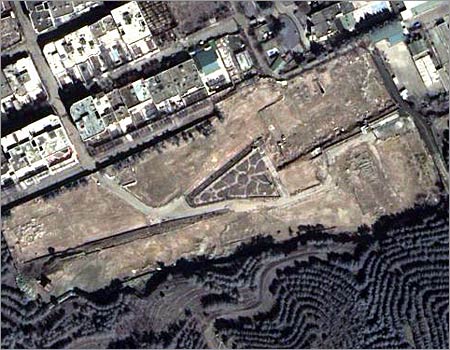
Well, some big developments today.
Louis Charbonneau at Reuters reports that IAEA samples of equipment from Lavizan-Shian suggest the presence of highly enriched uranium:
“Preliminary analysis by the IAEA showed traces of highly enriched uranium in the (pump) samples,” a Western diplomat accredited to the IAEA told Reuters on condition of anonymity.
The former physics center at Lavizan, which advised the defense ministry, acquired some dual-use machinery useable for uranium enrichment, including vacuum pumps.
A diplomat in Vienna, where the IAEA is based, confirmed the new finding but warned against exaggerating its significance: “It’s no smoking gun. There could be many explanations. But it increases pressure on Iran to come clean about Lavizan.”
Preliminary findings are just that—preliminary—but confirming HEU at the site would be major cause for suspicion.
One possible explanation for the HEU would be a clandestine enrichment program—a possibility raised by “a diplomat from a country critical of Iran” who told Charbonneau “Our (intelligence) assessment is that you cannot explain Iran’s progress without secret (enrichment) sites being involved.” US intelligence, by the way, doesn’t believe a “brick and mortar” parallel program exists.
***
The second bit of big news comes from a physicist using the nom-de-plume Richard Feynman.
“Feynman” noticed that I made a mistake in my post, More Fun With SWU. Readers may remember that I estimated the capacity of Iran’s centrifuges at 2.3 kg SWU/a year based on Aqazadeh’s claim that 48,000 Iranian P1 centrifuges could produce 30,000 metric tons of 3.5 percent LEU per year with a 10:1 feed to product ratio.
That may well be a goal for Iran, but other technical information provided by Aqazedah reveals the performance of Iran’s 164 centrifuge cascade was much lower—about 1.5 kg SWU/a:
There are two ways to go.
One is to take Agazadeh’s statement about how many centrifuges (48000) it takes to produce 30 t of low enriched fuel. That’s fine, this give 2.3 kg SWU/a per P1 as you posted. Fine.
But this could be their goal, not the current status for the P1. Because….
If you start from his other statement, that “currently” 70 g/h uranium are fed, that makes the Feed 613.2 kg/a, the Product 61.3 kg/a and the waste 551.8 kg/a. Putting this into SWU = product*V(xp) + waste* V(xw) – feed* V(xf) (this is standard textbook formula) and the V(x) are defined as (2x-1) ln(x/1-x) where ln is natural logarithm and xp,xw and xf are 3.5 %, 0.4 % and 0.71 %.
Then this simple ex gives a total 240 kg/a or 1.46 kg SWU/a for the P1.
So maybe with the earlier statement in the interview he was giving information that he did not intend to reveal. 1.46 kg SWU would clearly show that some technologies are not mastered yet.
I offer “Richard Feynman” my admiration, gratitude and, next time he visits Cambridge, a beer for his efforts.

Not sure why the discovery of traces of HEU at Lavisan would be any more of a big deal than discovery of the same traces elsewhere in Iran—which were traced to contamination. Jumping ahead a bit, aren’t we?
That was (sort of) going to be my question… are these centrifuge components that were bought used? Or is there good reason to think that this is some good old-fashioned domestically manufactured HEU?
Most other data points support the idea that this could be contamination, probably from Pakistan. However, material facts may not matter in this case.
given the subject matter here, what did you think about the washington post article on bio weapons labs, and scott mclellans harsh response?
covered here in a bit of detail.
meanwhile, at the very same time, the beginnings of Big Brother
it didn’t seem to link, so link is in the name in the post above. the link to the bio weapons lab story/controversy is the name in this post. thanks
The IAEA has repeatedly noted that it has been able to trace some of the HEU environmental traces to contamination of equipment from a third country. It has made clear, most recently in the SIR released on Monday, that there it can not explain some of the HEU traces and any of the LEU traces to that source.
The Iranians put forward explanations for traces at Kalaye, those explanations don’t work for the cleared and razed site at Lavizan.
IF HEU really was found in the pumps it would be a big deal. Except if they also were supplied from the centrifuge enrichment yunkyards of AQ Khan. In that case the HEU contamination could be explained.
But how was it now, these pumps were not intended for Natanz, for kalaye or any of the other declared enrichment facilities. I seem to remember they were not even intended for the lavizan facility. So what then were the Iranians using HEU contimanted pumps for ???
Re “Richard Feynman’s” analysis – he assumes that Aqzadeh was talking 70g U as UF6 when in context he most likely would have meant 70g UF6 (47g U).
Quantities of UF6 are measured – the contained U is inferred. The cylinder in the autoclave will be losing 70g an hour of UF6 – their load cell will tell them that.
It seems to me that we are inferring more information than is really present.
As Russell points out, it isn’t clear exactly whether we are talking about UF6 or U. But, if it is UF6 as Russell suggests, then the SWU of the centrifuges is even smaller – now only about 1 SWU/yr.
Also, I think 3.5% and 0.4% works out to be a 9:1 tails:product ratio anyway.
10:1 would be about 0.43% tails, I think.
And, maybe they’re just running the centrifuges a little slower at first.
Or, maybe they don’t have the gas velocity profiles optimized yet.
Or, maybe for the first cascades, they haven’t set up the product/tails cut optimally. I mean, it probably takes time to optimize that – a little time.
Or, if the Iranians really are interested in nuclear weapons, they might have arranged their 164 unit modules so as to permit more efficient batch processing to elevate the enrichment ratio to HEU. In this case, the cascade wouldn’t be optimal for LEU production.
By the time you add up all the uncertainty, I don’t see how this limited information could reasonably be extrapolated into an estimate of what they will be getting when they have 48,000 of the things installed – or how long it will take them to step up to that point.
I don’t think “richard feynman” is wrong, but given all the wild uncertainties, I think you’ll get a more accurate answer by directly calculating what the capabilities of the P1 are based on its physical design rather than attempting to do signal processing on the noisy rumor mill coming out of the news media.
I checked the 28 april IAEA report on Iran. There it says that the samples the IAEA took were from equipment bought by the former head of the PHRC (i.e. Lavizan ) for a university. And now that equipment appears to have been HEU on it. If it’s true, Iran will have some difficulties to explain it.
Please give some perspective for the ignorant: is this sort of discovery common in the vicinity of all processing plants or is it evidence of carelessness/incompetence? Did they dig up the trees or leave the stumps?
Sam,
no the traces were not found on the environment but on vacuum pumps, which were shown to IAEA at some university. So incompetence? sort of…
Some nice before and after shots:
http://www.iranwatch.org/privateviews/ISIS/perspex-isis-Lavizan-061704.htm
John Field is right on target. Too much analysis supported by too little information from too noisy a source, as usual. The reports are news because they are in the news in the midst of a political crisis. Not because it is likely that they signify something previously unknown.
The NY Times’s William Broad took the effort to mention the eariler swabs of HEU found, but never mentioned that the IAEA is now generally under the impression it was contamination and not local. Neither does Broad provide any possible explanation for the recent HEU than the most damning.
It would have been nice if you’d provided a link to one of your old stories on the last swabs, or a peice you find even more enlightening on the same.
Oh, and I have this weird feeling that the unnamed diplomat is, in fact, John Bolton 🙂
a Western diplomat accredited to the IAEA told Reuters on condition of anonymity…
How much credence can we assign to this report if we can’t see who filed it, in order to further verify it????
The IranWatch.org images of “before” and “after” at Lavizan reminds me of the before and after shots of Iraqi trucks at “WMD sites” which according to Powell supposedly showed that the truck were “decontamination vehicles” sent to “sanitize” the site—it turned out to be a water truck.
And if I am not mistaken, it was touted by IraqWatch.org
Note for Hass,
The Lavizan site was more than simply cleaned – it was razed to the ground with all buildings removed and 1-2 metres of soil removed from beneath the buildings. This was a bit of an over-reaction on the part of Iran to the IAEA’s success of finding traces despite of the extensive clean-up at Kalaye.
There is no doubt that the site was razed – that is not a mistake or an illusion. The Iranians say it was done over a dispute over the ownership of the land between differing tiers of the Iranian government.
Note Josh Narins – last September the IAEA published a sentence in their Iran report that was widely misinterpreted as meaning the traces had all been tracked back to contamination. What the sentence actually said was that contamination explained SOME of the HEU and NONE of the LEU. The new traces make the third party contamination possibility even more remote.
Note for Russell;
There’s no evidence that soil was removed, according to the Reuters report, and “razing” is also called “grading” in construction.
“Former U.S. ambassador to the IAEA, Kenneth Brill, accused Iran in
June of using “the wrecking ball and bulldozer” to sanitize Lavizan
prior to the arrival of U.N. inspectors. … But another diplomat close
to the IAEA told Reuters that on-site inspections of Lavizan produced
no proof that any soil had been removed at all.’”
SOURCE: No Sign of Nuke Work at Suspect Iran Site – Diplomats – Reuters
September 30, 2004
Although the IAEA believes the information provided by Iran is “coherent and consistent with its explanation of the razing of the Lavisan-Shian area,” Russell is correct to point out the site was razed.
That this was an over-reaction is plausible, but not proven.
Hass is creating a false distinction as regarding the removal of soil. Regardless of motive, the simple fact that the site was razed prevents the IAEA from verifying Iran’s compliance with its safeguards obligations:
Now, verifying Iran’s compliance, in light of the razing of the buildings, requires additional information from the Iranians, including taking samples from various pieces of equipment that were present at the site.
Iran provided access to vacuum pumps — the fact that the results came back contaminated is, to say the least, not very reassuring. Now, these are preliminary results, so we should wait for the final word.
I didn’t creat a false anything. He claimed that soil had been removed, and I pointed out otherwise. I didn’t deny the razing, I denied the removal of soil. Please lets not start casting aspersions without justification.