
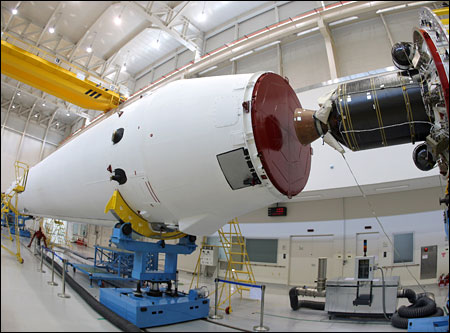
Mating the Indigenous KSLV-1 Second Stage with the Angara
It always helps to go back and read the original documents, even to things you think you know fairly well. I found myself doing that recently when a number of ( wonk-readers questioned the MTCR-soundness of Russia’s sale of the Angara as a first stage for the KSLV-1. Now that the announced launch window for the KSLV-1 has come and gone (and with it the delegation from the DPRK) and they are still fixing the software problem, it might be a good idea to review the MTCRs relevance as we await developments. Not only is it interesting in and of itself, but it also might help define exactly what is South Korea’s space launcher development path.
First, selling the Republic of Korea the Angara counts as a category I sale (specifically Category I, Item 2), the sale of an individual rocket stage, according to the MTCR Equipment, Software, and Technology Annex. However, selling Category I items is still left up to the discretion of the seller if that country believes it will not be used for delivering weapons of mass destruction. Additional items that Russia might have considered selling ROK (but my guess is that they didn’t) include a guidance set suitable for putting something in orbit. Even SCUD guidance sets would be considered Category I. Of course, once Russia, along with the most of the rest of the world, has reached the conclusion that the ROK isn’t going to develop WMD, it can sell almost anything except production equipment. The guidelines clearly say that the “strong presumption” would be to deny the sale of production facilities for Category I items.
Instead, I think it will turn out that the ROK developed its own guidance set, which after all would also have to be used for the indigenously developed second stage. By purchasing a powerful first stage (but not its production facilities), the ROK can continue to develop its liquid-propellant technology in parallel with the orbital insertion technology which it will exercise during the KSLV-1 launch.
Update:
As a number of readers point out, South Korea did launch the KSLV-1 during the previously announced period. (I must have missed the announcements some how.) Initial media reports indicate that the “orbital injection” was somewhat higher than intended. Perhaps there was an attitude determination/control issue or some other guidance issue.
Update (9:45 EDT 26 Aug 2009):
As of this morning, the NORAD catalog still does not have the South Korean satellite listed so its looking more and more like it failed to make it into orbit.
Bloomberg. com is reporting that the nose fairing failed to separate , causing the satellite to fail to get to orbital velocity. I’m a little surprise at that AND the report that the satellite was inserted into a higher than planned orbit. Perhaps that was just the peak trajectory reached? Or perhaps its just media noise?

quite interesting. the rocket will launch in 12 hrs from now…
As of now the South Koreans are scheduled to launch around tomorrow afternoon local time (5 pm if I recall).
As for production facilities, it seems that the guidelines go a bit further, with a ‘just say no’ position:
“Until further notice, the transfer of Category I production facilities will not be authorised.” My understanding is that including production technology as well.
The Russians and South Koreans did conclude a technical safeguards agreement which included end-use and no re-transfer assurances, but it seems that would only be necessary if something other than hardware was transferred. Any ideas what that could be?
It does appear to fit this clause of the MTCR guidelines:
“The transfer of other Category I items will be authorised only on rare occasions and where the Government (A) obtains binding government-to-government undertakings embodying the assurances from the recipient government called for in paragraph 5 of these Guidelines and (B) assumes responsibility for taking all steps necessary to ensure that the item is put only to its stated end-use.”
Not any better than the north
/quote/
The Associated Press
August 25, 2009 | 3:53 a.m.
GOHEUNG, South Korea – South Korea’s first rocket blasted into space today just months after its rival North Korea drew international ire for its own launch.
A problem quickly surfaced, however, when space officials said that an initial investigation showed that the satellite the rocket was carrying apparently failed to enter its intended orbit.
/endquote/
HD movie of the launch:
http://www.youtube.com/watch?v=k0JtHMGac2U
Note the “pendulum” motion of the launcher. BTW, I don’t recall seeing a lunch vehicle with just 2 fins.
“Not any better than the north” as b said is FAR from true. The satellite IS in orbit – not the correct one, but it reached space.
It is to early to determine its status.
Hmm, i’m not so sure if this was not better than the north;
From what i’ve read so far, the satellite overshot the intended orbit (aka would have ended in a higher orbit than planned, not sub-orbital as all the north-korean attempts so far) – and i wouldn’t be surprised by this, since i can’t find signs of a thrust-termination system on the KSLV-1’s solid-fueled upper stage…
Any reliable information yet if STSAT-2 (and/or the kick-stage) did not reach orbital velocity?
I have seen conflicting and/or ambiguous media reports on whether or not the satellite is in orbit. Right now, I’m planning on waiting until I see the NORAD catalog contains a listing for it before I commit myself. Unless anyone has seen an “official” statement?
Some observations i’ve made (BTW, thanks for posting the link to that video, Tal Inbar!):
1.) I think it’s clear by now that the KSLV-I/Naro-1 used a RD-191 as first-stage engine (size of the nozzle, liftoff-acceleration/estimated liftoff-weight, length/shape of the exhaust-plume, etc.), not, as frequently purported, a RD-151.
2.) No visible rocket-exhaust from additional first-stage roll-control-engines – first-stage roll-control obviously fully relies on the two aerodynamic ‘tailerons’; As far as i see, this is a somewhat risky approach, since you won’t have sufficient ram-air-pressure directly after launch or at great heights. That would also offer an explanation for statements like these:
“Initially, the rocket will be moving relatively slowly, making it hard to maintain stability as the main engine tries to push up the 140t launch vehicle and satellite payload,”
(see: http://www.space-travel.com/reports/First_Minute_After_Liftoff_To_Decide_KSLV_1_Success_Experts_999.html)
3.) At about 64-67sec after liftoff, the missile seems to maneuver quite a bit; if my preliminary calculations/estimations are right, that would coincide with a) sound transmission and b) a height of approximately 8-10km (a typical height for jetstream winds – although i’m confident that the South Koreans timed the launch for meteorologically advantageous circumstances).
4.) The launcher seems to climb almost vertically (if we disregard the, as Tal Inbar put it, “pendulum motion”, which i interpret as ‘balancing on the thrust vector’ due to lack of stabilizing aerodynamic force at low speed) until it’s ‘kicked over’ rather hard at about 12sec flight-time (from then on, i guess we’re seeing a classical gravity turn).
(Another interesting observation, if we would not yet know about the cryogenic propellant combination, would be the smother around the first stage and the LOX-refueling-coupling on that swivel-arm, which is disconnected immediately before engine ignition.)
I’m waiting to hear Jochen’s opinion on why the ROK with four times the GDP of the IRI and the outright purchase of the Angara base stage failed to achieve a comparable level of orbital insertion.
Still no NORAD objects, and reports from S Korea suggest a fairing separation failure and subsequent bath in the Pacific.
Simple answer to Azr@el –
Launcher success rates worldwide for first launches are less than 50%.
Both stages functioning to something close to nominal, and only an orbit trajectory / altitude issue, is a lot closer to success than is average for first tries.
@Tal Inbar
http://www.youtube.com/watch?v=k0JtHMGac2U
is it me or is there a female voice speaking Russian (with a thick Korean accent) at liftoff +02:15 ?
Azr@el:
First of all, according to the data available to me, the ROK has only about 2.2 (official exchange rate; only ~1.5 if corrected for purchasing power) times the GDP than the IRI (and both far in excess of ten times that of the DPRK!).
Secondly: May i remind you of the failed Safir-1-launch on August 17., 2008?
As i wrote before, it’s not really advisable to put an invaluable payload (hey, satellites typically are multi-multi-million-dollar items about ten times more expensive than the launch vehicle itself!) on an untried launcher – like Arianespace did with the first set of Cluster-sats.
(BTW, at the moment, the current rumor on the Naro-1-launch is a partially failed fairing separation leading to underperformance of the second stage, and that would make perfect sense to me, too…let’s see what will be the final version of what really happened, as Geoff rightly suggested!)
Third: How precise was the orbital insertion of Omid? Did the Iranians publish any accurate data before launch, like the South Koreans did (maybe not their most clever move…)? Yeah, right, “100% as expected”, like all those space missions of the Soviets (“Hey, this payload that looks like a failed interplanetary probe was planned from the beginning to be a MEO-satellite in exactly that highly elliptical orbit, really!”)…
Last but not least, let’s do a quick comparison of STSAT-2 and Omid:
100kg launch weight vs. 27kg;
solar generator vs. batteries only;
attitude control via thrusters vs. no attitude control at all;
projected life cycle of two years vs. 1-2 months (due to type of energy source, but also rapidly decaying orbit);
actual scientific payload (DREAM, LRA), albeit perhaps rather limited, vs. simple repeater (plus temperature transmitter?);
The Iranians can do a lot better, as they proved with Sina-1 several years earlier. Omid looks to me like an absolute minimum-sat heavily restricted by the maximum payload-capability of the launcher (i could say something similar about STSAT-2, but that one is arguably a lot more capable than Omid…although still miles away from a ‘real’ satellite); Let’s see if there is still potential for growth in the Safir IRILV (i expect another iranian launch soon), although i personally would not bet on a large payload-increase (at least not without additional boosters).
On the other hand, the KSLV-I has a large growth-potential: just add a larger, liquid-fueled upper-stage (preferably with a LOX/LH2-closed-cycle-engine, but as far as i understand, the South Koreans apparently are working on a LOX/Kerosene-open-cycle upper stage engine…my guess is that that will be used on the KSLV-II).
First, my apologies, I hadn’t realized the IRI has more than doubled their economy in the last eight years. I guess I’ve been sipping at the kool-aid over here and hadn’t bothered to check unbiased sources.
Secondly, do you believe the safir-1 to have been a two stage satellite carrier with payload? As opposed to a test of the base stage with a dummy second stage.
Thirdly, the omid made an orbit from which it could make contact with Iranian controllers, the Nora-1 payload is as of this writing still either lost in space or resting under the sea.
I’m not sure the Iranians will go for another Safir launch, I expect another vehicle probably late next year.
And with respect to the growth potential of the KSLV-1/Nora-1 according to Russian sources the Angara 2stage lite configuration can heft 2 tons into LEO. I’ll assume that to be the upper limit for the ROK “indigenous” space launcher as well.
Looks like it’s time to pass the Sujo. Wow 400+ million usd, most of it just to progress the Angara. Wow, I’d hate to be standing for office in the ROK right now.
“I hadn’t realized the IRI has more than doubled their economy in the last eight years”
Mostly due to the absurd amounts of money the west was/is willing to pay for crude oil in that timeframe/at the moment (climbing prices in the face of stagnating or even diminishing demand – this is what i call absurd! And i wonder how the Chinese with a GDP in the range of Germany or Japan alone can supposedly buy out the international markets…); What remains to be seen is if that will last.
Another strange thing is – considering the oil price development in the recent years, the IRI should have overtaken the ROK’s GDP by far…
“Secondly, do you believe the safir-1 to have been a two stage satellite carrier with payload? As opposed to a test of the base stage with a dummy second stage.”
Well, i can’t exclude that the Safir-1’s second stage was a dummy, but from what i’ve read on this issue, it seems to me that that stage actually ignited and then went out of control (as i tried to hint in my previous post, it’s always advisable to withhold information pre-launch – if something goes wrong, then “that was intended to happen”…);
And a low-cost minimum-satellite like Omid (or STSAT-2 or even Sputnik-1) can hardly be called invaluable – but if the launch would have succeeded (as George William Herbert correctly wrote, at less than 50% probability), the gain would have been, without doubt, invaluable!
So, yes, i do assume that Safir-1 actually was an earnest try to launch a first incarnation of Omid (and that the participating iranian scientists know from first-hand experience how the South Koreans feel at the moment…).
“I’m not sure the Iranians will go for another Safir launch, I expect another vehicle probably late next year.”
It’s hard to say for certain, but i wouldn’t be surprised if the Iranians would conduct another Safir-launch anytime now. But, of course, it may take them much longer as well (indicating perhaps a ‘cooling-down’ in financing). Let’s wait and see…
Considering the growth-potential of the KSLV-I:
Yes, i’m thinking somewhat along the same lines (although my guess is that the South Koreans will not outright buy a complete Angara 1.1 but rather will take their own try at a LOX/Kerosene upper stage). Anyway, 1.5 or 2 tons to LEO would be a large growth compared to 0.1 tons, isn’t it?
Oh, and those 400+ million $ may have been well-spent, since that bought the South Koreans an apparently perfect working, large first stage with considerable growth-potential (actually, if you compare this to assimilable development efforts, that may even be a bargain…making the north korean missile program even more incomprehensible to me; They must be spending a much larger percentage of their meager GDP on this ‘space race’ than the South. And they shouldn’t have started it if they can’t afford it…the Soviets made the same mistake) – it’s obviously the south-korean-developed part that causes the problems (like i would expect…).
Update on the fairing as mode of failure
Iran’s safir program seemed to be a spur effort to secure the number 9 slot, not a dedicated development path with much legs. If Safir does have a future it would require solid zero stage boosters to allow it to get anything more than ~80 kilos up.
And as to the efficacy of the ROK investment in Naro-1; Cui bono? South Korea? All they’ve developed is small solid upper stage bus of questionable performance. Russia on the other hand just had someone else foot their production bill for the Angara. To clarify none of the tooling for the Angara seems to be transfered to the ROK. Every time South Korea wants to “try” to launch a satellite on their “indigenous” SLV they’ll be at the mercy of Russian extortionist eager to wring the ROK for every deca-won Seoul’s willing to part with for the sake of space prestige.
“they’ll be at the mercy of Russian extortionist”
Oh, you mean like the ULA with their Energomash-powered Atlas V?
Or Arianespace with their Soyuz-ST? (BTW, killing the ‘obsolete’ Ariane-4, only to supplant it later with, in essence, the ancient Sputnik-launcher was one of the worst management-decisions ever in my eyes…)
One thing is for certain: The South Koreans would face a lot more difficulties (and cost and lack of growth-potential) if they would have stuck by the KSR-III-based pressure-fed LOX/Kerosene-lower-stage for their original KSLV-I-configuration. Hey, they’re apparently having problems with fairing separation – if that is a show-stopper for them, imagine what could have happened with that lower stage…
ULA maintains an inventory of 2-3 years worth of RD-180s to safeguard against Russian “renegotiatians”.
With respect to the Ariane-4, ‘obsolete’ is not the keyword, ‘uneconomical’ is the keyword. At usd 80+ mil a pop with all storable propellants it was an expensive over engineered nightmare. Compare that with the reliable,robust, usd 34 mil a shot Soyuz-ST which mainly uses cheap LOX/Kerosene save for the Fregat GTO bus. Arianspace operates out of a dirt lot hacked out of a bloody jungle in the middle of nowhere, the Soyuz-ST, with it’s heritage of launches from Kazakstani desert, is a much better site fit.
And yes, the ROK would have had a much harder teething process with an indigenous launcher but at the same time they would have developed a broader space industry. Taking a short cut into space will result in either dependency on the goodwill of Ivan or flash in the pants efforts without the political/economic base to sustain momentum.
Azr@el
“with all storable propellants”
The HM-7 (third stage) uses LOX/LH2.
Considering the Viking-engine: nobody seems to care if russian, chinese, indian, iranian or north korean space carriers use storable propellants (in fact, the Fregat-upper-stage of Soyuz-ST uses NTO/UDMH, as well as the Aestus-upper-stage of the Ariane-5G, which uses NTO/MMH) – so why should anybody care about the Ariane-4?
(Not that a new, more modern LOX/Kerosene-engine supplanting the old Bringer-technology and a new, large lower-stage plus a modular booster-concept instead of the first two Ariane-4-stages/boosters would have been an outright bad idea – maybe even a better one than the Ariane-5 in the current form!)
And you can say a lot about the Ariane-4, but not that it wasn’t reliable and robust (which i somehow doubt for the Soyuz under tropical climate so close to the ocean…let’s wait and see, but i wouldn’t be surprised if additional problems in this regard would surface in the future).
BTW, the actual cost per Soyuz-launch has arrived at 50+ million dollars by now (and i wouldn’t be surprised, either, if that goes up even farther…the initial 30-40 mio $ estimate was totally unrealistic from the beginning, just like the original 3.5 billion Euro cost-estimate for the Galileo-sat-nav-system…or the ~1.8 bn $ for the INS Vikramaditya…).
Oh, and we’re still waiting for the first Soyuz-launch from Kourou (i guess that “end of 2009”-appointment can be confidently considered void by now, once again)…
Had Arianespace voted to build another batch of Ariane-4’s, the cost/launch would have gone down, naturally (no new design-cost, paid-off production-line, already existing launch-infrastructure etc. – the larger the numbers, the lower the price!).
The Soyuz in Kourou, on the other hand, needed a completely new launch-complex for several hundred million bucks (in fact more than those 500 million Won the ROK paid all-in-all, if i understood that right) alone!
Last but not least: other than the south korean KSLV-I, Soyuz-ST is completely built in Russia, and even assembled at Kourou by exclusively russian workers…while european ‘rocket-scientists’ have to fear for their jobs.
Additionally, as you correctly noticed for the south-korean example, european politicians will have to be very careful to not ‘anger’ Russia, unless they want to lose their primary space-launcher in the future.
Only those Arianespace-managers won’t have to worry about their future – without doubt, they collected millions over millions in bonuses for ‘efficient downsizing’.