
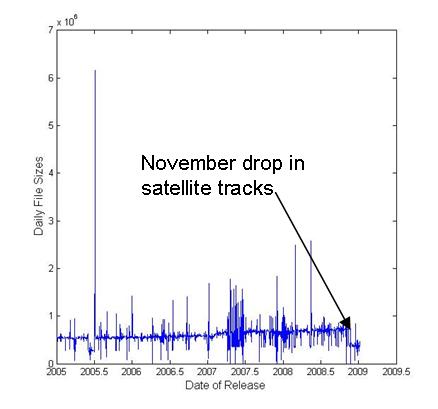
File size of daily orbital parameters distributed from the NASA space-track website. This is proportional to the number of satellites tracked each day, or at least listed as tracked each day.
I’ve been trying to recall all the space-derived information the US government provides to the world for free. The reason I’ve been thinking about this is because of the recent drop in satellite tracks the US provides through NASA’s space-track web page that was first point out on this blog. While I’m still waiting to find out what caused this, it certainly appears to be a bookkeeping “error” that should be fixed soon. First, of course, is the catalog of all objects in space big enough track, which most analysts place as bigger than 10 cm in diameter. (It’s not all of them, of course. The US classifies some of its military satellites; something many of us have alternatively laughed at or complained about depending on our mood.) I understand that everybody from private companies to other countries use these files to move their satellites to avoid collisions. (To that extend, even a bookkeeping problem, while not effecting the US military, has seriously affected space situational awareness.) What is the economic value of that service, I wonder?
Then there is GPS. That is starting to filter into every single pocket in the US with a proliferation of smartphones containing a GPS chip. I keep on seeing all the wonderful things that will do for the consumer from knowing where your friends are to what’s on sale as you walk by the store. Perhaps it will even be used to speed up air travel in the US by allowing planes travel directly to their destinations as opposed to sticking to the “roads” that are easier to control with radar. That, I think, I will personally find valuable but I cannot easily assign an economic value to that. Europe is trying to break into this market with its Galileo constellation but they seem to want to charge people a license fee for each circuit produced. (Perhaps they have dropped this?) I’ve never understood the business model behind Galileo; it’s very hard to compete with free.
Then there are the ubiquitous satellite weather photos. Do people pay for those? What about LANDSAT images? Do people pay for those? Communications satellites have been privatized because there is an easy way to charge for them. But the other contributions from space to the economy have already been very great and new ways are continuing to be found for exploiting them. When the Obama administration thinks about building up the infrastructure, perhaps they should really consider the near-Earth space infrastructure too? If readers think of other services the US provides for free from its space assets or even new space services that might be created, I invite you to list them.

The US military gives away the the catalog data for free because it must – it’s unclassified data paid for by public funds and thus every American citizen has the right to access it. Same thing with C-SPAN broadcasts. Beyond that, the US Congress has mandated that the data be provided to others (with certain restrictions) through the CFE Program.
Competing with products/services that are offered by others for free is definitely possible. And going forward with a global information economy it’s going to be essential.
Here’s a really good post on the issue:
Grand Unified Theory on the Economics of Free
Don’t forget the timing signal embedded in the GPS broadcast. This makes our cell phones (with or without a GPS chip), ATM’s etc. work.
I’ve noticed that the Alan ‘Maestro’ Greenspan’s Grand Unified Theory of Economics of Proprietary hasn’t been working all that well lately too.
The whole point of having things cost money in the first place is to do price discovery to get efficient allocations and create incentive. If the market can’t set prices better than an casual eyeball guess – which appears to be the case in many formerly and ‘obviously efficient’ markets – then the whole intellectual market edifice collapses.
So, as much as we might like to bang our shoe on the table and bury the Reds, I think we’re headed for a system that has much more ‘commons’ and much less ‘proprietary’
There is a defensible scholarly argument that the entire patent and copyright system should be eliminated:
http://levine.sscnet.ucla.edu/general/intellectual/against.htm
I believe the basic idea behind the Galileo business model is along these lines: If accurate location data is business-critical for you, then the fact that GPS is provided to you with no guarantees of service currently represents a real risk to your business. If subscribing to Galileo mitigates some of that risk, then it may be cost-effective for you.
I don’t necessarily agree with this, though – most businesses in that situation would probably be better off buying insurance against GPS being unavailable, since its so unlikely.
The Galileo deal is in fact fairly simple. Its a commercial contract. It provides companies that so require a GPS signal (slightly more precise than the current US GPS generation). If the signal goes missing, Galileo will have to pay up compensations. It is this provision (signal guaranteed or compensation) that makes the difference.
Sek—Im afraid that makes no more sense to me than anything else. For instance, are they just compensating the amount that you paid for that time when you dont have the highest precision? Since that is going to pennies, that will hardly seem worthwhile even applying for it. If your plane crashes because Galileo goes down, do they pay for that? I think I will be staying with GPS.
You’re missing the biggest USP – the US Gov can’t turn off/degrade Galileo whenever they feel like it. As we get more and more exposed to geolocation services and they start to move into the “necessity” column (see eg VLCC/ULCCs, civilian/law enforcement UAVs, emergency service provision there’s going to be a real commercial opportunity. Would you put your domestic security or commercial viability in the hands of the NSC?