

I have long wanted Allen Thomson to take up blogging. Allen is one of those old guys — you know, the kind who have forgotten more than you’ll ever know, but aren’t well known from the DC rubber chicken circuit or hanging out in various cable TV green rooms.
If you’re smart, you run stuff by people like Allen, a former intelligence analyst who prepares these little dossiers based on open source information. He’s latest one is pretty amazing.
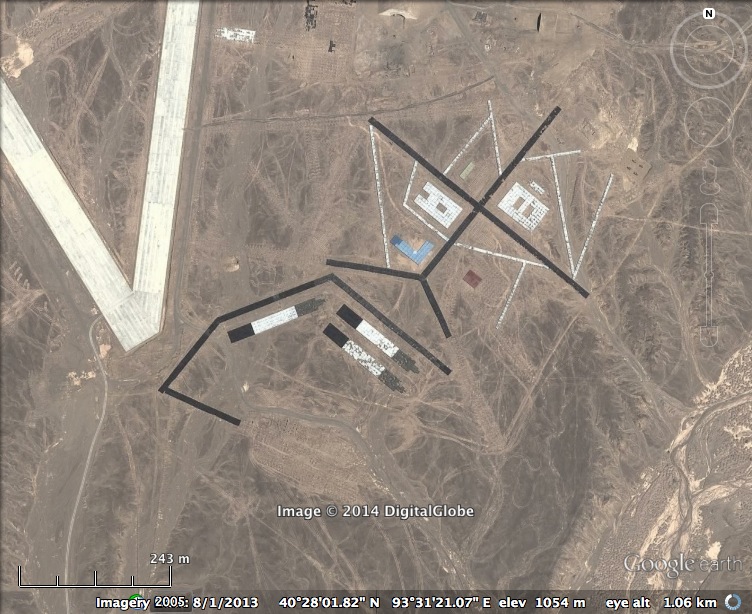
Allen has been documenting China’s construction of targets in the Gobi desert for anti-ship missiles:
In the course of a search for possible target areas for the failed Chinese hypersonic glide vehicle test of 2014-08-07 (*), it came to light that two and possibly three areas which appear intended to test antiship weapons recently became identifiable in an area of China previously known to have weapons targets. Although no connection could be made with the hypersonic test, the areas , arbitrarily designated A, B and C, seem to have intrinsic interest and are documented here.
Any further information concerning them would be greatly appreciated. Please email it to thomsona [at] flash.net and indicate whether the sender wishes to be acknowledged in possible future versions of this document.
You should read the whole document, entitled Appearance of Apparent Antiship Missile Targets in Gobi Test Areas during 2013, but here are the comparisons to whet your interest:
Area A
40.466 N, 93.521 E
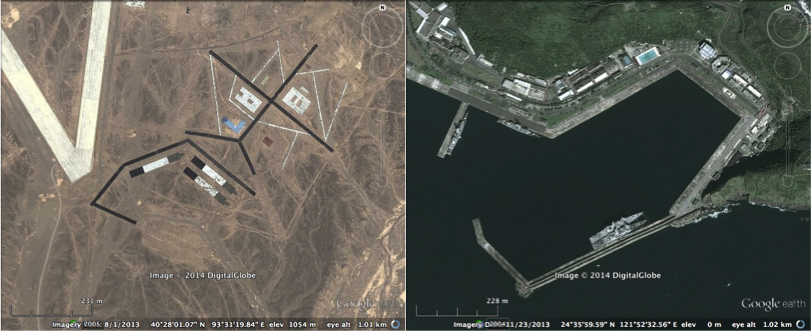
I would add the adjacent airfield just happens to match the on located in Taiwan at: 23°27’34″N, 120°23’32″E.
Area B
39.150 N, 88.616 E
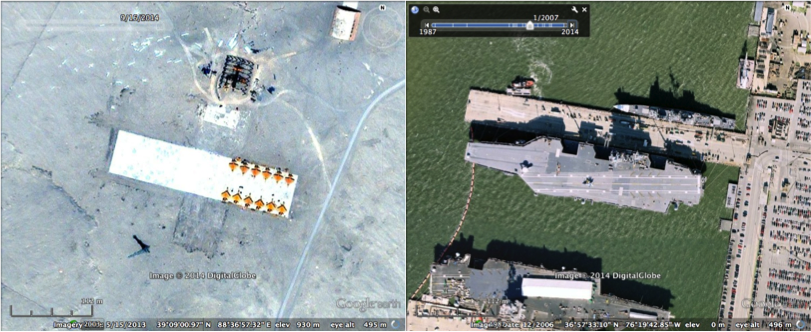
Sadly, I couldn’t find a decent overhead with aircraft lined up on deck — but this shot gives you the idea.

Area C
40.371 N, 99.859 E
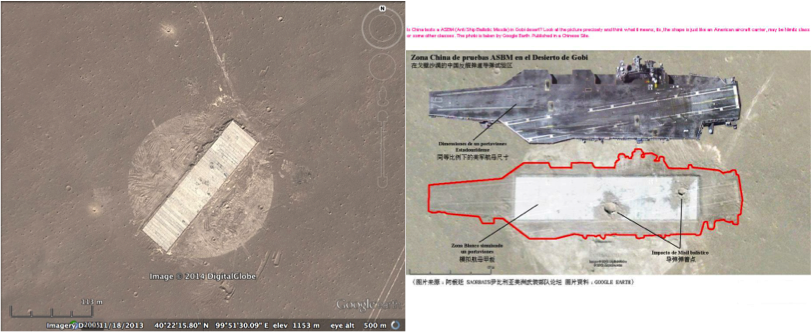
This site has been widely reported in the press as a Chinese ASBM target. (Although the person who posted it, apparently using the handle Charly015, rarely gets credit for his discovery.) Charly015 didn’t give the lat/long but Allen found it anyway.
Harry Kazianis at The Diplomat asked “Did China Test Its Carrier Killer?” Yes, but probably not here.
Allen notes that “it seems at least as likely that it is used for training the crews of the fighter-bomber aircraft based at Dingxin.” I tend to agree — the location is actually too close to the missile test complex near Jiuquan (~100 km to the missile pads) and the geometry is all wrong. A short-range ballistic missile launched from one of the pads associated with missile testing at Jiuquan would overfly the civil space launch area and all the housing for the base, impacting within 7 km of the main airfield that supplies the site.