

I had some comments today in a Wall Street Journal piece by Anika Seth and Ashley Cai about North Korea’s uranium enrichment plant at Yongbyon. Those comments, and parts of that story, were based on the following analysis by Jeffrey, John, and I.
Keeping up with the Kangs: A Small Addition to Yongbyon’s Original UEP
By John Ford, Sam Lair, and Jeffrey Lewis
Earlier this week, Reuters reported comments IAEA Director General Rafael Grossi made about the North Korean uranium enrichment plant at Yongbyon. Grossi stated that “Since mid-September 2026, a further extension to the original Yongbyon enrichment facility has been under construction with the new extension externally complete by late October 2026.”
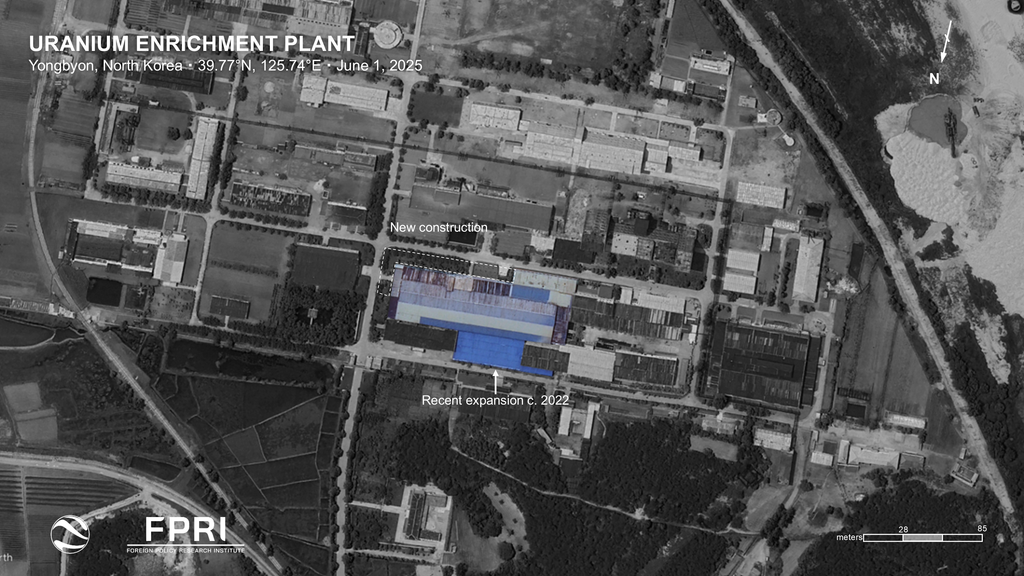
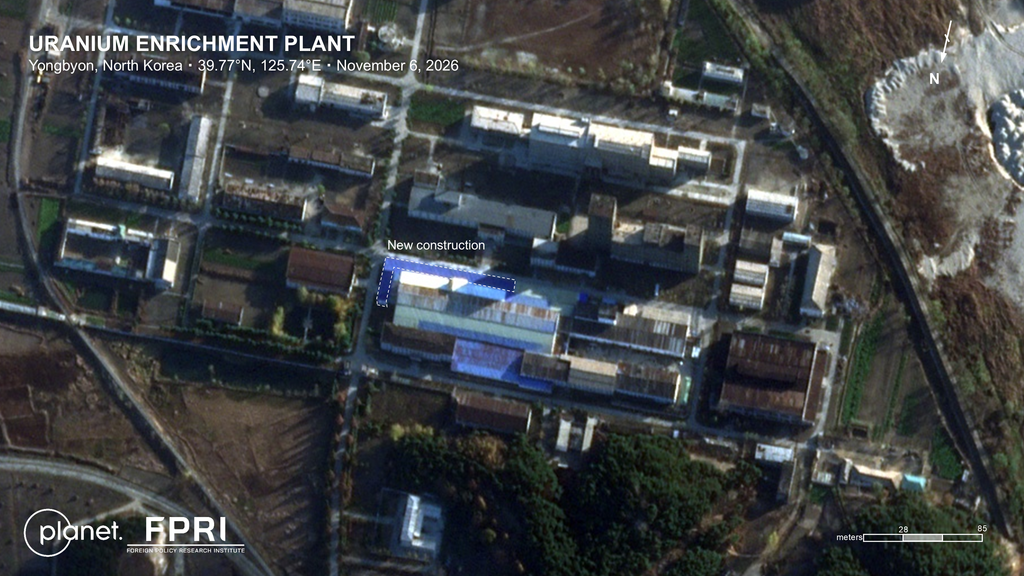
Imagery from our friends at Planet Labs PBC shows a small, L-shaped addition to the plant. The imagery does not reveal the purpose of the addition. It is probably for additional centrifuges, like the annex North Korea added at Kangson in 2024, but its awkward location in the enrichment plant leaves open the possibility that it might fill an operational or administrative role instead. Whatever its purpose, the expansion reflects the DPRK’s commitment to maintaining and expanding the fissile material production apparatus that sustains its nuclear weapons program. In June, Kim Jong Un said the Ninth Party Congress had adopted a “strategic decision to further expand the nuclear materials production capacity.”
Because there are now two enrichment plants at Yongbyon and the addition is rather small, it was helpful that DG Grossi specified the “original” plant. You can read Jeffrey and Sam’s analysis of the second Yongbyon plant here.
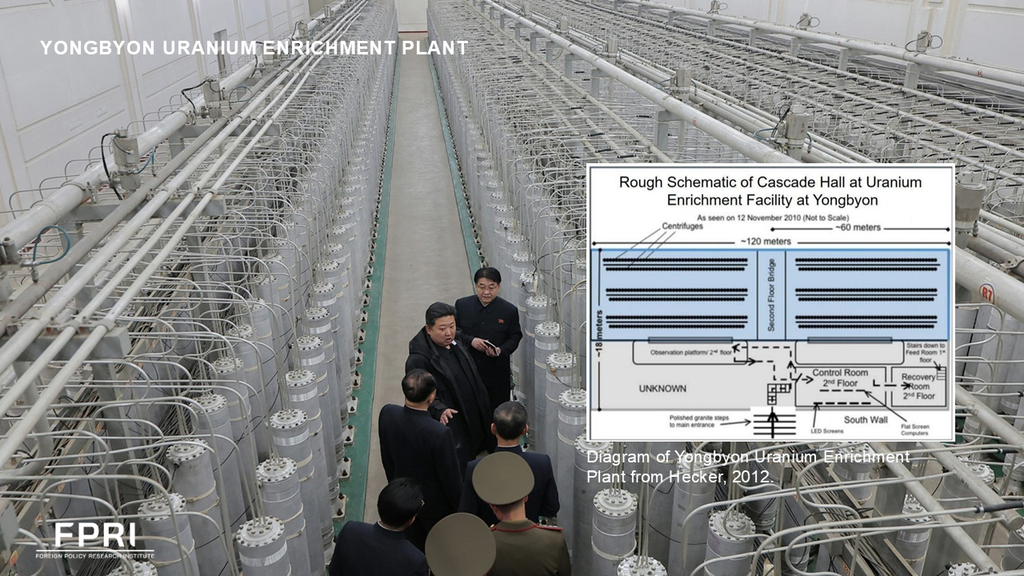
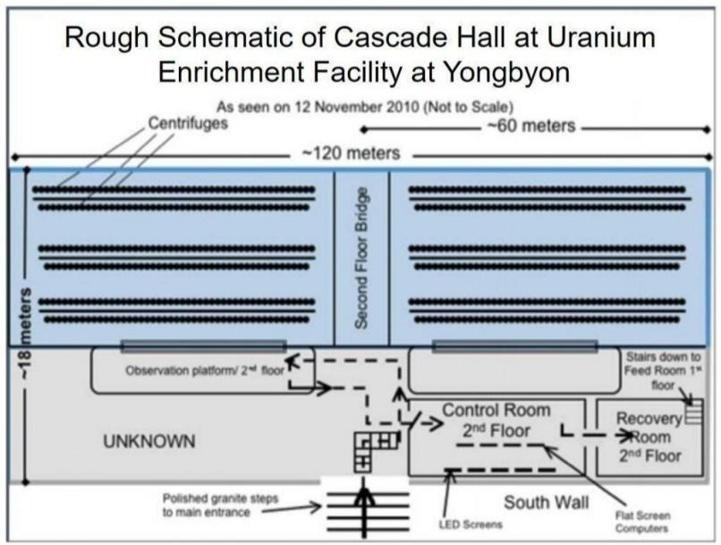
Based on Kim Jong Un’s visit to the original site in 2025 and Sig Hecker’s recollections from when the North Koreans invited him in 2010, the addition abuts the control and support spaces of the uranium enrichment plant. It even covers the original main entrance to the facility (whither the polished granite steps!). That location suggests the addition is an awkward place to house additional centrifuges. The alternative is that they needed room for new equipment, an upgrade to the plant, additional storage, or more offices.
But we doubt the North Koreans need additional space for those purposes at this enrichment plant. The existing control spaces appear adequate to operate the facility, and we struggle to envision an upgrade that would demand that much more space without adding more centrifuges. Moreover, Planet images taken during construction in mid-September show the new area does not have any small rooms, the kind of subdivision we would expect in office or administrative space.
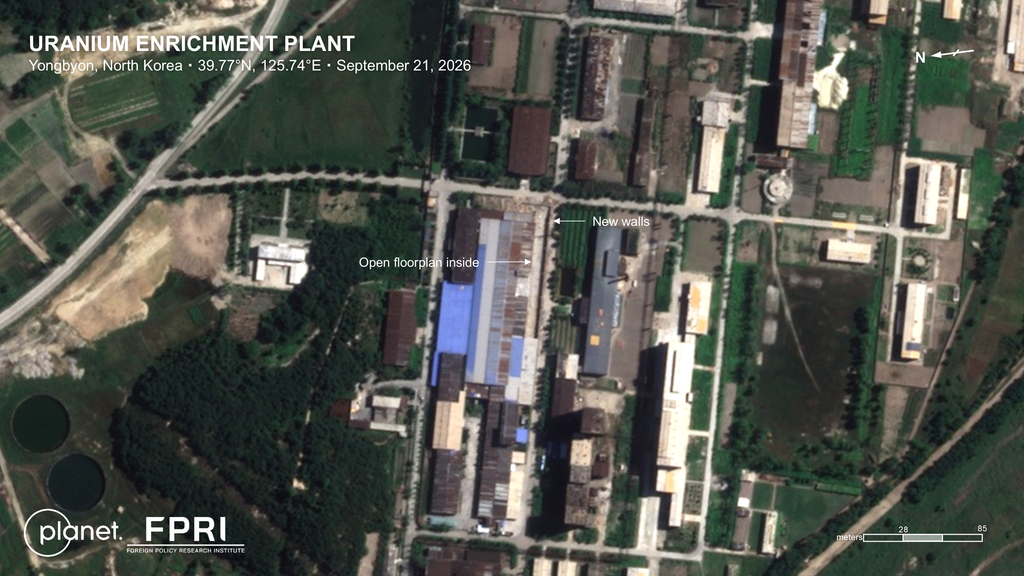
Even as the roof is going on, there are no internal walls or barriers visible within the addition.
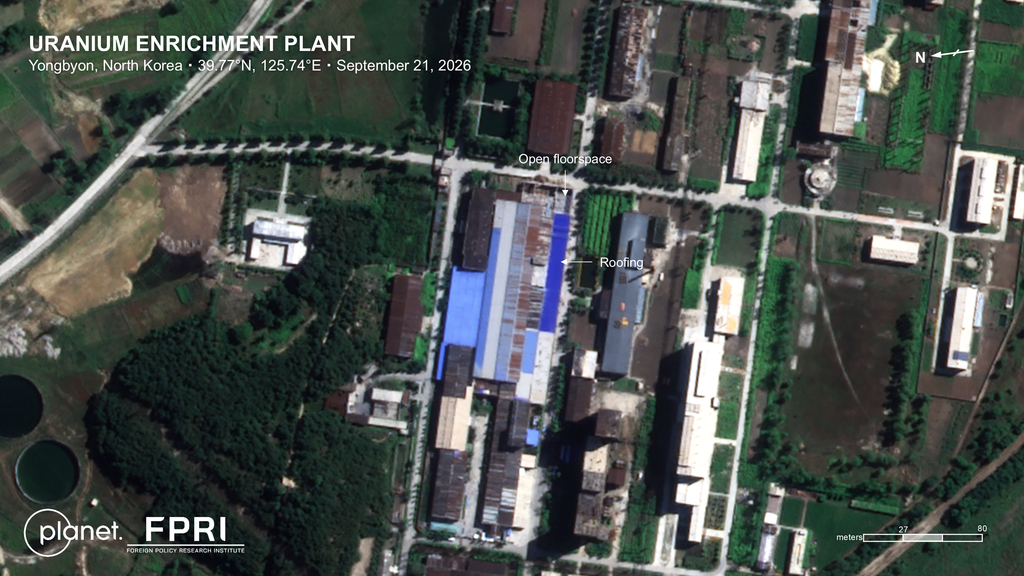
Of course, the North Koreans could add interior walls later, but the open floor plan points to enrichment.
North Korea has added centrifuges in awkward expansions before. This new space at Yongbyon looks a lot like the annex added at Kangson in 2024. DPRK engineers managed to pack 12 cascades into that skinny space.
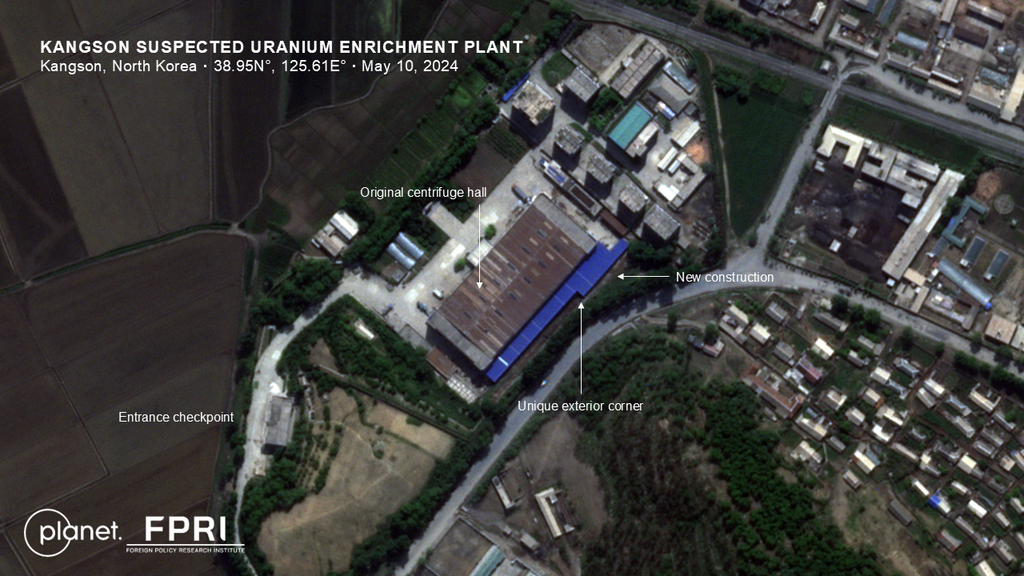
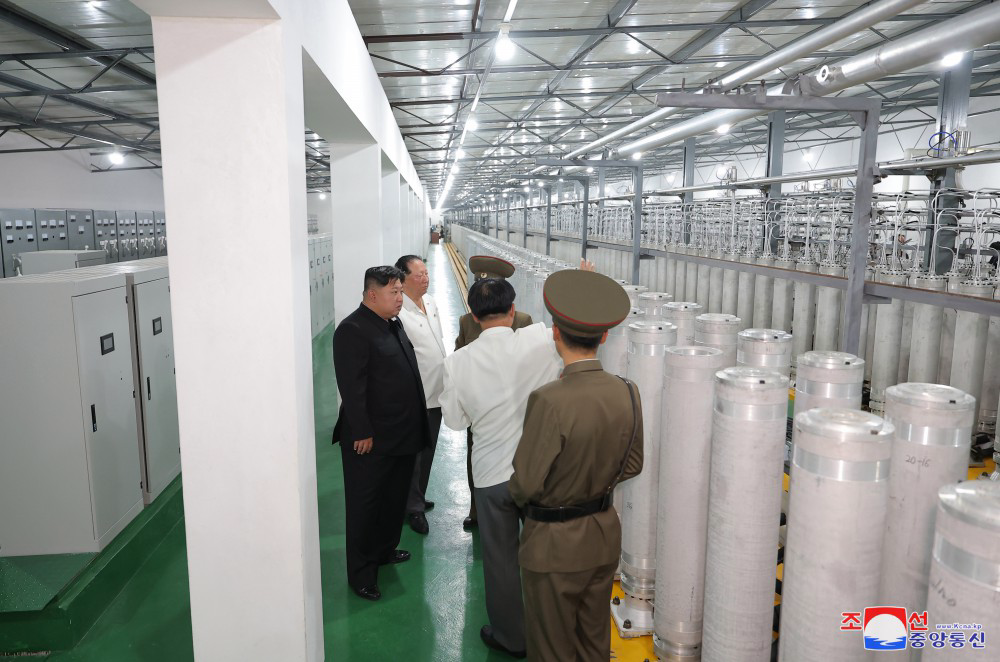
The addition at Yongbyon is 8-10 meters wide and totals about [number] square meters. That is somewhat larger than the annex at Kangson, which is 9 meters wide and houses just under 2,000 centrifuges.
If the new space is for centrifuges, we can use centrifuge density at other sites to estimate how many it could hold. Based on some work Jeffrey and Sam did last year, we have a good sense of how tightly packed various North Korean enrichment plants are.
| Table 1: North Korea’s Known Enrichment Facilities | |||||
| Date Completed | No. of Cascades | No. of Machines | kg SWU/a | HEU (KG/YEAR) | |
| Kangson | 4/5/2003 | 24 | 3,936 | 15,744 | 73 |
| Kangson Annex | 3/24/2024 | 12 | 1,968 | 7,872 | 37 |
| Yongbyon A1 | 6/21/2010 | 12 | 1,968 | 7,872 | 37 |
| Yongbyon A2 | 7/28/2013 | 16 | 2,624 | 10,496 | 49 |
| Yongbyon A3 | 5/15/2022 | 12 | 1,968 | 7,872 | 37 |
| Yongbyon A4 | TBD | 12 | 1,968 | 7,872 | 37 |
| Yongbyon B | 06/01/2026 | 28 | 4,592 | 18,368 | 85 |
| Total | 116 | 19,024 | 76,096 | 354 | |
| Table 2: How Tightly Packed Are North Korea’s Centrifuges? | ||||||||
| Length (m) | Width (m) | Floorspace (m2) | No. of Cascades | No. of Centrifuges | meters per cascade | meters per centrifuge | width (m/cascade) | |
| Kangson Main | 93 | 24 | 2232 | 24 | 3936 | 93 | 0.57 | 2.0 |
| Kangson Annex | 93 | 9 | 837 | 12 | 1968 | 70 | 0.43 | 1.5 |
| Yongbyon A1 | 93 | 16 | 1488 | 12 | 1968 | 124 | 0.76 | 2.7 |
| Yongbyon A2 | 93 | 14 | 1302 | 16 | 2624 | 81 | 0.50 | 1.8 |
| Yongbyon A3 | 50 | 22 | 1100 | 12 | 1968 | 92 | 0.56 | 1.8 |
| Yongbyon A4* | 85 | 13 | 1020 | 12 | 1968 | 85 | 0.52 | 1.1 |
| Yongbyon B** | 95 | 24 | 2280 | 14 | 2296 | 163 | 0.99 | 3.4 |
** Yongbyon B is two floors, so spacing is per floor while HEU production in Table 1 is for both floors combined.
The annex at Kangson, which houses just under 2,000 centrifuges, is a good approximation for a new Yongbyon addition. Packing the space full of centrifuges would give the North Koreans approximately 8,000 additional kg SWU per year, enough to make about 37 kg of HEU per year.
We think the addition at Yongbyon is for centrifuges, though we cannot be certain. (At Kangson, Kim helpfully visited the site and confirmed it was being used for cascades.) It is in an awkward location relative to the other enrichment halls and covers up important features like the facility entrance. But it is reminiscent of the Kangson annex, and its open floor is more consistent with enrichment than with anything else.
If it is for more centrifuges, why not just build a separate structure, as North Korea did with the second Yongbyon plant? It is possible that some limitation in DPRK cascade design, in either control or input/output, prevents expanding a cascade beyond a small addition like this one. Maybe the risk of extensive contamination at the site limits the North Koreans’ ability to refurbish or rebuild existing structures. No matter the explanation, North Korea has made a habit of shoehorning centrifuges into small annexes at its enrichment sites, first at Yongbyon and then at Kangson, and why remains a mystery to us.
More work at the enrichment plant at Yongbyon is yet another sign that North Korea’s nuclear weapons program remains a key state priority and continues to receive investment. The North Koreans are taking the necessary steps to maintain or expand their fissile material production infrastructure in support of their arsenal, another reminder for U.S. policymakers that this issue isn’t going away anytime soon and demands a dynamic approach.