

Jon Landay has a story in Reuters (Saudi missile plant expansion may produce more powerful missiles, study says) on the ongoing expansion of Saudi Arabia’s solid propellant missile production site at al-Duwadimi. We have been monitoring the site for many years. It was originally identified by Jeffrey Lewis and the team back in late 2018, and in 2021 Zach Cohen got a number of sources to confirm that China was helping the Saudis actively manufacture their own ballistic missiles.
After wreckage from a DF-15A appeared in Yemen last week, we decided to survey known Saudi missile-related sites and we noticed the construction. The Saudi missile program has flown somewhat under the radar this year, despite war raging in the Gulf. In fact, the debris in Yemen was the first indication the Saudis have used any of the missiles they have spent decades importing from China. In the meantime, the Saudis have been producing ballistic missiles at al-Duwadimi since late 2021 while expanding existing missile bases and building new ones.
Saudi efforts to build out their missile infrastructure take place in the context of a worsening regional security environment for the Kingdom and an agreement with the United States which may allow them to enrich uranium domestically. The larger missiles with longer ranges and heavier payloads that the new casting facilities at al-Duwadimi would enable the Saudis to build compound existing concerns about Saudi proliferation that stretch back decades.
This is a crosspost from Michael and I’s new home at the Foreign Policy Research Institute. You can see the write up there as well.
The write-up follows:
Saudi Arabia Expands Missile Production at al-Duwadimi
Sam Lair and Michael Duitsman
October 23, 2026
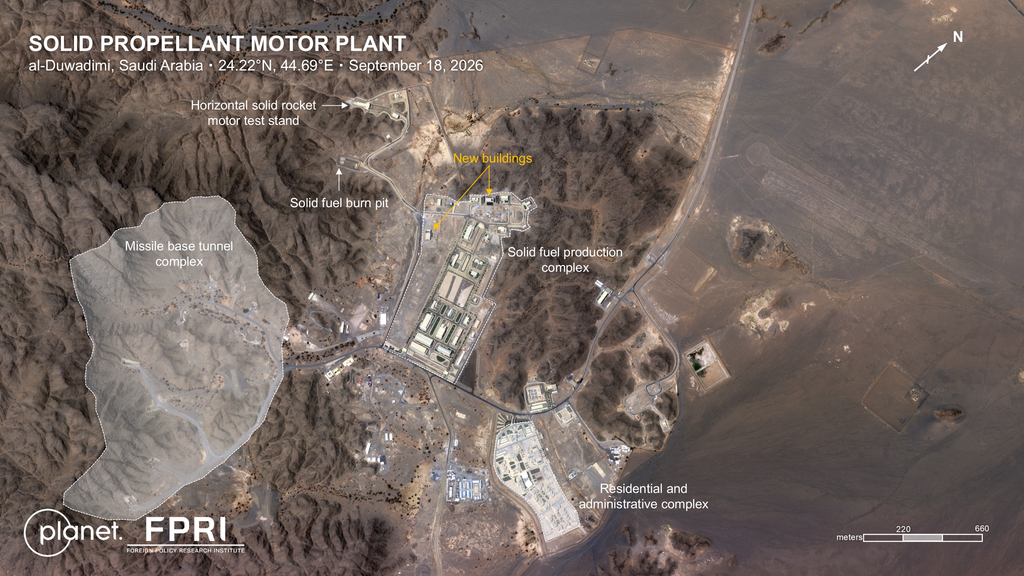
Commercial satellite images taken by Planet Labs PBC and analyzed by researchers at the Foreign Policy Research Institute show that Saudi Arabia is expanding the solid-propellant missile production plant near al-Duwadimi.
Researchers first publicly identified construction of the plant in 2019 and confirmed in 2021 that Saudi Arabia was operating the plant with Chinese assistance.
New satellite imagery suggests Saudi Arabia is expanding the infrastructure at the missile production complex, likely to produce larger missiles that could deliver heavier payloads or reach longer ranges.
Solid propellant ballistic missiles are made much in the same way as a bundt cake. Dry components are mixed together with an epoxy binder using large, planetary mixers. The mixture is then poured into a casing in a casting pit where it is allowed to set and cure, usually at an elevated temperature. The size of the casting pit is a major constraint on the diameter of the ballistic missiles a plant can produce. The motor must be slim enough to fit into the casting pit.
Two new buildings are being constructed at the site. We assess one to be for casting solid-propellant rocket motors, and the other to be for storing either solid propellant precursor materials, such as ammonium perchlorate, or finished missile components.
Ground clearing and excavation for the possible storage site began in April 2025 while work began on the probable casting building in late April or early May of that year. However, little progress on the project was made until the fall of 2025.
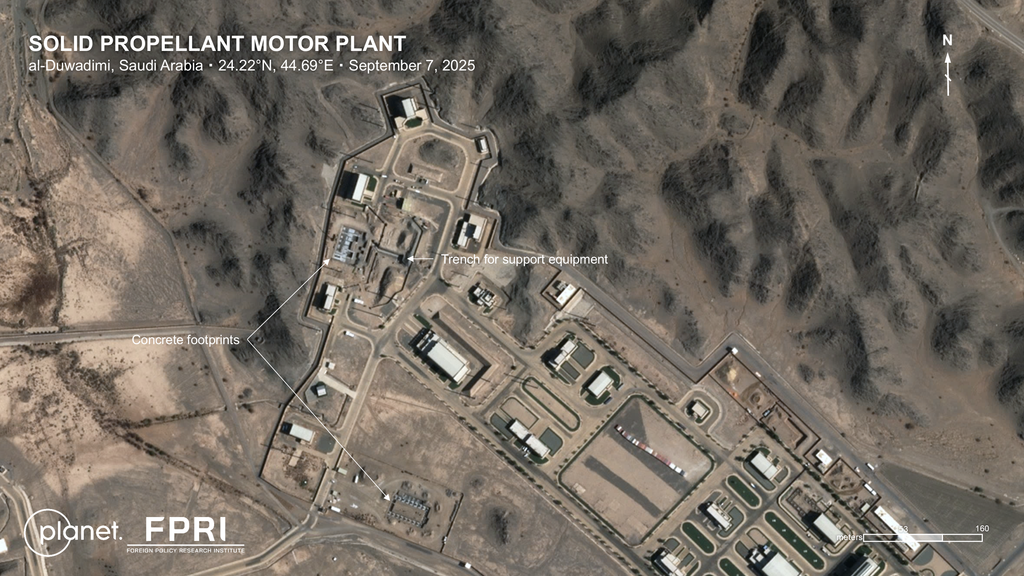
That fall, concrete footprints were poured at the two construction sites. The footprint at the possible storage site only covered the perimeter of the site while the footprint at the probable casting building was more extensive. A trench was also dug to connect support equipment and cables from the probable casting building to a bunker, which may house a control room.
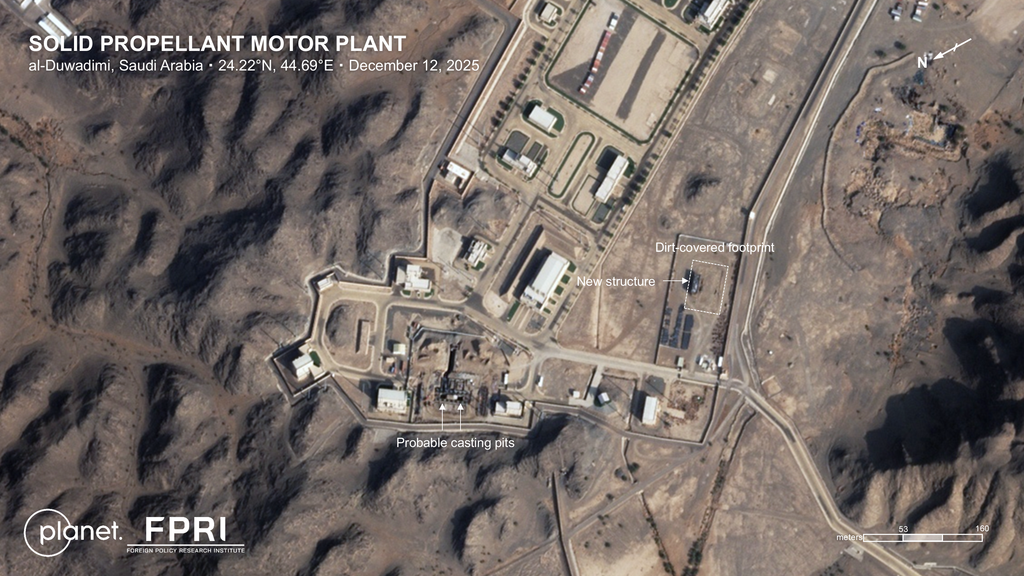
In December 2025, the footprint at the possible storage site had been covered in dirt, and construction on top of the footprint had started. The casting pits were visible at the probable casting building, measuring about 5-6 meters on each side.
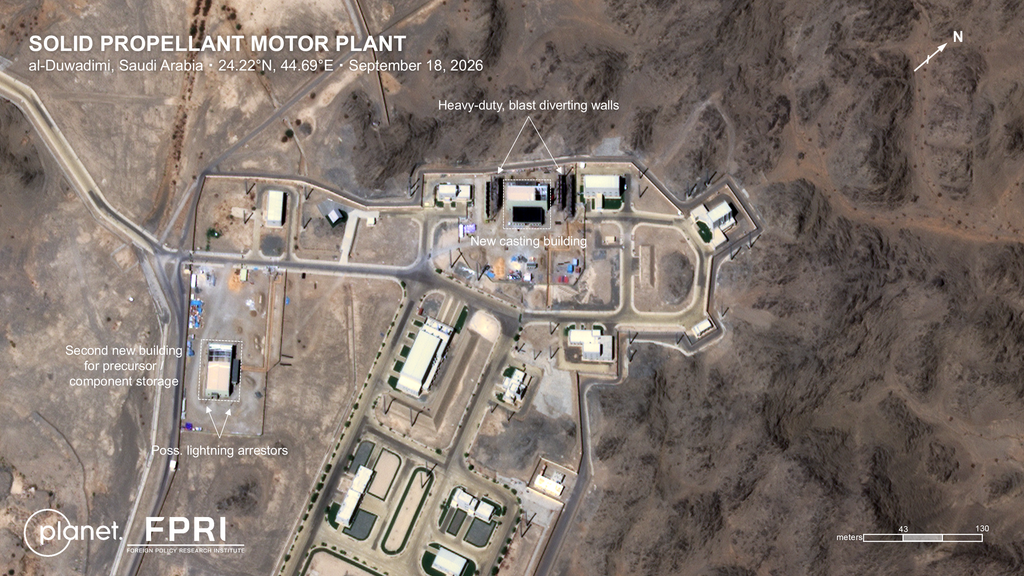
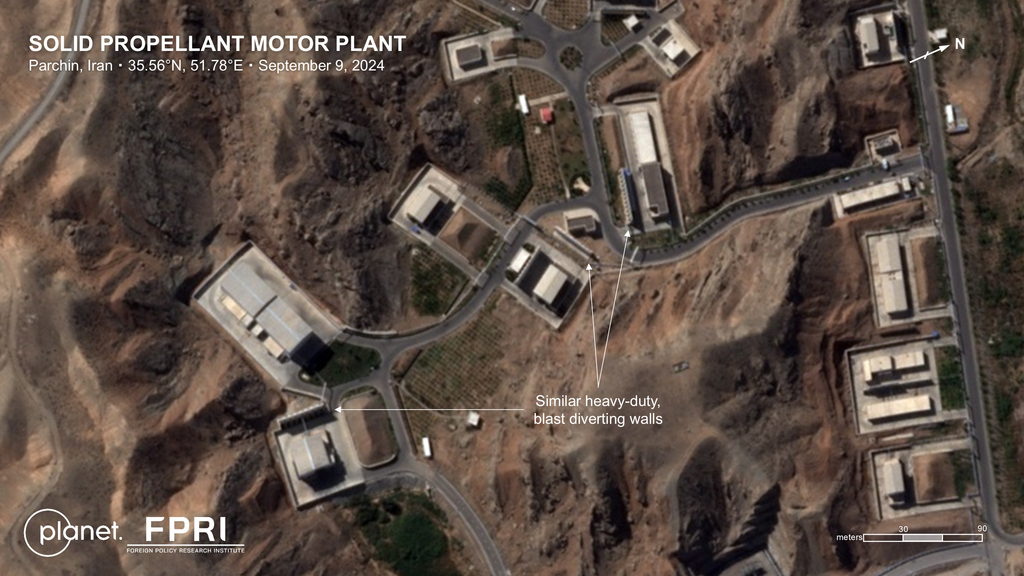
A Planet image from September 18 shows the two buildings are nearly complete. Both are missing part of their roof, and two heavy-duty blast diverting walls are being installed on the north and south sides of the probable casting building. The walls are somewhat similar to those seen at the Bacchus West plant (for example the mixing building that was destroyed in a 1989 accident at 40.667° N 112.108° W) in the United States, and those at a propellant or explosives plant at Parchin in Iran (35.564173° N, 51.780052° E). Beyond the large, deep pits, the walls are further evidence that the building is to be used for casting solid propellant motors, as they would shield nearby buildings from any accidental explosions.
We assess the possible storage building to house precursor materials or finished components for two reasons. One is that it is slightly removed from the site, suggesting it is not directly involved in production operations. Second, it has poles around it that we think are lightning arrestors. Such arrestors can be seen throughout the facility, and indicate the materials stored inside the building are sensitive, like ammonium perchlorate or completed motors. However, we are less confident in the purpose of this building than the probable casting building. It could be a manufacturing building, such as for motor ignitors, but this is unlikely. The facility likely already has an ignitor fabrication building; storage would make more sense, as increasing motor production (or producing larger motors) will require more precursor materials to be stored on site.
The new casting building is larger than any other possible existing casting buildings on site. This suggests the new facility could support a new, larger missile than those already being produced at al-Duwadimi, but that cannot be confirmed without additional evidence. It could also support an expansion in throughput, as the building adds new pits to the facility, and the pits are large enough that it might be possible to cast multiple, smaller motors in one pit at the same time.
If the new infrastructure is to support a larger missile, it would add reliability and readiness to the Saudi regional-range missile force. Reliant on about 40 DF-3s acquired from China in 1987, according to declassified CIA estimates, Saudi Arabia has few options to hit targets at regional-ranges, putting much of Iran out of its reach. It is unclear what missiles Saudi Arabia currently produces at the al-Duwadimi plant. In addition to the DF-3, wreckage from Yemen indicates the Saudis have also acquired or produced a domestic copy of the DF-15A from China. There were unconfirmed reports in the mid-2000s that Saudi Arabia bought DF-21s from China which may have been a misinterpretation of a DF-15 transfer. Nevertheless, a domestic production line for a regional-range capability would make the Kingdom more self-reliant, something they have already demonstrated an interest in given the existing missile plant. It would not be surprising if Saudi Arabia sought to produce longer-range missiles such as a copy of the DF-21 or something similar at al-Duwadimi.
A larger missile would also be able to deliver larger payloads. The recent war in the Persian Gulf has demonstrated the utility, albeit limited, of a larger throw-weight missile like Iran’s Khorramshahr-4 in overcoming defenses, as they can carry cluster munitions or more sophisticated re-entry vehicles. However, considering the lack of Houthi or Iranian missile defenses, this might not be as significant a motivating factor.
Whatever the purpose, the expansion to al-Duwadimi is not yet complete. While completing the roofs will not take long, installing the new casting equipment may take several months. The upgraded casting facility could, therefore, be ready as early as the end of the year.
While Iran’s missile program has absorbed the lion’s share of attention in the past several years given the several True Promise operations and Operation Epic Fury, the Saudis appear committed to growing their own missile force. The Middle East is rife with missile proliferation, and Iran is not the only contender in that competition. This facility expansion is only the most recent indicator that the Saudis are not interested in being left behind.