

Links (and Pictures) of Note
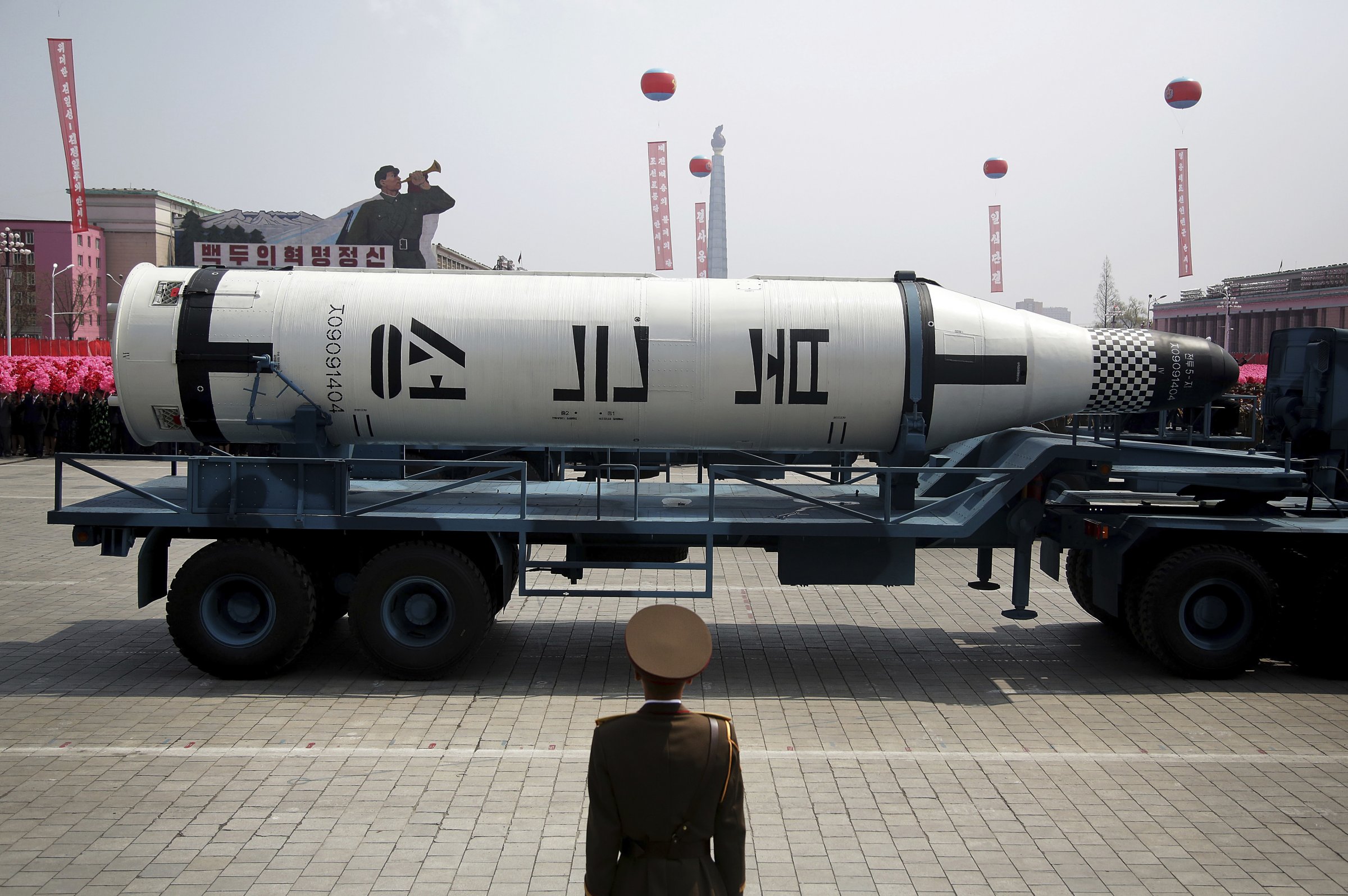
The Pukguksong-1 on parade with its potentially-new airframe on display.
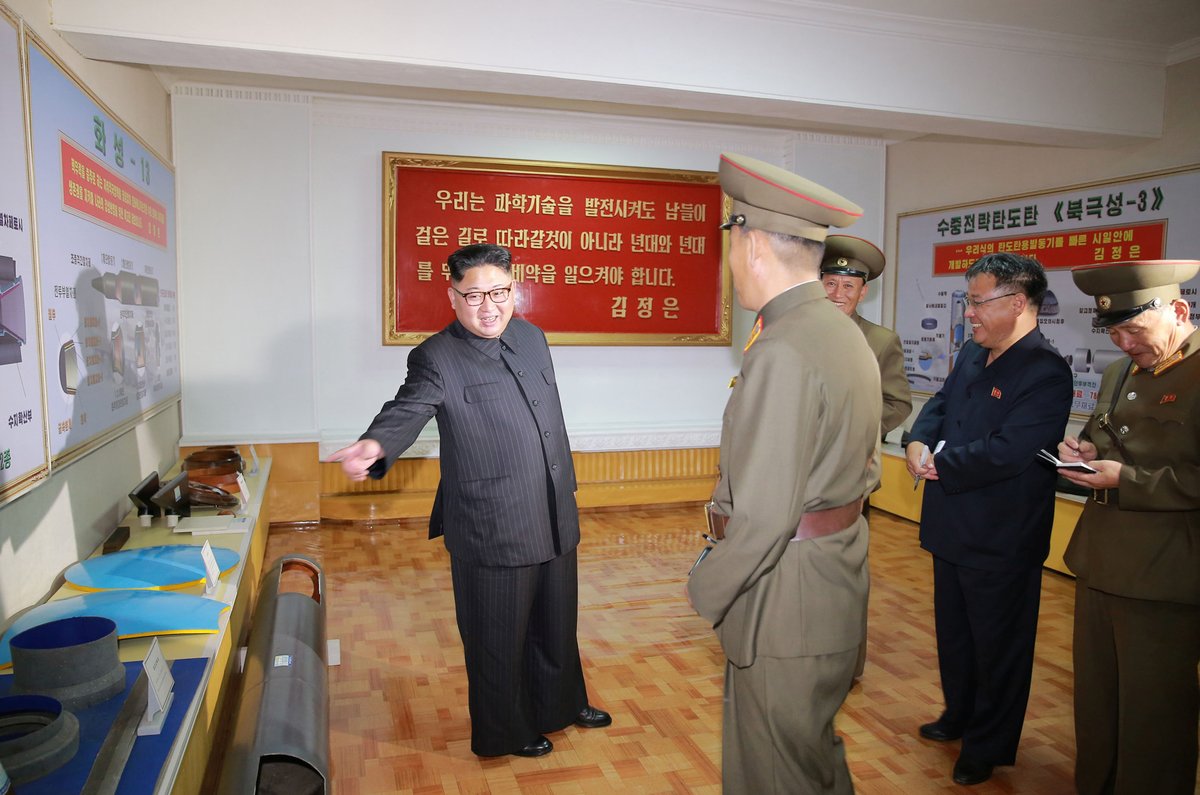
Kim Jong Un visiting the Chemical Material Institute of the Academy of Defense Science, flanked by posters of the Hwasong-13 and Pukguksong-3
This episode is from September 2017. Facts and links may have changed since. See more from that month
Links (and Pictures) of Note
The Pukguksong-1 on parade with its potentially-new airframe on display.
Kim Jong Un visiting the Chemical Material Institute of the Academy of Defense Science, flanked by posters of the Hwasong-13 and Pukguksong-3
Transcribed automatically: it certainly contains errors. It’s pretty good, just not perfect. We provide it here because, for accessibility, it’s better than nothing.
Jeffrey Lewis 0:02
It's about time to see something new and interesting and upsetting. You are listening to the Arms Control Wonk podcast, the leading podcast on arms control, disarmament, and nonproliferation. I'm Jeffrey Lewis, the founding publisher of the Arms Control Wonk blog, and a scholar at the Middlebury Institute of International Studies at Monterey. Aaron's not with us today, but we're joined by a very special guest, Joseph Dempsey, who's a research associate for defense and military analysis at IISS.
How are you doing, Joe? Good. Thank you, Jeffrey. Good to be here. So although we have done a lot of North Korea podcasts, they have all been liquid-fueled missile North Korea podcasts, and we have not talked about the solid fuel program. And I am super excited to try to do a really deep dive into North Korea's solid fuel missile program, mostly because about a year or two ago, I wrote a little article when I said we should Think seriously about North Korea's coming shift to solid fuel and we should do everything we could to head it off.
And then I sort of said, but we're not going to do that. This is just a future I told you so paragraph. And we're now here in the land of I told you so. And so I think this is one of those things where we don't talk about it, but it's a big freaking deal.
Joseph Dempsey 1:25
It is. Yeah. I mean, I think what we've seen is we've seen two large solid field missiles over being developed. We've seen that the latter one, which is Pukguksong to the land-based version. We've had two tests of that this year. We didn't know about it previous to this, although Jeffrey, you had speculated that that's the direction they would go.
They've even said that after the second test, it's an operational capacity. I don't necessarily believe that, but it shows that, you know, they're, they're very keen on it. It's going to continue. The other interesting aspect is in the language they use as well, they're also talking about standardizing it. This is the way they're going to go. Solid fuel missiles are the way forward.
Jeffrey 2:03
Well, I've noticed that on the Iranian side, you know, we've seen a real drop off in tests of liquid fueled missiles. We've seen increasingly capable solid fueled missiles. And then when the Iranians went ahead and took that poke at those ISIS targets, most of those were Solid-fueled missiles. And so it's not surprising that they would prefer them.
But I guess, you know, we've spent so much time on the no-dong, right, that maybe it's hard to get our head around the shift. So I guess the place to start is why we think the North Koreans are doing this, because this is a Wholly separate alternative technological approach to increasingly long-range missiles. Which, you know, given that we often refer to North Koreans as being sort of poor and backward and isolated, like having one missile program is quite a lot.
Having two is eye-opening.
Joseph 3:06
Yes. And I think in terms of the, I think seeing the solid fuel, particularly on the Pukguksong-1, the SLBM program, We traversed all that last year. And I think it's fair to say it was a surprise for everyone. When I talk about surprise, I don't mean necessarily that the Pucasson 2 was a surprise. I think the kind of the breakthrough where we saw in the Pucasson 1, where they basically switched from what appeared to be a liquid fuel system to a solid motor.
Jeffrey 3:33
Well, I guess in that sense, it was really a surprise. Yes, because we spent so much time looking at Scuds and Nodongs and Taepodongs and things like that. There were some hints. I mean, the North Koreans did Have the the KN-02 which you know is a much smaller solid field missile, but yeah, there wasn't really a lot of hints. there weren't really a lot of hints that we were gonna, that we were gonna see something like this. And and you know, frankly, they, we, it seemed like right that the, that the submarine program was going to launch a Musudan clone. yeah, so well, firstly, the the
Joseph 4:12
The KNO2, the Toshka derivative, the Soviet Toshka derivative, much smaller motor. And that step up to, I think, a 1.5 diameter is quite considerable. And it begs the question about how did they make that jump and where did that jump come from? That's a very interesting question. It's not really been talked about. I don't know the answer, to be honest.
I think it's still a mystery.
Jeffrey 4:38
Yeah, it's a shame that Scott's not here because he actually wrote a really nice piece for NK News looking at how quickly states had been able to make that jump to that larger size motor and then how quickly that led to the development of an ICBM. I mean, it's a big, yeah, that's a big step.
Joseph 4:56
And just because you mentioned the KNO2, an interesting little side note is that, where is it? We haven't seen it for years in terms of testing. Yeah. It's been surprisingly absent.
Jeffrey 5:10
Yeah, you know, one of the interesting questions which we don't really talk about or haven't talked about in the podcast is how the North Koreans approach testing and deployment. You know, I think at the beginning you said it seems a little premature for the North Koreans to be going into mass production of Of this system given that it's only had a few tests.
And I sort of agree with that. And yet there's this other side of it, which is if I look at U.S. intelligence judgments really closely, they seem to think that the North Koreans deployed the Musudan for like a decade prior to trying to test it, which of course is a crazy thing to do because when they went and tested it, it didn't work, right?
Indeed.
Joseph 5:52
And if you look at K-08s, And that, you know, they considered or assumed it was operational before it even tested. And technically, it hasn't even tested yet. Right.
Jeffrey 6:02
So, you know, I do wonder, I mean, again, to, you know, I have this bias of looking at the Chinese program. The Chinese would always do a few tests prior to deploying a system, but then they would do like a trial deployment and they would keep testing. North Koreans seem to be willing to put systems in the field very early and then test them, which, you know, anthropologically is interesting.
It's not what I would recommend. Yeah.
Joseph 6:26
I think we're trying to assess when a Korean system, regardless of whether it's a missile, is operational. It's a very tricky thing. And part of my job here is involved in writing a book which looks at all the operational systems in the world. And North Korea is a constant headache because trying to determine when something is operational or in development is hard.
Consideration on a career and definition of what is operational is probably quite unique. And even if they only tested it once or maybe not even at all, notionally, it probably has some inherent operational capacity. Whether it actually works if they ever had to put it in operation is another matter, but they could vary.
Jeffrey 7:10
Yeah, I mean, there are also all kinds of reliability questions for me that come out of that. I mean, I think one of my favorite stories, which probably has gotten better every time I've told it, and I should go back and double check the data, But I seem to recall when the Iraqis tried to do larger solid-fueled motors, they didn't have the equipment to cast them as single pieces.
And so they had to do this kind of iterative casting, which introduces a lot of risk. And the U.S. view was this was a really unreasonable thing to do because some very large percent, like 10% of them, just simply exploded. But then, you know, I think it was Unmovic asked the Iraqis and they were like, no, no, no, it was fine.
You know, 90 percent of them worked.
Joseph 7:58
Yeah, I think that failure rate is very different depending on what country you're in.
Jeffrey 8:01
Yeah. So, you know, just whatever, you know, as we as we look at the sort of North Korean rationale for development. Yeah. Gee, I don't know. So why do you think I mean, this is a really expensive thing for them to do. And I've been thinking a lot lately about why the North Koreans make technical choices they make because I'm a big fan of bureaucratic politics as explanations for things.
So why do you think they opened up a whole second missile program?
Joseph 8:35
I think there's probably two aspects on this. So firstly is – Solid motors, using a solid propellant, generally considered a more robust system than liquid fuel. And I think there has been, shall we say, instances of explosions and failures with liquid fuel in general. They're also moving towards more mobile forces and more deployable forces as well. So that could be an aspect as well that solid fuel is more suited for that.
Jeffrey 9:02
What do you think about the submarine program? Because I also think it's interesting. When I saw the solid fuel missile on a submarine... I kind of defaulted to the Chinese expectation that we would just eventually see it on a truck. We did end up seeing it on a truck or at least a tank, but they're still building the submarine.
So, I mean, that's a whole additional level of complication. And I can come up with reasons for doing that, like getting behind the THAAD system to shoot at it. But do you think that's a tactical choice they're making? Is it a technological choice? Is it a I always blanch when other people use prestige, but I'm going to use it here because I'm tired and lazy.
Joseph 9:43
I think there's a multitude of potential rationales for their development. So, firstly, it's a status thing, and this is no particular order. I'm sure there is an element of status in there. They want to be seen as a nuclear power. Most nuclear powers have an SLBM capability. CSLB have and have not, I guess you could say. US has one, Russia has one, UK, France, China, India's developing one as well.
So to be seen as a nuclear power, it's often associated as kind of the apex, shall we say, of a nuclear system. It's no coincidence, of course, that the naming of the system, so how it translates is loosely translated as North Star, which means Polaris, which is an early US system. So I don't think that was purely coincidental.
You touched upon, Paddy, an increased chance of potential success, looking at gaps in, say, radar and ABM focus. I think there's potential for that. But I also think that what we'll see as a system, at least in terms of when it becomes initially operational, is it's not going to stray too far away from North Korean waters. So I wonder how much that would actually come into play.
Jeffrey 10:59
Yeah, you know, I think one of the interesting things is that Maybe in the non-proliferation community, we've been focused on liquid-fueled missile proliferation with the kind of implicit assumption that it's easier. But I think the reason it was easier is because the North Koreans were busy selling that stuff. So it was easier because North Korea had chosen liquid-fueled missiles.
When we went back and looked at other cases of proliferation, I was really shocked, and Scott's now been doing a bunch of work on this, By the 1980s, with the exception of North Korea, most new missile programs were solid. Yes, the Iraqis had liquid-fueled missiles, but they were engaged in the Condor co-development program with the Argentines and the Egyptians.
The Taiwanese and South Koreans were both going down the solid-fuel missile path. And so, you know, and that's, that's 30 years ago now. So I, there's this kind of interesting feature where I think when we looked at it from the outside, we thought, Oh, well, liquids are easier than solids because that's what people are building. But actually it was like just kind of contingent, right?
It's just, it was a choice the North Koreans made because that's what they got from the Egyptians first. And that's what they reverse engineered. And that's what they then turned around and sold. So actually, I think the reason I say that is I wonder if instead of asking why they switched, maybe I should really be asking why it took them so long.
Joseph 12:42
Well, I think an aspect to this is why they switched is because the liquid fuel wasn't working.
Jeffrey 12:46
Yeah, I mean, so do you think that then the push for this, which I can totally buy, comes from the frustration with Musudan?
Joseph 12:57
Yeah, I think, I mean, the engine that we believe the Bucason 1 started with is known as the 4D10, which is a liquid system that came from the R-27, which is an SLBM. And it's a well-documented thing. And Jeffrey, you've written some great articles on this in the past about their access to that in the 90s.
Jeffrey 13:18
It would be interesting to see it. I suppose it's not a bad hypothesis that They had the 4D10, which also represents a shift to better propellants. And then it doesn't work. And we've now seen them shift to yet another motor design for their ICBM. But they presumably didn't know that that was going to work when they shifted over and started the solid-fueled program.
Joseph 13:42
Well, I think this clearly has some problems with the 4D10. Now, when they certainly got it or access to it to a degree, we don't necessarily know what degree, We assumed it'd be in Musudan. I believe that all the imagery that come out since has kind of suggested that's true.
Jeffrey 13:59
Well, let's talk about when you think that shift happened, because I think we all assume that the program was starting as a liquid-fueled program. And then we saw it, and it was like, oh, that's not liquid. So when, I mean, there are definitely people who think that it was solid all along. And there are definitely people who think that it wasn't.
And I don't know which one of those people I am.
Joseph 14:26
Well, I think it was probably liquid to start with. The imagery is consistent with that. I appreciate our interpretations are different. The engine we think they used, the 4D10 engine, is something we think they've acquired or the technology around that they acquired in the early 90s. It's the basis for the R-27 Zayeb, which is... An earlier Soviet SLBM.
And the key thing with that engine is it's a submerged engine. It's submerged within the fuel tank. So it allows for a much more compact missile. And that's key when we're talking about, you know, putting a missile on submarines. You can't put a big submarine, sorry, big missile, On a submarine without making an incredibly big submarine. You are more restricted to size, which limits your capability and range of a missile.
So this engine, if you're going to develop an SLBM, this was a great place to start in theory. But in practice, no, because that missile sucks.
Jeffrey 15:24
All right. So, I mean, I'll just share. I mean, the part where we're confused is in January 2016, there was video of a test from the previous December. I've got the years right, right? These years, now that I have children, the years flow by so quickly.
Joseph 15:43
What? 2015.
Jeffrey 15:46
The December 2015, or was it January 2015?
Joseph 15:50
The test, I believe, is on about the 21st of the 12th.
Jeffrey 15:53
Of December 2015.
Joseph 15:55
It may not come out until January, potentially.
Jeffrey 15:57
Right, but that's January 2016 when the footage came out, right?
Joseph 16:01
Yes. Okay, good.
Jeffrey 16:03
So when we saw that footage, we see the engine sort of chug before it ignites. And so we have this debate going on where we concluded it wasn't successful because it didn't look like An R-27 launch, and we don't think it was successful. But what we can't decide is, is that chugging a sign that the liquid fuel engine is having problems and then blowing apart?
Or is that chugging, because it's also a feature of solid-fueled engines that are failing. So we are having an open debate among ourselves about what the December 2015 launch was.
Joseph 16:53
Two points. Firstly, the footage they showed that we assume was the December. It could have also been one in November, which we also know was a failure. True. Very true. I know you and your team have done some great analysis about looking at that footage and say, this was a failure because you also think it exploded shortly after launch.
I did also wonder that it could have also been the failure that happened just a month earlier, which we know was, from all reports, known to be a spectacular failure because reportedly it even damaged a submarine.
Jeffrey 17:27
Right. So you're right. It very well could be that November test. The reason we moderately think it's the December test is how he's dressed. But that's like the world's lowest confidence dating technique. I mean, he does sort of get these outfits, which he wears for like set periods of time.
Joseph 17:48
I've often looked at can we date imagery based upon his clothing and his hairstyle and his weight. I've never been successfully able to put it all together, though.
Jeffrey 17:59
I mean, I feel like I can get myself into, you know, a sort of couple month period. So it's sort of moderate confidence judgment of a couple month period, but not enough to tell November from December.
Joseph 18:14
And I think the other thing about the chugging, and I'm not exactly sure why it chugged, but it does raise an interesting point, is that all the footage we've seen suggests that this system, when it was liquid and solid, is a cold launch system. So it's injected from the submarine or the stand or whatever. It's injected from the tube.
Yeah. Using compressed gas or something along those lines. It's not a hot launch system where it ignites in the tube. Now, the R-27, which it's reportedly based upon, is a hot launch system. So we're already seeing quite divergent technology here.
Jeffrey 18:49
Yeah. Well, you know, I mean, one of the – not to go too far afield, but, I mean, Scott and I, and I'm sure you were too, I mean, those canisters we saw on the parade, are they making two different – Solid-fueled ICBMs, or are they going to try to cold-launch a liquid-fueled?
Scott LaFoy 19:07
I mean, you can do it.
Jeffrey 19:08
You know, the Soviets do cold-launch some of their large liquid-fueled missiles, which is an incredible thing to do, but...
Joseph 19:17
I mean, I see those, the large canisters, and whether they're actually, you know, ICBMs, we don't know what missile they have in mind for that canister. We don't know the size of it.
Jeffrey 19:28
You're right.
Joseph 19:28
So it's hard to say, is it IRBM or... They are big canisters, certainly. I mean, my view on this is it's aspirational. They're showing us what's next. What we actually see them develop in reality and the timeline for that, I don't think we can say.
Jeffrey 19:44
Yeah, well, I think that's fair. I mean, at this point, it's... You know, the North Koreans certainly notice that we pay attention. So there is an interesting question about, like, what's truthful and... It's it's difficult. All right.
Scott 20:03
So we think.
Jeffrey 20:05
Well, so I mean, I think we just so the problem is we're just stuck with this. I mean, Josh Pollock, I hate putting words in people's mouth, but Josh makes a really persuasive case in that he agrees with you that, you know, the North Koreans, even though some of those early images were animations, they were animations of a liquid fueled system.
And you know, the, the paint, I mean, this sounds silly. The name doesn't change, but the paint job changes, right. It goes from red lettering to black lettering.
Joseph 20:34
It does. Yes. Yeah.
Jeffrey 20:35
You know, so there's definitely, there's definitely some rebranding going on. But I don't know. I don't know. Is that like when LeBron James went to the Cavaliers and they got new uniforms, you know, I don't know.
Joseph 20:50
So it's interesting that the, you know, the, they went on the, the, because someone, the SLBM They didn't keep it simple. They could have gone hot launch, yeah. and also they went to solid fuel. Now, I think they went solid fuel because they're having trouble with liquid fuel. but the the the jump, shall we say, straight to to cold launch is an interesting one. and where they got the technology for that is an interesting question as well. And the rationale for jumping straight to that is very interesting, I think.
Cold launch has two real advantages for an SLBM. One, you can potentially reuse the tube. It's less damaged because it's not under the explosion, shall we say, of rocket igniting. So that's one. I think that's probably less important for North Korea. I don't think they're going to be using it too many times. Secondly is the safety aspect.
It's less likely the missile is going to blow up and take out the submarine.
Jeffrey 21:47
Yeah.
Joseph 21:48
If it does blow up, it'll be above the water, 20, 30 feet above the water it does so. And it's one thing, shall we say, to order another red truck from China. It's another thing to build an entirely new submarine.
Jeffrey 22:01
Well, and I mean, even with the red trucks from China, right, we've seen the deadbeat dead transporter, which erects the missile and then splits.
Joseph 22:14
Yes.
Jeffrey 22:15
So, I mean...
Joseph 22:16
Yeah, I think certainly what we've seen is that they've had issues with TELs. I think you can look back on the Musudan testing last year. There were reports that they damaged at least one TEL. We've also seen them putting additional kind of protection on the TELs from the previous parades that we'd seen. And I think what we've seen with Howisong 12 and 14 is them using a separate stand.
I think just, yeah, I think that's very concerned about losing any more tells. I think tells are quite valuable to them, to be honest.
Jeffrey 22:55
Poor Scott can't chime in, but he, he, or he can chime in, but he can't record. So for listeners, what Scott has just chimed in to say is that he reminded us that when we looked at the concert footage that showed some historical pictures of the North Korean missile testing program, The early launches of the Hwasong-12, some of which were failures, including one that Ankit Panda reports was a quite spectacular failure where the thing fell over.
Those appear to have been from traditional transporter erector launchers, which probably would have put some of those at risk. So I'm – Scott's point – Which I think I'm inclined to agree with is they do seem a little nervous about protecting those assets, which I guess are hard for them to import.
Joseph 23:50
I agree. I think, you know, we've seen them move towards that. I think they're protective of their telestip on us, a valuable asset. The interesting thing is obviously that direction they've taken has some disadvantages. So what it does appear is you do have to have a prepared stand to Sorry, not STAN. The STAN comes with the TEL or the missile, but you have a prepared ground that you have to prepare.
I think there's some suggestion that it's specially prepared. You can't just launch it from any road due to resistance issues and weight issues as well. The other interesting aspect, though, is what we've seen from the tests of the 12 and 14 is currently that launch pad is stepped up.
Jeffrey 24:37
Yes, I've noticed that in the satellite photographs.
Joseph 24:42
And you can also see it when you see the release imagery. You can actually see that step also. So just where the tell kind of, probably it's not a tell, sorry.
Jeffrey 24:50
Yes, that's right. It's a TE, or we just call it the deadbeat dad because there's an erection and it splits down.
Joseph 24:57
I call it a tell without the L. That's my thing. Yeah, so that step's interesting. So the TE drives back. And it puts the missile down on the ground, which is probably about, I want to say, six inches-ish below the level. It's interesting it does that.
Jeffrey 25:15
Wait, wait, wait, wait, wait, wait, wait, wait, wait, wait. Since Brexit, you don't do meters and centimeters anymore?
Joseph 25:22
Oh, I can't possibly come up with that. And Brexit hasn't happened yet.
Jeffrey 25:26
So give it to me in metric.
Joseph 25:30
20 centimeters?
Jeffrey 25:32
I'm just being a jerk. It's my natural status.
Joseph 25:36
So that's interesting. So it means that that launch area has to be even more prepared than normal, which, you know, potentially means you could, you know, the US... I certainly hope they're looking like crazy. For these little concrete platforms a step down. Because you would be able to see them from space, in theory.
Jeffrey 25:56
You should be able to, yeah. I mean, I sincerely hope, and I sincerely hope if they do find them, that they don't leak that information.
Joseph 26:05
However, I think it's important that that may not be a long-term plan. So the TEs themselves have these extendable kind of support arms. And in theory, they can jack the vehicle up. Right. So in theory, they could jack the vehicle up and they could put it on level ground. Now, they possibly haven't done that because they're playing it safe.
Jeffrey 26:28
Yeah, I mean, that makes sense to me. You know, the other question is whether this thing is, I mean, I'm sounding like the conspiracy theorist, but, and this, I think, brings us back to this question of the investment in the submarine. You know, we're seeing them spend all this money on a submarine for the solid fuel missile program.
We've seen a new transporter for the land-based variant of it, right? So it's this tracked vehicle. I'm shocked that we haven't seen rail cars yet.
Joseph 26:55
Yes, I've heard the idea has been suggested previously. I wouldn't say we won't see it. Whether they'll show it to us, I don't know. They've shown us the system, but as you said, it wouldn't necessarily be too hard to mount it on a rail car.
Jeffrey 27:10
I mean, I would like it on a rail car if I were them, right? Because you've got Nicer rails than roads for most of the country. And, you know, it's fairly easy to disguise, although the Chinese didn't do as good of a job with their missile transporting rail cars, I think, as they might have thought they did.
Yeah, I don't know. So what do you think about the submarine? Because I, the whole reason that, you know, I imagine that they might put this on a, on a land-based system was I had sort of questions about the, Feasibility and survivability of the submarine?
Joseph 27:45
Sure. I think, well, the main rationale, we've covered a couple of reasons why they might have done it. The main rationale is probably to work towards a credible second strike capability. We've seen that in the new missiles they're producing, there's a greater focus on mobility. And the idea that potentially a preemptive strike to take them out would be harder would And the possibility of survivability for a second strike.
Jeffrey 28:14
So the question that... Oh, you were going to... No, no.
Joseph 28:17
It's okay. You go first.
Jeffrey 28:18
Scott, you broke us. So one of the questions I was going to ask is about the possibility of a West Coast site because we've seen a... You know, for listeners, all of the tests happened out of Shinpo, which is on the East Coast of North Korea. Yeah. Well, I shouldn't say out of Shinpo, they happened on the East coast.
There's, there's one very interesting test that we want to talk about that happened a little bit North of there. But there's another big Naval base on the other side that does have a submarines based at it. That does have the infrastructure that you might expect. The Kim Jong-un made a pretty high profile visit to a couple of years ago.
And then now we've seen a new launch barge or, or what Joe Bermudez says is a launch barge, and I don't really see any reason to dispute that, on the West Coast. So what do you make of that? Because, I mean, I know one of the things that we wanted to talk about is I'm not convinced that they just have the one submarine right now.
Joseph 29:26
So what we saw is a few months ago on satellite imagery, At Nampo, which is a big shipyard not too far away from the naval base you mentioned, where they have produced submarines in the past, I should point out, is we did see this test barge. And it is very similar to the test barge we saw at Simpo in its design.
So I agree with Joe Bermudez on this, that it does look very similar. It probably is the same kind of system. But the significance of it is interesting. So one could speculate that they're expanding Their program to the West Coast. I don't necessarily buy that so easily. I'm not saying they won't expand it. I won't necessarily say that the long-term thing is they won't have SSBs, so ballistic missile submarines, on both coasts.
I think that could be well within their plans. But I don't necessarily see the rationale of testing the same system on two coasts. The potential reason, most likely reason, I think it is, is by putting it on the West Coast... You're expanding your potential test area.
Jeffrey 30:33
Oh, so longer range.
Joseph 30:36
Potentially. So the Lofted tests that we have seen, for a lot of them, the longer range missiles they're developing, it's limited. The reason I think they are doing Lofted tests of these longer range systems is because they physically don't have the geographical freedom to test them any further without going over Japan or without getting too close into Japanese territory.
I mean, over provocative. So what we have seen is when they – so if you launch from, say, the East Coast, you're generally limited to around the 500-kilometer mark in terms of your testing.
Jeffrey 31:11
Yeah.
Joseph 31:12
If you launch from another site within Korea, within the land, and particularly when we have seen some of the longer-range tests, we've seen it from the northwest. Right. Right. And there you can get up to a range of about 1,000 kilometers by going in the same direction firing into the Sea of Japan.
Jeffrey 31:31
Ah, that's a really good point. So you think that this is sea room for longer range missile systems?
Joseph 31:38
Potentially. So what you could do is, you know, you could launch even technically as far as you can launch from the west is by going into the sea. Right. Now, granted, I don't think they're going to be going too far out into that sea. I think well within near the coast, well within territorial waters. That's my own assumption.
But You would be able to do a test of that system probably upwards of 1,000 kilometers. Yeah. Actually, it brings an interesting question about the range of this system, which, you know, is the lower estimates of this system, and that's an interesting question about what the actual range is of the system. The lower estimates are about 1,200 kilometers.
So actually, you might see a more or less operational, the realistic test rather than the lockdown.
Jeffrey 32:20
Yeah, you're right. You get a lot of nice choices there, don't you? Yeah. Huh. All right. Well, so that's an interesting question. So you think it's just the one submarine, though?
Joseph 32:34
I think it's the one submarine that's been launched. Okay. I think we're not going to see just one submarine. Whether that submarine is the same kind of submarine is another question. But no, I think... The obvious thing is, yes, we have only seen one submarine from satellite imagery at any one time based at Simcoe. That's true. It's not moved far apart from that one test that you alluded to.
I think there's been some minor changes to that submarine since it was launched. We first saw it, by the way, in December. I think July 2014, I think it's the first time we saw it on satellite imagery. And that was the first real whiff of this program coming into the open. It was always rumor and speculation before we actually started seeing, this is actually, we can see this now.
So yeah, I believe, and I'm quite happy that there is one submarine currently. I think they're probably building at least one more right now, but we haven't seen it yet.
Jeffrey 33:35
I guess my caution is, you know, It's hard to know. I mean, the, the, the submarine, the images we've seen, yes, there have been, there have at least been changes to submarine. And so I, you know, they're not the kinds of changes that would absolutely require it being a different submarine. But it has been a long time that they've had just the one.
And that really leaves me and there, and they, they do have caves You know, I just, I don't know. Maybe I should just say I just am not confident that it's really only one.
Joseph 34:16
I think a key question for this is, what is the submarine? What's its purpose?
Jeffrey 34:22
Yes, that's a very good point.
Joseph 34:25
How do you answer that?
Jeffrey 34:27
Is it just a test asset, or do you think...
Joseph 34:29
I'm not 100% sure on this. It raises a mental question about why did they build it in the first place? And just to get a clear one, I'm going to refer to this as the Gori-class submarine, by the way. Some people refer to it as a Simpo-class submarine. Even the NASAC report earlier this year referred to it as a Simpo, which was a bit surprising.
Simpo, it was called Simpo because that's when we first saw it. Right. Unfortunately, we also have another Simpo-class boat, which is a small patrol vessel. So that's why I distinguish and call it Gori, so there's no confusion.
Jeffrey 35:01
Never make anything easy with these designations.
Joseph 35:03
They don't, no. So Gory is reportedly the name that's come from, I think, South Korean officials. So I'm going to call it Gory, if that's okay.
Jeffrey 35:13
Fine by me.
Joseph 35:14
Okay. I may not be pronouncing that rightly. That's what I'm going to call it.
Jeffrey 35:18
That's in the best Arms Control Wong podcast tradition. We don't ever pronounce anything correctly. Okay.
Joseph 35:26
So, yeah, what is the goal? So I think the interesting thing is if it's – there's two sides to this story. If it was purely to test an SLBM, could they not have modified their existing submarines to try it out? Right. That's what the Soviets did when they first started developing this technology.
Jeffrey 35:47
And the Chinese?
Joseph 35:51
Not really. The Chinese actually – Well, they build a – yeah, go ahead. They built the, this is where we come back to the Gulf here, and we'll come back to the Gulf class again. The Chinese got plans from a Gulf class submarine from the Soviets, and they built it themselves.
Jeffrey 36:09
But it was a dedicated test asset.
Joseph 36:12
As far as I know, yeah, it's a Gulf class SSB. And it was, yeah, a dedicated test asset. And it served for many years. And it was only retired, I think, in 2013-ish when they built a new test bed. Right, so, oh, I see. But you mean the Soviets? They, they repurposed existing submarines? Yeah, so there was some, I did not know that. SSK's originally. So, I can't remember which class they modified, but they, they started modifying them to test the principle. and then they built a custom built ship, which was the Gulf, essentially, on the SSK side, on the conventional side. Okay, so you know, North Korea have a, have a large fleet of conventional submarines, as we know.
They're larger ones, so it might be a bit tricky to implement that kind of size system on a coastal vessel or a midget submarine. And Romeo's potentially could have integrated that just purely as a test bed. However, those larger submarines, there's limited assets in it for about 20 of them probably in operation. They may also be technically issued, though, because you would have to cut through the pressure hole.
So they may have operated for a totally different system on that basis. The question is, though, this is a completely new design. We've not seen this design anywhere in the world as far as we know. It's the biggest submarine design that they've ever built indigenously by quite some margin.
Jeffrey 37:34
I had been warned, by the way, that submarines were your great love.
Joseph 37:39
Well, anyone who follows me on Twitter will know that My feed is probably dominated by two key things. One, North Korean military developments. And two, submarines. So the opportunity to talk about both in the same podcast is brilliant to me.
Jeffrey 37:53
It's called Arms Control Wonk for a reason. You go crazy.
Joseph 37:56
Thank you. So yeah, when we first saw it, it's the biggest submarine they've ever indigenously produced. They've produced and have a long history of submarine building. They're generally quite small submarines, midget submarines and coastal submarines. Coastal submarines. This is considerably larger in terms of displacement and length. Yes, they operate bigger submarines than that. So the Romeo class, or if it is real name, because these are Chinese-built Soviet submarines, the Type 033.
So they operate those. The first batch they got were from China. They were Chinese-built ones. And then they built them themselves, but they were built from kits. So they never built any large submarines from scratch before. This is, as far as we can see, an indigenous design. It's much bigger, which brings some interesting challenges about how they did it and, you know, how capable that is and how seaworthy it is.
Jeffrey 38:51
Right.
Joseph 38:52
If it's going to operate as an SSB in future.
Jeffrey 38:55
Yeah. Well, and I, you know, I mean, I realize the, you know, I'm talking about an early generation Chinese nuclear submarine, so it's really a different animal. But, you know, the stories on the Chinese side, Of that first system are pretty funny. It seems like it's quite a jump.
Joseph 39:18
It is. And I think the Chinese took a long time to develop that capability. So I think since the 60s, and Geoff, you wrote about this, so please correct me if I'm wrong, but the ambition has been decades long to get to a credible operational system. And they've only now just done it, really, in the last couple of years.
Jeffrey 39:36
Yeah. We think. Right. I mean, we still haven't gotten we've gotten an implicit confirmation that they finally put the missiles on the damn boats. But, you know, we don't don't technically know that, although I think it has to be true at this point. Yeah. So I don't know. I think it's all it's all very interesting whether this is going to be just a test asset or whether it's the first of a series of boats that come after look anything like this.
Joseph 40:06
I think one interesting thing from the Chinese program is they were nuclear-powered submarines as well.
Jeffrey 40:11
Right. Yeah, there was a big difference.
Joseph 40:13
Which is a whole new area which North Korea, as far as we know, is not going into anytime soon.
Jeffrey 40:19
So I wonder about that, because the South Koreans are now talking about going in that direction. And I wonder if the South Koreans do it, if the North Koreans will feel obligated, no matter how terrible their own version is.
Joseph 40:32
Yeah, it's an interesting stuff. Recently, the South Korean defense minister said that they were now considering nuclear-powered submarines as an option, and particularly in reference to countering the North Koreans' submarine ballistic missile program.
Jeffrey 40:50
Yeah, I get the sense that Kerry is just looking for work to do.
Joseph 40:55
So, I mean, it's interesting. So the advantage, I mean, we can get into the holders a bit about, you know, the advantage of nuclear propulsion. It's a lot more expensive than conventional powered systems, but it does offer the advantage that you, you know, virtually unlimited, but not unlimited. You're only limited by how much food you can really store.
That's the limit. So generally it's about three months.
Jeffrey 41:17
Yeah. And it was free, you know, you don't really have to feed them all that much.
Joseph 41:20
Well, interesting way of looking at it.
Jeffrey 41:24
Dark famine joke.
Joseph 41:26
So I think my personal thing on this is it's probably not going to happen that South Korea is not going to go nuclear-powered submarine for a while. I think that they're not operating that far away from their territory that they probably need it. I think what they could do is for the general ratio, I should point out that the South Koreans are developing a very capable infrastructure Indigenous submarine program.
And that's a very interesting case study in itself. So they're already increasing their capacity with some very capable conventional power submarines, AIP. So this is air independent propulsion, which potentially, depending on the system, you can be submerged, loitering around an area for up to a month.
Jeffrey 42:09
Yeah, well, my sense is that's what they want to do, is they want to try to loiter off those two submarine bases and try to catch the North Korean submarines as they go out to sea.
Joseph 42:19
I think, you know, long term, when we see an operational deployment, that's probably exactly what they want to do. I think AIP is probably enough for that, personally. You can probably get two or three quite capable AIP submarines for the price of one nuclear submarine. That's about the going rate. Yeah.
Jeffrey 42:35
I was not joking when I said I think just Kerry is looking for something to do. I think to the extent that there is a real push for this in South Korea, I think it's the bureaucratic imperative of people who make nuclear reactors, not the Navy.
Joseph 42:53
So going back to your question about the glory class, is it going to be operational? Now, the interesting thing is on the article that Joe Bermudez published, he notes something very interesting in satellite imagery that This appears to be something on the side of the sail. The sail being what we modernly call the calling tower in submarine terms.
And that appears to have some writing on it. His suggestion is there's a pennant number. So it probably says a number on the side. That would imply it's going to be operational. That would imply it is or is going into service. Now, whether that means it's going to be an auxiliary vessel, so a test bed, an in-service test bed like the Chinese did, whether that means it's actually not going to be a test bed is an interesting question.
Jeffrey 43:34
Yeah. Well, you know, the Chinese also had this weird notion, which kind of goes back to our conversation about when we decide North Korean systems are deployed or not. But the Chinese had this idea of like trial operational deployment, you know, that that part of and we don't really have an analog to this in the in the United States or the West.
But the part of the R&D process is a trial deployment where you operate the system to see how it works. Which is a strange way of thinking about it, I guess, but not entirely stupid.
Joseph 44:08
No, no, that makes sense to me. I don't know what North Korea does on this. I don't know how their in-service acceptability tests go.
Jeffrey 44:18
Well, they've never done it with a missile submarine before, so no one knows.
Joseph 44:23
They might be making a puzzle to go along.
Jeffrey 44:26
Sometimes there aren't actually answers to these questions because the North Koreans themselves don't know. Like, Yeah, go ahead.
Joseph 44:34
I think we've both been looking at North Korea a long time, Jeff. I think answers are very hard to come by. I think the best we can do is sometimes framing the questions correctly.
Jeffrey 44:42
Yes, that's right. So that we're not totally shocked when they do something. We're like, oh, that's what that means.
Joseph 44:47
Yeah. I think in terms of... What we'll see next from the submarine side of things is they've increased the capacity, shall we say, at Simpo quite significantly in terms of their ability to produce a submarine. So they've refurnished the existing assembly hall. They've put in a new slipway there. So potentially... They could produce a submarine, like they have done the Goray class again, but they could potentially make it easier.
Potentially the slipway would make it easier to launch a much bigger submarine. And there's been speculation that what we will see is a bigger version of Goray, potentially having two to three missile tubes.
Jeffrey 45:31
Yeah, I mean, at some level, I mean, it's more ambitious, but I would not want to send a submarine to sea with a single missile tube.
Joseph 45:40
Yeah, no, I think in fairness, if you invest in that, it's not much of an extra step to put two to three missiles on and to launch in a salvo, and you're probably more likely to succeed in doing so.
Jeffrey 45:52
We've started to wonder about what's next for the submarine. So, I mean, do you want to try to tackle that holistically? So the possibility is a new submarine with more launch tubes. Yep. But then there's the missile.
Joseph 46:04
There is. There is. It's interesting. So we've obviously seen a step change in the missile already with the switch from liquid to solid. And the question is, what's next? So if you look at the timeline for this program that we've seen, at least, so we saw the kind of first sign, the first kind of test launch. We didn't see it in fairness.
It was reported. The test launch or I should say an ejection test. So when we say ejection test, we're talking about ejecting because it's a cold launch system. So as we know, it's ejecting it from the tube before it ignites. So what they did is they did some land-based projection tests. They have a lovely little stand at Simpo.
Jeffrey 46:42
Man, nice picture of that in the concert.
Joseph 46:44
I think you talked to me in one of your previous concerts about the take-homes from that imagery, about what our favorite was. I think that was probably my favorite, finally seeing that.
Jeffrey 46:53
Yeah, that was pretty cool. You know, we actually are kind of bummed out because we wanted to use Planet's really high revisit rate to see if we could catch the Marks. From the ejection tests, in the same way that in World War II they used piston marks from the V1 launch rails. Okay, to count ejection tests, because I think you have pointed out we probably have undercounted the number of ejection tests. I, yeah, I get the impression, and we can talk about
Joseph 47:26
I think that's the case because we're seeing a lot more of them lately. And a lot of these are reported in retrospect. So I think we probably missed a lot previously. And they'd be quite hard to see as well.
Jeffrey 47:39
The only thing I think you would get is the mark in the landing spot where the missile body falls back down.
Joseph 47:46
Yes. Yeah, possibly. Yeah, you wouldn't see any, let's say, scorch marks, but it's a cold launch system as well.
Jeffrey 47:54
So but, you know, we have this really beautiful there's this beautiful analog. So in World War Two, the way they identified the camouflaged V1 rails is there was a piston that pulled the V1. And the piston flew off the end and landed in the soft earth in front of the launch rail. And so it would leave a scar.
And so if you had high enough resolution from airplane images, which was World War II, that's all they had, they could actually find those scars. And so we thought, oh, well, if we have satellite images of this site, this is a much larger scar because it's a much larger missile body. And we wanted to try to track the tests that way.
But it turns out the scars are just not large enough for us to see, given the resolutions we were working at. So that's my own personal pain right there.
Joseph 48:44
Okay. It's interesting. I mean, I'd love to see, I don't think we'll ever see it, is actually what that ejection test looks like.
Jeffrey 48:51
Yeah.
Joseph 48:52
Does it just come down on concrete? Well, yeah. No, no.
Jeffrey 48:59
We think it's a sandbox. Sandbox or dirt. Because there are, you can see in the high resolution images, which there just aren't enough of, you can see the mark from the missile body and then the mark from when they Pull it off, and then they like re-rake it or rebuild it. Okay, yeah, so we thought by looking at the marks we would be able to monitor the number of tests, but again, just the resolution or our ability to interpret it just weren't quite there. maybe we'll go back and take another look at that. Maybe we're just not being enterprising enough. Yeah, these are like For every like cool open source thing we do, you know, there are like 10 open source things that we couldn't pull off.
Joseph 49:44
Yeah. I think we do fairly well in the open source though. I think, you know, first world problems.
Jeffrey 49:50
Yeah, that's true.
Joseph 49:51
Yeah. And what's interesting, if you want to look at what it could look like, I think we've seen so many recent tests that you could probably go and look at that imagery and then work backwards.
Jeffrey 50:02
Yeah.
Joseph 50:03
So going on to the test schedule. So yes, we think that the first kind of The first reported one, I should say, was October 2014. And then we started to see them move towards at-sea testing.
Jeffrey 50:16
Right.
Joseph 50:17
So we saw in 2015, there was five at-sea tests that we know of. Now, they weren't necessarily tests that involved the submarine. We've mentioned the test barge, which is, you know, you tow it out with a tug, that infamous tug that you'll mention, I'm sure. And then you submerge the stand, and then you launch it. So it simulates underwater launch of the missile without involving a submarine.
So we saw five of those with some success, some failure, we think. And then we see the next reported, and again, I think we're undercounting on these, land-based ejection test. And that was in March 2016. The next time we see it is in April. So just over a month after that launch, Almost return, again, under counting, that return to land-based ejection.
We see it again in April 2016. That's when we see an apparent switch to solid motor away from the liquid motor. Oh. And that makes sense if you're looking at it. So you test it on, you kind of do at least one, and I suspect more, land-based ejection tests. You think, right, it's worked okay on land. We've checked the ejection system.
Let's now bring it over to sea, check the ejection system from underwater. Reach towards the submarine at some point. And then also check the ignition system to agree and, you know, not say full flight test, but at least check it works. It may fly a couple of kilometers up and then it splashes down, which is what seems to have happened.
Then for whatever reason, they've gone back to land. And now we see the switch to solar fuel. It would suggest that the, you know, the liquid fuel, which we believe is the 4D10 out of the R-27, wasn't working. So they've gone back to the ground slightly and tested something new. Now, I don't say it's a direct switch.
I think it probably only has parallel programs, potentially, just because of the timelines. It's interesting that we see that switch.
Jeffrey 52:12
Yeah. But, I mean, the implication of that is, since we're seeing ejection tests again, that something bigger is coming.
Joseph 52:18
Yeah. I think the SLBM program has kind of slipped off the radar a little bit because of the, well, as we've seen, as we all know, and any listener of this podcast will know, we've seen a lot of lag. Systems. It's been busy, it's been busy. I mean, I look back at all the tests and it's an interesting little statistic here in in 2017 we have seen, for the first time, four new ballistic missile systems. The first time we never saw them, we didn't even necessarily know about them, and they've all been tested successfully. Yeah, it's been busy. Yeah
Jeffrey 52:59
And so it's easy to lose sight of the submarine launch.
Joseph 53:01
It is. I mean, I like the submarine. I'm not going to lose sight of it. So I'll always be keeping an eye on it. So what we've seen is in 2016, we saw three ATSI tests. Two they showed us because they were considered successes. And there's a failure as well in there. But the last one we saw, which was August 2016, was considered a big success.
The interesting thing about that is it flew for 500 kilometers. So as we talked about, about the limit you're going to do within the East Coast. And the apogee, we don't necessarily know the stated apogee on this one, but the estimates put it around 550 kilometers. I'd have to check about who came up with that and did the estimates on that.
But the interesting thing is, though, that seems about right, considering we have better data points for the Bucasson 2
Jeffrey 53:55
Right.
Joseph 53:57
And the two tests that they did in 2017 flew virtually identical profiles, so 500 kilometers out and about 550 apogee. So it's kind of virtually identical tests between those two systems, and they are very similar as we know. Not identical in design, but very similar.
Jeffrey 54:14
Yeah, I mean, they were close enough for us that we guessed what it was before we saw it based on the trajectory.
Joseph 54:21
Yes, yeah. So, yeah, we can either talk about what the differences are or we can kind of look at the land-based injection tests. So we saw that last kind of, I'd say, a big success of the program in August 2016. And that was a year ago now, virtually. It went quiet.
Jeffrey 54:41
I mean, that's the thing is it's so easy to let time slip by, you know, and then you realize it's been a whole year and then we're surprised when they do something new. And it's like, well, what did you think they've been doing for a whole year? Like they're doing stuff. And the issue is we don't necessarily always know what that stuff is until we see it.
Joseph 54:58
Yeah, it's just that they've been showing us a lot lately. So it's hard to get track of all the programs and assume that they've given up on some programs or where the progress is. I don't feel they've given up on much, to be honest. Possibly Mr. Dan, I think, but certainly not the SLBM program. So what we have seen, what we saw reported, I think, end of last month, I think it was a CNN report, was talking about there's actually been four ground-based ejection tests at Simpo this year.
The first, including three in July alone. Now, Ankit Panda, friend of the pod, was able to give some dates on this. So the first one was, I think, end of May. And then we saw in July, we saw the 7th, the 25th, and the 30th. That's quite a lot of land ejection tests, quite a series of land ejection tests.
As I said, I think there was a lot more historically, but this kind of return to land-based ejection tests suggests that they're working towards at-sea tests of something a little bit different.
Jeffrey 56:00
Yep. So we should not be shocked when that happens.
Joseph 56:04
No, you heard it here first.
Jeffrey 56:07
You know, yeah, it's... Ah, yes. Yeah. It's about time to see something new and interesting and upsetting.
Joseph 56:19
You know, just as you think they couldn't really do anything new or upsetting or diversify their missile systems anymore or do new programs, you might see something new. I think the question is, what's going to be the change?
Jeffrey 56:29
That's, by the way, not going to be a cheery spot to end the pod. We're going to go into a second episode, but I think we should stop here.
Scott 56:36
Scott, you want to tell us about where we are with the Patreon page and the Slack channel? We actually have a Slack channel meetup this week in D.C. again. We have our second one now and head over to the Slack channel to find out when and where that is later this week. The Slack channel is excellent as always.
There's currently long-running ongoing discussions about recent North Korean events, including questions over legitimacy, analyses over size, shape, function, that sort of thing. So if you would like to be part of that sort of discussion, head on over to the Arms Control Wonk podcast Patreon page at patreon.com slash acwpodcast. It's $3 a month if you are a student with a .edu or equivalent email address, or $5 a month if you are not a student.
Come by and hang out with us. We're currently in a fundraising drive to reach $2,000 a month so that we can regularly purchase, analyze, and disseminate satellite imagery to all Slack channel members. And Joe, you're joining us for an interview slash question and answers slash ask me anything on there later this week, and we're looking forward to it.
It's going to be a lot of fun. As well, if you have business inquiries or advertising inquiries, please contact us at armscontrolwonkpodcast at gmail.com if you'd like to either take out an ad or sponsor a whole episode.
Jeffrey 58:01
Joe, thanks for joining me, and thank you for listening.