Transcript
Transcribed automatically: it certainly contains errors. It’s pretty good, just not perfect. We provide it here because, for accessibility, it’s better than nothing.
Jeffrey Lewis
0:01
North Korea has tested an intercontinental range ballistic missile.
Aaron Stein
0:10
You are listening to the Arms Control Wonk podcast, the leading podcast on arms control, nonproliferation, and disarmament. I'm Aaron Stein, a senior fellow at the Atlantic Council's Rookie Career Center for the Middle East.
Jeffrey
0:21
And I'm Jeffrey Lewis, the founding publisher of the Arms Control Wonk blog and a scholar at the Middlebury Institute of International Studies at Monterey.
Aaron
0:31
And calling in from an undisclosed hotel in Los Angeles from an iPhone and not the best Wi-Fi connection. But, you know, it's worth it because we have a lot of stuff to discuss.
Jeffrey
0:42
Yeah, you know what? Kim Jong-un, this is my vacation.
Aaron
0:47
For anybody who's close enough to be your friend on Facebook, it seems like it's been a lot of pools and tacos.
Jeffrey
0:54
It's been pools, tacos and interviews. I did three CNN hits in four days.
Aaron
1:00
It's nice to be popular, right?
Jeffrey
1:02
Yeah. Well, Mrs. Lewis is not so excited about having her vacation ruined by Kim Jong Un. She better or he better be careful because like she might actually try to decapitate him herself.
Aaron
1:12
I was about to say, would she endorse preemption?
Jeffrey
1:15
Yeah, yeah. She's actually now gone home with the kids, and I'm actually here for a series of meetings. This is really cool. N Square and the Norman Lear Center have set up meetings with TV show writers. Oh, really? Yeah, we've been talking to them about nuclear weapons and TV shows.
Aaron
1:38
That's awesome. Why don't I get any of those good gigs? It's because I'm stuck too much out in the Middle East. Nobody cares.
Jeffrey
1:44
Yeah, yeah, yeah. So this has been really fun though. Like I've gotten to see writers rooms for like a whole bunch of network TV shows which is crazy. So I like the blind spot and the people from the blacklist and Madam Secretary. It's been really cool.
Aaron
2:00
So you're ready to move to La La Land, my hometown, and the place I often find myself asking my wife, why did we leave that place? 80 degrees, pool, tacos, good food, Koreatown?
Jeffrey
2:10
Oh my god, I have spent so much time in Korean saunas. Again? Did you have the – and good dumplings, of course, and Chinese dumplings, soup dumplings. Now, the downside is it was really, really hot this week. It was like 100 degrees, so that part was not so good. And traffic, you don't know this because you've been away, but in the last year, traffic in LA has gone nuts.
Aaron
2:35
I visit four or five times a year. I do now. I often think about if I could charter a helicopter like Kobe Bryant.
Jeffrey
2:43
But like even the locals are complaining. They think that the traffic just in the last six months has gone totally out of control. So something weird has happened. So I don't know if I'm going to move.
Scott LaFoy
2:51
It's nice down here though. Tacos, jimjilbangs, yeah.
Jeffrey
2:55
Are you in range? I think we're in range. So yeah, that's the thing we got to talk about, which is North Korea has tested an intercontinental range ballistic missile. That's a bad thing.
Aaron
3:07
It's a bad thing. Because you were on vacation, we're recording this pod about a week after it happened, correct?
Jeffrey
3:12
Right. Although, again, half of that is me being lazy and trying to get in some vacation, and the other half of that is doing three CNN hits in four days and crap like that. So other people got the love. Well, let's talk about the missile. Okay. Let's talk about the missile. So on July 4th, Happy Independence Day.
Scott
3:39
Happy Day of the Strategic Force, Jeffrey.
Jeffrey
3:42
Yeah, that's right. On July 3rd is when Kim Jong-un signed the order to launch on July 3rd, which was the anniversary of the founding of the Strategic Rocket Forces. And then the missile flew on July 4th. And wasn't there some – didn't they release a statement where Kim said that they should keep giving us such gifts for our Independence Day?
Aaron
4:04
Maybe he's just a big fan of the movie and wants to recreate it.
Jeffrey
4:07
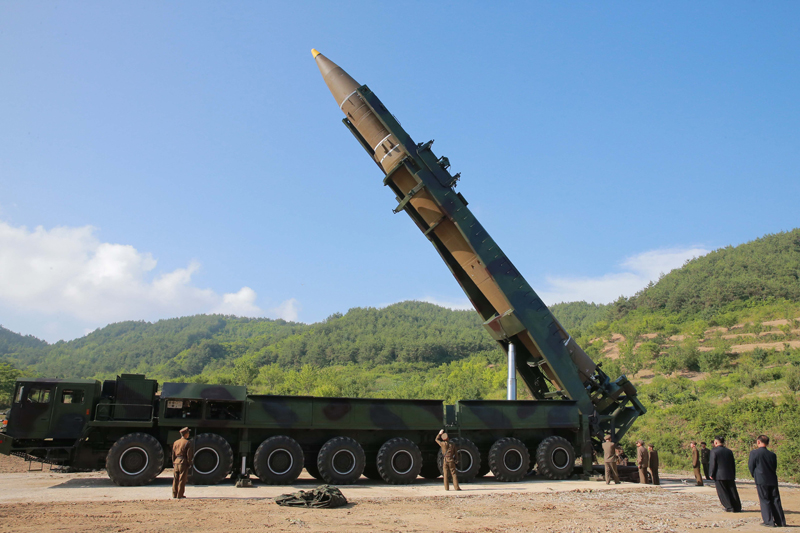
Yeah. But so they call the missile the Hwasong-14. Ankit Panda has a story in The Diplomat that says the United States designates this the KN-20. It's an intercontinental range ballistic missile. Holy crap.
Aaron
4:24
Yeah, and I think – From the outset, I think it's really important because it combines both a lot of the open source work that gets done and then gets verified later by reports like Ankit's and the Diplomat about range modeling, about how you guys and others were able to basically get a sense of how far the thing could fly based on the trajectory of when they tested it.
Jeffrey
4:47
Right. And, you know, I'm so bummed because we had this article completed and it's actually sitting in the content management system. And it was an analysis of the Hwasong-12 launch from mid-May. And this was a really edgy article we had written that said, when we model the Hwasong-12, we see all of the technologies on display that North Korea would need for an ICBM.
And at the time, we thought, we're pushing it a little bit. And then they flight tested the missile with all of those technologies in the form of an ICBM. So now our edgy article is no shit.
Aaron
5:29
Yeah, we'll unpack that a little bit for the listeners who don't know what the technologies are to flight test an ICBM.
Jeffrey
5:35
Right. So in mid-May, the North Koreans tested this missile called the Hwasong-12. And there were a couple of things that stood out about that missile when we analyzed it really closely. The first is it had a new engine. The engine was the same engine that we saw them test on March 18th. They did a ground test of the engine at Released a bunch of pictures and put out a press release in which they said this was the March 18th revolution in North Korea's design of engines.
We had a podcast. Right. The world would soon learn what this was. So then they flew it. The answer is it was a much more powerful engine than we had seen, or I should say probably a much more efficient engine. We were able to figure out what the fuel type was. It was NTO and UDMH, which is a sort of proper modern propellant set for a missile program.
It's not the crappy old scud fuel. But then because we had the mass of the missile, and I think we mentioned this in a podcast, I looked at the acceleration of the missile in the high-resolution video every tenth of a second.
Aaron
6:55
Yeah, I think we talked about this two or three episodes ago. What was that, off-pot?
Jeffrey
6:58
Oh, it might have been off-pot. But basically, we were able to get a really accurate thrust estimate for the power of the engine, which we put at like 47 tons. And so what the, oh, and then the last thing was in order to make that thing fly, the last piece of it was it looks like the dead weight, right?
The, the weight of the missile that is not fuel, but rather is just structure, which you want to get as low as possible is down underneath about 7%, right? It might actually be as close. It might be pretty close to 6%. And that suggests much more advanced airframes. My personal hypothesis is this thing called an isogrid airframe where they use machine tools, which North Korea has shown off at their missile plants, to kind of hollow out these sheets of metal so that they're Really strong, but also very light.
So, you know, you got a better, you got better propellants, a better engine and a lighter airframe. And when we put all that together, right, that missile flew. But what was really noticeable to us was not only could we recreate the trajectory of the mid-May launch, we started playing around by putting a second stage on top of it.
Right? Yeah. What happens if you put a little missile on top of that missile? And we got an ICBM. And we, you know, we, our review was this, the Hwasong-12 might or might not be the first stage of a future ICBM, probably wouldn't be, but you could translate all these technologies. And so that's what the article was going to say.
And then, yeah, they did it right. They launched this new missile And it's got all of those same techniques. We think it's a larger version of that March 18th engine, same propellants and also a lightweight airframe. But it's bigger, right? It's physically bigger and it's got a second stage on it and it flew real far.
Aaron
8:54
Yeah, I was about to prompt you, you know, There is a slight difference between what the Hwasong-12 looked like and I think what was the first stage on the KN-20, just to use the U.S. designation. The diameter was wider. Am I remembering that correctly? Yes.
Jeffrey
9:11
Yeah, that's right. I mean, we've had a big back and forth about this because early on, our estimate for the diameter of the Hwasong-12, the intermediate range ballistic missile tested in May, was larger than other people's estimates. We're fairly sure we're right. I mean, we measured it a lot. David Wright had a very funny comment, because as we were talking about why our measurements were higher than everyone else's, and I think we ended up convincing David, and he was really helpful for a lot of the modeling.
There was a point at which he said, well, you know, I guess there's some debate about the diameter, but I would think just saying Schmerler would do it. Just invoke – like Schmerler did the measurement, so it's probably fine. Could you explain that?
Aaron
9:58
I mean I know – because I've taken classes on this, but how do you get the measurements? How are you able to do that from the pictures just briefly? I think it would be useful for the open source stuff.
Jeffrey
10:06
It's really hard. It's very hard. Yeah. You know, you've got a picture of a missile, and ideally it's on a truck that you know how big the truck is, or it's near an object, you know how big the object is. Some people like to size things to Kim Jong-un, but I don't really feel like... We don't know how tall he is, right?
Yeah, and some people tried to, like, figure out how tall he is by figuring out how tall Dennis Rodman is. But unfortunately, NBA player heights are, like, pretty unreliable.
Jeffrey
10:38
You know, the teams didn't always record them accurately. So we don't actually know how tall Dennis Rodman is, and he's probably shrunk a little bit since his playing days. So, you know, you try to find some kind of reference point. And then the problem is, of course, you've got perspective and other things that make it really hard.
Aaron
10:54
Kim Jong-un could be wearing lifts, Tom Cruise style. Yeah.
Jeffrey
10:58
Well, I was thinking more that, you know, the missile's at a funny angle in the picture. But yeah, I mean, there are all these little things. So what you do is you make a lot of measurements using different images. And you sort of see where they cluster. And then, you know, at least for the Hwasong-12, which is an analysis we've finished, you fit everything together.
So, you know, the... Once we had an estimate of how big that missile was and we were able to use that along with the acceleration data to figure out how much thrust was involved and we could calculate the burn time, you know, you end up actually confirming some of your measurements because you're building this model in which you've got multiple data points with different connections to the real world and they have to all match up.
So, yeah, so we were able to get a measurement of the Hwasong-12, again, the intermediate range ballistic missile they fired in May, and then now we've measured this new ICBM, and it's wider. Like, it's 1.9 meters in diameter, we think. Yeah, it could be 1.8. It could be 2. It's probably not. It's probably around 1.9. But it's a big honking missile.
Aaron
12:12
Yeah, and big honking missiles can fly far. Yeah. Presumably with the wider diameter, you can get more range out of it. And so this thing goes far. And I think that's important because I think you wrote this in one of your really well-done Daily Beast pieces that only a Jeffrey Lewis can pull off where your intro sort of mixes in intense snark, but somehow builds in male analysis.
Jeffrey
12:36
Yeah, I had three Daily Beast pieces, and I think that's the one that starts off like, yes, you are definitely going to die.
Aaron
12:45
Right. But it's a similar theme on the Arms Control Wong podcast about the tendency to infantilize the North Korean program and already the debate starting about, well, it can only hit Alaska and Alaska's way the hell up there and nobody lives there anyways. Sorry, Anchorage.
Jeffrey
13:04
Yeah, totally. I mean, I understand why that happened. So for listeners, the North Koreans fire their missiles on what's called a lofted trajectory. They fire them nearly straight up. And the reason they do that is because if they fired them on a kind of more normal trajectory, what you call a minimum energy trajectory in order to maximize range, it would fly over Japan.
That would like really piss the Japanese off. And I think the North Koreans are going for like just the right level of aggravation, right? It's like the Goldilocks level of aggravation, like, like just frightened enough to be really worried, but not so frightened that we're going to have a war. And in 1998, they flew a missile, which they said was a space launch, but whatever.
They flew it over Japan. And I think they decided that that was too much aggravation. So they've been launching things nearly straight up so that they come down in the East Sea of Japan. Please, no angry letters, Korean and Japanese people who care about geography.
Scott
14:08
And you fix that with the compromise by making it the East Sea of Japan?
Jeffrey
14:13
That's right. Yeah.
Scott
14:15
Don't email us. Don't email armscontrollongpodcast at gmail.com.
Jeffrey
14:22
So they launch it nearly straight up and it comes down into the ocean. And so this launch, you know, it traveled not quite a thousand kilometers, but it went 2,800 kilometers in altitude, which is, you know, like seven times the height of the International Space Station. And so what David Wright did, which was right, was he took the energy that would have been necessary to take that missile up to that altitude and then back down to that range, and he calculated – How far it would have gone on a minimum energy trajectory, right?
So that got us, I think he said 6,700 kilometers. I think for those of us who deal with this, it's probably better to round, call it 7,000 kilometers. But what was really weird is reporters started saying, well, that's just a maximum theoretical distance, right? And it's like, no, that's actually the minimum demonstrated distance. The maximum theoretical distance is not what they showed that they could do because they could have cut the engines early.
It's what are the computer models show that a missile of that size and of that power could do. We were running those models and we were consistently getting like 9,500 kilometers. And like, we weren't really optimizing. I mean, we were just taking existing rocket stages we had seen in North Korea and sticking them on top of our model of the first stage.
And, you know, you get like... You know, you easily get, you know, 9,000, 10,000 kilometers out of it. And then, again, right, Panda and the diplomat gets out of the intelligence community. I don't know where he's getting this, but it's awesome that the U.S. assessment of the range is 7,500 to 9,500 kilometers.
Jeffrey
16:26
Right. Which is – yeah. I mean 9,500 kilometers I think is – that's probably it. I wouldn't – computer models are like – computer models are useful for estimating ranges but you really have to round. So definitely Seattle, San Francisco, Los Angeles. I tend to round up to 10,000 kilometers and think New York is probably in range.
Because the Earth is round. Yeah, and, you know, they're not going to make a... They're not going to make a... They're not going to make a missile that falls 100 kilometers short of New York. Do you know what I'm saying? Like, if your computer model shows... If your computer model shows that it falls just a little bit short, then it's probably your computer model that's wrong, right?
They would have just made it like 10% better or something. I mean, I guess it's possible that they might be trying to max it out. But John Schilling made this point to me once, and I think it's pretty astute. They're not going to make a missile that falls short of a big target like that. And the thing I would add is, These computer simulations that we do, if you ever look at what David Wright or John Schilling or other people put together, the computer simulations are just that.
They are simulations. And there are a lot of assumptions that go into that. And they are really valuable to help us understand how the missile works and what the missile might be capable of. But they're just simulations. They're just approximations of reality. And there are always little details that are different if you're actually building and flying the missiles.
Aaron
18:08
So, you know, don't get too hung up on 9,500 kilometers, I guess, is my... Yeah, you know, a lot of the assumption is around the weight of what it's throwing. I'm curious, just in your models, what you guys were estimating, because that goes to the weapons design.
Jeffrey
18:23
Yeah, we keep using 500 kilometers or 500 kilograms rather as a pretty standard mass. I think some people's models are consistently configured in such a way that they're kind of showing that there's no payload or a dummy payload.
Aaron
18:41
Yeah, I was going to ask about that too because there are some people that test without anything on top. I think that's a little –
Jeffrey
18:48
Yeah, I think that's a little bit of denial, not wanting to deal with the fact that not only is the missile going up, but the reentry vehicle is coming down. Right.
Aaron
18:58
And they've shown each one of these off along the way. I mean, if you go back and look in the archive of our podcasts, we'd had the discussion about the engine. We had the discussion about the Hwasong-12. We had the discussion about the reentry vehicle. And we've had the discussion about what their warhead probably looks like.
Jeffrey
19:17
Oh, yeah. I mean the North Koreans are not leaving a whole bunch to the imagination. No, they're delegates. Yeah. If you read their propaganda, this is clear as a bell. Right.
Aaron
19:30
It's totally clear what they're doing. Right. Hence back to the infantilization. But anyways, keep going. So you went around 1,200 – around 500 kilograms because he posed in front of the disco ball of death.
Jeffrey
19:41
Right. Now, one thing that's really interesting is when he posed in front of the disco ball of death, there was a reentry vehicle or reentry body, I guess, depending on whether you're in the Air Force or the Navy, next to him. And that had a really distinctive shape. And we saw a similar shape on the Hwasong-12 launched in mid-May.
This missile, this ICBM, was launched with a shroud over the reentry body or reentry vehicle.
Aaron
20:12
Explain what a shroud is.
Jeffrey
20:13
So a shroud is like a covering. So there's something – the actual reentry vehicle is underneath the shroud. And the shroud pops off and there's a video where you can see the shroud pop off. A couple of camera angles where we think we can see maybe the reentry vehicle peeking out. It's a little unclear. Yeah. But it's not – there's a big debate about why they might do that.
I mean one reason you would do that is if you had multiple warheads and this is where I have to like quickly say we don't think that their nuclear warheads are so small that they have multiple warheads. Yeah. Poor Dave Schmerler got quoted saying that, and it was like he was trying to make the abstract point that that's one reason to do it, and it became North Korea has multiple warheads, says Dave Schmerler.
We've all been there. Yeah, we have. So we're not saying they do. We're saying that's one reason you would do it. Other reasons are maybe it has countermeasures. You know, balloons, decoys, chaff, that's right. And, you know, maybe there's yet some other reason that we're not thinking of. They don't want us to see the reentry vehicle or, you know, I don't know.
But that adds a little extra weight. But I think, you know, When we model the missile, we don't have any trouble getting it to go where it needs to go with a significant payload. So we don't think that this is like a stunt. And the North Koreans, by the way, have said this missile is capable of carrying heavy payloads, which really catches our attention for two reasons.
One is because, you know, maybe the payload's a little bigger, right? Maybe we're underestimating the missile a bit. But the second thing is, do you know what North Korea hasn't tested yet? A heavy nuclear weapon.
Aaron
22:08
In terms of megatons?
Jeffrey
22:11
Well, so that's the question is North Korea has been really proud of testing these compact devices that they say can arm their ballistic missiles. And that's what the disco ball is, right? It's not heavy. It's a compact device. So if this is intended to carry a heavy warhead, that's a new nuclear warhead design, which means if there's going to be a nuclear test, it's going to be something that's heavy.
And there's no reason to make it heavy unless you're trying to make it more powerful. So I am a little nervous that we're transitioning to the era of thermonuclear weapons with the DPRK.
Aaron
22:46
And just listeners note, we're recording this amid speculation that there may be another six tests, correct?
Jeffrey
22:51
Yeah. I mean, I think so. You know, I don't want to predict another test because I think people forget that there was a test in September.
Aaron
23:00
You know, like – Go back to the archives.
Jeffrey
23:03
Yeah. But I mean, you know, like people are like, why haven't they tested? Like, Jesus Christ, give them a break. They just did a test. You know, like there is some turnaround time. You know, if you look at like the Chinese testing program, they didn't. They occasionally would test more than two times a year, but like normally it was once or twice, sometimes none, sometimes three.
I think once it was four tests. So, you know, it's not really time for the North Koreans yet. You know, I wouldn't expect them to do more than one or two tests a year, at least until things get going really crazy. But yeah, I worry that all their references to a heavy warhead, that means we're talking ICBM.
I mean – I mean we're talking thermonuclear weapons. Sorry.
Aaron
23:55
Is there anything we missed about the missile before we transition?
Jeffrey
24:00
Well, we could probably talk about the launch operations because that's kind of fun.
Aaron
24:04
It is. So okay. So my favorite picture out of this thing was the Kim Jong – I think it was from RT who got like a screenshot of the YouTube video. And he looks like he's doing the Michael Jackson, you know, smooth criminal lean. Yeah. And, like, I love that music video. So when someone pointed that out on Twitter, like, I was dying.
Like, it was fantastic.
Jeffrey
24:27
The one I like is the video clip where he appears to be smoking.
Aaron
24:31
I was going there, too. And so, yeah, so then he appears to be smoking next to an untested missile that's liquid. It's just fantastic.
Jeffrey
24:39
Yeah, next to, I don't know, 30-some tons of highly volatile liquid propellant.
Aaron
24:44
Yeah. I mean, I'm not Schmerler, but just eyeballing it, he looks to be about 30 feet away.
Jeffrey
24:50
Yeah. We could talk about whether the missile was fueled or not, but we're having this discussion about like, well, maybe the missile wasn't fueled. But if it wasn't fueled, that means there are fuel trucks behind him.
Aaron
25:02
Somewhere around. No, it's fantastic.
Jeffrey
25:04
He just doesn't give a – He kind of doesn't – yeah. That's actually tweeted like, why am I smoking next to 30-some tons of highly volatile propellant? Because fuck you. That's why.
Aaron
25:14
Yeah, because he can. And then on top of that, he's doing dance moves with a Photoshopped ear. I mean everything is fantastic.
Jeffrey
25:22
Yeah. So I think the big question or the big debate that we're all having is the North Koreans again released video showing dudes in bunny suits with hoses, which appears to suggest that they fueled the missile in the building and then drove it out to the site, erected it, and fired it. And obviously the reason that you would do that is to reduce your vulnerability to attack.
Right. Fueling something out in the field means you've got time that you're going to spend, but also a whole bunch of vehicles that that that the United States can spot.
Aaron
25:58
So, well, there was a leak, too. That's from the US, I believe. Right. So that cast some doubt on that.
Jeffrey
26:05
Well, you know, yeah. So let's talk about that. So the way the North Korean propaganda is presented. Don't believe everything you see on KCTV, obviously. But the way it's presented is that they fuel it in the building and they take it out to the site and then they erect it. And they give you wide-angle shots of the scene so you can see that there are no fuel trucks around.
Now, that doesn't mean that they're not just off-camera and that they don't come in afterwards. But we had some... Do we have some doubts about the feasibility of this? We're all wondering whether the airframe is strong enough... To be able to deal with the process of erecting the fueled missile. You know, so that's a kind of interesting, that's an interesting question.
Obviously if the North Koreans can do it, that's a big bonus for them because it means their force is a lot more survivable.
Scott
27:00
But as you say there is this report Ankit Panda got a scoop that the United States monitored the site and watched For up to 70 minutes prior to launch, though it's not clear what assets they used or if that meant regularly for 70 minutes or just got a shot 70 minutes beforehand with the satellite. It's not super clear, but the phrasing, I think, was 70 minutes prior to launch.
Jeffrey
27:28
If that story is true, then they're out there for 70 minutes and they're being monitored. That's tight.
Scott
27:38
Yeah, you know, I don't...
Jeffrey
27:41
I mean one thing I would say is that even if it was fueled, so they erect it and you're like, I don't know. Kim Jong-un dicks around for 10 minutes taking pictures. Like that's reasonable.
Aaron
27:51
Just to finish his fact, right?
Jeffrey
27:53
Yeah. And then like – then he like gets in his car and he drives five or ten minutes to the observation point and I don't know. Maybe he takes a dump and maybe he has another cigarette. And then he sits down and they give him like a briefing. Like, okay, this is what's going to happen. I think you could piss away 70 minutes on stuff that isn't fueling.
Especially with how Kim probably moves. I don't know what you're talking about. He's nimble like a cat. Probably, right?
Aaron
28:23
KCTV tells us that.
Jeffrey
28:25
Yeah. I mean, I'm not sure that the real pre-launch exposure time would be 70 minutes. I mean, I –
Scott
28:32
It's also the first time this missile's ever been launched in its current configuration. Like, it would not be exactly representative of an operational launch because, like, the crew isn't trained. Like, no one's trained for this one yet, so... Yeah.
Aaron
28:48
And we don't know how the command and control works either. I mean, that's just a big... Oh, yeah. We have no idea what their procedures are, or at least I don't.
Scott
28:54
The human and operational side of this is still, like, essentially experimental... So, like, yeah, I have no idea what the actual timeline would look like.
Jeffrey
29:03
Although I got to tell you, it's another deadbeat dad transporter erector. Yes.
Scott
29:08
Yes, it is. It's my favorite. It's a TE.
Jeffrey
29:12
I love calling it a deadbeat dad.
Scott
29:15
That was a good, I was, I, when you sent that out over Twitter over the holiday, I turned to my wife and I was just like, damn it, that's a good joke. And that's going to be way more popular than anything I could come up with.
Jeffrey
29:26
Well, you know, I mean, the reason I like it is because it's an erection and then it splits town. Yep. Aaron just now got it. I didn't see that joke. This is the first time I'm hearing it. I'm not on Twitter all day every day. I like it. so yeah, I, I don't, I don't know. And you know, it's also possible, I mean, we here is where all due respect to the reporting, you know, reporters Have sources and sources have to be accurate and sources are not always accurate.
So, you know, I mean, it's possible that they watched it for 70 minutes. It's also possible that some guy told a reporter that they watched it for 70 minutes because that sounded better than, Oh, we had no idea. Right. So, you know, I mean, I, like it's a data point, but I'm not sure how, how I'm not sure how strong of a data point it really is.
I mean, you know, to go back to the hacking story, which I really don't like, you know, this claim that we're hacking North Korean missiles.
Aaron
30:41
Yeah, that's being floated. It's a serious policy. OK, go ahead. Sorry.
Jeffrey
30:45
Well, people like still believe it's working. You know, it's like they just tested an ICBM.
Aaron
30:52
It's not working that well.
Jeffrey
30:53
Didn't, didn't look hacked to me. You know, like, like, yeah, some of them are probably going to blow up, but that's because they're new missiles. So you know, like, and I, to, to be, you know, full disclosure, I had officials darkly hint to me during the Obama administration that they were hacking missiles. I mean, they didn't say it quite as directly as Sanger seems to have gotten it said to him, but like, I clearly understood that's what I was being told. And I was like, oh, bullshit, right, like That's a nice story, but that's a little bit like it can only hit Alaska or it doesn't have a payload or they wouldn't dare.
This is like – or China will fix our problem. I think these are all things we do that are a form of denial because we don't want to admit the reality, which is North Korea tested an ICBM. They're probably about to test a thermonuclear weapon. That's a bad thing.
Aaron
31:41
Well, this is the wrap-up. Don't jump the gun yet. Back to Kim Jong-un and Smooth Criminal.
Jeffrey
31:51
Did you see they invited, Kim invited all of the people involved with the launch to Pyongyang for a partay.
Jeffrey
31:58
Oh, yeah. There was a big show with, you know, singing North Korean musical talent acts. I don't know how to describe them. Maybe Scott can put a little clip of the audio in.
Scott
32:18
Oh, I think we'll get a DCMA notice from KCTV. And you know how respectful we are of North Korean copyright practices.
Aaron
32:25
Yeah, you're right. You're right. But back to the fueling. So the debate about whether it was fueled indoors and then moved outside, saw for 70 minutes. I mean, and then the deadbeat that TE.
Jeffrey
32:37
Yeah. So I think for what it's worth, my current working hypothesis is this. It's that it was fueled indoors, that the airframe is stronger than we are giving it credit for, that they did transport it fueled, they did erect it fueled, and... The reason it was standing for 70 minutes is because they took their sweet time because they wanted to make sure everything went smoothly.
They weren't in a rush. They didn't think we were going to attack them. And they were right. We're not going to freaking attack them. We're not going to start a war. I think somebody wrote a story saying, we knew Kim Jong-un was there. Why didn't we just kill him? And I think the answer is because we didn't want nuclear-armed Nodong missiles to rain down on South Korea and Japan.
That's why we didn't kill him.
Aaron
33:20
That was the policy option proposed in the seat next to me on the Amtrak three days ago. Why don't we just kill them? Direct quote.
Jeffrey
33:29
You know, I do. I think when people feel powerless, you know, like you get the impotent rage thing. You know, like, we'll just kill him. Like, yeah, okay, okay, you'll kill him. You'll kill him. But, you know, like, I did a little study on Dora Farm, the strike that opened up Operation Iraqi Freedom in 2003 when the United States tried to kill Saddam in order to short-circuit the war.
Aaron
33:53
Podcast favorite.
Jeffrey
33:55
Yeah, and it was a fiasco. Like it was a straight up fiasco. The planning was bizarre. The assumptions that went into the planning were fouled up. My favorite is that is Tommy Franks and the Air Force chief of staff or no, the guy who later became the Air Force chief of staff had a conversation about kill probabilities because they needed to bust a bunker.
And they were – they figured out that the chance of – I think it was an F-117 destroying the bunker was like 50 percent. And Franks asks like, well, how do I get to 100 percent? Do I just add a second one? And they were like, yes, sir. 50 plus 50 is 100. Yeah. And it's like, oh, Tommy Franks is unfamiliar with multiplication. Okay, you know and, and the reality was Saddam had never been there, hadn't been there, or hadn't been there in a decade. Wasn't there. There actually wasn't a bunker on site. So there wasn't really a reason to put an aircraft with a human being at risk, let alone two. and I worry about a similar kind of thing, like You see a missile test and you think, oh, Kim's going to be there, right?
And, you know, maybe you get lucky. Maybe Kim is going to be there. But, like, maybe you don't. And maybe even if you do kill him, you know, you're not taking out their entire leadership, right? He's got A group of people around him. And I just don't think there's any guarantee that killing him either collapses the regime or, or goes off without them retaliating. so yeah, I wouldn't do that. Yeah, we had the, the dueling op-eds in the Wall Street Journal after the test. You know, on, I think it was on page A16. It was regime change. Let me guess. Let me guess Let me guess.
Oh, you mean regime change in Iran, regime change in Korea?
Aaron
35:51
Yeah, they were like on opposite sides of the paper. Oh, that's funny. I read them both online, but somebody took a picture and put it on Twitter. It was like they were literally like mirror images of each other just swapped out of Iran and North Korea.
Jeffrey
36:02
Oh, see, I thought the dueling op-eds would be op-ed one, we should kill Kim Jong-un. Op-ed two, we should kill Kim Jong-un twice.
Aaron
36:10
No, it was we should kill Iran, then we should kill North Korea. That's insane. I have seen, okay, like we usually end the DPRK podcast with a call for negotiations and diplomacy. This time around, despite some of the downplaying of threats that it can only hit Sarah Palin, is more rational, sober analysis from more heavy hitters that the only way forward is to try and negotiate a moratorium, at least on expansion of the arsenal.
Jeffrey
36:46
Yeah, I mean, the North Koreans were right. Once they had the ability to strike the United States, all of our tough talk was going to stop. I mean, you know, the Wall Street Journal editorial board is still going to be, you know, cray cray. But they're not wrong about the impact of their ability to hold the United States at risk.
They're not wrong about that.
Scott
37:07
It's like they read literally any Cold War assessment of how deterrence works.
Jeffrey
37:12
Yeah, you know, it's, I mean, you know, rest his soul, it's like they had Tom Schelling over for lunch.
Aaron
37:18
And our policy response option was just so formulaic. We had the B-1 flyby, the drop of the inert bomb.
Jeffrey
37:26
Oh, we had the missile launchers?
Aaron
37:28
We did have the attack, it was missile launch, which was interesting and fun.
Jeffrey
37:31
And a Hunmoo 2.
Aaron
37:32
And a Hunmoo 2, so literally they were like following our podcast, which was great. And I thought Scott's head would explode. He had a Takums, Hunmoo 2, and a North Korean ICBM all within a span of 48 hours. And then to make it even more exciting for Scott, we tested that.
Scott
37:51
Yeah, man. They're just doing a roundabout of things I enjoy.
Jeffrey
37:56
Well, now that everybody has shown everybody else their penises, maybe we can sit down and negotiate.
Aaron
38:01
Yeah. Yeah. So what are your plans for the rest of your time in Los Angeles?
Jeffrey
38:08
I've got one more meeting with some writers, but I probably should keep my mouth shut about which one because they have an episode in development which is cool. When, when it comes out, I'll, I'll flag it. So I, I won't, I don't, I don't want to let people maybe who watch that show know what's coming, but it's a good one.
Then I fly home.
Aaron
38:34
Oh, so you fly, you don't drive.
Jeffrey
38:36
Yeah, the family and I drove down, and then after hanging poolside for a couple of days, the family drove back.
Aaron
38:43
It's a tough life for you. But thank you for taking time out of your day to speak with us on the pod.
Jeffrey
38:51
Oh, it was great, great fun. I may go back and hit the pool one more time. I don't know.
Aaron
38:55
Scott, what's happening over in the Slack channel? There was a lot of excitement after the launch.
Scott
38:59
Yeah, the Slack channel is going great. We used some of our Patreon funds to fund our first original research. We acquired several pieces of satellite imagery. We distributed them to Slack channel members, and then we had Melissa Hanham was kind enough to donate some of her time, and she did a live cast of how she – Processes satellite imagery, so people could learn how to process their own raw satellite imagery. And then we sort of did group, like, combing through it for signatures. And we're still, this is still an ongoing thing. So that's, you know, still happening. But what was that imagery of, Scott? Oh, that's right. I'm sorry. Specifically imagery of the North Korean ICBM launch site the day after the test The day after the test, that's right.
We also got some comparative imagery from beforehand to show where the construction of the site occurred and all that, and so if we found anything interesting at the Panghon Aircraft Factory, we could look for it then.
Aaron
39:55
And Melissa's just worth following on Twitter. She gave a great tutorial on all sorts of stuff recently, right down to Donnie Trump Jr.'s emails, so very worthwhile. So thank you, Scott. Thank you, Jeffrey. And as always, thanks to the listeners for listening.