

James Sterngold has a long interview with NNSA Administrator Linton Brooks that contains this startling statement about how well plutonium ages:
In fact, experts close to Lawrence Livermore and Los Alamos have said scientists are finding that plutonium—a key variable in assessing the life span of the warheads—may actually grow more stable and reliable over time, and that a study due later this year will project an extended life span for plutonium bomb components, of perhaps 100 years.
Sterngold will have more to say about this, I am sure.
The entire debate about the aging of US nuclear weapons centers on the aging of plutonium. (For a nice primer on Pu aging, see Joseph C. Martz and Adam J. Schwartz, Plutonium: Aging Mechanisms and Weapon Pit Lifetime Assessment Journal of Metals 55:9, 1 September 2003, 19-23.)
One of the major stockpile stewardship activities involves studying how aging plutonium, when imploded, might produce spall that would mix with the DT gas used to boost the explosion (resulting in reduced yields). This was one reason that scientists were eager to conduct so-called hydronuclear experiments.
This finding would gut the need for programs like the Reliable Replacement Warhead and the Modern Pit Facility, which have been defended with sometimes alarmist rhetoric about the aging of plutonium. The Award for Hyperbole belongs to NNSA Spokesman Bryan Wilkes who told the Las Vegas Sun that a Modern Pit Facility was absolutely necessary because “We know that plutonium pits have a limited lifetime. [Without replacing the them] we could wake up and find out half our stockpile is gone to waste.”
Seriously Bryan, take a valium.
NNSA, in the draft Environmental Impact Statement for the Modern Pit Facility, estimates the “minimum age for replacement of pits is between 45 and 60 years,” extrapolating from observations of 42 year old plutonium pits.
So imagine if the lifetime of a plutonium pit were extended to 100 years. You could pretty much kiss the MPF goodbye.
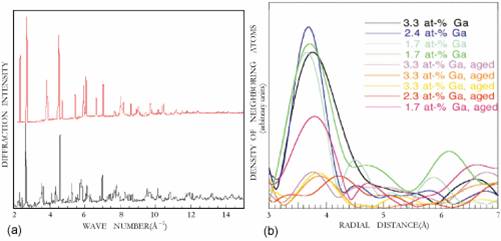
I should note that this finding isn’t out of the blue—in fact, several studies over the years have suggested that “Plutonium crystal structure persists and actually gets more regular with aging” (see chart above).
Writing in Physics Today in 2000, Raymond Jeanloz—professor of geophysics and planetary science at the University of California, Berkeley and chair of the National Academies Committee on International Security and Arms Control—described a study by Conradson in Applied Spectroscopy:
Perhaps the most important result from measurements is that Pu exhibits good crystalline order even after decades of aging. A good illustration of the long-term preservation of order comes from high-resolution x-ray studies of Pu more than 30 years old, illustrated in figure 3a. These studies have shown peaks in the diffraction intensity, indicating the presence of periodic structure, to high magnitudes of the scattering vector. The preservation of crystal structure despite displacements and other damage reflects an apparent self-annealing of the Pu. In the x-ray diffraction studies, both the a and d phases of Pu show this self-annealing behavior, suggesting that it is intrinsic to Pu rather than being limited to a single structural configuration.
But 100 years? Wow.

hmmm…I suppose this is going to have some serious implications at the labs. Since the government has been so worried about this, I guess it is important to try to understand why.
First of all, spallation seems like it would ruin the implosion symmetry. But, I believe the central issue with boosting is to keep the boost gas cool as long as possible – tricky inside an exploding nuclear bomb.
Spalled flakes flying off the pit at around 5000 m/s conceivably could generate entropy in the boost gas which would force you to compress along a higher adiabat. Seems like a small effect though.
Then, as the neutrons start to build up, the flakes are going to fission, evaporate, and generate all kinds of entropy in the gas. Potentially a big effect.
A larger boost gas volume will also probably end up heating up more from recoil from fission neutrons.
More heat and more volume means that further compression of the boost gas cavity after the neutrons build up will be much less effective at increasing temperature and density both.
Finally, the greater volume means that it will take more energy in photons to heat it up.
And so maybe the boost doesn’t really go in that event.
As an aside, let me suggest that it is at least conceivable that they are not using the most stable of Pu alloys because the phase transition properties may be important in the hydrodynamics. If true, that would help explain why the government has been so worried about this. Maybe – maybe not. Interesting to speculate about.
Anyway, it’s nuts to go around designing bombs so close to the margin that this would be a big problem…don’t we have enough things to worry about?
An MPF will be needed if there is a rework of the pits to a more robust design.