
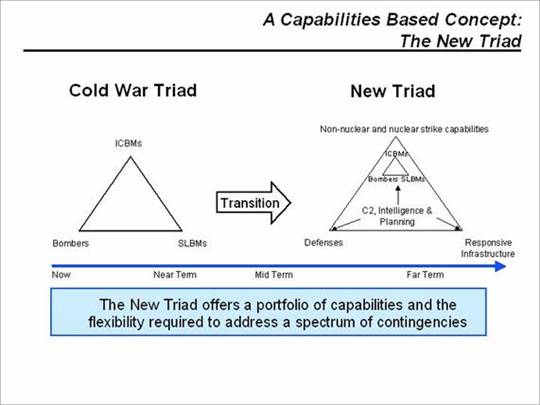
I never understood why a “responsive infrastructure” was one of the three legs of the “New Triad.”
Along with offenses and defenses, I always thought Command, Control and Intelligence (C2I) was the more logical candidate. It makes sense on logical grounds—Satellites that gather intelligence and handle communications are similar to missiles that delive nuclear weapons or intercept other missiles, certainly much more so than the conceptual “robust infrastructure.”
It also made sense on grounds of continuity—folks like Under Secretary of Defense for Intelligence Steve Cambone had long argued for a strategy that placed more emphasis on new strike forces, missile defenses and improved surveillance systems. So relegating C2I to a supporting role seemed … out of character.
During our lunch, Cambone told a story—“out of school” as he described it—about his time as Principal Deputy Under Secretary of Defense for Policy that explained a little.
Apparently Cambone did argue for making C2I, the third leg of the New Triad. He lost out to folks arguing for a “responsive infrastructure,”—“one of the few arguments I lost,” he humbly noted (or something aong those lines). C2I was relegated to a simple sentence noting “This New Triad is bound together by enhanced command and control (C2) and intelligence systems.”
Cambone didn’t, unfortunately, explain why C2I lost out. An interesting data point, none the less.

what the heck is a “responsive infrastructure” anyhow?
As the <a href="http://www.defenselink.mil/execsec/adr2002/html_files/chap7.htm2002 Annual Defens e Report explained:
Who knew that a triad could actually contain, no joke, ten separate items? (Count ‘em: bombers, ICBMs, SLBMs, non-nuclear capabilities, command, control, intelligence, planning, defenses, infrastructure.) And I thought academics were the experts in turning simple ideas into incomprehensible babble.
I thought Responsive Infractructure is the third leg because DOD wants to draw attention to it as an otherwise overlooked but crucial part of military capability. Modern military systems require a lot of supporting infrastructure to maintain them, improve them, and build new ones. There are two big things eating away at US military infrastructure: 1) the US is slowly transitioning away from being a manufacturing nation and moving towards being a service nation, and 2) DOD is having to slow procurement due to increased manufacturing costs (which is caused by, and in turn causes reason 1). Case in point, the US is the only nuclear power without the capability to manufacture new nuclear weapons. If DOD and DOE had prioritized nuclear infrastructure early on, the costs to maintain and consolidate it would probably have been much less than the costs to start it back up now (in addition to the fact that it will take us about 20 years to develop pit production capability). Maybe DOD is worried about something similar happening to Carrier production, or ballistic missile manufacturing capability in this time of reduced procurement.
A marketing thinly disguised as strategy. Andrew, your comment about pit production reminds me of the NASA bureaucrat who, in the aftermath of the Challenger explosion, asserted the Shuttle program had to continue because it would take twenty years to rebuild the Saturn V. It only took ten years the first time around.
What is your basis for asserting that it would take twenty years to restart pit production? How can you argue that anyone could build a carrier faster than we could and, if so, isn’t that more a sign of a sclerotic and corrupt procurement process than a lack of funding?
I agree with what Andrew said. BBoy, in reference to the number of systems, you’re missing the point, it’s a triad of capabilities, and each capability can have a Family of Systems supporting said capability. I understand the case – I think the prior triad was strictly offense-oriented, this new triad is more holistic and more counterproliferation centric. It’s not bad.
Why C2I lost out. It’s a horizontal enabler, not a primary system. I’ve seen the same thing in the CP discussions.
A few points. First, I am not advocating military infrastructure build-up, simply pointing out why it is an issue that weighs heavily on the minds of DOD decision-makers.
Second, my assertion as to how long it would take to re-establish full pit production capability comes from estimates of how long it would take to build a Modern Pit Facility. You can google the name, or look at a pretty comprehensive article about pit manufacturing [by Jon Medalia at the Congressional Research Service]:
20 years might not be exactly what they estimate, but I was going off memory when I posted. I know an interim pit capability can be established before then, but that would only apply to W88 production.
Third, I do think the procurement process is broken, and that is yet another factor hurting military infrastructure that policy planners would like to see fixed.
NNSA claimed in the May 2003 EIS that “it will take approximately 17 years to design and construct a MPF before full-scale production can begin.”
Draft Supplemental Programmatic Environmental Impact Statement on Stockpile Stewardship and Management for a Modern Pit Facility DOE/EIS-0236-S2, May 2003.
Just to be clear: that doesn’t mean that I support building the Modern Pit Facility, which I regard as unnecessary. See:
Steve Fetter and Frank von Hippel, “Does the United States Need a New Plutonium-Pit Facility?” Arms Control Today May 2004.
Andrew and Jeffery Lewis: thank you for the references. What I get out of it is that a new regulatory environment will extend the development time of the facility. But I think that, like many arguments about the size and capabilities of the defense industrial base, the argument for infrastructure investment tends to assume that peacetime conditions will prevail in a national emergency.
If we did find the need to rapidly expand our nuclear arsenal, we could restart pit production much more quickly via a law that simply exempted the facility from the EIS process. It’s entirely possible to spend seventeen years building a new pit facility, or twenty years redesigning the the Saturn V, or twenty years reinventing the aircraft carrier but it’s not necessary. It’s more likely to me that our ability to “surge” new weapons production depends more on our overall economic health rather than the number of factories we have turning out weapons at low production rates.