
A few months ago, David Albright and Corey Hinderstein wrote a very interesting article, “Unraveling the A. Q. Khan and Future Proliferation Networks,” in The Washington Quarterly that contained some previously upublished information about that Chinese nuclear weapons design that the AQ Khan network sent to Libya:
The documents appear to have been information that Pakistan had received in China in the early 1980s. They include detailed, dated, handwritten notes in English taken during lectures given by Chinese weapons experts who were named by the notetakers. These notetakers appear to have been working for Khan, based on their cryptic notations deriding a rival Pakistani nuclear weapons program led by Munir Khan, the chairman of the Pakistan Atomic Energy Organization. The design appears to be for a Chinese warhead that was tested on a missile, has a mass of about 500 kilograms, and measures less than a meter in diameter.
I had no reason to question that description, but it was inconsistent with other information we have about the “Chinese warhead that was tested on a missile”—the fourth Chinese nuclear test (CHICOM 4) in October 1966.
Alex Montgomery (preparing for a forthcoming article in IS) recalled that John Lewis and Hua Di report that the warhead weighed 1,290 kg.

I wasn’t sure how to resolve this discrepancy: 500 kg or 1,290 kg?
So—with a little help from Steve Fetter and David Wright—I did a little calculation.
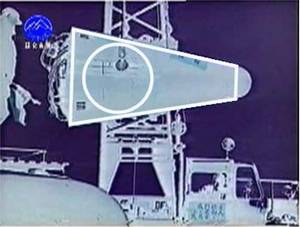
During my most recent trip to China, I obtained footage of most of China’s early, important nuclear tests including the one conducted in October 1966. Here is a still from that test, showing the warhead before being loaded onto the DF-2 (right).
From this image, we can make a basic judgement about the RV’s size and center of mass.
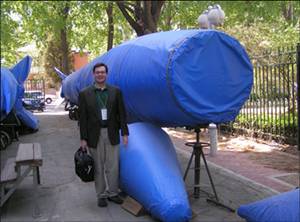
I also have the benefit of photographs of myself (left) and David Wright standing next to (empty) DF-2 RV’s in the museum yard at the Beijing University of Aeronautics and Astronautics.
Using these images, David and I think the diameter of the base of the RV is between 1.2 and 1.3 meters. One can then make a crude estimate of the diameter of the warhead within the RV, probably between 0.8 and 0.9 meters.
We can calcuate the volume of the spherical physics package with a 0.8 to 0.9 m diameter (V = 4/3 pi r3) and, assuming the mass of the physics package is roughly equivalent to a solid sphere of HE of the same size because the contribution to mass from the approximately 15 kg of HEU is trivial.
Conventional high explosives used in nuclear weapons weigh between with 1,500-2,000 kg per cubic meter. For example, Octol, an early US conventional high explosive used in nuclear weapons, has a loading density of 1.8 g/cc.
A sphere of Octol high explosive (HE) with a diameter of 0.85 M would have a mass of about 580 kg. Conversely, a 1290 kg sphere of Octol HE would have a diameter in excess of 1.1 M—which I believe would be difficult to fit into the RV pictured above.
Given the size and shape of the nose cone, I believe the mass and dimensions of the physics package tested in October 1966 on a DF-2 are much closer to Albright and Hinderstein (a mass of about 500 kilograms and a diameter less than a meter) than Lewis and Hua (1,290 kg).
That doesn’t mean Lewis and Hua are wrong—there is a decent chance that the entire re-entry vehicle weighed a total of 1,290 kg. The next step is probably to track down Lewis and Hua’s source—Zhongguo Junshi Baike Quanshi: Hewuqi (Chinese Military Encyclopedia: Nuclear Weapons), Beijing, Junshi Kexue Chubanshe, 1990, pp.157-158.
I am obviously neither a nuclear weapons designer nor a professional photo interpreter. But I did stay at a Holiday Inn in Xining, where I picked up the photo of the warhead.
Ok, it wasn’t a Holiday Inn. What I would have given for a Holiday Inn …

“I am obviously neither a nuclear weapons designer nor a professional photo interpreter.”
Me neither, but one thought comes to mind with regard to the DF-2 RV you show: The presumed location of the heavy warhead is far back in the RV, which might move the center of gravity behind the RV’s center of pressure during reentry. That’s a Bad Thing, as it can lead to tumbling. The straightforward way to fix the problem is to put ballast in the nose, at the expense of increasing the overall RV mass.
It might be useful to find a real aerodynamicist to calculate where the center of pressure would be and how much ballasting would be needed (if any).
I agree and we have been working on that.
The ballast idea was what prompted my speculation that the RV “as a whole” might still have a 1,290 kg mass.
Long-time viewer, first-time commenter 🙂
I’m completely unqualified to speak much on the topic, but perhaps the initial placement of the goodie bag in the RV is accurate – the RV may re-enter blunt-side-first (as in 1960s space capsules, Gemini, Apollo, etc.) I’d imagine you’d want the heavier end of your RV kept low for center of gravity reasons if this configuration was the case.
Again, you’re the guy with the nuklear edumacations & spiffy website, so perhaps you’ve already taken the above into account.
Thanks for reading.
My footage of the warhead shows the back end pretty clearly. It doesn’t look designed to enter back-end first.
Not really my expertise, either.
It is a pleasure to page through my old aerodynamics books.
In this case, the newtonian approximation for hypersonic flow allows us to estimate the aerodynamic center almost by inspection. For a perfect cone, at each normal cross section, the total pressure forces are a constant times the diameter. Consequently, we can average over the surface area to reveal that aerodynamic center is 1/3 of the way from the base of the cone to a pointy cone tip.
Several non-ideal effects in this case will act to push this center slightly further back :
(1) the cone is truncated by the rounded nose
(2) ionization of the air will be more significant near the front
(3) newtonian approximation usually relatively underestimates pressure farther back
(4) nose cone might ablate at the front
From this, it is apparent that a solid cone(whose c.g. is at 1/4 height from base) is hypersonically unstable.
Looking at the picture, I’d say they’ve got the center just about in the right spot if they want to be able to maneuver.
John Field said,
“I’d say they’ve got the center just about in the right spot if they want to be able to maneuver.”
Perhaps I misunderstand, but how would the depicted RV maneuver, and why? (This is a mid-1960s system.)
I assume you are right. It’s too old, and it probably doesn’t maneuver.
My comment was directed at the fact that the gravity center is close to and just in front of aerodynamic center. This would result in stable and relatively neutral handling and therefore facilitate steering if desired.