

Writing about “relentless American intelligence agent” Jack Bauer—Keifer Sutherland’s character in 24”—New York Times television critic Frank Rich claimed “a fictional TV action hero is more engaged with the war on terror than those in Washington who actually have his job.”
A couple months later, Condi Rice is talking up the Proliferation Security Initiative (PSI) like it’s an episode of “Alias”:
In the last nine months alone, the United States and ten of our PSI partners have quietly cooperated on 11 successful efforts.
For example, PSI cooperation stopped the transshipment of material and equipment bound for ballistic missile programs in countries of concern, including Iran. PSI partners, working at times with others, have prevented Iran from procuring goods to support its missile and WMD programs, including its nuclear program. And bilateral PSI cooperation prevented the ballistic missile program in another region from receiving equipment used to produce propellant.
This is the most explicit accounting of PSI sucesses to date. In November 2003, then-Undersecretary John Bolton declined to provide any details to Arms Control Today, although an anonymous source told Judy Miller in May 2004 that “there had been roughly a dozen such interdictions.”
In addition to Rice’s speech, Richard Boucher added details during the daily press breifing, as did an anonymous source to David Sanger.
But how are we to assess whether PSI has been a success? A few months ago, Jofi Joseph offered a framework in Arms Control Today:
Therefore, a fair question to ask, but difficult to answer, is to what extent PSI has made additional interdictions possible. Would interdictions like the intercept of the Libya-bound freighter last fall have occurred without the organizing framework of PSI?
Although government officials in PSI core states have discussed some of their successes to date, no accompanying information has been provided on failures. Have there been cases where a PSI participant identified a suspicious naval vessel but was unable to convince the state where the vessel was docked to undertake inspections?
We need some data. Toward that end, I’ve compiled a tentative list of probable PSI related raids over the last 9 months, followed by notes on the three more interdictions:
- September 2004: German authorities stopped the export of “24 long-distance detonators.”
- September 2004: South African police seize “11 shipping containers holding components of a centrifuge uranium enrichment plant and related documentation.”
- “End of 2004”: A Gulf state (probably Dubai) intercepts 15 “Vibration test machines.”
- January 2005: German authorities seize four special low-voltage motors destined for a nuclear power plant in Iran.
- February 2005: Taiwanese authorites arrest a Taiwanese man for shipping missile parts to Libya. [I can’t tell from the various press reports if this was a belated arrest for a 1999 seizure or followed another seizure in 2005.]
- May 2005: Authorities in Antwerp intercept a shipment of charged aluminum plates bound from Hamburg to Iran.
Some of these arrests are linked to one another—September 2004 arrests and raids in South Africa, Germany and Switzerland targeted the Khan network. A number of the German firms shipping to Iran appear to have been caught attempting to move goods through the UAE.
That still leaves two North Korean interdictions cited by Boucher:
- bilateral cooperation with several governments prevented North Korea from receiving materials used in making chemical weapons
- cooperation with another country blocked the transfer to North Korea of a material useful in its nuclear programs.
Also, the United States apparently conducted one interdiction on US soil (my best guess).
That is a total of 9 interdictions, although we don’t know what constitutes a distinct PSI “effort” for Condi et al.
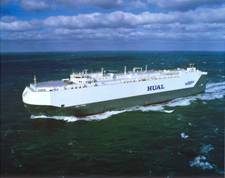
One PSI failure that Condi didn’t mention: Der Spiegel reported Mizan Machine—an Iranian firm reportedly linked to the Iranian missile program—purchased a mobile crane from a German firm that shipped out of Hamburg on ship called the Hual Africa (left) in April 2005.
Despite US consultations under the PSI framework, the crane reportedly arrived in Iran.
Oops.

Yemen SCUD snafu?
You’re leaving out the two key points:
1. Boucher said in December 2003 that PSI and the Libya-bound BBC China interdiction were unrelated. He called PSI “a more recent effort.”
2. The NYT and WaPo reported that another shipment of centrifuge equipment made it past the cordon sanitaire and was delivered to Libya in March 2003. So much for the vaunted success of PSI.
What I found really interesting is that in the Robb-Silberman report, there is zero reference to PSI in the chapter on Libya.
Even more curiously, in response to the notion that so many states are signing up as an indicator of the successfulness of PSI, Robb-Silberman warns under Recommendation 10 that “We do not believe, however, that sufficient strategic thought has been directed toward how [bilateral ship-boarding] agreements can be structured to serve intelligence purposes.”
It’s a fraud, and the fact that GAO hasn’t jumped all over it yet is a crying shame.
The worst part about the fraud is that we have no idea how much it costs our military and law enforcement to be engaged in all of these exercises for fun, or how much attention it is distracting State Department lawyers and diplomats from good ideas in the Bush nonproliferation agenda, like reforming the fuel cycle or changing the rules of how the IAEA deals with persistent violators of Safeguards Agreements.
Several notes:
1) The Yemen SCUD snafu was in fact the inspiration for the PSI. The Bush Administration came away with egg on its face following that episode, and vowed to structure a new policy framework to enable future interdictions. The irony, however, is that PSI would not change any material facts were the Yemen SCUD shipment to occur again. North Korea was lawfully transporting SCUD missiles (missiles are not covered by any nonproliferation regime) to a legitimate state purchaser. Nothing in PSI would have given the U.S. additional legal authority to stop this shipment.
2) The Boucher comment once again raises the question of where PSI ends and normal U.S. intelligence activities begins. It is ridiculous for the Administration to claim that none of these intercepts would have occured without an organizing PSI framework—successful WMD interdictions occured prior to PSI.
3) Steve Rademaker, the Acting A/S for State’s Nonproliferation Bureau, is scheduled to testify before a HIRC subcommittee on the PSI on Thursday afternoon. A webcast will be on the Committee website.