
P1. Hot dogs are better than nothing
P2. Nothing is better than steak.
C. Therefore, hot dogs are better than steak.
Ah, the fallacy of equivocation. The Oxford English Dictionary defines it thus:
The fallacy which is committed when a term has different senses in the different members of a syllogism.
1605 BACON Adv. Learn. II. xiv. §7 The great sophism of all sophisms being equivocation or ambiguity of words and phrase. 1646 SIR T. BROWNE Pseud. Ep. I. iv. 13 The fallacie of Æquivocation and Amphibologie, which conclude from the ambiguity of some one word, or the ambiguous sintaxis of many. 1870 JEVONS Elem. Logic xx. 171.
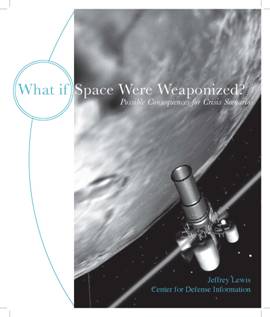
The Heritage Foundation’s Baker Spring has resorted to Bacon’s great sophism of all sophisms to suggest that a little monograph I wrote for CDI is “detached from reality” and that I live in a “make-believe world.”
In my monograph, I argued that neither the United States nor any other country currently deploys:
- space-based missile defenses,
- anti-satellite weapons, or
- space-based strike capabilities.
I then argued the United States should not deploy such capabilities:
In a world with space weapons, the United States may be better armed, but we may well be less secure.
Baker doesn’t get around to addressing my concerns, which focused on crisis stability scenarios. He does spend a few paragraphs obsessing about the title of the monograph—What if Space Were Weaponized. I reprint Baker’s comments here:
In order to argue against a U.S. national security policy that would prospectively weaponize space, it is essential to assert that space is not yet weaponized and that U.S. defense programs, and only U.S. defense programs, will initiate an arms race in space. Arms control advocates cling tightly to this prospective view. For example, Jeffrey Lewis of the Center for Defense Information authored a publication last year entitled What if Space Were Weaponized?
The problem with this prospective view, of course, is that it is inaccurate. Space is already heavily weaponized and has been since the dawn of the space age. This occurred with German launches of armed V-2 rockets at Great Britain during World War II.
Today, there are intercontinental ballistic missiles and submarine-launched ballistic missiles that are armed with the most destructive explosives man has ever invented. These nuclear-armed weapons spend a majority of their flight times in space.
These same ballistic missile weapons systems consist of more than just the missiles themselves. They depend on a variety of battle management, command and control, and early warning elements that are integral parts of the overall weapon system. Many of these assets are space-based.
By way of example, AEGIS weapons systems deployed on Navy surface ships consist of much more than just the standard surface-to-air missiles. The equivalent of the ballistic missile command and control and early warning elements onboard AEGIS class ships have long been defined as parts of the overall AEGIS weapons system. These include the SPY-class radar, target acquisition subsystems, and command and control elements. The same definition is appropriate for ballistic missile weapons systems.
Finally, arms control advocates are particularly concerned about the U.S. deploying anti-satellite systems. Leaving aside the fact that the former Soviet Union extensively tested a co-orbital anti-satellite system, any state that possesses a nuclear-armed intercontinental ballistic missile has an inherent anti-satellite capability. Again, the fact is that space is already weaponized.
It’s true that I argued that the United States does not (and should not) deploy space-based missile defenses, anti-satellite weapons or space-based strike platforms. It isn’t true that I denied the existence of ICBMs, missile defenses, military satellites and prior ASAT testing. In fact, I suggested the addition of what I called space weapons might add a dangerous element to a deterrent posture that relies heavily what Baker defines as space weapons—ICBMs, missile defenses and military satellites.
Not that someone who read Baker’s paper would know this, because Baker equivocates regarding the meaning of “space weapon,” thereby grossly exaggerating the arguments in my monograph.

I regret that I didn’t title the monograph: What if Space-based Missile Defenses, Antisatellite Weapons and Space-based Strike Platforms Were Deployed or, perhaps, What if Space Were More Weaponized Than It Is Now.
I understand why Baker equivocated. Equivocating helps strengthen a bad argument. Francis Bacon had good reason to call equivocation the “great sophism of all sophisms.” Plus, equivocating is fun. Take this example:
- I sent Baker Spring a miniature rooster pendant.
- Therefore, Baker Spring has a tiny cock.
Purely for illustrative purposes, of course. I did not actually send Baker a pendant. As far as I know, Baker has no cock—tiny or otherwise.
Equivocation has second, less common meaning, that I believe more accurately captures Baker’s discourse on weaponization:
The use of words or expressions that are susceptible of a double signification, with a view to mislead; esp. the expression of a virtual falsehood in the form of a proposition which (in order to satisfy the speaker’s conscience) is verbally true.
Tomorrow we start on Baker’s footnotes. I’ve already documented one instance of utter hackery involving Baker.
Update: Um, scratch that. Baker’s papers don’t appear to have footnotes.

If the arguments are on your side, why resort to schoolyard insults? It makes it easy for your opponents to dismiss you as a crank, and although it might amuse your ideological allies, it merely alienates those you might otherwise have talked around.
That’s an odd argument to make when it was clear that Baker read no more than the title of my monograph.
I rather suspect that Baker and his ilk would dismiss my arguments regardless of the cock-size that I’ve attributed to him.
I admire Australia, Canada and other countries that still having civil discourse. Ours died a few years back.
I am but a neophyte compared to the posters here but in my interpretation space is militarized but not weaponized. While ICBMs, SLBMs and other systems may transit through space that in itself does not weaponize space. Please let me know your thoughts on this and if I am completely off target here.
[That is, in fact, the set of terms typically used to distinguish between current military missions in outer space and “new” missions such as space-based missile defense. Not off target at all — ACW.]
“That’s an odd argument to make when it was clear that Baker read no more than the title of my monograph.”
So you felt you should join Baker on the low ground instead of taking the high. Civil debate may be dead in the US, but do you have to dance on the corpse?
“I rather suspect that Baker and his ilk would dismiss my arguments regardless of the cock-size that I’ve attributed to him.”
Agreed, you will probably never convince them, but what about the rest of us, who haven’t made up our minds? What’s more likely to sway us: reasonable argument or dick jokes?
I guess that last question is rhetorical …
An interesting empirical study could examine the persuasive effect of ridicule.
For the other side of the argument, a colleague notes:
I do, of course, think Baker is playing semantic games. The existence of ICBMs isn’t a prima facie reason to reject arms control in outer space, unless the ICBMs were covered by the agreement. Of course, I never say anything of sort, though one wouldn’t know that by reading Baker’s description of my monograph.
As for the second claim, having only met Baker in passing, I can’t comment on either his forthrightness or endowment.
I think of my tone as less “dancing on the corpse” of civilty than “fighting fire with fire,” to employ dueling cliches in a semantic game of my own.
Isn’t it also a metaphor for how silly and dangerous loose wordplay can be? There’s a reason we have the fallacy of equivocation.
That was my lofty destination, however low my path.
Just as a side note, the Joint Staff’s joint functional capabilities (numbering 21 now) include a capability called Joint Space Control. This joins maritime, land, and air control capability areas. Certainly the intent is to explore and perhaps implement some form of militarizing space.
“Agreed, you will probably never convince them, but what about the rest of us, who haven’t made up our minds? What’s more likely to sway us: reasonable argument or dick jokes?”
A weblog should strive to include both.
The beginning of a reasonable argument against space-based weapons seems to be the risk of escalation. No matter whether the initial intention is to strike against other entitites in space, such as missiles or satellites, the temptation of those who have the weapons and the suspicion of their prospective enemies is that space-based weapons will eventually be used against earthbound targets.
I was following along with your (somewhat snide) argument well enough, and even agreeing with you—right up to the point where you made the quip about a “small cock.”
Those kinds of comments are extremely unprofessional and make you look non-serious. Reading things like that instantly makes me wonder about the age and maturity of the writer—it’s the kind of thing that an undergraduate frat boy would write on his blog, not the kind of language that one expects in discussions of arms control.
And those kinds of comments also open you to being dismissed from the debate. I could easily see such comments as a great excuse to not include you in a conference or discussion—”Oh, isn’t he the guy who makes comments about penis-size on his website? Do we really want someone like that on our discussion panel?”
That was one of the most magnificent retorts to an intellectually dishonest critique that I’ve ever seen.
I disagree with Sam R, because to me “civil debate” requires honesty rather than…well, equivocation. Put me down in the apparently dwindling number of people who don’t believe that lying politely is evidence of a civilized mind. And who don’t think that one can refuse to accept truth just because it’s expressed indelicately. The willingness of people who’ve been intellectually discomfited – or worse, caught lying – to decry the “loss of civility” in debate is starting to seem kind of contrived and self-serving, in my opinion.
Plus, the tiny cock thing was hilarious.
What schoolyard insults? This all took place well outside any schoolyard, and Dr. Lewis is simply agnostic about the size or existence of Mr. Spring’s cock. If you have proof to the contrary, I’d say so much the worse for you …why are you poking around in his henhouse?
The cock size issue is not only crucial to the matter, but susceptible to empircal inquiry. Since we are here in the free marketplace of ideas, I request that anyone who frequents the Heritage bathroom or otherwise has info on the cocks of its vistors post to clear this up. We can have a frank exchange on the matter and let the truth prevail.
Bravo!!!
I shall plagiarize you Sir, repeatedly.
I’m not surprised you moderated away my prior comments. I’ll let Monsieur Nicholson finish up: “You can’t handle the truth!”