
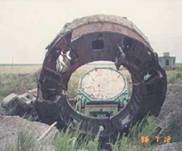
An SS-18 dismantled under START I.
Jonathan Landay of Knight-Ridder reports that the intelligence community cannot verify the terms of the Moscow Treaty.
The article is fascinating because of the revelations about how the Bush Administration approached the issue of verification and what that says about, for example, Stephen Rademaker’s recent claim that the Moscow Treaty was “the deepest reduction ever mandated by a strategic arms control treaty.”
First, a two facts:
- The Moscow Treaty limits the number of operationally deployed strategic nuclear warheads to 1,700-2,200 on December 31, 2012– the same day the treaty expires. There is no schedule for reductions.
- The Moscow Treaty contains no verification provisions. Russian strategic forces are largely monitored through the provisions of the START I Treaty, which expires in 2009. (The intelligence community concluded that, without START verification procedures, it could not verify Russian compliance with the Moscow Treaty with a high degree of certainty.)
How, then, did the intelligence community intend to confirm that Russia was moving toward, and then compliant with, the terms of the treaty on December 31, 2012? Ah, that’s the interesting part:
The assessment, which reflected the consensus of 15 civilian and military intelligence agencies, concluded that Russia’s precarious finances would force it to slash to about 1,500 the number of nuclear warheads deployed in bombers, submarine-launched missiles and intercontinental ballistic missiles.
But the assessment said there could be circumstances in which Russia could deploy without detection by the United States a few hundred more warheads than the 2,200 allowed by SORT.
In other words, Russian forces were declining as defense spending failed to replace aging systems. The Moscow Treaty didn’t mandate anything, so much as ratified the status quo IC predictions in 2001.
The point is not to suggest that the the deployment of a few hundred additional warheads would change the strategic balance; they would not. Rather, the point is that the Moscow Treaty wasn’t a reduction and didn’t alter the configuration of U.S.-Russian nuclear forces which remain, as then-Governor Bush said, on “high-alert, hair-trigger status—another dangerous vestige of Cold War confrontation.”
ACW recently noted that some on the Bush Administration are worried about recent changes in Moscow’s foreign and defense policies and are beginning to regret the amount trust placed in the Moscow Treaty. Perhaps this concern accounts for Bush’s recent call for more access to Russian nuclear sites, although a senior administration official told Landay on condition of anonymity that Bush was referring to efforts to secure nuclear materials and wasn’t changing his position on the lack of verification measures.
I too am worried about changes in Russia’s nuclear policies—though for a very different reason than the old Cold Warriors in the Bush Administration. We both worry that Russia may cheat on the agreement, deploying larger numbers of forces for a variety of military contingencies. We differ in that the old Cold Warriors worry about cheating because they believe it will give Moscow an intrinsic advantage. I think that advantage is largely illusory, but worry that larger, more ready Russian forces will be matched with our own, creating a pair of organizational nightmares that may be more prone to accidents and incidents.

Things to not forget:
1. Our good friends at NRDC in 2002 pointed out that the only way the US can “comply” with SORT is that at any moment, a pair of US nuke submarines are in the dock, and at this point, their nukes are non-deployed.
2. How is it exactly that we can’t conclude that Russia is in compliance with SORT? After all, there is only one day specified by the treaty when they must be in compliance with its terms.
3. Just to emphasize your point about how there are two poorly organized systems: the George Washington University debate team during 2002-03 spent a lot of time arguing that it isn’t the Russians we need to be afraid of. When the US lacks verifiability, it overexaggerates the dangers from Russian forces (thank you Ms. Gottemoeller in your mid-2001 ACT article). The historical result of this tendency was depicted lovingly by Bruce Blair in his 1993 book in which he explained how the US was ready to pull the trigger when all the Yeltsin madness was happening in the early 90s because we really weren’t sure who was responsible for what. It’s not that our forces are more ready—it’s that the Moscow Treaty’s evisceration of any possibilty of START II, and the possibility that START I’s verification protocols could lapse in a few years makes it more likely that we will be more ready to be wrong. Even if we shoot first and win, we lose.
Well, I would disagree that Russia could “cheat on the agreement, deploying larger numbers of forces”. The capability to produce and deploy anything in large numbers is just not there. As far as Russia is concerned, about 1500 warheads by 2012 is pretty much the upper limit.
I think you’re all missing the point about the purpose of the Moscow Treaty. These discussions about verifiability are what we arms control experts do, but this particular treaty was conceived, negotiated, and signed for reasons other than traditional arms control. It had much more to do with Russian domestic politics and bilateral US-RF relations. The Moscow Treay has served well the purpose for which it was fundamentally designed, whether or not you agree with that design, and any analysis of its provisions should keep that in mind.
I agree with Paul P that Russia lacks the capability to produce new strategic delivery systems in any large quantity. Ultimately, therefore, it is Russia who should be more concerned about verification provisions if START is allowed to expire (note that START could be extended if the sides desire to keeps its verificaiton process in tact): given the highly intrusive nature of the Nunn-Lugar CTR Program, and the fact that the US is funding all SOA dismantlement in Russia, the USG has tremendous insight into Russia’s force structure.
(PS It is not entirely true that SORT has no verification procedures. It relies on the comprehensive procedures in START. As the President stated in his SORT transmittal to congress: “The Parties will use the comprehensive verification regime of the Treaty on the Reduction and Limitation of Strategic Offensive Arms (the “START Treaty”) to provide the foundation for confidence, transparency, and predictability in further strategic offensive reductions.” This treaty could be extended to support SORT.)
(PPS I disagree with Paul and the US IC that 1,500 is Russia’s upper limit based on their analyses of Russia’s economic and industrial conditions. Russia has shown itself to be very adept at prolonging the life cycles of its systems.)
Missing the point?
That is the point: It isn’t arms control but domestic political theater.
The context was Steve Rademaker’s claim that the Moscow Treaty was a major arms control achievement only possible by jettisoning the ABM Treaty.
We all agree its a farce as an arms control agreement. The question, for me, is absent serious arms control efforts then what dangers do we face from the indefinite continuation of Cold War force postures?
Then the questions how many forces? of what kind? in what shape condition? become important.