
It’s been little remarked upon, but the United States appears to have a technical role, and not just a political one, in the agreement with Iran reached “in principle” in Geneva on October 1.
There’s no text in open circulation, and the U.S. government won’t say what’s in it. As a senior administration official told the New York Times after last week’s technical negotiations in Vienna, it’s the better part of valor to let Tehran spin the results.
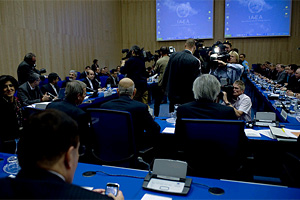
But as it turns out, the Iranian government has already given us a general idea. After the Vienna talks concluded, the head of the Iranian delegation, Ambassador to the IAEA Ali Ashgar Soltanieh, told the press that the U.S. would provide the wherewithal for what sounds like a new IAEA Technical Cooperation effort connected to the Tehran Research Reactor.
Here’s the full quote, via Julian Borger:
We had a trilateral meeting in the office of the DG (director general) – Iran, US and the IAEA – on the issue of the Tehran research reactor and of course one of the aspects in addition to the fuel is the control instrumentation and safety equipment of the reactor — as we have been informed about the readiness of the United States in a technical project with the IAEA to cooperate in this respect – and this will be also further elaborated at a later stage.
In case you’re wondering, a broad humanitarian exemption in UNSC Res. 1737 permits the importation of nuclear-related equipment for medical or safety purposes, among other things. (On the medical role of the Tehran Research Reactor, see A Primer on Iran’s Medical Reactor Plans, October 4, 2009.) In fact, a variety of TC efforts related to medicine, safety, agriculture, or public health are already underway in Iran, as described in a special IAEA report from February 2007.
Where This Comes From
The odds are pretty good that this aspect of the deal was part of the original Geneva agreement, and did not simply arise in the course of the Vienna talks.
First, in the days after the Geneva meeting, a variety of senior Iranian officials suddenly began talking about the high importance of improving the safety of Iran’s nuclear infrastructure. Safety even started cropping up as an explanation for the delayed start of the Bushehr reactor and (yes, really) the construction of the Qom enrichment plant. In hindsight, this outbreak of safety-mindedness seems like a way of burnishing a yet-to-be-fully-disclosed achievement.
Second, a seat at the main table in technical talks implies a technical role. Of the six great powers represented at Geneva, only Russia, France, and America participated in the technical negotiations with Iran last week. Lacking a technical role, China, Germany, and Britain sat it out.
Why It Matters
This entire subject might seem like a triviality at first glance, but it actually provides an important signal that the U.S. is serious when it says that Iran has both rights and responsibilities in the nuclear field — a theme touched on by President Obama on September 25 and apparently raised by the U.S. side in Geneva. (The same idea also appeared a couple of times last week in Secretary of State Clinton’s NPT speech.)
Assisting in the refurbishment of an Iranian research reactor is a material assurance of American intentions, which should undercut talk that the U.S. simply wants to deny Iran the benefits of nuclear technology. That is presumably the significance of these remarks in an interview by Soltanieh shortly after the Vienna round of talks:
“The Vienna talks are a new chapter in cooperation between Iran and the other participating states… We will be waiting to see whether they will stay true to their words and promises,” Tehran’s envoy to the UN nuclear watchdog told Al-Alam news channel.
“The International Atomic Energy Agency (IAEA) will be a witness to the other states’ behaviors when it comes to technical cooperation on using nuclear energy for peaceful purposes,” said Ali Asqar Soltanieh.
The underlying logic of the agreement seems to be coming into focus: Iran demonstrates the peaceful purposes of its nuclear program by shipping its LEU out for conversion to fuel; America demonstrates its acceptance of peaceful Iranian nuclear technology by participating in its development. This symmetrical arrangement creates an intriguing precedent for future rounds.
Whether It Will Happen
Foot-dragging has now set in. According to the IAEA, Iran has disregarded Director-General ElBaradei’s Friday deadline, and now plans to respond by the middle of next week. Given a variety of anonymous statements in the Iranian press, as well as the frank opposition expressed by a parliamentarian allied with a rival to President Ahmadinejad, a cloud of doubt has settled in.
There’s been a great deal of doubt all along, and it’s not hard to see why. Iran’s approach to the TRR talks has been a ceaseless series of manuevers. One aspect brings to mind Schrödinger’s cat. (LEU exports for TRR refueling, or just TRR refueling? Half the statements in the Iranian press say one thing, half the other.) Another aspect brings to mind the car salesman who, pressed to agree to a lower price, has to walk back to check with his manager first.
My own view remains basically the same as it did after the second day of the Vienna talks, when negotiations were widely perceived as stalled (see: Iran: What Sort of a Deal?, October 20, 2009). The foot-dragging, in my judgment, is tactical, and we’re likely to see the Iranians agree at any time between the conclusion of the initial inspections at Qom and the opening of the next IAEA Board of Governors meeting, set for November 26-27. But I’ll keep a can of alphabet soup close at hand, just in case.
Update. I’d completely missed it, but Julian Borger — whose blog is quoted above — had this story in the Guardian all the way back on Wednesday:
The four signatories to the draft agreement are Iran, France, Russia and the IAEA. The US took part in the Vienna talks but is not a formal party to the deal. However, the US and Iran struck a provisional bilateral agreement, also brokered by the IAEA, in which Washington would supply safety equipment for the Tehran reactor.
That deal is contingent on agreement over the shipping of Iran’s uranium, but if signed, it would represent the most significant business transaction between the two countries since Iran’s Islamic revolution 30 years ago.
The sourcing is opaque, but it does sound as if he got confirmation, and wasn’t relying exclusively on Soltanieh’s remarks.
Barbara Slavin of the Washington Times had the story in Friday’s paper, and reports that she got it from an American, too:
To sweeten the deal for the uranium transfer, the Obama administration has offered to provide safety upgrades for the Tehran research reactor, which was sent to Iran in 1968 when Lyndon Johnson was president and the U.S.-backed Shah Mohammad Reza Pahlavi was in power.
A U.S. official, who spoke on the condition that he not be named to avoid prejudicing Iran’s decisionmaking, said “the U.S. is willing to provide through the IAEA safety upgrades” for the Tehran reactor so that it will work properly with the new fuel.
Hats off to Borger and Slavin. If anyone else had it, I haven’t spotted it as of this moment.

Thanks for providing us with some important tidbits of relevant information. If this is pulled off – an open, peaceful Iran nuclear program with the US extending a hand of friendship to help with safety – it would be a far better outcome than I could have hoped for. For the US, Iran and the rest of the world except for Israel who is and would continue to do everything possible to undermine a successful outcome.
It is important not to oversell what this agreement can do or will do. First of all, it’s not a done deal yet. Second, we don’t know exactly what’s in it. Third, by all indications, it’s only a small initial step forward, not a comprehensive solution by any stretch of the imagination.
As for the role of Israel — the Israelis are justifiably concerned that Iran is simply playing for time, and is intent on getting nuclear weapons at an early date. What is more, they are merely the most vocal party to express these fears, which are held by many across the Middle East, Europe, and beyond. It doesn’t pay to make light of these concerns, just as it doesn’t pay to make oneself a captive of the worst-case scenario.
Apart from tactics, some of the foot-dragging may result from the need to deal with policy differences and factional infighting within the Iranian government—between those who depict this as a victory and those who insist the world owes them fuel and those who want nothing at all to do with outsiders.
Scott:
That’s well-observed. I certainly don’t mean to minimize the role of Iranian domestic politics, which colors everything related to the nuclear issue. Over to you, Robert Putnam…
PS. While it’s always risky to make confident statements about what’s inside the black box, I should add that at this point, the domestic aspects probably have more to do with salesmanship than any serious contest. It’s hard to imagine that the Iranian side would have agreed at Geneva, let alone have initiated the process in the first place, without the blessing of the Powers That Be.
For the record, Soltanieh has said that the discussions began with a June 2 letter he sent to ElBaradei. That was ten days before Iran’s presidential elections, not exactly a traditional time to launch major new departures in policy. The figure who represents continuity in Iran’s government is, of course, the Supreme Leader.
It’s impossible for me to believe that the early October killings of the highest ranking Iranians since the MEK terrorist campaign in the 1980s has not impacted Iran’s calculations regarding cooperation with the US.
I’m now nearly certain Iran will not ship anything out of the country on the basis embodied in this agreement which was that Iran would trust the foreigners to return it.
We’re just no longer in an atmosphere of trust. I think we can consider this deal dead, at least for the near future, unless the Western side has substantially sweetened its offer since the beginning of October.
A friendly note to commenters:
I’m going to resist the tendency, common to all discussions on this subject, to let the subject drift (any further than it has already) to the related but distinct question of Israeli threat perceptions, what they actually are or aren’t, and whether they make sense. It always threatens to take over the conversation. Let’s stick to the LEU-TRR deal on this thread, if we can.
The whole business smacks of appeasement. Sometimes appeasement can be a rational strategy.
Josh,
can you make a comment on the nature and the duration of the bond that will be created between the U.S. and Iran if this deal as you describe it goes on. Won’t it require somewhat stable relations for quite some time? If the deal runs for more than 8 years for example, there is a risk that something will go wrong, or that a future (republican?) administration pulls out, see Agreed Framework with the DPRK. And then things may become even worse than they were before the deal.
I believe that for the forseeable future, given the uneasy US-iranian relations, any deals should be focused on one issue, and short-lived, so that success can be observed, measured, achieved and “put in a bag” as a kind of trust capital building up over time.
VS:
You won’t get any argument from me on this one, except perhaps about the “short-lived” part, since there is considerable reassurance value in having safeguards in perpetuity. Incrementally developed bargains like the AF have a way of breaking down, as you say, either when there is lack of trust, or when one or more sides are hobbled by their own spoilers, or both.
I might add that this process has no agreed end-state, no “horizon” that both sides have agreed to. This just underscores that each agreement along the way ought to stand on its own two feet. Certainly, the desiderata of the P5+1 in Vienna — facility-specific safeguards and a takeback arrangement — seem to reflect a desire to avoid leaving too many loose ends along the way.
I wrote about these problems a little a few weeks ago.
As a point of interest: DG ElBaradei recently told L’Express a little bit about his recent visit to Tehran, as well as the trilateral talk in his office that Amb. Soltanieh touched on. The interview was conducted in English, and L’Express helpfully provides audio files at a few key points. Francophones, naturellement, can read the interview in a cleaned-up French translation. For Anglophones, here’s a quick paraphrase of the two passages mentioned above:
First, ElBaradei relates that President Ahmadinejad personally told him “very straightforward[ly]” that he wants to “regulate” Iran’s entire relationship with the U.S., the West, and the international community, and not just concerning one “piece of the puzzle” — apparently a reference to nuclear issues — but “the entire relationship.”
(L’Express translates “regulate” as “normaliser les relations.”)
Second, ElBaradei described his meeting with Deputy Secretary of Energy Dan Poneman and Ambassador Soltanieh “sitting here,” meaning in his office. Both were “very gracious.” Poneman “explained the implication of that deal in building trust” and expressed “the readiness [of the United States] to help Iran in many different ways” after this deal is done. Soltanieh, meanwhile, “took very careful notes.” This encounter, ElBaradei believes, was of great psychological importance, as it “shows sincerity” and helps “to start to heal the wounds” of the U.S.-Iran relationship.
I scarcely need repeat here what I’ve said previously about the risks of promising a “grand bargain.”
Thanks for the elucidating reply Josh. All points taken.
I’m not sure it is fair to characterise this as a recent “outbreak of safety-mindedness”. Back in 2003 GOV/2003/75 reports “Iran had decided to replace TRR because, after 35 years of operation, it was reaching the safety limits for which it had been designed”.
Looking in the IAEA RRDB at U.S. “POOL” type reactors at 1MWt or greater, 2 of 18 are still operational: “RINSC RHODE ISLAND NSC” (2MWt, Criticality 1964/07/28) and “UMLR UNIV. MASS. LOWELL” (1MWt, 1975/01/02). Might be interesting to know what upgrades they have had.
PS I forgot to add that the two U.S. “POOL” type reactors still operating do so for small amounts of time. IAEA RRDB lists RINSC RHODE ISLAND NSC as 35 MW Days per Year and UMLR UNIV. MASS. LOWELL as 40 MW Days per Year.
This is nothing like the usage needed for serious medical isotope production. Which makes me wonder if the TRR needs a very serious revamp if the E3+3/P5+1 want Iran to use the TRR for this purpose, to undermine the rationale for the IR-40. FWIW the RRDB lists TRR as a 300 MW Days per Year reactor (2520 hours averaging about 3MWt), though I doubt it has run at that rate recently given how many years the 116kg of Argentinian LEU fuel has lasted.
Maybe someone here can explain the importance to the West of Iran exporting its LEU in one batch soon.
Iran has no intention of actually sprinting to a weapon this year, nor does it have any intention of slowing down its LEU production. So this time next year, Iran will have the same amount of LEU whether it is shipped out in one batch now or in 100 batches of 1% each ending in September 2010.
If the plan is that after the LEU is gone, the West can add new conditions and use returning the uranium as leverage, that is very bad faith negotiating that will produce a backlash encouraging Iran to go further and faster towards full nuclear weapons capability.
If the deal is as I interpreted it when I first heard it, a symbolic but meaningless in practical terms expression of good will then it is puzzling that the West is so insistent on the LEU leaving in such a large amount before any tangible commitment is made to Iran.
My best guess at this point is that the West is both negotiating in bad faith and critically overestimating the amount of leverage it has over Iran, or the amount Iran needs a deal like this when Iran has the option of keeping the status quo instead.
Maybe someone more sympathetic to the West’s negotiating position can explain otherwise.