
I apologize deeply for posting without a picture, but it may not arrive for some weeks to come, and this article would then be too old. I’m Andreas Persbo, and I’ve been asked to write a couple of posts once in a while.
Some of you may know me from my blog Verification, Implementation and Compliance. Yet others, like my colleague James Acton, knows me through my work at the Verification Research, Training and Information Centre in London. In a previous life, I used to hang out with UNPROFOR and UNIFIL, and while I forgotten most things about peacekeeping, I still haven’t laid off my deep affection for the Middle East, its lands and its peoples. And for some reason, I really like deserts.
The Syrian desert is a hot, dusty, and surprisingly dirty place. Most visitors expect a serene environment, unsoiled by the boots of man, but are surprised and disappointed at the large amount of junk strewn around the grey sand and hard rock. More often than not, the Syrian desert acts as an improvised landfill. After a September 2007 incursion into Syrian airspace by the Israeli Air Force, one particular patch of Syrian soil was instantly turned into yet another desert junkyard.
Overview of the area (including Tibnah Salt Mine)
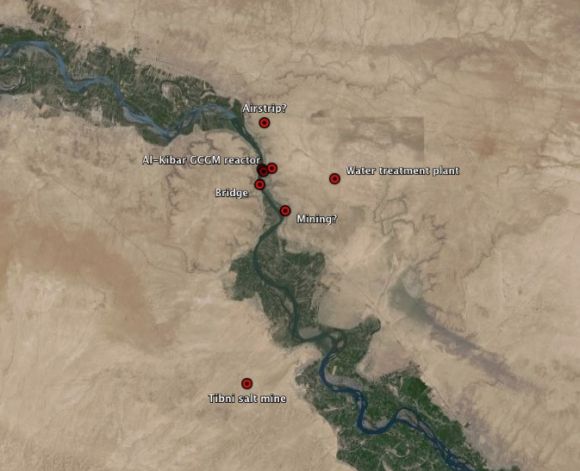
We in the open-source community have discussed for some time whether the target on the banks of the Great Euphrates River was or wasn’t a nuclear reactor supplied by the North Koreans. Despite photographs supplied by the US intelligence community, there are many that remains unconvinced by the strength of the evidence. You’ll find skeptics everywhere, on the comment pages of this blog, and even in the Vienna International Center’s staff cafeteria.
The destroyed building by the river bank remains an enigma. In Vienna, the Syrians continues to pretend like nothing has happened. The Israelis themselves keep out of sight whenever the mysterious air-raid is mentioned. The only country that seems to want some closure on the matter is the United States, its diplomats are busy trying to corner and contain the Syrians at the Viennese nuclear court. It is not that difficult. Syria, like its ally Iran, does not have many friends and allies in Vienna. However, many ask what the US have to gain by putting pressure on Damascus at this age of puzzling rapprochement between the Syrian government and its arch-enemies in Jerusalem.
Clearly, Syria wants this thing to disappear. However, it doesn’t want to expose itself too much while covering up its tracks. Indeed, the Syrian statement to the IAEA General Conference this year regretted some of the calls for more transparency and cooperation from their part. It held that its government was, and would continue to be, totally cooperative with the Agency but cautioned that, ‘this cooperation will under no circumstances be on the account of exposing our military positions and of threatening our national security.’
There are strong rumors about a report on Syria being prepared for the next meeting of the IAEA’s Board of Governors, set to convene in Vienna on 27 November 2008. There has been some discussion about whether the report will reveal the presence of nuclear-grade graphite at the site (see, for instance, Mark Hibbs, ‘Evidence from IAEA graphite probe not critical to Syria reactor case,’ Nuclear Fuel, 20 October 2008). The IAEA accumulated experience looking for this type of material during its verification activities in North Korea. However, for any meaningful analysis, the sample has to be large. So far, the IAEA investigation in Al-Kibar has reportedly turned up very little.
A while back, sitting down over a cup of coffee with a friend in Vienna, I heard how the Agency had structured its investigations. Keen to avoid leakage to the wider community and the press, the probe is handled by a small and tight-lipped group of people within the Department of Safeguard’s Middle East Division. Indeed, the Syria analysts keep to themselves, and do not share or discuss their findings with the rest of the division. This has caused disgruntlement amongst some within the Agency, who argue that there are risks with keeping information tight. Eventually the group sees what it want to see.
While there are skeptics in Vienna, the majority view within the Department of Safeguards is reportedly that the facility was a reactor. A recent report in the associated press quotes two diplomats saying that the Agency would press for more visits to Syria. This might be due to some ambiguous results from environmental sampling, but also because the department did not get access to all the sites it wished to visit. The press reports point to three military sites, but the Agency may also want to visit some civilian facilities closer to Al-Kibar itself.
Mining activities abound
While there certainly seems to be no reprocessing facilities around, there are mining activities in the area, including the Tibnah Salt Mine, which is located some 17 kilometers south of the destroyed facility (you’ll find the mine at 35°33’9.72“N 39°48’41.60“E). The Syrian General Company for Phosphates and Mines operates the salt mine, which has been known to operate in the area for years, not least because an Australian firm did the field mission and basic engineering survey for a mine expansion back in 1985.
SGCPM map of mineral assets
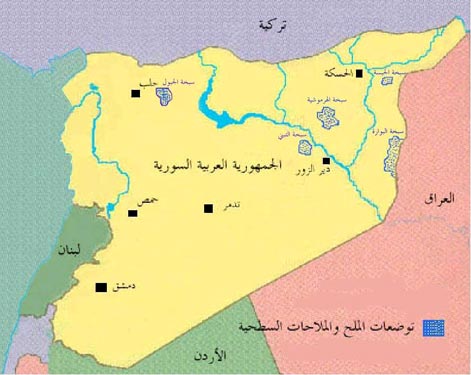
There are also some signs of mined materials being transported on the railway line that runs just west of the destroyed facility. It’s likely that the region, which is relatively rich in certain types of minerals, is home to some open-pit mining activities as well.
Why should this facility be interesting from a safeguards perspective? Well, the mines owners have started to think about ways to make alternative use of its 150 meter deep shafts and sprawling tunnels. One idea has been to study the geology of the site, as well as its hydrological, tectonic and geological settings to find out whether the site could be used for radioactive waste disposal. It goes further than that: a preliminary report on the matter has been produced and published by the Syrian Atomic Energy Commission.
Presumably, the site was assessed for disposal of Naturally Occurring Radioactive Materials (NORM), which are some waste products resulting from oil and gas exploration. Syria has had problems with this type of waste, and the Atomic Energy Commission of Syria has been trying to grapple with this issue for years. Burying it in a disused salt mine makes sense.
Despite the presence of this facility, known to the Agency for some time, inspectors did not visit the site during its assessment of Al-Kibar. Surely the IAEA must have asked for access to the facility?
No, it did not. Allegedly, the Department of Safeguards did not even mention the facility during discussions with the Syrians. In my mind, it would have been a perfectly reasonable request to visit, if nothing else but to find out whether the bombed building was associated, in some manner, with the local mining industry. What would the IAEA have found? Probably nothing much. However, it is part of a wise search logic to look around the inspected area, and pay special attention to activities that may be related, even if the connection is far fetched. And the mine is just a short car ride away.
A visit to a salt mine would surely not threaten Syria’s military interests, now, would it?

could the exploration of the mines shed light on whether the alleged reactor was close to operational?
in my mind that is the weakest link in all this. even if you believe it was a reactor — was it really that close to being operational that one would feel compelled to bomb it in lieu of other regular types of pressure?
at least in pakistan, US incursions are not having a positive impact on security overall.
> could the exploration of the mines shed light on whether the alleged reactor was close to operational?
I don’t see how. More explanation of the argument is needed.
> [I]n my mind that is the weakest link in all this. even if you believe it was a reactor — was it really that close to being operational that one would feel compelled to bomb it in lieu of other regular types of pressure?
That, I believe at the moment, is an important question. Just based on overhead imagery, the putative reactor project surely dated back to early 2002, more likely 2001.
The Yongbyon project took about a half-decade from ground-breaking to start-up, so I can believe that the Israelis were very nervous about waiting, particularly given the adverse publicity attendant on bombing an operating reactor next to the Euphrates. Then there was that ship that put into Tartus a few days earlier.
As for the other types of pressure, I certainly agree that Israel or the US should have presented the case to IAEA — first.
We know so little about the whole affair that guesswork is all that’s available.
Thanks for the interesting info on the Tibnah salt mine!
The Tibnah site was mentioned first in the Dreamer analysis who studied Digital Globe image orders before and after the strike. He found an image centered on this site appeared on the DG website but not in the Google Earth “more” layer. I brought this find to your attention a few months ago.
The Dreamer analysis is in my opinion the best study of this problem but unfortunately not very readable. The conclusion is it’s unlikely BoE was a nuclear reactor.
Yossi. Good that you decided to go for the Arabic spelling. There are at least four different ways to write TIbni. You did point the facility to my attention a couple of months ago, that’s why I followed up on it. Now, at least, you know what it is! Enjoy.
Andreas, I apologize for being so petty about the credit. I guess I’m a little bitter because the D analysis is almost ignored in the arms control community. I was very glad when it was attacked (and survived) here a few weeks ago but regretfully the discussion has died out. Maybe people are afraid it’ll associate them with the lunatic fringe that is always yelling foul without any proof?
Thanks a lot for the info about the Tibnah site. It’s certainly a good detective work that may shade light on the mystery. Maybe it was used as storage for BoE sensitive materials?
Thanks also for the info on IAEA internal politics. You say the Syria analysts are keeping to themselves separated from the department majority that is convinced it was a N-reactor without seeing the evidence. This seems like trying to keep their professional stance under political pressures.
I think the IAEA is aware of the D analysis but being isolated and pressured a good public discussion could help them make their mind about it.
Unfortunately like most Israelis I don’t know Arabic. We pretend here to live some place else, don’t learn the language and our papers rarely bring news about the neighbors. This makes it easier to see them as monsters but history teaches us that Jews and Islam got along fairly well and still do, e.g. in Iran.
We have an arabic speaking consultant which helped me out with some open source analysis. Some of the texts we worked through were quite … interesting.
The hypothesis that it was used for BoE storage has been discussed here. If so, there should be overhead on the movement of material to the location. I’ve not been looking into that yet, but might in the future.
Andreas, thanks. I get the notion you know more than you tell us…
I have a provocative question which hopefully may liven up the discussion.
According to USGS data in the gallery/earthquakes layer of Google Earth there were in 1994 two earthquakes, a M5.0 and M5.1 strong, 48km from BoE.
The quakes were only 18km apart but in different depths, 10.00km and 28.80km respectively. Somehow the first figure strikes me as suspect.
My question is: would you expect the Syrian government to start building a nuclear reactor in such a location 7 years later?
Yossi:
If we’re talking about motivation to build (or not) a nuclear facility, I’m sure you’ll be aware of the consequences of the Armenian earthquake in December 1988: The quake was about 6.9 on the Richter scale and was centred around Spitak, which is about 50 miles from the Armenian’s Metsamor nuclear power plant, and as a result of the quake both of the 1970’s vintage VVER 230 blocks were shutdown. However, because of lack of electricity in later years I believe one of the blocks (poossibly both?) was re-started in 1995.
Therefore if, “just” for the sake of electricity, a country is willing to re-start a nuclear power station that has already been hit by a very significant earthquake, I don’t believe that the possibility of an earthquake isn’t going to dissuade our Dear Leader from his nuclear plant (if that’s what the BOE was).
On the other hand, if we’re talking about choice of location, I suspect that the general area was chosen for its proximity to the river (whatever the ultimate purpose of the water) and its relative remoteness. Additionally, it seems that the specific site may have been chosen because a natural ravine allowed the Syrians to pretty much hide the structure from any direction at ground level. Maybe it also helped that a road and airfield were not too far away either. Using these criteria, there probably weren’t too many options available to the Syrians, and I’d hazard a guess that in the final decision secrecy, proximity to water, and logistics / access trumped any concerns that might have been raised about geology or seismic risk.
In short, I don’t think a couple of earthquakes would have dissuaded the Syrian government from undertaking something that may have been strategically very important.
Hairs, you are a knight in shining armor!
I agree that the earthquakes by themselves are not sufficient proof BoE was not a nuclear reactor. What about other points raised by Dreamer, e.g.:
* The “construction photo” being an obvious fake.
* The short construction time frame (15.5 months at most and using primitive scaffolding).
* Water circulation going: river/BoE/WTF/river.
By the way, I would appreciate it very much if you’ll email me at “dreamer371 at gmail dot com”. This can facilitate discussion.
I have been sleeping so much better lately knowing that EVERY speck of graphite from some facility could be safely stored in a nearby salt mine.
Since no one is picking the glove I guess I can declare a technical victory…
There are no excuses, this is a free country and posters have sufficient anonymity. I just wonder why the multi-billion agency that pushed this hoax didn’t dare to send someone to defend its honor, or maybe they have none left.
Yossi: I think it is fair to say that the jury is still out on the BoE, and way too early to call a technical K.O. You should wait and see what the BoG report on Syria says, if there is one in the works. This discussion is by no means over!
Yossi:
Sorry, I didn’t realise it was a gauntlet before me. In fact I’m a bit surprised that my posts had been seen as a challenge, or as somehow supportive of anyone else’s agenda. The (perhaps disappointing) truth is that I’m just a private citizen trying to take a disinterested view, and throwing in my opinion every now and then for what little it’s worth.
Just so we don’t get confused, I live and work in what used to be called “the third world” with intermittent web access and an awful lot of timezones between here and the developed world. We don’t have multi-billion agencies here for the simple reason that the entire GDP scarcely qualifies as “multi-billion”. The timezones and poor web access, along with a full-time job, are the explanation for the (in)frequency of my posts and also why I prefer not to engage in any one-to-one communications.
I’m afraid you’ll have to find someone else (or a windmill) to tilt at because I’m nobody’s champion. Once again, sorry to have been a disappointment to you. If it’s any consolation, there are many others equally disappointed in me.
Hairs, I deeply apologize if I made such an impression! I never thought you represent any organization or evil force. It was clear you are someone who is interested in this case just because it’s interesting, like all or most ACW readers. I’m not disappointed with you, certainly not after your excellent contributions to boxology.
My lamenting etc was generally directed at a very fuzzy windmill including the USIC and probably any techie who may want to defend it.
I guess I should take Andreas advice and wait for new developments.
Andreas, your blog may become the hottest topic yet!
Suppose the Syrians already started using the Tibnah salt mine for radioactive waste disposal, then the source of the non-natural Uranium compound found by the IAEA in BoE samples could be visitors to the salt mine that hopped to visit the neighbor facility…