
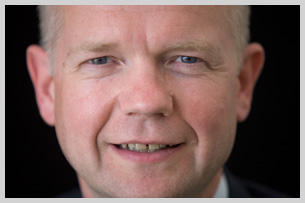
I just got back from the IISS where William Hague, the Shadow Foreign Secretary, gave a speech on Preventing a New Age of Nuclear Insecurity. It is, apparently, exactly two years to the day since he last spoke on this subject to the IISS. Since then, however, the electoral prospects of the Conservative Party have brightened considerably so it had more of a buzz than last time.
I confess that I didn’t take notes and the speech isn’t online yet. When it is, I’ll assume it’ll be on the IISS website and the Tory party website.
I didn’t have the opportunity to ask a question at the event so after summarising the speech, I’ll pose two questions here instead.
First off, I thought it was an excellent speech: detailed and well-researched. I really mean that.
Many of us have been wondering for a while whether a future Conservative government would continue the high-profile initiatives on disarmament launched by the current Labour government and outlined in various recent speeches (including those I blogged about here and here).
And, it does appear it would. Mr Hague spoke, on a number of occasions, of the need to move towards disarmament if the P5 are to have the “moral authority” to curtail proliferation. Indeed, Mark Fitzpatrick observed in questions how strong the bipartisan consensus on these issues in Britain is.
In regard to non-proliferation, Hague essentially argued that what the current government was doing was right—but that it needed to go further. He launched his own eight point plan (very much in vogue these days). Many of those points are what you’d expect: universalize the Additional Protocol, fund the IAEA properly, freeze the assets of entities involved in proliferation and ‘internationalize’ the fuel cycle (by which he appeared to mean create a system of fuel banks).
All good sensible stuff. But, it will require the cooperation of non-nuclear weapon states to effect and I’m not sure he quite appreciate the challenges here. For instance, he painted the idea of fuel banks as being a way to ensure states article IV rights, which (whether they are or not) is certainly not how they are perceived at present.
So, the first of my two questions for Mr Hague, is this: How can an international consensus among nuclear-weapon states and non-nuclear weapon states to strengthen non-proliferation be created? Is good diplomacy sufficient? Will serious progress toward disarmament be enough? Or, is something additional required?
The most controversial suggestion raised by Mr Hague was that India, Pakistan and Israel should be ‘brought into the non-proliferation regime’. When asked about the US-India deal, he said was an example of the kind of thing he meant. But, he didn’t provide any other examples.
So, my second question is this: What does he mean, in practical terms, by bringing India, Pakistan and Israel ‘into the non-proliferation regime’? Can he provide some examples of a policy of this sort, beyond the US-India deal?
Of course, on the off-chance that Mr Hague doesn’t read this blog then any of you who want to speculate about possible answers are welcome!

The answer to your second question should come first; since I think Hague is completely right by saying that the 3 non-NPT Haves should be brought in. I believe this is a sine qua non condition to save the current NPT regime.
But it is more than likely that Hague is thinking in the way of dismantlement for the Pakistani arsenal, similar to the current on-going project in DPRK, while in the case of Israel he is looking for an India like solution, the contour of which should be discussed in a general Middle-East peace agreement.
If this is the case, then we can say that his team of Non-Proliferation advisers hasn’t done its home-work correctly and hasn’t thought it thru with complete insight: such a demarche will not bring any solution to the article IV rights the way you see it and the way he recommends it, and by failing to do so, it will be a complete waste of time and dilpomacy.
The modern UK Conservatives sold out to the liberal leftist agenda years ago. I know what life was like under the good old Mrs Thrasher days. Unions were put in their place. The unemployed were made to work and a blue blooded Brit was a Tory and a lefty liberal socialist wet was a piece of ****.
Could a way to adress many of Hague’s concerns, and add your ‘something additional’ be negotiations for the proposed Nuclear Weapons Convention? This could bring in those outside the NPT, and also strengthen disarmament and non-proliferation efforts. Have you guys posted anything on this before?
I’m hoping to get an interview with William Hague this month so I’ll fill you in once I get a response to my nuclear proliferation questions. Also, the ISS have published the speech in full – both in video and transcript. It’s very useful indeed.
I assume Major Lemon doesn’t live in somewhere Northern like Salford then, or he’d be hung from the lamp-posts for supporting “Mrs Thrasher”.
I emailed a link here to Hague and his constituency office, hopefully he’ll respond either here or through Ms Haywood.
It is interesting that the Conservatives in the UK have had to hold closer to the centre as the traditional Left becomes Right than perhaps elsewhere has seen – I couldn’t imagine the Republicans standing on a platform of Green issues, for instance.
The single most positive thing that could be done to move things forward in this domain would be for the UK and France to de-nuclearise. There are no good reasons for them to have ‘independent’ nuclear forces, and if they were honest they would (should?) admit that the only reason they keep them are for reasons of prestige (sending precisely the wrong signal). However, I won’t hold my breath waiting for this.
This is the exact quote: “And as part of the drive to reinvigorate the NPT, we should aim to bring the three nuclear powers outside its remit – India, Pakistan and Israel – within the wider non-proliferation regime.”
Seems to me an ambiguous statement. One interpretation could also mean rollback.
Here are two things for you to chew on, dear Mister Acton:
1. An international consensus on any issue can only be created by removing the obstacles created by criminals. Of the countries that concern you, Russia, China, North Korea and Iran are criminals.
2. India, Pakistan and Israel will not join the non-proliferation regime in the next 40 years.
Now you can go and devise some policies.