
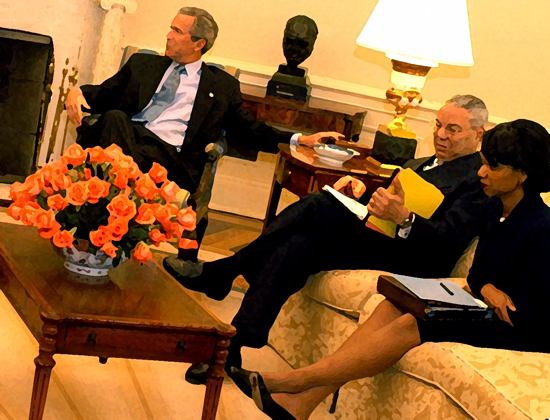
The last week or so has seen an interesting development with regard to North Korea (even if the image above is rather retro now).
As part of the Valentine’s eve agreement, North Korea is required to declare all its nuclear activities. The US has previously insisted that the North Koreans must confess to three programmes: plutonium production, a centrifuge enrichment programme and assistance to Syria.
The ‘draft declaration’, submitted towards the end of last year, only makes mention of the former and the DPRK vehemently denies the existence of the latter two.
And so, in spite of Chris Hill’s world record attempt for accruing airmiles, the process stalled.
Then, last week, it came out that North Korea and the US had reached a tentative agreement on how to proceed. The North Koreans would submit their plutonium declaration ‘officially’ (and allow it to be verified) and “acknowledge” US concerns about their enrichment programme and assistance to Syria.
Since then repeated press reports have added little to this basic picture, except to confirm that Chris Hill has successfully sold the plan to his political masters.
As far as I can see, there are broadly three possible scenarios that are consistent with these recent developments:
Scenario 1: North Korea never had a centrifuge programme or gave nuclear assistance to Syria
This scenario is oddly problematic because, as many have commented before me, it is very hard to prove a negative. If the US is convinced that North Korea has experimented with centrifuges and sold Syria reactor designs, there’s no easy way for the DPRK to demonstrate the contrary.
Thus, in this scenario, North Korean innocence could derail the entire process.
Scenario 2: North Korea won’t admit to its secret activities for fear of loosing face
In this scenario the North Koreans basically did (or even still are still doing) what they are accused of but won’t admit it in public. However, they might be willing to admit it in private. I think Chris Hill may have been hinting at this when he said “North Korea has difficulty saying things publicly.”
If this is the case—and I really am speculating now—maybe the North Koreans have agreed to provide details of the enrichment programme and the Syrian deal to the US secretly. There was a lot of talk a few weeks ago that part of the declaration would be kept secret—so perhaps that’s exactly what happened.
Even though scenario 2 is the most promising, it isn’t entirely rosy.
If the North Koreans admit to a less extensive covert programme that the US believes exists then we’re back to the pantomime problem (US: You did build a pilot scale enrichment plant; DPRK: Oh, no we didn’t; US: Oh, yes you did…an excruciatingly British reference, I’m afraid.)
Scenario 3: North Korea has no intention of complying with the agreement
In this case, the DPRK simply agreed to the 13 February agreement because of the short-term expediency of energy assistance. It has no intention of giving up its nukes, or compromising any of the other, more secret elements of its nuclear programme. Its refusal to confess to its enrichment programme or help to Syria is reflective of this.
In this scenario, the whole deal is doomed… and sooner rather than later.
Crucially, for me, an indicator of which of three scenarios is correct will be the extent to which North Korea allows verification of its plutonium declaration.
The DPRK has declared less Pu than most experts think it has produced. If the North Koreans allow really intrusive measures (such as drilling into the graphite moderator to permit forensics) then that would suggest scenario 3 is wrong. If they don’t, then I’m pretty pessimistic about the fate of the deal.

One slightly interesting development is that last week Chris Hill, Ms. Rice and President Lee all used the word “Syria” when answering questions about the process. The only previous time that happened that I know of was back on February 19 when Mr. Hill acknowledged discussing “the Syrian matter” with the North Koreans.
To the extent this might mean anything, it would appear to make it harder for the US to back away from requesting information about NK/Syrian nuclear cooperation. “Cooperation” presumably means the infamous Box.
How trusted is the GIRM graphite analysis method now? The 2004 PNNL paper mentions only one full-scale demonstration at Trawsfynydd with results “within their stated uncertainty”. Other uncertainty modelling was by simulation. We don’t want to be using low-confidence methods in a situation with such political ramifications, as the numbers are sure to be bandied about by those that don’t understand fully.
The 2002 paper said Russia needed more work to give a high level of confidence of no misleading results. And this 2005 paper still only refers to the one empirical demo at Trawsfynydd, and says “the GIRM methodology has changed substantially in recent years and additional sources of error have been included” and “Any error associated with the local (WIMS) model or global 3D model has important consequences for the resulting total Pu estimate.”
I’m no expert, but it does sound too leading edge for comfort.
Also the NKs may be uneasy about sampling, as for now they only want temporary disablement. I know you can sample production reactors, but this may still be a hurdle to be overcome.
Two things come to mind:
(1) What does the US (or, rather, what do the North Koreans) do if the amount of Pu that is verified is more than the 30kg Pyongyang has reportedly declared? I can imagine the Yongbyon reactor’s operating records will be the best barometer apart from US intel and that seeking that is a key US demand in the verification talks. (Chosun Ilbo was reporting as much late last night.)
(2) Regardless of what the Syrians were or were not once up to, I’m pretty sure they’re not up to it anymore.
The point made here about Scenario 1 is worth dwelling on.
Assume for the sake of argument that the truth lies with either Scenario 1, Scenario 2, or between them (e.g., there was a centrifuge program but no nuclear cooperation with Syria). What sort of access to people, facilities, or documents would satisfy the U.S. of the accuracy of NK claims, and to what level of confidence?
I ask because I honestly don’t know the answer to this question, and suspect that nobody else does, either. In one form or another, this question-without-an-answer has been staring us in the face since ca. October 2002.
Scenario two seems to be the most plausible one, although it certainly doesn’t preclude scenario 3 since the final decision on this will be the giving up the plutonium and the tech behind their bomb(s). Look at Rice’s statements recently about the fact that “diplomacy does not always have to be public.”
I really fail to see the problem with North Korea declaring to the U.S. the nature of its uranium program and the Syrian connection in a classified fashion. The details can still be classified as long as all parties to the 6Party talks are given access to the information. Forcing North Korea into a situation that they consider to be extremely embarrassing would more than likely reduce our ability to get at the plutonium.
If they are unable to come clean about and then give up their Pu, then its a failed agreement.
Scenario 1: in this case the onus is on the US to a certain extent – put up, or shutup, i.e. they need to present a case that it is possible for the North Koreans to disprove. The DPRK is then not required to prove the absence of an enrichment programme and/or Syrian collaboration, merely to refute the ‘evidence’ that the US claims to have.
Scenario 2: When did this process [officially] become bipartite as opposed to hexapartite? Is the DPRK more likely to give details of any such secret programme to the US than to China or Russia? Are the other parties not intersted, or not entitled to be interested or do they not share the US’s conviction of other North Korean misdoings?
Scenario 3: Perhaps not that soon, the North Korean’s are masters at stringing out such negotiations. At present they’re reportedly admitting to 30 kg Pu of which 6 kg was used in the October ’06 test, 18 kg has been used for ‘nuclear development’ (what a quaint euphamism) leaving 6 kg which they perhaps might be willing to put up for verification in the first instance, with the prospect of more to follow – for a price.
And of course there’s the question of verification by whom? One wonders quite how the somewhat strange bedfellows involved in this process are, by themselves, going to arrange a verification activity that will be mutually acceptable to all parties.
Maybe the White House is trying to get North Korea to “admit” that they supplied Syria with a nuclear reactor so that they have an excuse for more UN sanctions against Syria.
However, the White House should get their crappy lies straight first. From the WSJ (via Syria Comment):
“The information is expected to confirm that North Korea was helping Syria develop a plutonium-based nuclear reactor similar to the Yongbyon facility North Korea built north of Pyongyang, said an official familiar with the deliberations.”
urls:
http://online.wsj.com/article/SB120889732155735901.html?mod=googlenews_wsj
http://joshualandis.com/blog/?p=686
Some pointed comments:
1. I have doubts about the existence of a DPRK centrifuge plant; the intelligence I saw was awfully thin, tho’ better than the infamous Iraqi aluminum tubes. I suspect they played with the idea, but didn’t take it very far.
2. Assuming the pictures shown by the Administration today from inside the Syrian reactor building are real and have good provenance, then the Syrian reactor matches up very well with the available interior photos from Yongbyon. And there is that damning picture of the heads of the Syrian and DPRK nuclear programs standing together.
3. I have no objection to the DPRK making a secret uranium declaration to the US.
4. It’s hard to believe that the DPRK only made 30 kg of Pu given that the reactor’s potential was so much greater. The Koreans did a good job back 7-8 years ago of scrambling their spent fuel, etc., so that there was no way to do good analysis of it to determine total irradiation.
5. Given the low yield of their test, it’s also surprising that they used six kilos of Pu in the design. Oh well, somebody had to be the first to screw up badly.
6. I have some old videotape of the interior of Yongbyon supplied by the USG back in about ’93. It was an intercept from North Korean domestic TV. The pictures of the reactor in it match up extremely well with the two photos I saw on tonight’s news of the Syrian facility.
-pz