
One of the best things about this damned blog is that really great people will send me little bits of analysis — short pieces that could never make the Washington Post but are totally awesome nonetheless.
Click to play.
Debris visible at 2:33.
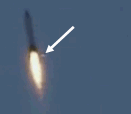
Case-in-point: Friend of Wonk and former UNMOVIC inspector Geoff Forden. Forden observed a little bit of debris popping off a Shahab-3 during a February 4 test and concludes that Iran might be having a hard time producing graphite jet vanes:
Iran’s February 4th launch of a Shahab-3 just keeps on getting more and more interesting; that is if you are interested in just how good of a missile the Shahab/No’dong is. Video from Iran’s television show that there is a failure of the missile’s thrust vector control system nineteen seconds into its powered flight. At that point, there is a brief flaring at the very end of the missile and an object is seen flying off for several seconds, until it leaves the video’s frame as the camera continues to follow the missile. Tellingly, it doesn’t just drop off the missile but is given quite a transverse boost.
What is happening? The most likely explanation is that a part of one of the graphite jet vanes, little fins that are stuck into the exhaust just outside the nozzle and are used to steer the missile both in its pitch program and to correct for unwanted deviations in its trajectory. Jet vanes must be manufactured from very hard and pure graphite otherwise it is subject to being “eaten” away by the corrosive effects of the exhaust. Nineteen seconds is also about the time that a No’dong missile might be just starting its pitch program. (As I watch the video, it appears to me that the Shahab-3 has just started its pitch-over program, though why a sounding rocket needs to pitch over is beyond me. But then again, I don’t understand why Iran would use a nosecone for scientific purposes that looks exactly like the combat warhead.)
Clearly, the failure was not enough to cause a fatal instability, such as a veering off course that might trigger an automatic self-destruct charge. SCUDs are known to have just such charges on them for range-safety purposes even during combat operations so that there is reason to suspect that a Shahab-3 being used as a sounding rocket would too. Presumably, just a piece of a jet vane flaked off but still left enough to help steer the missile and, perhaps more importantly, enough “drag” in the exhaust stream to balance its opposite number. In fact, this is where the story gets interesting: it is very reminiscent of a Syrian test of a so-called SCUD-D variant that crashed in Turkey when it was aimed almost ninety degrees away, to a point in the Mediterranean just to the east of Cyprus.
In that test, in May 2005, pieces from a Syrian SCUD-D rained down on the Turkish towns of Golbasi and Mahmutlu. The most likely explanation for that failure has always seemed to me to be associated with a failure of the jet vanes but one so catastrophic that it veered off course, triggering the self-destruct mechanism as it picked up an unwanted lateral acceleration. After all, the drag from the jet vanes in a SCUD waste about 5% of the missile’s thrust. If you eliminate one of them, it could create quite a torque that might very well force the missile to veer off in the direction opposite the missile vane.
So what does this mean for missile proliferators in general and Syria and Iran (and North Korea since they are all involved in the development of these missiles) in particular? It means that they are still having a hard time producing graphite tough and pure enough to be used in large missiles. It also indicates that a top priority for their missile engineers will be to develop other thrust vector control mechanisms.
You earned yourself a brewski with this one, buddy.

The thing falls off at, as said above, about 2:32 into http://tinyurl.com/2xu6bq
I’d noticed it before, but hadn’t thought of the jet vane possibility. Probably be useful if somebody could do a frame-by-frame analysis of the event.
Fascinating stuff here indeed.
That Shahab was not a sounding rocket; it tried to reach an orbit (and might have actually if it had no payload other than the RV). I saw an interesting video of the event and can say that the missile remained under control up to the separation of the main stage.
Iran and North Korea should have meanwhile enough experience with those jet vanes; they use it on all of their liquid fuel missiles already since more than 20 years.
If they are having trouble producing high quality graphite, that might have ramifications in regards to their nuclear programs also, as reactors need very pure graphite to moderate the neutrons. Or are they going the heavy water route?
> though why a sounding rocket needs to pitch over is beyond me
If the payload reaches several hundred km altitude and needs to be recovered near the launch area, wouldn’t the rocket have to steer a bit to the east to allow for earth rotation while the payload is in ballistic flight?
If you load a Shahab-3 with only a 10 kg payload, then it would have a burn out velocity of 3 km/s (at an altitude of 73 km, after which it continually slows down) and reach a maximum altitude of 600 km (at which point it would have zero velocity). Clearly, this had no chance of putting anything into orbit since the orbital speed at 600 km is about 7.5 km/s. And if I can indulge in some shameless self-promotion, you can verify these calculations using my program, GUI_missileFlyout, which you can download for free at http://mit.edu/stgs/downloads.html You can also see that a Shahab-3 fired straight up will land about 15 km away from its launch point because of the rotation of the Earth. Is that enough to warrant a pitch program? I don’t know, but most sounding rockets do not try to compensate for that since they aren’t guided. Perhaps they don’t have recoverable payloads?
These countries have flown SCUDs with graphite jet vanes for many years now. The questions of where they get those vanes and whether they are sufficient for the more powerful—and wider—engines being flown in Shahab/No’dong/SCUD-D variants is an open question. Iraq, for instance, imported its graphite even for its rather modest Al Samoud II. Pyrolytic graphite is produced by a process called chemical vapor deposition and requires its own dedicated industrial infrastructure. My guess is that Syria imports its graphite and perhaps so does Iran. But even if they did produce their own graphite, as North Korea probably does given its relative isolation, it is not clear that experience with SCUDs would directly translate to No’dong variants. For instance, the nozzle diameter for the No’dong is almost certainly larger than for the SCUD-B. That means that the jet vanes have to stick out longer into the exhaust plume. Consequently, there is a larger mechanical force on the graphite and it is likely that a jet vane manufactured to the same specifications as a SCUD vane would break. Thus, they need to develop new jet vanes and their past experience isn’t very useful to them. In fact, it is only the non-catastrophic failure of this missile (which, as you say, did appear to remain under control) PLUS the Syrian catastrophic failure that is most meaningful, at least to me.
I don’t know enough about reactor-grade graphite to say what this implies for these countries’ nuclear programs. It is my understanding that nuclear grade graphite is usually produced through a liquid-phase pyrolysis and a purification process before being converted into graphite. In general, liquid-phase processes can produce larger quantities than vapor-phase processes, which makes sense since reactors use much more graphite than missiles. However, the underlying processes are so different that I doubt much can be said about one using the other as a model.
Not one but two bits of debris visibly fly off the missile. This is apparent in the shot from the second camera. See 3:01 and 3:10.
So is that good for a brewski? Partial credit, maybe? Perhaps you can issue punchcards.
I’m reluctant to characterize this as information, but FWIW. If somebody who knows Farsi could check out the translation, it would be useful.
90 seconds is the burn time of the Shahab-3.
http://afp.google.com/article/ALeqM5iVbMLLCdc8nalTh0RcFcxg_oNQtQ
On February 4, Iran fired a rocket into space…
Ahmadinejad hailed the launch of the rocket, named Kavoshgar-1, as a success and for the first time gave some technical details about its launch.
“The first rocket that was launched had three parts. It was a success,” he said in the speech marking the 29th anniversary of the Islamic revolution.
He said the first section of the rocket detached after 90 seconds and returned to earth with the help of a parachute while the second entered the earth’s atmosphere after 300 seconds.
“The third section of the rocket, which contained the probe, was sent towards orbit.”
“The probe is sending information on wind, temperature, pressure to allow the sending of new probes into space,” he added.
That Shahab has serious navigation problems. On the TV news I saw that the Shahab flies while zigzagging in the air.
You cannot really tell the quality of a missile’s flight by watching videos of it. Much of the motion noticeable on the videos is caused by the camera and the twisting of the contrail is due to winds aloft blowing it in different directions and with different speeds.
i agree there are plenty of sound reasons for thinking Iranian and Syrian metallurgy is pretty shaky.. + high quality (Chinese perhaps??) graphite may be hard to come by right now. However, I’m less convinced about using the Syrian example as corroboration for the jet vane theory. The Syrian SCUD-D is a different missile than Shahab-3, No-Dong etc (half the range for starters) and probably has a diameter similar to standard SCUDs (just stretched out).
As to the reason for the May 05 failure reports from the time in the Israeli press claim it was a new advanced version of SCUD-D (better guidance, improved accuracy) that was tested. Inconclusive maybe but a new version seems more likely to be prone to catastrophic failure and could account for the inadvertent ballistic missile attack against NATO territory… – Also I don’t understand why you think the Syrian test was being conducted out to sea? And in the general direction of Cyprus? If that’s a factual statement, ok. But it makes absolutely no sense to me, especially if they were trying to test accuracy (unless you have a sea-based target in mind) and you’ve got plenty of land. Launch on a lofted trajectory, or limit the range but surely aim to keep it within your territory.
Gee, let me see….pitch-over program…nosecone that looks exactly like a combat warhead…nah, couldn’t be.
Syria normally tests its missiles by firing from a base in the southern corner, west of Damascus, going northward. For some reason, Syria fired its SCUD-D that day from the Minakh Airbase (36.5233°N 37.0426°E) southwest toward the Mediterranean, or at least that’s what the news papers report. (There were even reports that Israel was some how observing the launch.) There is a clear flight path from Minakh to the East of Cyprus that doesn’t pass over (and hence endanger) Damascus. Of course, I don’t know that the media reports are correct…
I don’t think they were testing accuracy. It is much more likely, at least to my thinking, that they were just testing the missile to see if it worked. As to lofting a trajectory, I wish I knew more about it. I believe that, in practice, it is much difficult to do than just saying “lofting.” It certainly subjects a missile to different forces, both aerodynamic and inertial loading. Perhaps they didn’t want to test the missile in those unrealistic forces? Until we know more about the status of Syria’s missile program and what problems they are trying to resolve it seems meaningless to try to apply a “common sense” (not your words, I realize) test to it. It would, of course, be a totally circular argument to suggest that they were testing the motor and its thrust vector control system…
Jet vanes seem to be one of the thorny problems you run into in increasing missile range. The Chinese missile designer who was in charge of designing the jet vanes for the DF-3 missile told me some years ago that it turned out to be a much harder materials problem than anyone had anticipated. The thrust of a DF-3 is more than 3 times that of a Nodong/Shahab and the burntime is 50% longer (about 135s vs 95s), so these conditions are considerably more stressing.
Not sure if you’ve spotted this already, but there’s a Jan 24th CRS report on “North Korean Ballistic Missile Threat to the United States,” available through FAS here:
http://www.fas.org/sgp/crs/nuke/RS21473.pdf
The Shahab has serious navigation problems because it’s a long range missile that is zigzagging while it flies. This is not the case like when a short range anti-tank missile is zigzagging towards its target, Let’s say 5 KM away.
Note to G Forden:
CVD infrastructure is not that dedicated to just producing high purity graphite.
It is widely used in semiconductors —- though in producing very thin layers rather than big, chunky parts.
Those who have access to CVD gear for microelectronics applications would need to do a certain amount of kludging and scaling to make it work, but it can be done.
Thank heavens the Middle East is not a major area of semiconductor production despite the abundance of raw materials(sand) there.
The Israelis presumably monitor Syrian missile tests through the “Green Pine” radar stationed near Hadera.
Interesting.
I wouldn’t have thought that a broken off jet vane would be given such a transverse boost if the scenario proposed occurred in reality.
It doesn’t necessarily imply a malfunction IMHO.
There are many other possibilities for what may have occurred here.
It is amusing to take wonkish hypotheses to extreme conclusions and pat each other on the back and buy each other brewskies, but this does not mean you know what happened.
I encourage you to back up and come up with a few other hypotheses before latching on to this one.
And of course the putative research nose-cone would look like the warhead’s. To zeroth-order you don’t want to mess with the moments of inertia etc. of the payload, and would try to keep everything as similar as possible in a sounding rocket to that used in the missile.
It is very hard to “prove” anything in intelligence gathering activities, at least not to the same level that is possible to prove something if you can run experiments. So your point is well taken. However, the broken jet vane is compelling enough to warrant experimentation, if you ask me. In fact, I would urge the CIA, if it had access to a No’dong engine, to test it with a missile jet vane to see if the remaining three could compensate for it. Remember, according to my hypothesis, this was one of the jet vanes that was used to implement the pitch program. (That is one of the reasons why it was important that the missile flew 90 degrees off its intended track.)
Completely breaking off a jet vane on a No’dong class missile produces something like 0.7 ton thrust imbalance. If we assume that all of that is applied at a distance of half a meter away from the center line, this equals a torque of 0.35 ton-meters. Can the other jet vanes compensate that? I don’t know. In fact, the Iranian launch would seem to indicate that they could. But perhaps the Iranian vane was wasn’t a pitch vane, and perhaps it didn’t completely break off. See above for my suggestions on how to find out.
As to other hypotheses, I would like to hear other suggestions; if you don’t mind stooping to wonkish speculation. (Backed by some sort of physical argument, of course.) The only other one that makes any kind of sense to me is that the people who launched the missile just mis-aligned it. If they got the fins confused it is possible that they set the missile 90 degrees off what they intended. In that scenario, they launched, saw that it was heading off toward Turkey, and detonated the self-destruct mechanism. They were, after all, training the launch crews. But, if this had been a SCUD, which is probably resembles in terms of its set-up procedures, than the launch crew would have to be incredibly stupid to make that mistake.
Dude,
Which broken jet vane are you talking about? The object ejected from the rocket you assume to be a broken jet vane?
I agree it is one possibility.
Another possibility is that there was an object ejected from the rocket on purpose.
Why? It could be a canister containing the hi-fidelity data from the launch which could not be transmitted to ground given the bandwidth; or, could be a simple backup of those data in case of later explosion of the test rocket.
I don’t see the “vane” emanating from the jet plume. It appears to be an object ejected (on purpose) sideways.
I don’t understand the second scenario: do you mean this was a failed self-destruct?
Im sorry if Ive been confusing. Im talking about two separate missile launches. Most of my last post was about the Syrian launch. Perhaps that helps?
As to a canister being ejected: dude, that’s an original one.
See
http://iran-newspaper.com/1386/861128/html/rodarro.htm#s814842
For details (in Persian) of the rocket launch.
Iran never claimed the payload reached orbit. Just that it transmitted and recorded data while in flight.
I think this was the object which got separated from the missile:
http://img.photobucket.com/albums/v204/mattin4/kawoszgar3.jpg
another missile photo:
http://img.photobucket.com/albums/v204/mattin4/kawoszgar1.jpg
First this is not a Shahab-3 missile/Rocket
and small things fly off of Missiles all the time its nothing significant
if even NASA has problem sometimes
you can’t expect Iran not to have one
U.S.‘s first attempt to put a satellite in to space was a disaster
this missile only reached an altitude of 200km only (120Miles) and it was never spouse to put anything in orbit
second this was a research rocket not a SLV (Satellite launch vehicle )
This Missile only had Two sections SLV’s usually have 3 or more sections
the First two sections of Iran’s SLV might be the same as this Rocket or it might not we just have to wait and see
Iran will send 2 or 3 more research rockets before they send a satellite in to Space
I would think that they would want to test an SLV before they launch one with a satellite
Iran has announced that it will send a satellite in to orbit some time before August, 2008