

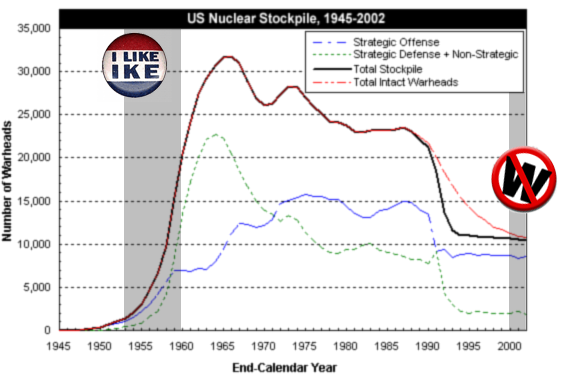
On December 31, 2012, when the Moscow Treaty both takes effect and expires, the United States will have the lowest force levels since the Eisenhower Administration, or at least that is what the latest State-Defense-Energy white paper says:
In 2001, President Bush directed that the United States reduce the number of operationally deployed strategic nuclear weapons from about 6,000 to 1,700-2,200 by 2012 – a two-thirds reduction. Corresponding reductions in the nuclear stockpile will result in the lowest level since the Eisenhower Administration.
This claim is worth our consideration in detail, as it is one of the regular talking points delivered by Bush Administration officials and defenders of our current stockpile plan. To wit:
- “When we have completed this task, our nuclear arsenal will be at about a quarter of its size at the end of the Cold War, and will have reached its lowest level since the Eisenhower Administration.” Chris Ford, United States Special Representative for Nuclear Nonproliferation, March 17, 2007
- “You should not hesitate to remind critics that President Bush negotiated the Washington-Moscow Treaty to cut the number of weapons to the lowest level since the Eisenhower administration.” Senator Pete Domenici, April 18, 2007
- “By 2012, the stockpile will be lower by nearly one-half from the 2001 level – down by roughly a factor-of-four since the end of the Cold War and the lowest level since the Eisenhower Administration.” Linton Brooks, then-Administrator, National Nuclear Security Administration, March 3, 2006
- “It’s the lowest level since the Eisenhower administration.” National Nuclear Security Administration spokesman Bryan Wilkes, February 22, 2007.
This talking point—“lowest level since Ike”—is interesting because of what it says about secrecy and nuclear weapons policy.
When Ike left office in January 1961— as you can see from the NRDC chart that I slightly modified—the United States nuclear stockpile totaled about 20,000 nuclear warheads. Every President since George H.W. Bush has been able to claim that the stockpile was at its lowest since the Eisenhower Administration—which, frankly speaking, isn’t really an accomplishment.
But what else can they say? Although the Bush Administration does appear to be making reductions, it also continues the long-standing secrecy policy that treats stockpile size and composition as classified information.
As a result, Administration officials are reduced to blabbering about the Eisenhower Administration, when they should be talking hard numbers.
What Kind Of Reductions?
Here is what we know about the size of the US nuclear stockpile and reductions since Bush came into office.
Sometime after the 2001 Nuclear Posture Review (released in January 2002), President Bush signed NSPD 10, a nuclear weapons stockpile plan that implemented the reductions starting in Fiscal Year 2002. Then, in May 2004, Bush signed NSPD 34 “Fiscal Year 2004-2012 Nuclear Weapons Stockpile Plan.”
Although these documents are classified, Linton Brooks stated that the arsenal would be 1/4 the size at the end of the Cold War and about 1/2 the size in 2001. Assuming that NRDC is right about the number for 1989 and 2001, then the United States should have about 5,000-6,000 nuclear weapons in 2012. (Hans Kristensen estimates 5047)
Almost all of the remaining 5,000-6,000 weapons will be strategic. That is interesting, because it means the US stockpile of strategic nuclear weapons—those carried by SLBMs, ICBMs, and heavy bombers—will be at its lowest level since, well, the late Eisenhower Administration.
That’s an accomplishment, but 5,000 nuclear weapons is still an awful lot. Ike or not, the point is that US nuclear forces grew quite dramatically in number after Truman.
Moreover, numbers tell only part of the story. Eisenhower was important not just because he presided over a huge increase in the number of nuclear weapons, but also because of organizational changes to emphasize military custody of weapons and predelegation of launch authority.
That is the important legacy of the Eisenhower Administration that came to define the Cold War and remains with us today.
Secrecy and Democratic Oversight
Americans know very little about US nuclear weapons stockpiles and policies. The University of Maryland Program on International Policy Attitudes (PIPA) surveyed 1,311 Americans. PIPA asked:
- “How many nuclear weapons do you think the
US has in the US, or on submarines, that are ready to be used on short notice?” The median answer was 200. - “How many nuclear weapons do you think the US needs to have to make sure other countries are deterred from attacking it?” The median answer was 100.
Public opinion surveys should be viewed cautiously and, of course, secrecy is just one of many barriers to a proper public debate about the role of nuclear weapons in US security policy.
But, honestly, it would help to be able to use real numbers. We’ve seen some efforts at declassification. DOE, for example, released some not very insightful information on stockpile size—the total stockpile numbers stop in 1961 and there is no information about composition.
Yup, the number of US nuclear weapons during the Cuban Missile Crisis is apparently classified. (And don’t even get me started on reclassification of delivery vehicles.)
More serious efforts at declassification seem to be held up by the Department of Defense. In May 2000, former STRATCOM commander Gene Habiger, then-director of the DOE office of security and emergency operations, wrote a letter to DoD proposing “declassification of total nuclear weapon stockpile quantities (past, present, and future) and subcategorization of those quantities by purpose, delivery system, and active/inactive status, but not by location, or specific weapon type.”
Seemed like a good idea to me, but DOD disagreed. Arthur Money responded that the “proposed declassification and subcategorization would reveal sensitive information pertaining to the pace and scope of changes in nuclear weapon stockpile quantities and status [and] could provide significant information on stockpile modernization, international treaty compliance and negotiation positions.”
Uh huh.
FAS has all the correspondence and documents if you are interested.
Update: I meant to note that, in 1992, then-Chairman of the Joint Chiefs of Staff revealed stockpile numbers during Congressional Testimony:
Now let me take you back to 1990, just the year before last, when we had deployed with our forces some 13,000 individual strategic nuclear warheads, distributed as you see: approximately 4,500 on bombers, another 2,500 on intercontinental land-based ballistic missiles, and another 6,000 that you see down here on submarine-launched ballistic missile—missiles aboard our submarine fleet. The START treaty would have taken this 13,000 and will take that 13,000 down to 9,500. That puts 4,600 in the bomber fleet, 1,400 ICBMs, and 3,500 on SLBMs. Those of you who are familiar with the START accounting procedures know that some of these bombers have discounted values, so they only count up to here with respect to the bombers for START purposes.
The initiative last night—50 percent of this number, 40 percent of this number, and about a third of the submarine numbers—bring you down to here. So if we could go to closure on the President’s initiative last evening we would be talking about numbers in the range of 4,700 overall and roughly 3,600 with respect to START-accountable systems distributed as you see here, somewhere in the neighborhood of approaching two-thirds reduction.
Let me move this slide—chart over and show you another way of looking at this. And on this chart, I have added the tactical nuclear weapons that were the subject of the President’s announcement in September. If you take the strategic warheads that you saw in the previous chart, add to them the tactical warheads which are being reduced as a result of the previous initiative, we are going from 21,000 overall, just in 1990, a few months ago.
Through all the initiatives that have been announced, we would bring this number down to 6,300. This is an historic change. This is unprecedented, and it’s truly, I think, a remarkable achievement which shows the Pentagon’s willingness to adjust to the new reality that is facing us with respect to strategic forces.
As far as I am aware, the world did not end. I’d love to get a copy of this chart, by the way.