

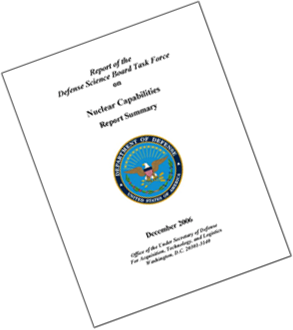
The Defense Science Board Task Force on Nuclear Capabilities—co-chaired by Johnny Foster and Larry Welch—has released a hilariously retro report on nuclear weapons.
Concerned citizens should be aware, the authors warn, of “an entrenched set of views held by an influential segment of the U.S. population” … crazy views like …
- smaller, less alert forces would be good;
- US emphasis on nuclear weapons might encourage proliferation;
- nonproliferation is more important than deterrence after the end of the Cold War;
- nuclear weapons should only be used to deter other nuclear threats; and
- that new nuclear weapons might just generally be a bad idea.
Gee, I don’t even know where to start.
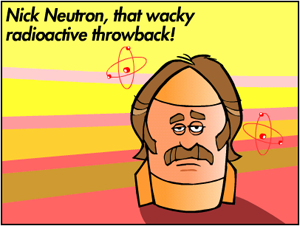
All I could think of, was Mark Fiore’s stoned nuclear weapon, Nick Neutron: “Whoa, what decade is it? Is it, the seventies?”
You might look at what Ivan Oelrich, Hans Kristensen and Cheryl Rofer have said.
The DSB Task Force demurs that the report “is not about which views are right and which are wrong” (uh huh) but rather “about coming to a more complete understanding of complex issues that ultimately frame progress on future nuclear capabilities.”
Ah, yes, I see now, a more complete understanding of just how totally awesome our nuclear weapons are.
Seriously, this report is such a through-and-through hack job, I can’t even begin to take it seriously. (I thought General Welch was better than this.) Just look at the list of briefings and presentations—just three, count ‘em, three “outside” briefings (non-government, non-contractor) from: The National Institute of Public Policy, The National Institute of Public Policy and … wait for it … The National Institute of Public Policy.

… because Nikolai Volkoff is awesome, that’s why.
Hmmm, apparently no one at, say, RAND was worth giving a call to address topics such as “Russia and Its Near Abroad: From One Empire to Another?,” “Weapons Policy of the Russian Federation,” and “In Search of ‘New Ideology’ in Russia.”
The subject of Russia, really, is where the report reaches it craziest, Cold Warrior depths. Warning against further nuclear reductions beyong those in the 2001 Nuclear Posture Review, the Task Force concludes:
Although United States relations with Russia are considered relatively benign at the moment, Russia retains the capability to destroy the United States in 30 minutes or less.
Now, admittedly, arming ourselves to the teeth is one possible way to deal with such a threat. (But what will we do about the polonium sushi?)
Another might be to accept Russian proposals to move to lower force levels, perhaps reducing that Russian ability to destroy the United States or, at the least, making the process take longer than ordering a pizza.
Were a Task Force interested in such a solution, it might have asked David Mosher and the other authors of Beyond the Nuclear Shadow: A Phased Approach for Improving Nuclear Safety and U.S-Russian Relations (RAND, 2003) to cross the street and give a little talk.
But, this isn’t really about hunting bears, is it? (Or, wait, given the Russian connection, maybe it is about hunting bears? Damn mixed metaphors).
The point is: Keith Payne—main author of the 2001 Nuclear Posture Review, DSB Task Force member and President and co-founder of the National Institute for Public Policy—and his buddies had some lunch and reprised some tired talking points in favor of keeping US forces configured to fight Russia as though it posed a moderately less capable version of the Soviet threat.
Good job, guys.