

Readers have probably already noted that Israeli Prime Minister Ehud Olmert ventured beyond the carefully worded description of Israel’s nuclear status—Israel will not be the first country to introduce nuclear arms in the region— in effect confirming Israel’s possession of nuclear weapons. Olmert, after making the standard statments, objected to comparing Iran’s pursuit of nuclear weapons with that of the United States, France, Russia … and Israel.
Oops.
Iran openly, explicitly and publicly threatens to wipe Israel off the map. Can you say that this is the same level, when they are aspiring to have nuclear weapons, as France, America, Russia and Israel?
You can watch the gaffe (which happened in English) by clicking on the pictures of Olmert or read the transcript (in German, unfortunately):
Understanding the implication of Olmert’s slip requires a sense of why Israel chose and maintains a policy of nuclear opacity.
Israel’s refusal to acknowledge its nuclear weapons arises from a desire on the part of the United States and Israel to avoid an outright confrontation over the latter’s nuclear status—an agreement that dates to the Nixon Administration. The United States, although suspicious, was slow to recognize Israel’s successful development of nuclear weapons in the late 1960s.
The Nixon Administration conducted a very serious internal debate about whether or not to pressure Israel to forgo nuclear weapons—nuclear weapons that US officials were beginning to realize Israel already possessed.
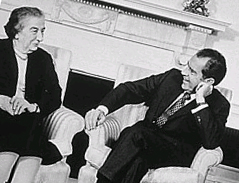
The Nixon Administration’s internal debates culminated in a fascinating meeting between Israeli Prime Minister Golda Meir and President Nixon, as imagined by Avner Cohen and Bill Burr:
Perhaps the most mysterious event of this tale (perhaps even of the entire Nixon administration’s history) was Nixon’s one-on-one meeting with Meir in the Oval Office on September 26, 1969. Kissinger was in a meeting with Rabin and Rogers at the same time and apparently remained only partially informed about the details of the talk with Meir, even after Nixon debriefed him. Senior officials with a need to know would never find out what happened. Nixon later told Barbour that he dictated a record of the meeting, but if that record exists, it has not yet surfaced.
[snip]
Even without a record of this mysterious private meeting, informed speculation is possible. It is likely that Nixon started with a plea for honesty and openness on this most sensitive issue, as was appropriate to these two allies. Meir, in turn, probably acknowledged—in a tacit or explicit form—that Israel already had reached a weapons capability, which would have meant that pressing Israel to equate “non-introduction” with “non-possession” would be absurd. (Years later, Nixon told CNN’s Larry King that he knew for certain that Israel had the bomb, but he wouldn’t reveal his source.) It is also possible that Meir assured Nixon that Israel thought of nuclear weapons as a truly last-resort option, a way to provide her Holocaust-haunted nation with a psychological sense of existential deterrence.
[snip]
Politically, the Nixon-Meir agreement allowed both leaders to continue with their old public policies without being forced to publicly acknowledge the new reality. As long as Israel kept the bomb in the basement—which meant keeping the program under full secrecy, making no test, declaration, or any other visible act of displaying capability or otherwise transforming its status—the United States could live with Israel’s “non-introduction” pledge. A case in point: Even in a classified congressional hearing in 1975, the State Department refused to concur with the CIA estimate that Israel had the bomb.
Over time, the tentative Nixon-Meir understanding became the solid foundation for a remarkable and dramatic deal, accompanied by a strict but tacit code of behavior to which both nations closely adhered. The deal created a “don’t ask, don’t tell” stance. And the United States gave Israel a degree of political cover in international forums such as the NPT review conferences. Secrecy, taboo, and non-acknowledgement became embedded within the U.S.-Israeli posture.
I highly recommend Cohen and Burr’s article, “Israel crosses the threshold” (Bulletin of Atomic Scientists 62:3, May/June 2006)—which comes with supporting primary documents on the National Security Archive website—and Cohen’s book, Israel and the Bomb.
Over time, of course, Israel’s policy of opacity also reduced some of the pressure on states such as Egypt to follow suit and join the nuclear club—Cohen and Bur note that even during the “darkest hours in the 1973 Yom Kippur War, Israel was cautious not to make any public display in deed or word of its nuclear capability.”
Israel’s nuclear capability, however, has inreasingly become much harder to ignore—particularly after Mordechai Vanunu took his camera to work. As Israeli society has become increasingly open, the calls for revisiting Israel’s nuclear opacity come not primarily from the hawks, but from those—such as Cohen and Burr—who believe that Israel’s secrecy about nuclear weapons offends contemporary values of transparency and accountability, undermining Israel’s democractic values. This is a point that Cohen—often a target of Israel’s security apparatus—has eloquently argued before.
Israel has become, in recent years, somewhat more open about its nuclear program—if only because of the pressures generated by a democratic society. Israel’s military censors recently allowed the country’s Channel 10 to air a 14-minute video depicting wide-angle shots of Dimona and showing some external activities.
Olmert’s slip is likely to have, therefore, a much more profound impact on Israeli democracy than on Israel’s neighbors—most of whom, as Hans Blix noted , are “fairly sure” Israel possess nuclear weapons.
Olmert’s statement helps to demonstrate the widening gulf between the perogatives of Israel’s military censors and the needs of an open society. As one Israeli columnist wrote in Haaretz:
Olmert made a mockery of the military censor, who threatens the media with trials and fines for merely hinting at what he announced.

Olmert’s statement actually helps demonstrate the widening gulf between reality and how much Israel can influence the US – in this case to pretend not to see the elephant in the room. Opacity my foot. Funny, when it comes to the Iranian “nuclear weapons program” people feel free to engage in the wildest speculation contrary to all the facts, and yet when it comes to Israel’s actual, existing nuclear weapons we’re here still talking about “opacity”. The “opacity” is just plain legimitized intellectual dishonesty, and the sort of double standard that has fundamentally wrecked any hope of a non-nuclear armed world.
…so in other words, Iran doesn’t have a nuclear weapons program, but if it does, it’s the fault of Israel. An intriguing approach: all the passive-aggressive bases are covered.
The real double standard is, of course, the one enshrined in Article IX of the Nuclear Nonproliferation Treaty: “For the purposes of this Treaty, a nuclear-weapon State is one which has manufactured and exploded a nuclear weapon or other nuclear explosive device prior to January 1, 1967.”
As a non-signatory, Israel doesn’t factor into that question; neither do India or Pakistan, for that matter. And fair or not, the distinction at the heart of the NPT is broadly beneficial; for Iran, just to pick a country at random, it has meant not being in an dangerous nuclear arms race with half of the surrounding region for the last few decades. Indeed, only from a rather childish perspective can the posession of nuclear weapons be considered a matter of fairness to begin with. But never mind: Iran’s disregard for its NPT obligations may well render these advantages a thing of the past.
Israel has nuclear weapons?!
Yawn.
The question is why is the US complicit in this deceit?
No, really.
Why does the US give about $2,000,000,000 /yr military aid to the most militarily sophisticated country in the region?
http://www.fas.org/man/crs/IB85066.pdf
“U.S. aid to Israel has some unique aspects, such as loans with repayment waived, or a pledge to provide Israel with economic assistance equal to the amount Israel owes the United States for previous loans.”
Loans with repayment waived?! Nice. Can I get some too? Thanks, US taxpayers.
And spare me the “it’s the only democracy in the region” refrain. It’s a quasi-democractic apartheid state, as you may have read about in President Carter’s book. He states Israel’s current policy in the occupied territories is “a system of apartheid, with two peoples occupying the same land but completely separated from each other, with Israelis totally dominant and suppressing violence by depriving Palestinians of their basic human rights.”
Why are US tax dollars propping up this state?
To find out why one has to look into the incredibly effective lobbying carried out by AIPAC, the American Israel Public Affairs Committee.
http://www.bloomberg.com/apps/news?pid=10000103&sid=aqKsV0UlPXng&refer=us
“Over the years, Israel’s opponents have unsuccessfully appealed to the Federal Election Commission to classify AIPAC as a political action committee or an agent of the state of Israel, rather than as a tax-exempt lobby.
Registering as a PAC would subject it to restrictive campaign-finance laws and limit contributions from participants. Being designated a foreign agent would subject AIPAC to strict government scrutiny, forcing the group to register with the Justice Department and report on its finances and activities. ”
But to no avail.
A rich and effective right-wing Israeli lobby has effectively hijacked the congressional oversight of US foreign policy. And you’re surprised the US is hated in the mideast?
Further information on how effectively US foreign policy has been perverted can be found in the following :
http://www.lrb.co.uk/v28/n06/mear01_.html
and
http://www.nybooks.com/articles/19062
And, no, I am not anti-Semetic. I may be anti-right-wing Israeli policies, but I think until AIPAC is classied as a PAC and/or an agent of Israel, it will only hurt the prospects of peace and stability in the mideast. Reining in AIPAC would be in the long-term security interests of the US and Israel.
Here are some facts, not speculation, Hass. Israel, along with India and Pakistan, never signed the NPT. In contrast, Iran did and, by so doing, promised both nuclear-weapon and non-nuclear-weapon state Parties to the treaty that it would uphold its NPT and IAEA obligations. According to the IAEA and the IAEA Board of Governors, Iran failed to comply with its NPT and IAEA safeguards obligations.
If you read Cohen’s book, the opacity began long before Meir and Nixon.
It is no longer possible to discuss nonproliferation rationally without including Israel’s role.
Maybe it never was.
One of the reasons I find nuclear secrecy an interesting issue is that it has always sat at the intersections about the nature of the modern state; is it to be the Hobbesian security state, or the ideal Enlightenment transparent democracy? The answer is of course “both,” and its that tension that I find “fun.” Nuclear weapons, and the issue of secrecy in particular, seem to bring out that conflict much stronger than anything else, symbolizing for some the ultimate justification for a Hobbesian state, while for others they symbolize the ultimate defilement of the Enlightenment ideal and the grossest encroachments of official power.
I’m not sure it can be simplified into just being one or the other, though I know more about the U.S. case than I do of Israel. I’m a bit dubious about black-boxing the idea of “democracy,” here and taking it as a stable category—“democracy” can mean a lot of things to a lot of people in a lot of places—and ditto with “transparency.” In any case, Israel has been a very odd place in this respect for a long time; it is clearly not just an issue of openness vs. secrecy (if anything is ever “just” that issue). Perhaps it is more akin to the Victorian notions towards sex—the Victorians knew it was out there, they knew what it was, they had it themselves, but the act of talking about it was constrained (but not prohibited) along very specific lines.
Hate to break the news to you but whether Israel signed the NPT or not isn’t the point and is a strawman. The point is that pretending that Israel’s nuclear weapons are “opaque” is intellectual dishonesty. Furthermore, US law requires(d) the US to limit scientific/technical interactions with non-NPT nuclear armed states, and the “opacity” in question was specifically intended to allow Israel to circumvent these restrictions by agreeing to pretend that Israeli nukes don’t exist (never mind the Israeli theft of US nuclear material involved in the Samson Option.) And whether Israel signed the NPT or not, the fact remains that it is Tehran which is under the actual threat of nuclear attack by Israel, not vice versa, and assuming that the Iranians want nuclear weapons (not proven) then there’s ample reason for it (and even Gates admitted that, much to the chagrin of the pro-Israeli lobby which would like us all to continue pretending that Isreali nuclear elephant isn’t sitting on the coffee table.)
Off topic – Any comments on these stories?
Nuclear bomb “mishap”:http://www.upi.com/NewsTrack/view.php?StoryID=20061215-124703-2900r
Top Pentagon advisers say the nation needs at least five different kinds of new nuclear warheads:http://www.orovillemr.com/news/bayarea/ci_4852119
One of the things I find notable about US aid to Israel, which neither side of the debate likes to cite, is that Israel doesn’t need it.
According to the CIA Factbook, Israel’s GDP by purchasing power, 2005 estimate, was $157 billion, GDP by official exchange rate was $114 billion, and annual GDP growth was 5.2%. So US aid to Israel amounted to less than half a year’s growth in the Israeli economy, despite being several times larger than US aid to any other nation.
Surely Israel would not collapse or be forced to compromise its vital security interests if the US were to cut the economic umbilical cord, and it would seem to have important political benefits to both nations. So, other than AIPAC, who is sustaining this arrangement, and why?
Hass, I think you’re wrong about this …
… The fact that India, Israel and Pakistan did not sign the NPT does matter.
The legal argument against Iran’s posession of nuclear weapons is, in fact, its treaty commitment.
Mark,I believe that some fraction (most?) of the US military aid to Israel has to be spent on US-built arms. So besides AIPAC the usual US suspects (Lockheed-Martin, Boeing, Raytheon, etc.) are probably interested in sustaining the arrangement.
I haven’t read it in detail but I think the CRS report that FSB pointed us to says that if you put everything together the total aid (loans, write-offs, military aid, non-military aid, charitable donations, loans that don’t have to be repaid [sic], etc.) adds up to considerably more than $2B.
Jeffrey, I am wrong about what exactly? Who said that Iran is entitled to have nukes? That was a strawman arguement raised by the anonymous poster in order to take the emphasis off my point that Israel is a nuclear armed state, and the fact that you experts are mouthing the “opacity” nonsense, and the fact that the American legal/political system has convinced itself that there is no elephant in the room, is really a shame. Characterizing Israel’s nuclear status as “opaque” is simply dishonest. This has nothing to do with whether Israel has signed the NPT or not. Israel is a nuclear-armed state. Not “opaque” – nuclear armed. Say that 10 times. For God’s sake, stating that shouldn’t be so difficult!
But if you want to talk about the separate and distinct matter of the NPT, it is certainly true that Israel has not signed the NPT and is not legally required to implement it (though the World Court ruling on the threat or use of nuclear weapons would apply to Israel) but considering the total disregard of that treaty by the nuclear-haves, and the overt threat of nuclear annihilation explicitly mouthed by The Decider, Iran would be quite legally justified to withdraw from the NPT and exercise its Art. X rights. Remember, the NPT merely suspended the sovereign right to build nukes. Otherwise there is no law of nature that says Israel and the US are entitled to nukes but not Iran. However, as the Iranians have repeatedly pointed out, nuclear arms would not improve their security environment. But how many more times will Bush and Israel threaten Iran before their strategic planners start having second thoughts? As Dr Gry Sick pointed out, you can’t on one hand totally violate the NPT willy-nilly, and on the other hand demand that Iran do more than the NPT ever required. Nuclear energy is the energy source of the future, and no country will simply walk away from it just because the Israelis want to have an ensured monopoly on threatening other countries with nukes.
Hass wrote:
“Nuclear energy is the energy source of the future”
That is an assumption being stated as a conclusion. (Which is being assumed and concluded by many people in the arms control community. It aint necessarily so, and this unsupported belief contaminates useful discussions)
yale
Well, until reactors are run by pixie dust, I can’t think of any other sources and there’s a reason why uranium prices are going up!
Hass, under Article VI of the NPT, both nuclear-weapon and non-nuclear-weapon State Parties to the treaty are legally bound only “to pursue negotiations in good faith on effective measures relating to cessation of the nuclear arms race at an early date and to nuclear disarmament, and on a Treaty on general and complete disarmament under strict and effective international control.” Although neither Article VI nor any other part of the NPT legally obliges signatories to do anything more than that, State Parties to the NPT have concluded many arms control agreements, such as the SALT treaties, START, INF and now SORT (Moscow Treaty).
To counter this, you would probably cite the final documents of the 1995 or 2000 NPT Review conferences. Yet, the NPT Review Conference Final Documents (just like the International Court of Justice’s advisory opinion on the legality of threats and uses of nuclear weapons) are not legally binding in force, but are, at best, politically binding—viz., legally non-binding.
For you to argue that the nuclear-weapon (and, based on the language of Article VI, non-nuclear-weapon) State Parties of the NPT have “totally violate[d] the NPT willy-nilly” is totally disingenous. In effect, you assert the existence of a legal obligation—which, in legal fact, does not exist.
Your argument, that the nuclear-weapon State Parties to the NPT have violated politcally non-binding obligations, in no way exculpates Iran’s noncompliance with its legally binding NPT and IAEA safeguards obligations. To argue that it does, as you appear to do, is a strawman.
Mark,
found some more concrete numbers—apparently the figure is 74% of US Foreign Military Financing (FMF) must be spent on US built arms:
http://www.washingtoninformer.com/A1Weapons2006Aug10.html
“A major factor in this trend was the rise in U.S. Foreign Military Financing (FMF)—outright U.S. grants to Israel —which now totals about $2.3 billion a year paid for by U.S. taxpayers.
By U.S. law, Baranauskas said, 74 percent of FMF assistance to Israel must be spent on U.S. military products. This U.S. assistance has now become the main source of financing for Israel ’s major arms procurements, especially its fighter planes.”
ie. Israel is merely a conduit in the US taking money from taxpayers and giving it to the arms-exporting firms.
I’m not clear on the “Iran’s disregard for NPT obligations” – are the Iranians preventing inspections that the NPT and their Safeguards Agreement requires? Seems to me no – in fact El Baradei has instead demanded that Iran “throw out the rule books” and allow more inspections than required, a demand that the Iranians largely accomadated for a period until the US-EU3 uped their demands to include a permanent cessation of enrichment too. Have the Iranians diverted nuclear material for non-peaceful uses? Seems to me that the IAEA keeps saying no to that one too. Did Iran fail to report importation of uranium and centrifuges and experiments? Sure, but so have other countries, and in any case the IAEA has said that the unreported activity had no relation to a nuclear weapons program. So what “disregards of NPT obligations” are we talking about? Seems to me that the US isn’t in any position to throw stones in glass houses . . .
Hass, Uranium prices are being bid up by both speculation on a pure hype nuclear energy resurgence in the west and an actual build up in the East which will almost certainly crash into the economic brick wall that killed the industry in the West. In any event, a few dozen reactors is chicken-feed compared to world energy demand. It is a future technology whose time has passed.
The only thing it creates is bombs and poisons.
yale
yale
Anon, the NPT obligations of the US do not consist merely of working towards disarmament – which the US has blatantly disregarded. They also include not sharing nuke technology with non-signatories such as Israel and India, and also includes sharing civilian nuke tech with signatories such as Iran. All three counts have been blatantly disregarded. Then, there’s the issue of the US’s Negative Security Assurance, which has also been violated, as well as the UN Sec Counsel Res and the WOrld Court ruling on the threat of nuclear attack, which has also been violated by the US when the QDR adopted the nuclear first-use policy.