
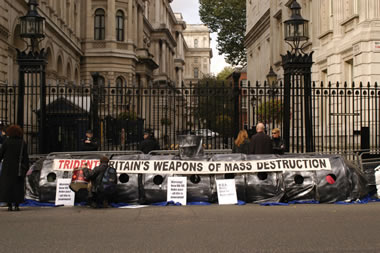
The large object at 10 Downing Street is supposed to be a submarine.
Strangely reminiscent of Claes Oldenburg’s soft sculptures (more).
No. 10 Downing St. has released a white paper—The Future of the United Kingdom’s Nuclear Deterrent—arguing that Britain should replace the Trident system, keeping its nuclear deterrent (though dropping the number of warheads to 160).
The debate over Trident is somewhat surreal because, frankly, the UK’s nuclear weapons are irrelevant: they don’t deter anyone, confer any status or, frankly, threaten anyone. They are not particularly good or bad. It isn’t even clear to me that you could get a really passionate argument going among people from Aldermaston and CND, unless you got them talking about football.
Sir Michael Quinlan—whom I have met and would guess leans more toward maintaining the UK deterrent than I would—best summarizes the issues. Writing a marvelously honest essay in the July 2006 International Affairs, Quinlan concludes that the decision is between competing interests that are significant but not overwelming:
For some participants in the debate the ‘right’ conclusion to the debate about continuance is already evident almost a priori, whether in one direction on perceived ethical grounds—not explored in this article—or in the other for nearinstinctive reasons of national identity, sovereignty and security. But for those (perhaps a majority, and including this writer) for whom the issue cannot be settled out of hand in such ways, the debate is scarcely yet sufficiently developed or factbased to warrant categoric conclusions. The core of the issue becomes how to weigh possible strategic advantages—significant, but not overwhelming—against certain costs, also significant but probably not overwhelming. Government ministers, while giving several indications of a disposition towards continuance, have declared the government’s readiness for full and open debate—by implication, in advance of a firm decision rather than, as in 1980, in examination and defence of a decision taken.
Quinlan’s essay accompanies others by Michael McGwire, Julian Lewis, Keith Hartley and Len Scott in an issue of International Affairs that is a great place to start thinking about the Trident debate.
***
But I live in the United States, and I have another question.
Did the Bush Administration pressure Blair’s government to replace Trident?
The UK MOD white paper notes the US has never threatened to cut the Brits off:
The US has never sought to exploit our procurement relationship in this area as a means to influence UK foreign policy nor does this relationship compromise the operational independence of our nuclear deterrent.
And that makes sense: The US has, since the 1950s, wanted Britain in the nuclear weapons business. But I wonder about a different question, namely how Washington would react if Britain wanted out?
I suspect the Bush Administration (and most Democratic ones) would freak, seriously worried about how NATO debates over tactical nuclear weapons and nuclear first use would change without the UK as a partner in such blocking efforts. (A dynamic that Lawrence Freedman described in 1981.)
The conversation probably never happened—because the Brits probably never wanted out—but I bet the Brits internally assumed some level of damage to the relationship if they ditched the nuclear weapons. Moreover, it probably didn’t have to be said.
Now that the US Congress may start exercising some oversight, I think someone ought to inquire into exactly what the we told the Brits about their nuclear deterrent. Given the deep relationship between the two nuclear capabilities, those discussions absolutely took place—if only to appraise them of development on a reliable replacement warhead to supercede the W76 that arms their US made Trident missiles.
And our policy, absolutely, should be to make clear to the Brits that the decision about keeping nuclear weapons is their sovereign decision and would have no effect on the special relationship.
***
Something else I’ve noticed: British strategic debates are just wittier than ours. From Michael Clarke’s article “Does My Bomb Look Big in This?” to Michael McGwire’s description of nuclear weapons as “the lace curtains of Britain’s political poverty,” British nuclear strategists seem to be channeling Oscar Wilde.
What’s next? Malcolm Chisholm demanding that “either Trident goes or I do” before dropping dead in the House of Commons?


The US need not inform the UK of the developmental status of the RRW, since, in fact both countries have been looking into this. There has been much cooperation between US and UK on this and even some sub-critical testing: e.g.
http://www.timesonline.co.uk/article/0,,2087-2081514,00.html
A senior British defence source admitted: “We’ve got to build something that we can never test and be absolutely confident that when we use it, it will work. We are ahead of the Americans.”
Not sure why the central role of the UK in the US RRW program has been generally overlooked.
Can one country really stop the RRW program without the other’s blessing? Would the US stand idly by as the UK rearmed w/ RRWs?
Hi all. Being a Brit myself I think you also need to consider the European picture, in that if Britain were to get rid of its nuclear capability that would leave only France possessing them within the EU. For a lot of people both sides of the Atlantic this would not be seen as a good thing. As to your points about the wepaons being irrelevant, considering the US arsenal etc, perhaps so, but unexpected things can happen where the UK and US might not be as united militarily as they happen to be at the moment – a good example would be something along the lines of the Falklands War in 1982. There is some evidence, for instance, that the British fleet had nuclear depth charges when it sailed, which may have been one reason the Argentine navy was so reluctant to leave its bases (notwithstanding the sinking of the Belgrano). In terms of my own view I think it is right that Britain retains an independent strategic nuclear capability (independent in use, not necessarily to procure) for now, but at the minimum deterrant level possible – which is the government view (about the only time they and I will agree). If the US and Russia could bring themselves to reduce their stockpiles to a comparable level, it would have done more to reduce nuclear arms than just about anything else in the last 30-40 years. One thing I did note from the White Paper was that the UK government did not rule out a First Strike firing – something I believe a few years ago they had done, but no one seems to have picked up on this change?
Jeffrey,
I think your analysis is a little too sanguine. I think a little look at the attitude of John Bolton’s section at State towards the renewal of the MDA until 2014 would indicate that the deal was likely rather tougher than you indicate. you might alos link to the Parliament’s Defence Committee investigation which was rather good and to John Ainslie’s study for Scottish CND which is better on the Trident computer systems than most anything i have seen. See alos a couple of cover stories of mine in the New Statesman.
best
D
“So tell me Blair your Energy Review says you will no longer have a civil nuclear industry and yet you want us to take you seriously as a nuclear state.. could you explain that?
A colleague writes to note:
My bad. But the perfect opportunity, on the Scottish question, to refer readers to The United Kingdom, Nuclear Weapons, and the Scottish Question by Malcolm Chalmers and William Walker in The Nonproliferation Review.
Here are links to the publications that Dan Plesch cites:
John Ainslie, The Future of the British Bomb, October 19, 2006.
Dan Plesch, “How to start an arms race,” New Stateman, December 11, 2006.
The Future of the UK’s Strategic Nuclear Deterrent: The Strategic Context HC 986, Eighth Report of Session 2005-06, Report Together with Formal Minutes, Oral and Written Evidence.
What’s fascinating about the UK Trident replacement debate is what’s left out of the (otherwise excellent) UK Government White Paper: how much it relates to politics and status, namely : the relationship with the United States and the UK conception of independence (see the HoC Defence Committee debates for that). What’s also fascinating is the constant reference to France. I’ve never heard the reverse argument in Paris (“we need to keep our nukes, otherwise the UK would be the only nuclear power in Europe”). But, hell, that’s also because we don’t have a debate on whether or not to keep our own nukes. In terms of nuclear policy, the real monarchy is France, not the United Kingdom.
My understanding is that the first RRW pits are meant to replace the pits on the W76. Trident replacement debate is occuring at the same time as the RRW decision is supposed to be made in the US. Timing seems too cute.Maybe doing RRW work at Aldermaston is a way of further advancing work on the RRW without congressional approval?
To say that Aldermaston is part-owned by Lockheed-Martin (as stated in the New statesman article) is not quite correct. Lockheed-Martin, together with Serco and British Nuclear Fuels operate Aldermaston for the government, which is the actual owner. Aldermaston is a GOCO (Government Owned, Contractor Operated) facility.
Having said that, it is bloody worrisome that Lockheed-Martin also runs the Y-12 plant at Oak Ridge National Lab.
Let there be no doubt that this company is very interested in seeing RRW go ahead, and is lobbying hard to make sure this is done. In both countries.
It is a sad thought that a commercial enterprise may significantly influence the shape of the future US and UK nuclear deterrent.
Okay, back to basics:
The UK’s nukes are bad. They are as bad as anybody’s nukes. That’s very, very bad. Getting rid of them would be a very, very good thing. It would be a big step toward getting rid of everybody’s nukes. Which would be a really, really great thing.
Got that?
I suppose my only worry is what effect this might have on the NPT. Along with the US plan to develop new types of nukes and potentially resurrect the nuclear test infrastructure, two members of the nuclear club are pushing back their NPT obligation to work towards disarmament. As an American, I’m not saying that the US/UK arsenals worry me. My concern is the erosion of the reciprocal promise by the non-nuclear weapon states to not gain an arsenal. My money for the next state to develop nuclear weapons is either Japan or South Korea.
My money for the next state to develop nuclear weapons is on Iran.
And given that Israel has now admitted to having nuclear weapons, one cannot blame them for trying.
One might bomb them, but one cannot blame them.
As I mentioned in the comments to blogging piece from a couple of days ago, a dailogue on the Israel-Palestine problem is urgently needed but is being actively supressed by lobbying groups in the US.