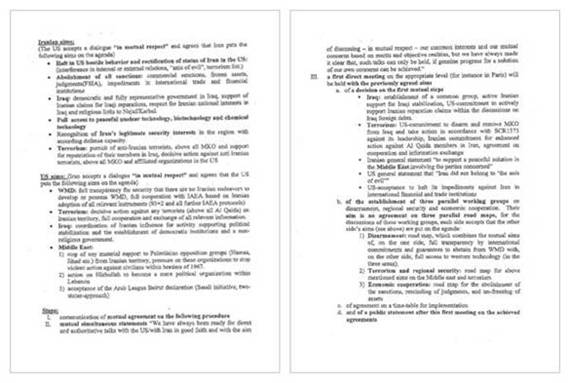
Over the weekend, I and several colleagues finally got our grubby mitts on the full text of the March May 2003 offer that Iran puportedly sent to the US via the Swiss Ambassador.
At least, I think so.
To recap:
- In July 2003, the Financial Times’ Guy Dinmore reported the details of an offer from Iran “conveyed by Tim Guldimann, the Swiss Ambassador to Tehran, in a recent visit to Washington.”
- Dinmore released additional details in March 2004, describing the offer in some detail and citing an official who claimed the Bush Administration had “rebuked the Swiss foreign ministry for overstepping its diplomatic mandate.”
- Bart Gellman and Dafna Linzer picked the story back up in October 2004, describing the offer as a grand bargain.
- Things pretty mcuh died down until Flynt Leverett, former Senior Director for the Middle East Initiative at the National Security Council, mentioned the offer in a January 2006 op-ed for the New York Times and subsequent interviews.
- The Leverett op-ed resulted in a detailed February 2006 examination by Gregory Beals in Newsday and another story in May 2006 by Guy Dinmore.
The accounts vary in some small details—was the document a one-page fax or a more detailed offer hand delivered by Guldimann? (Background on the two page version).
All accounts seem to agree that the proposal was written by Iran’s then-Ambassador to France, Sadegh Kharazi. (Kharazi, by the way, is no longer Iran’s Amabassador to France in part because he favored negotiations with the United States—or at leas that is what he told AFP. “I am one of those who are in favour of negotiations with the United States, and I have paid the price.”)
The offer appears to have been one of a series of overtures that included efforts by the Iran’s representative to the United Nations, Mohammed Javad Zarif, a message passed through IAEA DG Mohammed ElBaradei, and “soundings” from Iranian envoys to Sweden and Britain.
The big question is whether the any of the offers reflected a consensus effort by the leadership in Tehran. Leverett thinks so, but other’s aren’t so sure.
Debate over whether the letter reflected a consensus, however, was not why the Administration didn’t respond. It was a lack of consensus in Washington, according to Gellman and Linzer, who report then-Deputy National Security Advisor Steve Hadley wasn’t able to produce consensus on a national security presidential directive on Iran.
Regular readers may recall that I scoffed when Hadley announced that “we decided to shelve the NSPD and go ahead and implement the policy” because “No NSPD means no policy.”
That seems to have been the problem, no NSPD meant no agreement on how to respond to the offer—other than to hassle Guldimann for doing his job.
_Late update: I missed a passing reference in a Barbara Slavin article that contained more reporting than entire stories in other papers_.
Paul Adds:
This piece by Garth Porter in the American Prospect deserves a read as well….more detail on the story behind the offer.


The text and pretty much the same story are posted at http://www.mideastweb.org/iranian_letter_of_2003.htm and
http://www.mideastweb.org/log/archives/00000467.htm inclduding texts of the FT articles.
There was apparently more than one letter and that accounts for the one page vs two page discrepancy.
The reasons why the US ignored it (and why the whole story is STILL ignored!) and the reasons why Iran would be willing to sacrifice its major principles regarding Israel and the “Great Satan” in order to be able to refine uranium are them most interesting aspects of the story, which we still do not understand completely.
A.I.
— Ami Isseroff · May 29, 05:06 AM ·
— hass · May 30, 03:18 AM ·
Iran’s major principle may be independence and energy security. It’s curious they are choosing nuclear for energy security though. Consider this DOE study:
http://www.globalsecurity.org/wmd/library/news/iran/2006/iran-060421-usia02.htm
Even if more reserves are discovered (and they reportedly have been), there are still inconsistencies between what Iran says it wants and what it does.
— Andy · May 30, 06:56 AM ·
http://www.atimes.com/atimes/Middle_East/GH24Ak02.html
— Hass · May 30, 09:24 AM ·
The other mistake Mr. Isenberg makes is arguing that nuclear energy is desirable because Iran’s petroleum sector can’t keep up with demand. Then he argues that the reasons the petroleum sector is lacking are due to sanctions and a lack of investment in the oil sector. Well, duh. The whole point is that if Iran modernized its petroleum sector, which would cost much less than a fully domestic nuclear program (not to mention that part of the modernization cost would be recovered by increases in efficiencies and exports), its domestic energy needs would largely be solved. It’s ironic that Mr. Isenberg would argue that Iran needs a domestic nuclear program because sanctions are hurting the petroleum program. Iran could easily get investment back and sanctions lifted by moderating and ending its support for terrorism.
Mr. Isenberg states: “Third, the large oil and gas reserves that Iran possesses do not mean that Iran can use oil and gas at no cost.” Of course not, but that cost is less than the huge sums of money they are pouring into the nuclear program. And again, what happens when Iran builds this entire infrastructure and runs out of domestic uranium in 20-30 years?
— Andy · May 31, 07:10 AM ·
Also Iran has never said that it would be 100% reliant on domestic uranium. In fact, as part of its offers of compromise, it has said that it would be willing to limit its own enrichment to only the amount required to protect against a fuel cut-off from outside sources – a valid concern, considering Russia’s practice of cutting off energy supplies to Ukraine and the Caucasus. Iran could also import the necessary uranium from neighbors such as Turkmenistan, which have vast reserves of the stuff. Also, at this point the question or enrichment has become for Iran is about vindicating its sovereignty. Whether enrichment is economically a good idea or not, Iran has every right to enrich. If Iran can be arbitrarily deprived of that right today, why not something else tomorrow?
— Hass · May 31, 10:08 AM ·
I guess we’ll have to agree to disagree on the economic questions. It seems obvious to me and many others that Iranian energy needs would be better served by exploiting their petroleum resources, which will give them energy security through the latter half of this century.
— Andy · May 31, 11:36 AM ·
Finally, take a look at http://iranaffairs.typepad.com and see how Iran’s nuclear program started under the Shah, with the support and participation of the same countries that now object to it.
— hass · May 31, 01:40 PM ·