
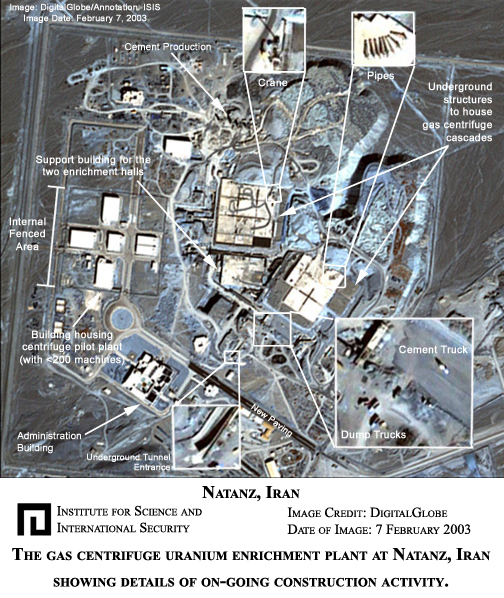
Seymour Hersh is at it again.
With lots of discussion about possible US military options against Iraq (read Joe Cirincione in Foreign Policy and the Washington Post today), Hersh has found a way to stand out.
Suggest the US will nuke Iran:
One of the military’s initial option plans, as presented to the White House by the Pentagon this winter, calls for the use of a bunker-buster tactical nuclear weapon, such as the B61-11, against underground nuclear sites. One target is Iran’s main centrifuge plant, at Natanz, nearly two hundred miles south of Tehran. Natanz, which is no longer under I.A.E.A. safeguards, reportedly has underground floor space to hold fifty thousand centrifuges, and laboratories and workspaces buried approximately seventy-five feet beneath the surface. … The elimination of Natanz would be a major setback for Iran’s nuclear ambitions, but the conventional weapons in the American arsenal could not insure the destruction of facilities under seventy-five feet of earth and rock, especially if they are reinforced with concrete.
Let’s leave aside the fact that Natanz is still under IAEA safeguards and that UK Foreign Secretary called the idea of a nuclear strike against Natanz “completely nuts.”
Is Natanz so deep that a nuclear weapon is necessary?
Iranian officials claim Natanz is more than 18 meters underground. Hersh suggests 23 meters. Anyway, you get the picture—Natanz is about 20 meters undeground. (Dissidents NCRI claim the facility is only 8 meters underground. I wonder if Iranian officials were counting from the ceiling or the floor.)
Depth, though, is less important than the “thickness” or “concrete overburden equivalent” of a Hard and Deeply Buried Target (HDBT). Natanz was constructed using the “cut and cover” method—first, dig a hole, thenbuild a reinforced concrete roof, cover with rock and soil, and repeat. It’s a Persian mille-feuilles, with dirt, rebar and concrete.
“Thickness” measures the strength of the concrete, rock, and soil in terms of concrete. In other words, how thick would a eqivalently strong structure of reinforced concrete be? The “thickness” at Natanz is probably considerably less than the actual number of meters worth of structure, rock, and soil above facility.
Generally speaking, “shallow” cut-and-cover facilities are thought to be vulnerable to the current US suite of earth penetrating munitions. The National Academies, in their report Effects of Nuclear Earth-Penetrator and Other Weapons, presents a “Summary of Precision-Guided Munitions in U.S. Family of Conventional High-Explosive Weapons, Current and Under Development…” (pp 99-102).
| Weapon | Description |
|---|---|
| Guided Bomb Unit (GBU)-28/EGBU-28/BLU-113 | Air-launched, 5,000 pound, laser-guided “bunker buster” with a 4,400 pound penetrating warhead. |
| GBU-24B/D/BLU-116 Advanced Unitary Penetrator (AUP) | Air-launched, 2,000 pound, heavy steel penetrator warhead filled with high-energy explosives and void-sensing hard-target smart fuze that detonates the AUP at the optimum point in a target to inflict maximum damage. |
| BLU-118B | Thermobaric bomb, which added a thermobaric explosive fill for the BLU-109 penetrator. The BLU-118/B is a penetrating warhead filled with an advanced thermobaric explosive that, when detonated, generates higher sustained blast pressures in confined spaces such as tunnels and underground facilities. The BLU-118/B uses the same penetrator body as the standard BLU-109 weapon. The significant difference is the replacement of the high-explosive fill with a new thermobaric explosive that provides increased lethality in confined spaces. |
| Conventional Air-Launched Cruise Missile (CALCM) Block II Penetrator | Air-launched cruise missile with precision guidance and a 1,200 pound AUP penetrating warhead augmented with two forward shaped charges (BROACH concept) for use against buried and/or hardened targets. |
| Joint Standoff Weapon (JSOW)/Bomb Royal Ordnance Augmenting Charge (BROACH) | Air-launched weapon incorporating the BROACH Multiple Warhead System (MWS), combining an initial penetrator charge (warhead) with a secondary follow-through bomb, supported by multi-event hard-target fuzing. Has a 500 pound class “unitary” warhead providing blast/fragmentation effects as well as enhanced penetration capability against hard targets. |
| Tactical Missile System Penetrator (TACMS-P) | An Advanced Concept Technology Demonstration integration of the Army Tactical Missile System (ATACMS) booster with a Navy reentry vehicle, resulting in an improved capability against buried and/or hardened targets. The TACMS-P range extends to 220 km and will be compatible with the Multiple Launch Rocket System family of launchers. |
| Joint Air-to-Surface Standoff Missile (JASSM) | Conventionally armed, low-observable cruise missile with a 1,000 pound warhead optimized for penetration; it carries a new, high-yield explosive and a hard-target smart fuze. Joint Direct The JDAM will upgrade the existing inventory Attack Munition of Mk-83 1,000 and Mk-84 2,000 pound (JDAM) general-purpose unitary bombs by integrating a guidance kit consisting of an inertial navigation system/Global Positioning System guidance kit. The 1,000 pound variant of JDAM is designated the GBU-31, and the 2,000 pound version is designated the GBU-32. Hard-target penetrators |
| Tactical Tomahawk Penetrator | Tactical Tomahawk missile modified to incorporate a penetrator warhead and the hard-target smart fuze. |
***
Performance data about these systems is, understandably, classified. LtCol Arnold Streland, citing an Air Force Magazine article that I am in the process of procuring, suggests the GBU-28 is designed to penetrate up to 100 feet of soil or approximately 22 feet of reinforced concrete.

That jibes with a leaked DIA estimate placing the depth of penetrators at about 6 m (20 feet) of reinforced concrete and the assessment of then-Lt Col Eric M. Sepp (furthest right) …
I am not kidding, that really is Colonel Sepp. Anywho …
… in his master’s thesis for the Air War College. Sepp states explicitly what is implied in both the joint DOE/DOD Report to Congress on the Defeat of Hard and Deeply Buried Targets and the National Academies:
The “cut-and-cover” facilities are constructed by digging a hole, inserting a facility, and then covering it up with dirt and rocks. These cut-and-cover facilities can be just below the surface of the ground or may reach a depth of perhaps 100 feet, and represent the vast majority of underground facilities today. In the case of contemporary cut-and-cover facilities, there is no question that conventional munitions can defeat them.
Of course some cut and cover facilities are harder than others—Saddam’s German-built bunker beneath the Believer’s Palace seems to have survived the war in tact.
(The link is to a fascinating site Subtopia: A Field Guide to Military Urbanism, with an article on Natanz.)
Natanz is probably not like Saddam’s bunker. Although perhaps 20 meters underground, much of the cover appears to be rock and soil. I would guess—though a structural engineer would be helpful here—that Natanz has an overburden is closer to 6 m than 20.
I note, coincidentally, that Israel is purchasing 100 GBU-28s.
One enormous weakness of Natanz is that it lacks the best defense any HDBT can have: concealment. Concealment includes both hiding the location and layout of the strcuture and inhibiting battle damage assessment to know when enough is enough. In the case of Saddam’s bunker, one defensive mechanism appeared to be “false floors” that caused GBU-28s to detonate prematurely.
Collapsing the roof, by the way, is not the option. Given the overhead imagery available, the US IC should have a very sophisticated understanding of the facility and its links to the outside world. The United States could choose to entomb the structure by collapsing entrances, ventillation systems and cutting the water and power. Centrifuge facilities like to be clean and temperature controlled, so entombing the facility would do quite a bit of damage. Anyone inside the entombed facility, slowly suffocating in the dark, would probably be praying for the roof to cave in.
If the President was feeling particularly plucky that day, he could use special forces teams to breach the facility, though I think serving as spotters is probably the most likely role.
All of this is to say that I would be surprised if a nuclear weapon were our only option in cracking this facility.

Bits, n pieces
Tactical nukes being the only option against Natanz is of course highly classified fact….
A non classified fact is of course that Natanz is the only option for explaining nuclear earth penetrator research…. It may not be deep enough, but the alternatives just aren’t evil enough 😉
I have been worried about where he might have picked up that “no longer safeguarded” bit… Lets hope he heard it from Rove`s office in the white house and not somewhere in the pentagon. Maybe he is talking about the removal of camera`s or something….
Minor nitpick: Hersh doesn’t say the U.S. will nuke, he says the U.S. has Plans involving nuking and that the JCS are having trouble getting the nuke option out of these plans. Maybe Cheney`s “all options remain on the table” means even more than most think….
Its just that they made this mistake at redstate.org…. and then corrected it by saying that “only an idiot” mistakes a plan for a prediction, and all of the bush plans are brilliant. (Of course they started by assuming Hersh was wrong… they made no correction there though)
These and other fans of first use will love fancy animations, remember this one? http://www.ucsusa.org/global_security/nuclear_weapons/nuclear-bunker-buster-rnep-animation.html . Especially fun when combined with this map http://www.lib.utexas.edu/maps/middle_east_and_asia/iran_industry_mining78.jpg
For those who forgot, these plans aren’t that new, Seymour Hersh mentioned them before (Must see for Hersh fans: http://chomskytorrents.org/TorrentDetails.php?TorrentID=1000 Its full of those little tragedies, supply trucks racing without headlights trough the nigh, hitting people, and shocked soldiers shooting roadside bomb bystanders…) Others have been wondering about the role of nukes in the “global strike” plans as well… (http://www.fas.org/blog/ssp/2006/03/will_the_right_nuclear_policy.php, http://www.washingtonpost.com/wp-dyn/content/article/2005/05/14/AR2005051400071.html)
Big nitpick:
“With lots of discussion about possible US military options against Iraq “, Iraq? Please tell me you haven`t turned neocon on us! Trowing these countries on one pile would mean I have misunderestimated you 😉 Lets hope the real planners didn’t make this mistake…. (precision bombing, only one letter off… )
Or perhaps they should, who is gonna notice a few more bombs more in Baghdad? (http://www.nytimes.com/packages/pdf/international/20060409_report_text.pdf) Then when the people at Natanz wake up one morning after a good nights sleep, turn on CNN and hear they have been bombed all night with the most fearsome weapons the US has to offer, then maybe they will consider letting the whole nuke thing go.
Jeff- You end the piece by saying, “All of this is to say that I would be surprised if a nuclear weapon were our only option in cracking this facility.” The title of the post, however is, “We Are Not Going to Nuke Iran.”
Now, say what you will about Hirsh’s article in general, I thought the analysis concerning the increase in ideologically pro-nuclear policymakers at high levels was compelling. This, combined with the account of the “shouting down” of those who have tried to get the nuclear option taken off the table, makes me think that a nuclear strike against Natanz could happen even if it were not tactically necessary.
On a sidenote, I think the question of whether or not a strike could eliminate all of the necessary targets is very interesting in historical perspective. In the Cuban Missile Crisis, it was this dilema that was principally responsible for the decision not to launch an air strike. The Cuban Missile Crisis was a miracle of US foreign policy, and I think we can expect (or at least hope) that history will influence the policymaking process w/r/t Iran.
Not going to happen….Not with our Troops on the ground in Baghdad…..
Jeffrey, think back to that conference in December, when one of the speakers mentioned that, in the future, we might use nuclear weapons to “send a signal.” He said that, unlike in the past, we would not necessarily select the target for nuclear use on the basis of military need (with a nuke being the only way to destroy a vital target), but to “send a signal” to the current bad guy. And to send a signal to the next bad guy. This is the news in the Bush Administration’s nuclear policy, the potential use of nukes to send signals rather than destroy targets. With that image in your mind, does the threat of nuclear use against Iran (Natanz or not) make more sense? This would be why the military really wants the option off the table. I cannot imagine a military officer recommending the use of a nuclear weapon for anything less than the most dire military need. But I can imagine several civilians in the current Pentagon and White House recommending that we threaten to use a nuclear weapon to “send a signal.” One can only hope that they realize the extremely high costs of sending such a signal, particularly when they can probably achieve the military objective without incurring the nuclear cost.
I should say two things. First, I probably should have chosen a different title. Amy has a point about said conference. I meant that we don’t have to and I was implying that Hersh was presenting a distorted view. But other considerations are an issue.
And, no, I haven’t gone neocon. I continue to believe that a strike, while creating significant delay, would leave us two years down the road in precisely the same situation but even less power. If we don’t know what to do now, we won’t know what to do then.
Delaying a problem without any strategy for using the delay is irresponsible public policy.
Thanks for that. Compelling. The last time we came near to the nuclear threshold in 1962, the civilians overruled the military and that was that. Chain of command. Now it’s reversed, so chain of command cuts the other way. I’d like to believe you but this latest leak sounds like the military leaking of the incidents in late March, 2003 (which Hersh reported on at the time and which was confirmed in Cobra II) in which the military was beaten down the the civilian echelon at DOD about basic isasues of war-fighting. We’re here again I suspect. There’s no need to nuke Natanz but that doesn’t mean that it’s not being planned. There was no need to invade Iraq either. The war drums have been picking up volume and tempo this time just like they did back in 2002-03. Pray for us all.
Suppose the Iranians took out photos of US nuclear sites and discussed “entombing” people in them through illegal bombing campaigns—the howls of “terrorism” would be heard around the world. But I guess not when the US does it…
Potential use of nukes to send signals. Hmmm. Let’s see:
1. If Bush admin is indeed harbouring such strategies then they are in for bigger failures compared to Afghanistan and Iraq. Please don’t even try telling me these aren’t failures.
2. Why is it so difficult to understand that the kind of enemy US (and many others) is fighting is actually immune to any weapon that might be used. Prima facie Iran would appear to be different but it is not.
Jeff is right when he says “Delaying a problem without any strategy for using the delay is irresponsible public policy.” Has US offered to withdraw all economic sanctions in return for Iran giving up secret activities and adhering to the treaties they have signed? I am asking because I don’t know. It will do wonders for US in the bigger picture. And there are friends that can be leveraged to implement that strategy.
The problem with “sending a signal” is the signal you’re sending. The prohibition on the use of nuclear weapons has been one of the bedrocks of international stability since WW2. It was understood that it was beyond the pale, an act that made all other appalling acts thinkable and possible.
The tragedy of using nukes against Iran is that the Iranians won’t really be that shocked. They already have a pretty low opinion of the US and think us capable of anything. But Latin America, Europe, Africa…they will be terribly shocked and disappointed.
Bush and Rumsfeld have already complained that America is “losing the war of ideas.” They attribute it to poor communications but I would argue that it’s the message they are determined to send.
The fact is that up to this point the US has not offered any comprehensive solution to the nuclear issue with Iran. The US lectures Iran, orders Iran, and yells at Iran. Iran yells back, thumbs its nose, and continues doing what it was doing. If a psychotherapist were to analyze this, he/she would say that the countries are in a highly disfunctional relationship.
Now, over here in Tehran, the government has actually been trying hard to get the US to sit down and talk. I don’t think you realize the significance of this move – the fact that after 27 years the Iranian government has decided to publicly engage in talks with the US (private talks have been held on and off, or indirectly). Why is the US not using this opportunity? Unless of course the US plans for one and only one thing: war.
I think a bunker like this is a little dicey for these weapons. I’m not saying it can’t be done – just dicey.
You know, reading the quoted penetration depths out of “Nuclear Earth Penetrator” Table 3.1 pg. 24, the situation is not so clear.
For their example penetrators, medium strength rock, 7.5 m. Low strength rock, 18.7 m. It’s not quite obvious how to apply that to a layer cake of concrete and dirt, but the penetration depth numbers are low enough to give one pause.
It is true that there is a explosive warhead that may be deep enough to collapse the roof. Spalling off the roof seems unlikely if there is soft dirt over it.
As an improvement, it would perhaps be possible to hit the same spot twice or three times and soften up the penetration zone. Or, maybe a rocket behind the bomb to speed up the descent.
The central problem a targeter faces is knowing what the bottom layer of soil is like. In order to spread out the support columns reasonably(6000 psi concrete?), I would expect the roof to be designed to hold maybe 250 psi. So, we’d like something that crushes nicely between 250 psi and 70 psi for the dirt above. Maybe 150 psi would be good. Some kind of styrofoam or rotten wood or similar. And, you want it to hold that 150 psi crush over a long distance of compression – like half a meter or more.
God knows how the delicate centrifuges would react to the vibration though.
Presumably, the crush won’t recover after the first shot, so a second shot has a better chance.
Another, if more provocative approach, would be to use a ballistic missile with a penetrating warhead.
Consider:
Impact speed > 4000 m/s
specific energy > 8MJ/kg
(double TNT specific energy)
That’s going to do it.
Young’s penetrator equation clearly shows it will go through – although at hypersonic speed, a lot of energy is going to go into vaporizing stuff, and a more conservative estimate is warranted. Nonetheless, I think it is sure to go right through.
I think that what we are seeing here is that centrifuges basically suck for weapons proliferators. Any technology that has a low enrichment per stage sucks because you end up having to put all your eggs in one fortified basket that gets blown up. Clearly a weapons builder wants to spread out her program. AVLIS is the way to do it. It’s the only way to succeed with the whole world watching you.(and an idiot in the White House)
I admire your very rational analysis of why we won’t nuke Iran. However, your rational analysis leaves out one important factor – that the Bush administration is NOT rational. Their decision about whether to use nukes will not be based on how the Iranian bunkers are constructed. It will be based on whatever non-rational ideological and religious factors influence the current crop of neoconservatives and radical fundamentalists. This may or may not result in the use of nukes, but the decision will not be based on what an analyst such as yourself will regard as rational factors.
Alex
Manne, you said, “Has US offered to withdraw all economic sanctions in return for Iran giving up secret activities and adhering to the treaties they have signed?”
Iran already does adhere to the treaties they have signed. The Nuclear Non-Proliferation Treaty does not preclude Iran the right to enrich uranium.
Again, Iran is well within its international rights to enrich uranium. The treaties allow for this.
What the treaties don’t allow is for Iran to enrich uranium to the levels required for a nuclear bomb. They have not done this nor is there any evidence that they will do this.
The problem the US has with Iran is not the breaking of treaties. The US does not want Iran to enrich uranium at all.
Nuking natanz seems for the time being somewhat of an overkill. Correct me if I’m wrong, but I was under the impression that the only thing the Iranians have achieved until now is an experimental 160 or so centrifuge cascade. Not in the buried bunker but in one of the glaring white buildings on top of it. A volley of cruise missile could take out that cascade, which anyway is so small that it will take maaaany years to produce 1 weapons SQ of HEU. The Iranians have announced they will begin installing 3000 centrifuges in the undergound facilty in the end of the year. Which probably means it will take a ‘bit’ longer before this cascade will be operational.
So, no need for hurry.
Still, may be Bush wants to set an example and decides to bomb the place anyway. Even if that really upsets the rest of the world, is likely to create more angry, militant, suicidal bombing anti americanists and will make it very unlikely that Iran will ever be prepared to negotiate an agreement.
Manyoso, you said:
“Again, Iran is well within its international rights to enrich uranium… What the treaties don’t allow is for Iran to enrich uranium to the levels required for a nuclear bomb.”
Another thing the treaties don’t allow for is the concealment of nuclear activity from IAEA inspectors, which the Iranian government itself fully admits to doing.
“They have not [enriched uranium] nor is there any evidence that they will do this.”
1) The infamous “Laptop of Death,” if it turns out to be genuine, would be just this sort of evidence.
2) Bush may be a religious nut, but the IAEA also agrees that Iran is attempting to develop a nuclear weapon.
Now, I don’t think any of the things I said above justify a US air strike. That’s not my point. I just think the facts mandate a bit more skepticism about Iran’s intentions than Manyoso is displaying.
The New Yorker is throwing out some pretty Wild accusations:
“Some operations, apparently aimed in part at intimidating Iran, are already under way. American Naval tactical aircraft, operating from carriers in the Arabian Sea, have been flying simulated nuclear-weapons delivery missions—rapid ascending maneuvers known as “over the shoulder” bombing—since last summer, the former official said, within range of Iranian coastal radars.” I thought that the US removed all tactical nuclear weapons from surface ships in 1991?
The usually excellent Fred Kaplan of Slate repeats Hersh’s apparently false claim about Natanz and conventional penetrators (which would be a great name for a Wu-Tang-style posse rap group, by the way):
”[Natanz] is reported to be dug 75 feet beneath the earth’s surface. (If it really is that deep, and if Bush wanted to destroy it and not just disable its operations briefly, a non-nuclear bomb wouldn’t be powerful enough.)”
http://www.slate.com/id/2139610/?nav=tap3
I haven’t looked exhaustively, but I’d be curious how often this claim has been regurgitated by uncritical journalists. It’d be a shame if the public debate were framed by what looks like bad scientific information.
there’s a QuickTime at the FAS about earth penetrators, updated. see
http://www.fas.org/main/content.jsp?formAction=297&contentId=401
If Iran is telling the truth about what they’ve accomplished to date, are there any technological barriers left for them to make HEU (and thus at a minimum make gun bombs)? If you can run 160 centrifuges and make LEU, is there any reason why you can’t build 3000 of the same centrifuges and make a larger quantity of more highly enriched uranium?
coupla points:
1. If you can make LEU with centrifuges you can make HEU with more of the same centrifuges or by running through the same centrifuges more times (with correspondingly lower yield).
2. I share John Field’s skepticism about the assured effectiveness of the non-nuclear bombs Jeffrey lists against Natanz. Available information seems to put this question into the raggedy margin. Only if the US IC is very sure it knows how the facility is constructed will it be able to have confidence that a non-nuclear strike would be effective, and even in that case there may be considerable doubt. Timing of the “Divine Strake” test may not be pure coincidence.
3. OTOH, John, I don’t know why you say AVLIS is a better option for proliferators than centrifuges. That may be what people thought, but in practice AVLIS has been a failed technology and has been abandoned by everyone who’s tried it. There has been some suggestion that newer forms of laser enrichment (MOLIS) may work better, but apparently the technology remains out of reach for proliferators and less cost effective than centrifuges for the big boys.
4. A surprise US attack on Iran would still surprise me and a nuclear attack would astonish me. See my comment on the previous Iran post. This “Iran crisis” is the political crisis of a war president who is losing his war and needs the threat of a new one in order to keep the polity militarized and to keep the corporate power structure from turning on him (read: impeachment). The purpose is served as long as the threat can be kept credible; they don’t have to actually do it. But of course, that requires continually ratcheting up the threat, and so we may come to a point of no return. But I think we will know when we are getting there.
I find it unfathomable that this administration, regardless of its past lapses in judgment, would seriously consider using nukes, even low yield tactical nukes on Iran. It would have been all but impossible to justify a couple of months ago and now completely so. If we as a nation hope to retain any credibility in the world community it would be advisable not to nuke an NPT signatory nation weeks after signing a nuclear technology sharing agreement with one of only, I believe, 3 non-NPT nations. After all India and its 1974 detonation of a nuclear device was the catalyst for the Nuclear Suppliers Group, which we spearheaded. The US-India deal also put us in violation of NPT article 1 and nobodies threatening to nuke us, at least not at the moment.
All this is negligible anyway once Israel is brought into the equation. We all know they ‘may’ have nuclear weapons.
In response to Ali,
Just what does he think Iran wants regarding the nuclear question? No one believes the goal is a civilian nuclear power capability or Iran as another supplier of EU to NPT members.
Does he really believe the Iranians will negotiate away their nuclear option, a decades-long goal on which they have spent billions of petro-dollars?
They will no more do this than the U.S., USSR,China,France,Israel, India or Pakistan did when they went on the path to develop nuclear weapons.
The nuclear deterrent works, as has been proven for over 50 years.
Anyone that believes Iran will forego this opportunity simply doesn’t understand realpolitik and the Iranian’s motives vis a vis the Arab world and their perceived U.S. hegemony over the region.
The Iranians aren’t going to blink, and it has nothing to do with who is President or which party is in control of the WH or Congress.They have been on this path for 4 successive US administrations.
manyoso,
If you expect me to believe Iran has not cheated any, I am afraid you will have to do better than that. Max has already explained why.
in response to J House:
Not improbable they started this in response to Saddam’s nuke aspirations. Hey, even the billion dollar US intelligence community chose to believe this right till the end… and why not? There were few who were not eager to help Saddam acquire just about anything “billions of petro-dollars” could buy to save him from humiliation back then.
At present however nukes would be more of a liability then anything else. They could never hope to achieve minumum nuclear deterrence within the NPT (against who anyway: they can’t even reach the “great Satan” and couldn’t nuke “little Satan” without killing lots of Palestinians in the process). If anything legal could hardly persuade the “Satan gang” against retaliation at present, making large quantities of HEU or quitting the NPT will surely make them experience some major shock & awe. This isn’t N.Korea where a few nukes (vaporware or real) are the only trade commodity they’ve got. If you believe the Iranians when they say they’re only interested in LEU fuel, this will make them even more dependent on the NPT. Because, for the number of plants they have in mind there’s just not enough uranium in the ground. So they’d rather keep their own LEU as a strategic supply and if sanctions are (still) in place by then and they are denied fuel from abroad, they can always decide to quit the NPT and take the HEU gamble, but with this they would’ve become as desperate as N.Korea.
Curious as to what you guys think about the possibility of using ICBM’s with either conventional HE’s or just depleted uranium warheads to attack the underground facilities?
I do realise that it is rather unfashionable these days but good old sabotage?
As discussed over and over again these centrifuges are delicate: is all the concrete being poured to the highest of standards? Are all the bits and bobs top notch?
Notwithstanding that lots of pieces come from the black market and hence do not carry a pretty extended warranty would it not be more effective (albeit less spectacular) to play “spanner in the wheels” over and over again?
All you need is a bit of additive to make reinforced concrete not that reinforced: it would be most unfortunate for the roof to cave in, even partially, after a little Tomahawk or an “accidental explosion” of some kind… Just imagine having to clean up the centrifuges!
From the people who gave us the Glomar Explorer can we not demand a little more elegance and creativity?
Never mind unethical, nuclear bunker busters are impractical. How do you do bomb damage assessment of an underground facility without having people on the ground? Worse still, the facility can be rebuilt in two years or so. Any U.S. assault had better deny Iran most of their technical staff (by capture and incarceration rather than death, one hopes), or the strike is pointless and probably counterproductive.
You can be sure that Iran knows this and keeps those people well distributed. Which is why any kind of assault is impractical.
If we blow the thing up, we’ll want to make sure it’s not recoverable. U.S. military planners do not mess around with this kind of thing. We are going to need people on the ground, for hours and perhaps days, in the midst of hostile fire, to first kill the defenders, then round up the staff, and then set proper demolition charges. GBUs may see use to clear the topside defenders and allow the troops to land, but they just won’t do what we need underground.
And then, after that, we are going to have to restrike, probably once a year, because the Iranians are proud and determined and wealthy. And since we’ll be at war with Iran, we will have to do without Iranian oil as well as Iraqi oil, and we’ll have to secure the Strait of Hormuz, which will involve denying Iran the use of its ports. Oh, and Hezbollah will get a large funding increase and lots of fresh recruits. All of these things will involve many dead Americans.
Nuclear weapons are the fantasy of people who want clean solutions, and I mean mullahs as well as western policymakers. If Iran gets a nuclear truck bomb into Jerusalem, or a boat bomb into Tel Aviv, it’ll kill a lot of people but it won’t wipe Israel off the map. Instead, Israel will retaliate—comprehensively. Sadly, the Iranian populace appears to have democratically elected people which just these fantasies.
The ignorance of posters like Max Postman and j house make me very concerned. The term “warmonger” instantly jumps to mind.
Max’s questions illustrate his grave ignorance. The laptop doesn’t even discuss what you think suggest it discusses, as Dr. Lewis has already discussed…
armscontrolwonk.com/858/sanger-hypes-the-laptop
2. The IAEA is convinced, Max? Can you find that in any IAEA report for sane people to read? Would you like to consider checking out the blog of Dr. Jeffrey Lewis?
armscontrolwonk.com/962/new-details-on-old-news
and
armscontrolwonk.com/985/gov200615
Thanks in advance for pulling your cranium completely out from the smelly end of your gastro-intenstinal tract.
Okay, folks, this is getting ugly, again.
quoting from above: “After all India and its 1974 detonation of a nuclear device was the catalyst for the Nuclear Suppliers Group, which we spearheaded. The US-India deal also put us in violation of NPT article 1 and nobodies threatening to nuke us, at least not at the moment.”
in some respects, the new alliance with India, assuming it is approved, by no means certain, puts a couple more nails in the coffin for the NPT. i have read neocon apologists who say the India alliance should be approved because the NPT is dead and useless anyway. there are even those who recommend IMO the ridiculous idea that U.S. security ought to be based upon “nuclear primacy”.
these changes would not at first be attacks but, rather, a Pakistan which decides its future is no longer so clearly allied with the U.S. but comes from encouraging others to get nuclear weapons and helping them (once more), and a China which is trying to step into vacuums this new unilateralism of the U.S. creates.
Mark wrote:
Mark says:
“I thought that the US removed all tactical nuclear weapons from surface ships in 1991?”
Yes, but…
As Daddy Bush said in ‘91 (emphasis added):
“Recognizing further the major changes in the international military landscape, the United States will withdraw all tactical nuclear weapons from its surface ships and attack submarines, as well as those nuclear weapons associated with our land-based naval aircraft. This means removing all nuclear Tomahawk cruise missiles from U.S. ships and submarines, as well as nuclear bombs aboard aircraft carriers. The bottom line is that UNDER NORMAL CIRCUMSTANCES, our ships will not carry tactical nuclear weapons.
Many of these land and sea-based warheads will be dismantled and destroyed. Those remaining will be secured in central areas where they would be available if necessary in a FUTURE CRISIS.”
yale
noah wrote: “Curious as to what you guys think about the possibility of using ICBM’s with either conventional HE’s or just depleted uranium warheads to attack the underground facilities?”
A nice discussion on hypervelocity penetrators (hmmmm.. that sounds a bit like my old college dating life..) :
http://www.rand.org/pubs/monograph_reports/MR1209/MR1209.appb.pdf
How is this facility powered? Uranium enrichment sufficient to make a nuclear device within a reasonable amount of time requires a lot of electricity.
Assuming they don’t have an underground power plant, isn’t this a weaker link than the underground facility?
There is no evidence of an underground power plant, hence my reference in the post to “collapsing entrances, ventillation systems and cutting the water and power.”