
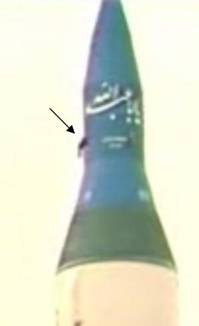
Much has been said about the various nosecones Iran uses on its missiles. In particular, the tri-conic or baby bottle nose cone of the Kavoshgar and Ghadr is one of the primary ways of distinguishing the various Shahab-3 variants. That’s why it’s somewhat surprising to me that no one has commented (at least as far as I know) on the protuberance sticking out of the Kavoshgar-1 launched in February 2008. This is particularly important with the reports that the Iranians will launch another Kavoshgar in the coming months. I just have a feeling that if we new its purpose, we would have a better understanding of what was intended by the Kavoshgar launch.
I have always assumed that this protuberance supported a camera pointed back toward the missile body; perhaps to study nosecone separation or something like that. ( The Kavosh solid-propellant “sounding rocket” carried a rocketcam for just that purpose.) However, the amount that it sticks out from the nosecone seems to indicate that it is primarily looking at something on the main missile airframe. (Note that it is shown in an oblique angle in this image, with its base attached to a point on the far side of the nosecone) It certainly looks like it is higher than is needed to observe the charge used to separate warhead from the main body. Perhaps it is looking at retrorockets that might be used to keep the main body from hitting the warhead? As always, I look forward to your thoughts, wonk-readers.

Maybe a cam… or just a simple antenna
First, Geoffrey, The reports from Iran talk about the launching of a SATELLITE (more superficially the Italian made, 65 kg Mesbah), not another Kavoshgar.
Then, when you look at this picture, I THINK that if it looks like an antenna, and if there is a need for antenna, it is logical to assume that it IS an antenna.
Telemetry antennas?
I tend to interpret these (there are two such structures on that RV – se e.g. in this video around second 0.56: http://www.youtube.com/watch?v=_XDZc_auKMo) as antennae for telemetry-purposes.
Rather similar structures can be found on the upper stage of the Safir IRILV, too (directly beneath the payload fairing on the opposite side of the cable duct; there is also the fin marked “I” on that side of the missile). Plus: it would make sense to me to test the telemetry for the satellite launcher before the first actual launch of the Safir on an already proven missile (the Ghadr-1).
On the other hand, i don’t see any signs of retro-rockets on the Kavoshgar-1/Ghadr-1.
Jochen
antennas certainly make sense, but do you think that the two symmetric “bumps” you point out are the same as the extended object seen in my photo? They might be but I have my doubts.
Just to make an obvious comment, but telemetry antennas (I’d guess UHF or S-band) should occur in at least pairs spaced around the rocket body so that one always has a clear line of sight to the receiver.
Actually, there are three of them (spaced equally around the rocket). You can see a second one to the right of the white text in this article’s picture.
I think you are right Ael! Good eyes! Certainly with three, it becomes much, much more likely that they are antenna rather than cameras.
Jochen
Is this the object/antenna you are indicating?
Geoff:
1.) Ael beat me on pointing out the second “structure” on the Kavoshgar-1. And yes, i think those are the same as in the video. I’m not sure if there are more than two, but it’s at least two such “protrusions”.
2.) Yes, that was what i meant in case of the Safir (note that there is a second, similar “object” to the left of the red circle). I may be wrong, but i think the shape and size of those “protrusions” seems to be identical to those on the Kavoshgar-1-RV (as can be seen on some of the pictures from the Safir-1 presentation in the hall in August 2008).
Thanks Jochen!
Now I have more more question. Its unfortunately something that I only have a vague memory of and I can’t seem to find a reference to. You mention that the antenna on the Safir is lined up with fin I. Is fin I the standard fin that points in the direction of target? ie is that the fine that marks what some call the “face” of the missile and would hence face “down” during the Safir’s pitch program? If so, it might explain why there is only one on the Safir and might indicate that the Kavoshgar’s multiple antennas (point taken about there might only being two though there still could be three) would be used after separation of the payload?
Right, Geoff, fin I is traditionally (since the days of the Aggregat 3) pointing into the direction of the target. I’ve been thinking along the same lines: this type of orientation usually (unless the missile loses roll-control) guarantees that the telemetry-antennas (if that’s what those objects really are) always point downward (aka in the general direction of the ground-station).
Oh, and let me again point out that there is a second, similar structure on the Safir visible to the left of the one encircled in red in the picture you’ve posted (i’d suggest to survey other Safir-photos, too – it’s more obvious from a slightly different angle).
Interestingly, the two visible “protuberances” on the Kavoshgar-1 seem to be approximately mounted on the III- and IV-quadrant of that missile.
A possible explanation may be that that missile followed a height-optimized trajectory (almost vertical with only little pitch-over), another one that there were actually more than the two visible “antennas” present, as Ael suggested (since that type of reentry vehicle apparently executes a tumbling reentry without any particular type of pre-alignment or active attitude control, such an “omnidirectional” configuration might be advantageous anyway).
BTW, there were two somewhat similar structures (of roughly similar dimensions but a slightly different shape) mounted on opposite sides of the RV of the Kavoshgar-2, too – and we know with some certainty that that rocket had in fact some sort of active telemetry-downlink (the inflight-video was transmitted, isn’t it?).