
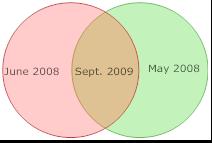
The Obama Administration has agreed to start negotiations with Iran on the basis of the latest Iranian proposal. A decision I certainly applaud and fervently hope that we can finesse to include the nuclear issue (an issue that was part of Iran’s May 2008 submission and one that they have suggested could still be talked about). I want to return to the nuclear issue in more detail below, but first I want to discuss the overlap between the two sides that this most recent agenda represents. Much has been written and said about how wide ranging Iran’s proposal is but few seem to realize that it is actually a subset of the intersection of those two proposals. Let’s review the major points of the West’s proposal (presented to Iran on 14 June 2008 by the governments of China, France, Germany, the Russian Federation, the United Kingdom, the United States of America and the European Union):
1) Nuclear Energy
[…]
2) Political
[…]
3) Economic
[…]
4) Agriculture
[…]
5) Environment, Infrastructure
[…]
6) Economic, social and human development/humanitarian issues
[…]
It is interesting to examine the West’s political section in a little more detail. This section included “support for Iran in playing an important and constructive role in international affairs,” “realizing the objective of a Middle East free of weapons of mass destruction,” and “promotion of dialogue and cooperation on non-proliferation, regional security and stabilization issues.” There is a lot of room in those proposals for expanding the agenda past what, I’m sure, the West had in mind and might very well explain some of the points that Iran lists in this current version.
Iran’s 2008 submission contained a number of important points on the nuclear issue that I hope we can incorporate in the coming talks. First, and most important, is Iran’s suggestion that the talks include “Establishing enrichment and nuclear fuel production consortiums in different parts of the world— including Iran .” (Emphasis added.) I believe, and my colleague John Thomson and I have written extensively about just this point since 2006, that such consortiums are the best way of ensuring that Iran does not get a nuclear bomb. It is my understanding that Iran’s 2008 proposals are still on the table, though this submission might supersede them. This is one advantage of Iran’s proposal not containing an explicit section on the nuclear issue. We should simply assume that these proposals continue to be on the table and ask them “What do you mean by international consortiums?” Surprisingly, the West has never asked this question even though Iran has, at the highest levels, brought this item up a number of times.
Of course, the West has been turned off by the awful prolog to the proposal; a prolog made all the more disgusting in light of the terrible suppression of the Iranian people since the June elections. Iran would have been better served, at least in terms of public relations in the West, by simply pointing out that their most recent package was this intersection. But then, the prolog was undoubtedly written for internal consumption and justification for a regime that has to be worried about its legitimacy rather than for the Western public.

I read your lengthy multinational enrichment proposal with your colleague, but I must have missed one point or perhaps you did not cover it; I am not sure. Anyway, the questions is that in your proposal, do you allow any R&D on future centrifuges by IRI? You suggested that Natanz will slowly phase out IR1s and replace them with say TC-12 from Urenco, but will Iran be able to do at least laboratory work for future designs? From their point of view, if no future work at least at the R&D level is permitted, it will be a reminder that EU cannot be trusted with their commitments; as Germans reneged on their contracts to finish Bushehr and French did not honor Iran’s investment in the fuel plant.
No, Iran would not be permitted to do research on centrifuges. There are purely economic reasons for this as well as the confidence building for the West this provides. This would put about half a dozen Iranian scientists out of their “primary” business but access to plentiful LEU and advanced nuclear technologies in other aspects of the nuclear fuel cycle will allow all the other aspects to flourish. Of course, scientists who work on centrifuge development have skills that can be directly applied to other hi-tech fields. I have a friend who designs centrifuges and when he is not doing that, he is designing artificial hearts; using the same “aerodynamic” skill set he uses for centrifuges.
The fact that the large enrichment hall is in Iran is Iran’s guarantee that they will continue to enrich uranium. That, and Iran’s suggestion that countries like South Africa also invest in the joint venture. An important non-aligned country like South Africa would ensure that Iran had allies on the board that would prevent the facility from being shut down for any arbitrary “political” reason.
“Establishing enrichment and nuclear fuel production consortiums in different parts of the world…” mmm, sounds like the start of a kind of Kafkaesque nightmare. Not surprised the saintly Iranian government dreamt it up.
They will probably get their nuke whether we like it or not. We need to adjust our defence planning to accommodate that prospect.
Iran is going to have a military nuclear capability.
If these consortiums are such that the West could shut them down and prevent Iran from making a weapon, Iran, I predict, will not accept them.
If these consortiums are such that as long as they are running, the IAEA is assured that, as of now, Iran is not building a weapon. But Iran could still in an emergency be released from its obligations and build a weapon (like Japan and Brazil), then if the consortium is structured in that way, Iran will probably accept it.
Until the West accepts that Iran will have a military nuclear capability, as Japan, Brazil and many others do, we’ll see the status quo continue, at least until Iran has enriched all of its converted uranium to LEU, at which point Iran will likely be willing to suspend and negotiate whatever the West wants for as long as the West wants.
I’ve heard it said that if Iran takes this position, it makes conflict more likely. After George W. Bush, threats do not work. The US is in no important way better placed to conduct military strikes on Iran than it was when Bush decided not to attack at the end of his term.
Bush did not attack Iran because he calculated that Iran’s response would be potent enough that the costs of the strike would outweigh the benefits. Obama was elected in part specifically because the US voters do not want a widespread war with the Muslim world. Since Bush was deterred and nothing important has changed, it is safe to describe Obama as deterred.
“Crippling sanctions” even if they hadn’t been taken off the table by Russia and China last week, instead of causing Iran to renounce its right to a nuclear status comparable to Brazil’s, would result in Iran harming US efforts in Iraq and Afghanistan.
Oh, and the freeze for freeze idea that had been floating around earlier this year obviously has been informally accepted. Iran has not put new centrifuges into operation when it clearly can. The next round of sanctions breaks that deal and allows Iran to accelerate uranium production possibly to enough LEU for two bombs per year which may get Iran finished with all the LEU it wants by the end of Barack’s second term.
Once again, not worth it from the US point of view – hopefully the US was just joking in even making the threat. If the US had been serious it really may unknowingly have been bringing upon itself a humiliating defeat in Afghanistan at a crucial moment in the Afghan enterprise with a simultaneous increase in Iran’s rate of progress towards a military nuclear capability. In that case the US really owes Russia a note of gratitude.
Really the West has to accept that Iran will have a military nuclear capability and begin discussions on how, within the confines of the NPT, it can have confidence that despite the capability, Iran is not building a weapon right now.
Once the West accepts that, there are any number of ways to strengthen the inspection regime – many of which Iran has already suggested, any of which Iran will accept if I’m right.
As long as the West does not accept that Iran will have a legal military nuclear capability, we’ll see, at best, the continuation of the status quo.
I wondered when I first read the latest Iranian proposal whether the brief reference to energy security (Proposal 3.1.: “Energy and its security in production, supply . . .” could be a very veiled reference to the uranium enrichment consortium. It’s a stretch, but in the absence of a direct mention of the nuclear program, if enrichment fits anywhere in the broad range of talks proposed, that would seem to be the place.