
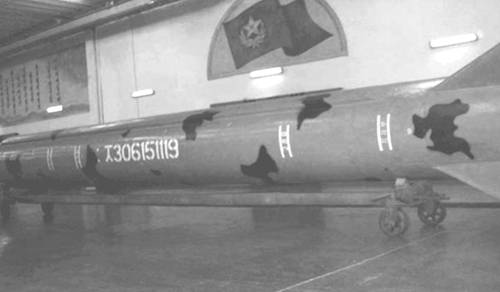
Wonk-reader Tal Inbar sends this image of a Nodong missile on its plant floor. Presumably, it was taken in the final assembly hall. Unfortunately, it doesn’t show some of the more interesting portions of the missile (would it have killed them to show the business end of engine section?). It does show that this portion of the plant does not have an overhead bridge crane as is clearly visible in the Safir assembly hall. That thing running just below what appears to be a flat ceiling looks to me to be a cable tray. Perhaps to run diagnostic signals from G&C units to a central computer room? The hall is well lit with white walls to take full advantage of the artificial lighting. (You would be surprised how many factories leave their walls unpainted, producing a considerable overall dimming.)
Just out of curiosity, do any of you wonk-readers know what the Korean character is in front of the numbers on the missile’s side? It looks like a lambda with a bar over it (to put it in a framework I can relate to).

The picture is dated from 2008. Note the white markings (stronger ribs for transport?) and the font of the numbers – which is identical to those appearing on Iranian Shahab 3.
a note on the flag – it is interesting to see this flag, since it is the personal banner of the supreme commander of the KPA. One could expect the national flag or the flag of the KPA.
Looks like a jieut.
The parallel white lines are a standard Soviet missile marking that the DPRK has copied from the Scud. They identify the hard-points in the missile fuselage that are lined up when placing the missile on the racks of the transloader for transport.
They still use Cyrillic markings as generic symbols for various maintenance/operating attachments. For example, if you look at the various attachment points around the exhaust chamber at the base of the missile used for attaching the various elecrical cabling for launching, you will see the same Cyrillic abbreviations used on the Scud B
in korean, it’s the jieut character, which is equivalent to the english ‘j’ if you put it in those terms. it doens’t seem to have any meaning on the missile though – just a way to classify it.
I defer to the experts as to whether it is a No Dong or a Scud, but the original source refers to it as having been taken at a Scud missile factory (and it’s in colour). It is in a collection of photos supposedly taken during a visit by a Burmese military delegation to North Korea and China in November 2008. For more photos, see burmatoday.net/regime/Shwe_Mann_NKorea_Trip_Photos.pdf.
Really interesting one, i much appreciate. Thanks for sharing the information.
Aside from not showing the pointy end and the hot end, the main problem is nothing in the photo to get an idea of scale.
The flag, as noted, is for the Korean People’s Army (KPA) Supreme Commander, which is Kim Jong-il.
The Hangul character preceding the Arabic numerals, is also Korean (‘j’ or ‘ch’ depending on the Romanization system).
The calligraphy to the far left in the photo is difficult to make out, but could be Hangul in the traditional top-to-bottom, right-to-left style.
The odd thing, however, is the camo pattern since most North Korean missiles are solid green. However, a coworker speculated the camo could be for an export models.
Richardson, please take a look at this picture as it shows identical pattern on Scud C missiles paraded in Pyongyang:
http://www.fresh.co.il/vBulletin/showpost.php?p=2488475&postcount=11
Richardson:
I think the camo pattern and the numbering/marking scheme (except for the additional hangeul character) of that particular missile resembles this one:
(source: http://www.globalsecurity.org/wmd/world/dprk/images/hwasong6-scudc-dprk-cdf001.jpg)
That picture shows a Hwasong-5/R-17E/Scud-B (although it’s frequently marked “Scud-C”, there are some peculiarities that let me come to the conclusion that it’s in fact “only” a Scud-B) on a MAZ-produced standard 9P117M1-TEL during a parade in Pyongyang (but unfortunately, i cannot say from when exactly – i suppose it’s from sometime in the 90ies) – obviously in DPRK-service.
The Iranians paint their Scuds/Nodongs either in green or yellow (and they re-mark them in english); The missiles delivered via So-San to Yemen back in 2002 were painted in some shade of turquoise-green; Can’t say anything about the color of syrian Scuds, though (well, maybe some sort of yellow/beige…).
BTW, without any conclusive indicator for size (or a view at the “hot end”), it’s impossible to say if the missile in the factory is a Scud or a Nodong; Has anybody an idea how big the wheels on that cart could be?